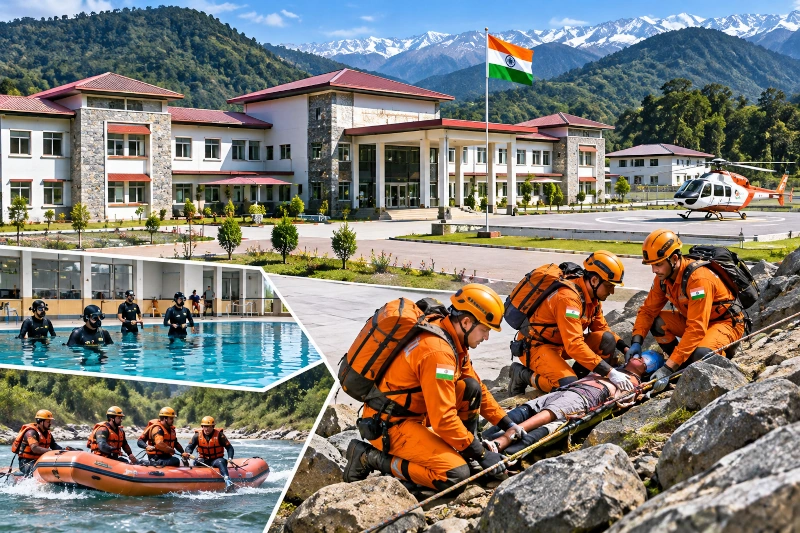
Arunachal Pradesh has received a major addition to its disaster management infrastructure with the inauguration of the National Disaster Response Force’s (NDRF) 12th Battalion campus at Hollongi, near Itanagar. The new facility will serve as a regional centre for disaster preparedness, rescue operations and specialised training, strengthening emergency response capabilities across northeastern India.
Union Home Minister Amit Shah inaugurated the campus on 22 November 2026 in the presence of Arunachal Pradesh Chief Minister Pema Khandu, Union Minister Kiren Rijiju, Deputy Chief Minister Chowna Mein, senior government officials and NDRF Director General Piyush Anand.
The facility has been developed with earthquake-resistant buildings and specialised training infrastructure suited to the disaster management requirements of the northeastern region. In addition to supporting NDRF operations, the campus will provide training facilities for State Disaster Response Force personnel from all eight northeastern states.
New NDRF Campus to Serve the Entire Northeast
The newly inaugurated campus is intended to strengthen the NDRF’s operational readiness in Arunachal Pradesh and neighbouring northeastern states.
The region faces several natural hazards, including earthquakes, landslides, floods and extreme weather events. Its mountainous terrain, extensive river systems and difficult transport conditions can also complicate emergency response operations.
The establishment of a dedicated NDRF campus near Itanagar provides infrastructure for personnel training, emergency preparedness and the coordination of rescue and relief operations.
During the inauguration, Amit Shah stated that the facility would serve not only Arunachal Pradesh but also the wider Northeast and adjoining regions.
The regional role of the campus is particularly important because major natural disasters can affect several states simultaneously, creating requirements for coordinated deployment of personnel, equipment and emergency resources.
The new infrastructure is expected to support more effective mobilisation and preparedness for such situations.
Earthquake-Resistant Infrastructure Developed for Regional Conditions
A significant feature of the new campus is its earthquake-resistant construction.
According to the Ministry of Home Affairs, all buildings within the facility have been constructed in accordance with earthquake-resistant standards.
This is particularly relevant to northeastern India, which lies in a region of high seismic activity.
Arunachal Pradesh and neighbouring states are situated within the seismically active Himalayan region, where interactions between tectonic plates create the potential for major earthquakes.
Disaster response facilities must remain functional during emergencies, especially when surrounding infrastructure may experience damage.
Earthquake-resistant construction can improve structural resilience and help maintain the availability of essential facilities during seismic events.
The inclusion of these design standards demonstrates the importance of adapting critical infrastructure to the geographical and environmental conditions in which it operates.
Training Centre for Disaster Response Forces of Eight States
One of the most important functions of the new campus will be its role in training personnel from the State Disaster Response Forces of all eight northeastern states.
These include Arunachal Pradesh, Assam, Manipur, Meghalaya, Mizoram, Nagaland, Sikkim and Tripura.
State disaster response personnel are often among the first specialised teams mobilised during emergencies within their respective jurisdictions.
Training programmes can improve their capabilities in search and rescue, emergency evacuation, flood response, equipment handling and coordination with other agencies.
The availability of dedicated regional training infrastructure can also support the standardisation of operational procedures and improve cooperation between state and national disaster response organisations.
Such coordination is particularly valuable during emergencies that require assistance from neighbouring states or the deployment of additional NDRF resources.
By accommodating personnel from across the Northeast, the Hollongi campus can contribute to strengthening regional disaster management capabilities.
Specialised Swimming Pool and Diving Tank Established
The new NDRF campus includes an Olympic-size swimming pool and a specialised diving tank for training personnel.
These facilities are particularly relevant to water rescue operations, including emergencies involving floods, submerged structures and difficult aquatic environments.
Training in controlled water environments allows rescue personnel to develop essential skills before undertaking operations under hazardous conditions.
Swimming proficiency, underwater orientation and water rescue techniques are important components of disaster response capabilities in regions affected by seasonal flooding and river-related emergencies.
The Ministry of Home Affairs also announced that the Olympic-size swimming pool would be made available free of charge to swimming athletes from Itanagar and other parts of Arunachal Pradesh.
This arrangement creates an additional opportunity for the infrastructure to support sporting activities while retaining its primary role in specialised disaster response training.
The facility therefore combines an important operational training function with a potential contribution to the development of swimming talent in the region.
Strengthening India’s Disaster Preparedness Framework
During the inauguration, the Union Home Minister highlighted the shift in India’s disaster management approach towards early warning, prevention, mitigation and preparedness.
He emphasised that disaster management should focus on reducing risks before emergencies occur rather than relying exclusively on rescue and relief after a disaster.
The Ministry of Home Affairs has been strengthening coordination between the National Disaster Management Authority, NDRF, State Disaster Response Forces and state administrations.
This coordination is intended to improve the movement of personnel, the implementation of standard operating procedures and the availability of emergency resources.
Early warning systems play an important role in this approach by providing authorities with additional time to assess risks and organise preventive measures.
Advances in meteorological forecasting, monitoring technologies and communication networks have improved the ability of disaster management agencies to prepare for certain hazards.
However, effective disaster preparedness also requires trained personnel, reliable equipment, accessible infrastructure and established coordination mechanisms.
The Hollongi campus contributes to this broader framework by providing dedicated facilities for regional training and operational readiness.
NDRF Expands Its Operational Reach Across India
The National Disaster Response Force has become an important component of India’s disaster management system.
Established under the Disaster Management Act, 2005, the force specialises in responding to natural and human-made disasters.
Its responsibilities include search and rescue, emergency evacuation, flood response and other specialised disaster management operations.
According to figures presented by the Ministry of Home Affairs during the inauguration, the NDRF has conducted more than 11,000 rescue and relief operations and saved over 1.61 lakh lives.
The force is deployed at more than 70 locations across the country, allowing specialised teams to respond to emergencies in different geographical regions.
NDRF personnel have also participated in international humanitarian assistance and disaster response operations, including missions in Nepal, Türkiye, Japan and Sri Lanka.
These deployments demonstrate the importance of maintaining a trained and equipped national disaster response organisation capable of operating in diverse environments.
2026 Designated as NDRF’s Year of Capacity Building
The Ministry of Home Affairs has designated 2026 as the Year of Capacity Building for the National Disaster Response Force.
The initiative places emphasis on strengthening personnel training, specialised equipment and operational infrastructure.
Capacity building is important because disaster response requirements continue to evolve with changes in settlement patterns, infrastructure development and environmental risks.
Modern rescue operations may require specialised engineering equipment, communication systems, underwater rescue capabilities and personnel trained to operate in hazardous conditions.
The Hollongi campus forms part of these efforts to expand the infrastructure available for training and operational preparedness.
Its regional location also provides opportunities for training programmes suited to the distinctive geographical challenges of northeastern India.
Importance for Arunachal Pradesh’s Mountainous Terrain
Arunachal Pradesh presents unique challenges for disaster response agencies because of its extensive mountainous terrain, remote settlements and substantial seasonal rainfall.
Landslides and road disruptions can isolate communities, while rapidly changing weather conditions can affect access to affected areas.
The state’s rivers and steep valleys also create challenges during periods of heavy rainfall and flooding.
In such circumstances, trained rescue personnel and coordinated emergency response systems are essential.
The presence of a dedicated NDRF battalion campus near Itanagar can support preparedness for emergencies involving remote communities and difficult geographical conditions.
The facility is also strategically located to serve the wider northeastern region, where disaster response often requires cooperation between several administrative authorities.
Although the actual improvement in response times will depend on deployment arrangements, transport connectivity and operational resources, the new campus provides a stronger institutional foundation for regional disaster management.
Building a Stronger Disaster-Resilient Northeast
The inauguration of the NDRF’s 12th Battalion campus represents an important investment in disaster management infrastructure in northeastern India.
Its earthquake-resistant buildings, specialised aquatic training facilities and regional training responsibilities provide a foundation for strengthening the capabilities of both national and state disaster response personnel.
The inclusion of training facilities for all eight northeastern states is particularly significant because it encourages greater operational cooperation and the development of common emergency response capabilities.
For Arunachal Pradesh, the establishment of the campus adds dedicated infrastructure for addressing the challenges associated with mountainous terrain, seismic activity and geographically isolated communities.
As India continues to strengthen disaster preparedness through early warning systems, specialised training and coordinated response mechanisms, facilities such as the Hollongi NDRF campus can contribute to protecting lives, improving emergency readiness and building more resilient communities.
The new campus represents another step towards ensuring that India’s northeastern region has the infrastructure and trained personnel required to respond effectively when natural disasters occur.
You may also like
-
DIVERSIFARM-India Maps 652 Community Seed Banks, Releases Manual to Strengthen Indigenous Seed Conservation
-
India’s Government Healthcare Spending Triples to ₹4.14 Lakh Crore, Household Medical Expenditure Share Declines
-
World Bank Hails India’s Water Management Initiatives as Model for Developing Nations
-
Government Invites Citizens Above 18 to Join Vayo SAATHI Initiative to Support Senior Citizens Across India
-
India Condemns False Narratives as Chinese Influencers Allegedly Portray Dhaka Neighbourhoods as New Delhi
