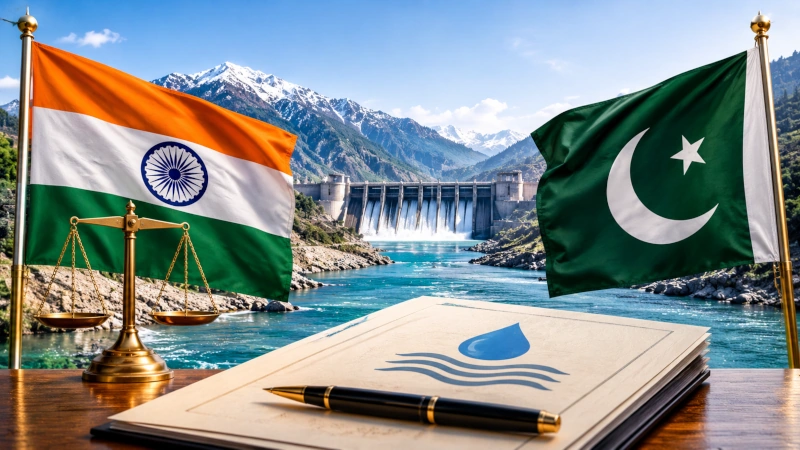
India has reiterated that there is no change in its position on the Indus Waters Treaty (IWT), following the participation of Pakistan’s Federal Minister for Climate Change and Environmental Coordination, Musadik Masood Malik, in the first Shanghai Cooperation Organisation (SCO) Civilisation Dialogue in New Delhi.
Responding to questions during the Ministry of External Affairs’ bi-weekly media briefing on 20 November 2026, spokesperson Randhir Jaiswal reaffirmed India’s position on the treaty. He stated that New Delhi had made its position clear and that there was “absolutely no change” in its stand.
The clarification came as Malik attended the opening day of the three-day SCO Civilisation Dialogue, hosted jointly by India’s Ministry of External Affairs and Ministry of Culture at Purana Qila, New Delhi, from 20 to 22 November.
Pakistan’s Participation in the SCO Civilisation Dialogue
Pakistan’s participation followed India’s decision to invite all members of the Shanghai Cooperation Organisation to the multilateral event. The Ministry of External Affairs had announced on 28 October that invitations were extended to every SCO member, including Pakistan, in accordance with the organisation’s established multilateral framework.
Pakistan subsequently announced on 14 November that Musadik Malik would represent the country at the dialogue. His attendance provided an opportunity for Pakistani representation at an India-hosted multilateral gathering despite the continuing challenges in bilateral relations.
When asked about the role of culture in improving relations between India and Pakistan, Malik told reporters that culture had an important role to play. His participation, however, did not indicate a change in India’s position on the Indus Waters Treaty, as the MEA spokesperson made clear.
India’s Position on the Indus Waters Treaty
The 1960 Indus Waters Treaty governs the sharing of the waters of the Indus river system between India and Pakistan. India announced on 23 April 2025 that the treaty would be held in abeyance following the terrorist attack in Pahalgam on 22 April, which killed 26 people.
The Indian government stated that the decision would remain in effect until Pakistan credibly and irrevocably ended its support for cross-border terrorism. The announcement followed a meeting of the Cabinet Committee on Security and formed part of India’s response to the attack.
India’s latest clarification confirms that its position remains unchanged. The government has maintained that the decision to hold the treaty in abeyance is linked to its stated security concerns and has not been reconsidered in connection with Pakistan’s participation in the SCO event.
Pakistan has rejected India’s unilateral decision, arguing that the treaty cannot be suspended or placed in abeyance by one party. The two countries therefore continue to hold opposing positions on the treaty’s status.
Multilateral Engagement and Bilateral Differences
The SCO Civilisation Dialogue demonstrates that India continues to participate in multilateral engagement involving all members of the organisation, including Pakistan. Such participation takes place within the framework of India’s commitments and responsibilities as an SCO member.
At the same time, New Delhi’s clarification on the Indus Waters Treaty establishes that participation in a multilateral cultural forum does not signify a change in its bilateral policy or position on outstanding issues.
India’s approach to the SCO dialogue and its position on the Indus Waters Treaty therefore remain distinct matters. The November 20 statement provides a clear indication that the invitation extended to Pakistan for the multilateral gathering has not altered the government’s stated position on the water-sharing agreement.
You may also like
-
India and Portugal Commit to Five-Year Strategic Roadmap for Bilateral Cooperation, 2027–2032
-
The Council of Ministers: How Kauṭilya Evaluated Advice, Secrecy and Decision-Making
-
Rāma’s Approach to Rāvaṇa: The Role of Negotiation Before the Use of Force
-
India and France Strengthen Counter-Terrorism Cooperation
-
The Duties of an Envoy: Diplomatic Representation and Political Intelligence in Ancient India
