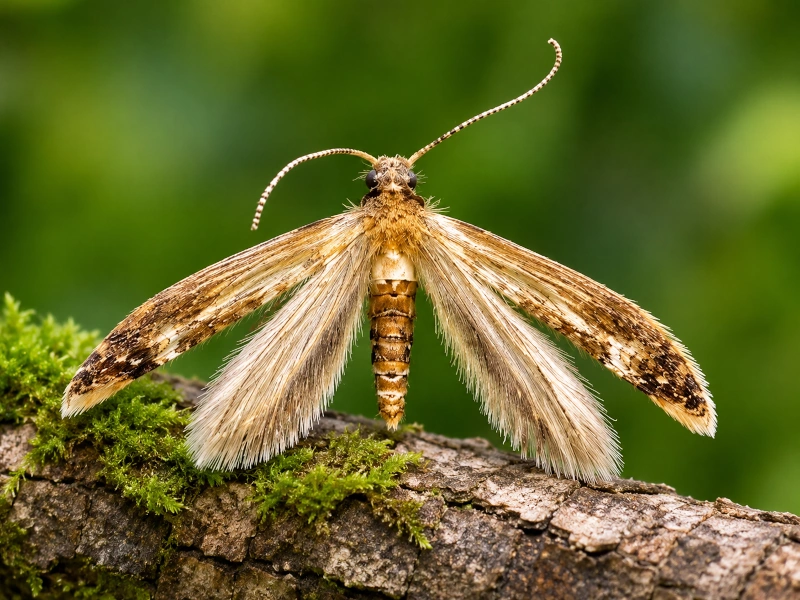
Researchers have identified a previously unknown species of micro-moth near Hollongapar Gibbon Sanctuary in Assam’s Jorhat district, marking the first new taxonomic addition to India’s sedge moth family in nearly a century. The tiny insect, named Glyphipterix brevimucronata, measures approximately 6.5 millimetres across its outstretched wings and represents an important contribution to the scientific documentation of India’s insect biodiversity.
The discovery was made near Mariani in Jorhat district and formally described by researcher Kishore Chandra Sahoo of the ICAR-Indian Agricultural Research Institute (IARI), Assam. The findings were published on November 18, 2026, in the international taxonomic journal Zootaxa, Volume 5909, Issue 1. The research provides a scientific description of the new species and highlights the relatively unexplored diversity of micro-moths in Northeast India.
The discovery has attracted attention because the family Glyphipterigidae, commonly known as sedge moths, has received comparatively limited taxonomic attention in India despite its considerable diversity elsewhere in the world.
Discovery Near Hollongapar Gibbon Sanctuary
The specimen was collected on October 2, 2025, during a field survey near Mariani, close to Hollongapar Gibbon Sanctuary in Assam. The collection site was situated approximately 141 metres above sea level in a landscape associated with the biologically rich forests of the Jorhat region.
The fieldwork was undertaken by Kishore Chandra Sahoo and Abhijith K. P., with assistance from local guide Jayanta Jyoti Sarmah. The specimen was subsequently examined through detailed morphological analysis to establish its taxonomic identity.
The moth was collected using a mercury-vapour light source, a method commonly employed in entomological surveys to attract nocturnal insects for scientific observation and documentation.
Following collection, the researchers examined the insect’s external appearance and specialised anatomical characteristics. Their investigation established that the specimen possessed distinctive features sufficient to recognise it as a previously undescribed species belonging to the genus Glyphipterix.
The discovery location is significant because the forests surrounding Hollongapar Gibbon Sanctuary support diverse plant and animal communities. Although the sanctuary is widely recognised for its population of western hoolock gibbons, the surrounding landscape also provides habitats for numerous lesser-known insects and other invertebrates.
A Tiny Moth with Distinctive Metallic Markings
Glyphipterix brevimucronata is an exceptionally small moth, with a reported wingspan of approximately 6.5 millimetres. Its diminutive size makes it easy to overlook during general wildlife observations, particularly in habitats containing diverse insect communities.
The species possesses brown forewings with a yellowish metallic sheen and distinctive white markings. These external features contribute to its identification, although detailed anatomical examination is necessary to distinguish it reliably from closely related species.
One of the most important characteristics used in identifying the moth concerns the structure of the male reproductive organs. Taxonomists frequently examine these structures because closely related moth species can appear similar externally while possessing distinctive reproductive anatomy.
The scientific name brevimucronata refers to a short, pointed anatomical projection observed during the examination of the specimen. The name reflects a diagnostic feature considered important in distinguishing the newly described species.
The formal scientific description provides a reference for future researchers seeking to identify the insect, compare it with related species and investigate its distribution across Northeast India.
First New Addition to India’s Sedge Moth Family in Nearly 100 Years
The most notable aspect of the discovery is its significance for the taxonomic history of the family Glyphipterigidae in India.
Sedge moths belong to the insect order Lepidoptera, which includes butterflies and moths. The family contains hundreds of described species worldwide, many characterised by their relatively small size and distinctive wing patterns.
Although more than 530 species belonging to Glyphipterigidae have been described globally, only about 25 had previously been documented from India, according to accounts accompanying the new research.
The genus Glyphipterix, to which the newly discovered moth belongs, includes more than 400 described species worldwide. Nevertheless, the Indian representatives of this group remain comparatively poorly studied.
The identification of Glyphipterix brevimucronata represents the first formal taxonomic addition to India’s known sedge moth fauna in nearly a century. This does not mean that sedge moths were absent from India during that period. Rather, it reflects the long interval since a new Indian representative of the family was formally described.
The finding underscores the importance of continued taxonomic research, particularly among smaller insects that receive substantially less attention than larger and more familiar wildlife.
Importance of Scientific Taxonomy in Biodiversity Conservation
Scientific taxonomy provides the foundation for understanding biological diversity by identifying, describing and classifying organisms.
Before a newly discovered species can be reliably studied or monitored, researchers must establish how it differs from previously known organisms. This process involves comparing physical characteristics, examining specialised anatomical structures and consulting existing scientific descriptions.
In the case of Glyphipterix brevimucronata, the researchers used detailed morphological examination to establish the species’ distinct identity and formally document it in the scientific literature.
Such work is particularly important for micro-moths because their small size and similarities to related species can make accurate identification difficult without specialised examination.
Formal species descriptions also enable future research into geographical distribution, habitat preferences, life cycles and ecological relationships. These details are essential for understanding the conservation requirements of individual species and the broader ecosystems they inhabit.
At present, the available published information establishes the moth’s occurrence near Mariani in Assam. Its wider geographical distribution, population status and ecological requirements have not yet been comprehensively documented.
Additional surveys will therefore be important for determining whether the species occurs across other suitable habitats in Northeast India.
Assam’s Forests Continue to Reveal Hidden Biodiversity
Assam forms part of Northeast India’s biologically diverse landscape, which supports tropical and subtropical forests, wetlands, grasslands and riverine ecosystems.
The region’s varied environmental conditions provide habitats for numerous species of mammals, birds, reptiles, amphibians and insects. While several of its larger animals are well documented, many smaller organisms remain insufficiently studied.
Hollongapar Gibbon Sanctuary is particularly important for the conservation of the western hoolock gibbon, India’s only native ape. The sanctuary and its surrounding forest landscape also support diverse ecological communities that include numerous invertebrate species.
The discovery of a previously unknown micro-moth near this landscape demonstrates that biodiversity research must extend beyond prominent mammals and birds.
Insects play essential roles in terrestrial ecosystems, contributing to food webs, nutrient cycling, decomposition and interactions with plants. Many moth species also participate in pollination, although the specific ecological role of Glyphipterix brevimucronata has not yet been established.
Documenting insect diversity can therefore improve scientific understanding of forest ecosystems and help identify areas requiring further ecological investigation.
The discovery also demonstrates the value of examining habitats adjoining protected areas, where lesser-known organisms may remain undocumented despite their proximity to established wildlife conservation sites.
Contribution of Indian Agricultural Research Scientists
The research highlights the role of Indian scientific institutions in documenting the country’s biological diversity.
Kishore Chandra Sahoo, associated with the ICAR-Indian Agricultural Research Institute in Assam, led the formal description of the newly identified moth. The field investigation also involved scientific assistance from Abhijith K. P. and local support during specimen collection.
The study was published under the title A New Species of Glyphipterix Hübner (Lepidoptera: Glyphipterigidae) from Assam, India in Zootaxa on November 18, 2026.
The publication establishes the species within the formal framework of zoological nomenclature and makes its diagnostic characteristics available for future taxonomic research.
The work demonstrates how systematic field surveys, specimen examination and scientific documentation can reveal species that have remained unrecognised within India’s diverse natural environments.
It also highlights opportunities for collaboration between institutional researchers and individuals possessing detailed knowledge of local landscapes.
Strengthening Conservation Through Biodiversity Research
The identification of Glyphipterix brevimucronata adds another scientifically documented species to India’s insect fauna while drawing attention to the importance of studying lesser-known organisms.
The discovery is particularly valuable because it concerns a group that has received limited taxonomic investigation in India for several decades. It also reinforces the significance of Northeast India’s forests as important areas for biodiversity research.
Further investigations into the species’ distribution, habitat associations and life history can contribute to a more complete understanding of the region’s insect communities.
The discovery near Hollongapar Gibbon Sanctuary demonstrates that even well-known conservation landscapes can contain species that remain unrecognised by science.
As Indian researchers continue to document the country’s biological diversity, discoveries such as Glyphipterix brevimucronata strengthen the scientific foundations of wildlife conservation and expand knowledge of the remarkable natural heritage preserved within India’s forests.
You may also like
-
Botswana-Born Cheetah Gives Birth to Four Cubs in Wild, India’s Cheetah Population Reaches 62
-
Gauhati University Scientists Rediscover Rare Flowering Shrub in Assam After 204 Years
-
Rare Striolated Bunting Spotted Near Mangaluru, Reported as Coastal Karnataka’s First Record
-
Ladakh’s Black-Necked Crane Population Rises Nearly 25% to 108, Marking Important Conservation Progress
-
Scientists Discover Five New Horned Frog Species in Arunachal Pradesh
