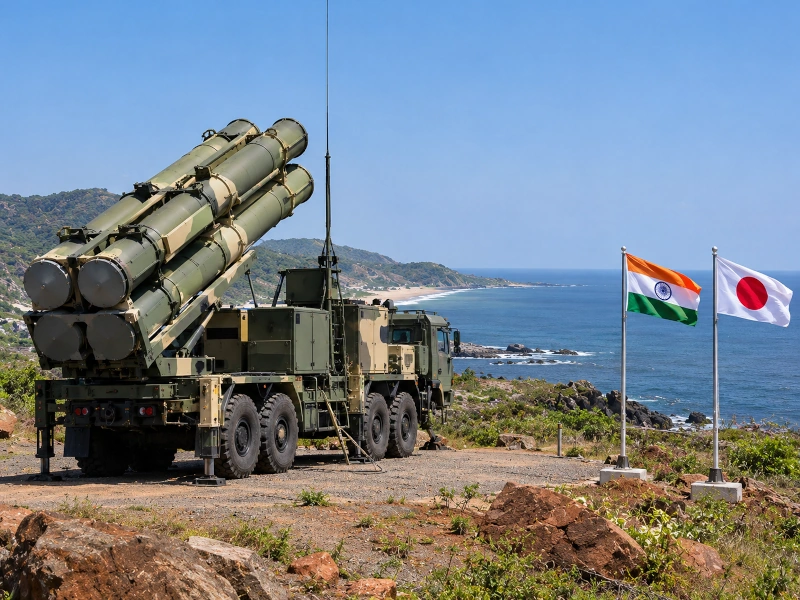
India and Japan have signed a Letter of Intent (LoI) to enable Japan’s Self-Defense Forces to use Indian military firing ranges for live-fire training, including exercises involving surface-to-ship missiles. The proposed arrangement represents an important expansion of bilateral defence cooperation and could allow Japanese military personnel to conduct such training activities in India for the first time.
The agreement was announced during bilateral discussions between Defence Minister Rajnath Singh and Japanese Defence Minister Shinjiro Koizumi in Tokyo on 19 November 2026. The meeting took place alongside the fourth India–Japan Foreign and Defence Ministers’ Dialogue, commonly known as the 2+2 Dialogue, which brought together the foreign and defence ministers of both countries.
The two defence ministers welcomed the signing of the Letter of Intent and agreed to accelerate coordination between their respective defence authorities to facilitate its implementation. The development reflects the growing scope of India–Japan military cooperation, which increasingly includes advanced training, operational interoperability, maritime security and defence technology partnerships.
Japanese Self-Defense Forces to Use Indian Military Training Facilities
The Letter of Intent establishes a framework for the proposed use of military firing ranges in India by Japan’s Self-Defense Forces. Under the arrangement, Japanese military units would be able to undertake live-fire training activities, including exercises involving surface-to-ship missile systems, at designated Indian military facilities.
This represents a significant development in India–Japan defence relations because military cooperation between the two countries has traditionally concentrated on joint exercises, maritime operations, professional exchanges and training involving their respective armed forces. The proposed use of Indian firing ranges introduces an additional dimension by providing facilities for specialised weapons training involving Japanese military equipment.
Live-fire exercises are an essential component of military preparedness because they allow armed forces to evaluate equipment performance, operational procedures, personnel proficiency and coordination under realistic training conditions. Such activities require dedicated facilities, controlled operating environments, safety arrangements and extensive logistical support.
The proposed arrangement would create opportunities for Japanese military personnel to conduct training in geographical and operational environments different from those available at their domestic facilities. It would also strengthen institutional cooperation between Indian and Japanese defence authorities responsible for military training and range operations.
Although the Letter of Intent has been signed, the two governments have not yet announced the specific Indian firing ranges that would be used, the participating Japanese military units or a timetable for the first live-fire exercise.
Surface-to-Ship Missile Training Forms a Key Component
One of the most important aspects of the proposed arrangement is the inclusion of live-fire training involving surface-to-ship missile systems. These weapons are designed to engage maritime targets from land-based launch positions and form an important component of modern coastal defence capabilities.
Surface-to-ship missiles provide land forces with the ability to threaten hostile naval vessels operating within their effective engagement range. Such systems can contribute to coastal defence, protection of strategically important maritime approaches and the denial of access to designated sea areas.
Modern coastal missile systems generally combine mobile launch platforms with surveillance equipment, communications networks, command-and-control arrangements and targeting systems. Their effective employment depends on the ability to coordinate information from multiple sources, prepare launch systems and conduct firing operations under controlled conditions.
Live-fire training enables military personnel to practise the procedures required to operate these systems, while also allowing defence organisations to assess performance and operational readiness.
For Japan’s Self-Defense Forces, access to Indian firing ranges could offer additional opportunities to conduct specialised missile exercises. The precise weapons to be used, the nature of the firing activities and the range infrastructure required will depend on arrangements established by the two governments.
The official announcement specifically identifies surface-to-ship missiles as part of the proposed training cooperation but does not disclose individual missile models or technical specifications.
India–Japan Defence Ministers Agree to Accelerate Implementation
During their meeting in Tokyo, Rajnath Singh and Shinjiro Koizumi welcomed the progress achieved in bilateral defence cooperation and reaffirmed their commitment to expanding practical military collaboration.
The November meeting was their third interaction within a relatively short period, following discussions in August and October 2026. This sequence of engagements reflects the increasing frequency of high-level defence consultations between India and Japan.
The Japanese side had previously expressed interest in exploring the use of Indian military firing ranges for training with Japanese equipment. During discussions in August 2026, Japan proposed examining the feasibility of such cooperation, while subsequent interactions helped advance coordination between the two countries.
The signing of the Letter of Intent on 19 November represents a further step in converting those earlier discussions into a structured bilateral initiative.
Both defence ministers agreed that their respective defence authorities should accelerate coordination to realise the proposed arrangement. This process would involve determining the operational, administrative and logistical requirements necessary for Japanese military personnel to conduct training activities at Indian facilities.
The Letter of Intent indicates a commitment to pursue the arrangement, while the detailed implementation framework remains subject to further coordination.
Importance of India’s Military Training Infrastructure
India maintains extensive military training infrastructure across different geographical environments, including mountainous terrain, deserts, plains and coastal regions. These facilities support the training requirements of the Indian Army, Indian Navy and Indian Air Force, as well as specialised testing and evaluation activities conducted by defence organisations.
Military firing ranges provide controlled environments for the employment of different weapon systems and are designed to accommodate specific training requirements. Depending on their location and purpose, such facilities may support artillery exercises, armoured warfare training, missile-related activities and other live-fire operations.
The proposed participation of Japanese military personnel in training activities at Indian ranges would extend the international use of India’s defence training infrastructure.
For India, the arrangement would provide an additional opportunity to strengthen operational cooperation with a major Indo-Pacific partner while demonstrating the value of its military training facilities.
Such cooperation also requires close coordination in areas including range safety, environmental considerations, logistical arrangements, communications and operational procedures. These requirements would need to be addressed before any training activity involving Japanese missile systems could take place.
The official announcements have not identified which Indian military facilities will participate in the proposed programme, making it premature to associate the agreement with any particular firing range or coastal testing establishment.
Military Cooperation Expands Beyond Conventional Joint Exercises
The proposed firing-range arrangement forms part of a broader expansion of India–Japan military cooperation involving all three armed services.
During the fourth 2+2 Dialogue, the two countries reviewed the progress achieved through bilateral and multilateral military exercises and agreed to increase the complexity of future training activities.
The ministers highlighted the participation of Japan Air Self-Defense Force fighter aircraft in Exercise Veer Guardian 2026 in India. The exercise marked the first visit of Japanese fighter aircraft to India for the bilateral air training programme and demonstrated the growing scope of cooperation between the two air forces.
India and Japan also agreed to pursue more demanding military exercises involving integrated unmanned systems, complex operational scenarios and training activities organised at shorter notice.
The increasing complexity of these exercises reflects the importance of interoperability, which allows armed forces from different countries to operate together using compatible procedures, communications arrangements and coordinated command structures.
The proposed live-fire training arrangement would complement these activities by introducing specialised weapons training as another area of practical bilateral cooperation.
Maritime Security Remains Central to the Defence Partnership
The proposed training involving surface-to-ship missiles is particularly relevant to the wider maritime security relationship between India and Japan.
Both countries depend heavily on international shipping routes for trade, energy supplies and economic activity. The Indian Ocean and the western Pacific contain some of the world’s most important sea lanes, making maritime security a major component of their strategic cooperation.
India and Japan have steadily expanded naval cooperation through bilateral exercises, participation in multilateral maritime activities and exchanges between their naval establishments.
The Japan–India Maritime Exercise, known as JAIMEX, provides opportunities for the Indian Navy and the Japan Maritime Self-Defense Force to improve operational coordination and familiarity with each other’s procedures.
Both countries also participate in Exercise Malabar alongside the United States and Australia, creating additional opportunities for maritime interoperability and operational exchanges.
During the November 2026 discussions, India and Japan reaffirmed their intention to strengthen cooperation in Maritime Domain Awareness, search and rescue, information sharing and humanitarian assistance and disaster relief.
The proposed firing-range arrangement would add a land-based maritime defence training component to this expanding relationship.
Cooperation in Advanced Defence Technologies
The military training initiative was announced alongside wider discussions concerning defence technology, industrial cooperation and naval modernisation.
India and Japan agreed to accelerate arrangements involving the Unified Complex Radio Antenna, known as UNICORN, an integrated naval antenna technology developed in Japan.
The two countries expressed expectations for early formulation of the relevant arrangements and India’s Acceptance of Necessity for the proposed acquisition by February 2027.
They also reaffirmed their interest in strengthening defence industrial cooperation under the framework of “Design with Japan, Make in India.”
The framework envisages closer collaboration between Japanese technological expertise and India’s expanding defence manufacturing ecosystem.
In addition, the defence ministers discussed opportunities for cooperation involving mine countermeasure capabilities, naval shipbuilding and advanced defence research.
These initiatives demonstrate that India–Japan defence relations are developing across multiple complementary areas, including military training, defence equipment, research, industrial production and operational cooperation.
The firing-range agreement is distinct from these technology initiatives but forms part of the same effort to develop a more substantial bilateral defence relationship.
Strategic Importance for India and Japan
The proposed use of Indian firing ranges by Japan’s Self-Defense Forces reflects the increasing practical dimension of the India–Japan Special Strategic and Global Partnership.
Military training arrangements of this nature require cooperation between defence ministries, armed forces, operational planners and technical authorities. They can help develop professional familiarity and institutional relationships that support broader military cooperation.
For Japan, the arrangement would provide access to additional training opportunities for specialised weapons systems, subject to the completion of the necessary implementation arrangements.
For India, hosting Japanese military units for live-fire training would deepen engagement with an important Indo-Pacific defence partner and strengthen the role of Indian military infrastructure in international defence cooperation.
The initiative also demonstrates how bilateral defence partnerships can expand beyond equipment procurement and conventional exercises into specialised operational activities.
The arrangement does not establish a permanent Japanese military presence in India, nor does the official announcement indicate that any Indian military facility is being transferred to Japanese control. Its stated purpose is to facilitate training activities through arrangements coordinated by the two governments.
Towards Greater Operational Cooperation in the Indo-Pacific
The signing of the Letter of Intent on 19 November 2026 represents an important milestone in the continuing expansion of India–Japan defence cooperation.
The proposed arrangement would enable Japan’s Self-Defense Forces to conduct live-fire training at Indian military ranges for the first time, including activities involving surface-to-ship missile systems. It introduces a specialised training dimension into a partnership already supported by regular military exercises, maritime cooperation and defence technology exchanges.
The immediate priority for both countries will be to finalise the operational and administrative arrangements necessary to implement the initiative. These will determine the participating facilities, equipment, training procedures and scheduling of the proposed activities.
For India, the development offers an opportunity to strengthen defence diplomacy through the use of its established military training infrastructure while deepening operational cooperation with Japan.
Together with expanding naval exercises, advanced technology partnerships and defence industrial collaboration, the proposed live-fire training arrangement reflects the growing maturity of India–Japan defence relations and their shared commitment to stronger maritime security and practical military cooperation across the Indo-Pacific.
You may also like
-
Bhairav Robotics Begins Rajasthan Desert Trials of Indigenous Vrishabh Combat UGV, Plans Unmanned Combat Testing
-
India and Japan Expand Defence Manufacturing Partnership, Accelerate UNICORN Naval Stealth Technology Cooperation
-
Sigma Advanced Systems and Spain’s Escribano Launch Joint Venture for Advanced Defence Manufacturing in India
-
India and Indonesia Review Trade Cooperation, Market Access and Investment Opportunities at New Delhi Meeting
-
Ṣāḍguṇya: The Six Measures of Foreign Policy in Kauṭilya’s Arthaśāstra
