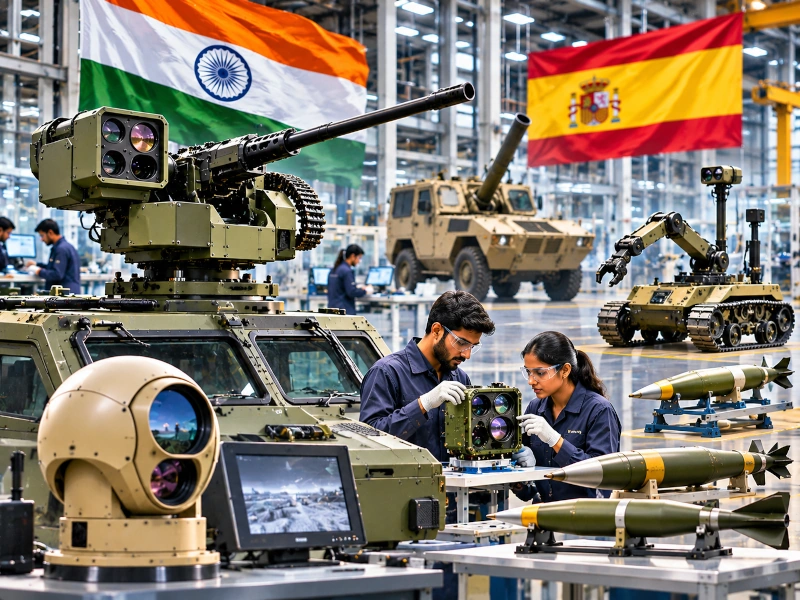
Hyderabad-based aerospace and defence engineering company Sigma Advanced Systems Limited has established a strategic joint venture with Spain’s Escribano Mechanical & Engineering (EM&E Group) to manufacture, integrate and progressively develop advanced defence technologies in India. The partnership brings together Spanish expertise in sophisticated military systems and India’s growing capabilities in precision engineering, defence manufacturing and systems integration.
Announced on November 17, 2026, the joint venture is headquartered in India and has already commenced operations. The collaboration will focus on remote-controlled weapon systems, precision ammunition guidance technologies, mortar carrier systems, electro-optical equipment and defence robotics.
The companies intend to develop an industrial platform that extends beyond conventional equipment assembly and technology transfer. Their long-term objective is to establish domestic manufacturing, engineering, research and product development capabilities while increasing India’s participation in advanced defence technology programmes.
The development represents another significant step in the growing industrial relationship between India and Spain, particularly in aerospace and defence technology.
Joint Venture to Manufacture Advanced Defence Systems in India
The partnership combines EM&E Group’s established portfolio of defence technologies with Sigma Advanced Systems’ manufacturing infrastructure, precision engineering expertise and experience in executing Indian defence programmes.
Under the arrangement, the companies will work towards progressively localising, manufacturing and integrating advanced defence products in India. They also intend to undertake joint engineering activities and develop systems adapted to the operational requirements of the Indian Armed Forces.
Unlike partnerships limited to the supply of imported equipment, the Sigma–Escribano venture is structured to support greater participation by Indian engineers, manufacturers and technology developers.
The joint venture will initially leverage Sigma’s existing manufacturing, engineering and testing facilities in India, providing an established industrial base for the collaboration.
The companies have also outlined plans to develop additional research and engineering capabilities, enabling the adaptation of existing technologies and the development of new defence systems over time.
Remote-Controlled Weapon Systems
One of the principal technology areas covered by the partnership is remote-controlled weapon systems, commonly known as Remote Weapon Stations (RWS).
These systems allow military personnel to operate weapons from protected positions using remotely controlled mechanisms, electro-optical sensors and computer-assisted targeting equipment.
Remote Weapon Stations are increasingly used on armoured vehicles, naval vessels, military installations and other defence platforms where crew protection and rapid target engagement are important operational requirements.
Modern systems can integrate day-and-night observation equipment, thermal imaging cameras, stabilised weapon mounts and digital fire-control technologies.
Their ability to support weapon operation while reducing crew exposure makes them valuable in a variety of military environments.
EM&E Group has established expertise in developing remote weapon stations and associated military technologies. Through the joint venture, the companies intend to build capabilities for manufacturing, integration and progressive localisation of such systems in India.
This could strengthen the domestic industrial ecosystem supporting advanced weapon stations and related military electronics.
Ammunition Guidance Technologies for Artillery, Rockets and Mortars
The joint venture will also focus on ammunition guidance technologies for artillery projectiles, rockets and mortar ammunition.
Guidance and course-correction technologies are increasingly important in modern artillery systems because they can improve the precision of conventional ammunition and help reduce the number of rounds required to engage designated targets.
Depending on the system, guided ammunition may incorporate navigation electronics, control mechanisms, sensors and specialised guidance components.
Such technologies require expertise in precision manufacturing, electronics, materials engineering and the integration of compact subsystems capable of operating under demanding conditions.
The inclusion of ammunition guidance systems in the Sigma–Escribano partnership creates opportunities for collaboration in this technologically sophisticated segment of defence manufacturing.
The companies have identified artillery, rocket and mortar ammunition guidance as areas of their combined technology portfolio. However, the announcement does not specify individual ammunition products entering Indian production or confirm procurement orders from the Armed Forces.
The proposed localisation and development activities could nevertheless contribute to India’s broader efforts to expand domestic expertise in precision-guided military technologies.
Mortar Carrier Systems and Mobile Fire Support
Mortar carrier systems constitute another important area of collaboration.
Mobile mortar platforms enable military formations to transport and operate indirect-fire weapons using specialised vehicle-mounted equipment.
Depending on their design, such systems can incorporate automated weapon positioning, digital fire-control equipment, navigation systems and mechanical arrangements for operating mortars from vehicle-mounted platforms.
Mobility is particularly valuable in modern military operations because artillery and mortar units frequently need to change positions while maintaining the ability to provide fire support.
Integrating mortar systems with suitable vehicles also creates opportunities for combining mechanical engineering, military electronics and specialised vehicle technologies.
The Sigma–Escribano partnership is expected to explore manufacturing and integration capabilities in this field, drawing on the Spanish company’s existing technology portfolio and Sigma’s industrial infrastructure.
Electro-Optical Technologies for Modern Military Platforms
Electro-optical equipment forms an essential component of contemporary military surveillance, observation and targeting systems.
These technologies allow military platforms to detect, observe and track objects under different environmental and lighting conditions.
Electro-optical systems can include visible-light cameras, thermal imaging sensors, stabilised observation assemblies and associated electronic processing equipment.
Such systems are used across a wide range of defence applications, including armoured vehicles, naval platforms, border surveillance equipment, unmanned systems and remote weapon stations.
Their integration with weapon-control and observation equipment can improve situational awareness and support military operations in both daytime and low-visibility environments.
The Sigma–Escribano collaboration will bring electro-optical technologies within the scope of its planned industrial development activities.
Developing local engineering and integration capabilities in this sector would complement India’s expanding defence electronics and surveillance manufacturing ecosystem.
Defence Robotics and Advanced Military Automation
Robotics is another technology area included in the joint venture’s portfolio.
Modern defence robotics encompasses systems designed to assist military personnel in surveillance, reconnaissance, equipment handling and other specialised tasks.
Depending on their configuration, robotic platforms can incorporate remote-control equipment, electro-optical sensors, navigation technologies and specialised mechanical systems.
Their development requires capabilities across software, electronics, mechanical engineering, sensing technologies and systems integration.
EM&E Group’s experience in robotics provides a technological foundation for possible collaboration with Sigma in this field.
The companies have not announced specific robotic platforms for immediate production in India. Nevertheless, the inclusion of robotics within the partnership indicates an intention to participate in increasingly technology-intensive areas of defence manufacturing.
Building Indigenous Engineering and Research Capabilities
A central feature of the partnership is its emphasis on developing capabilities beyond conventional manufacturing.
The companies intend to establish joint engineering and research and development activities that support the adaptation of existing systems to Indian requirements and the development of new technologies.
This approach recognises that sustainable defence industrial capabilities require more than the ability to assemble components supplied by overseas manufacturers.
Advanced military systems involve complex engineering processes, including mechanical design, electronics integration, software development, testing, quality assurance and product validation.
Building these capabilities within India can strengthen the domestic knowledge base and increase the participation of Indian engineers in high-value defence programmes.
The joint venture aims to progressively expand indigenous content while developing a wider network of Indian suppliers.
Such an approach could create opportunities for domestic companies specialising in precision components, electronics, mechanical systems, testing equipment and related technologies.
Sigma Advanced Systems Expands Its Defence Technology Portfolio
For Sigma Advanced Systems, the partnership represents part of its broader transition from manufacturing components and subsystems towards developing and integrating more complex aerospace and defence technologies.
The company operates across aerospace, avionics, naval systems, radar technologies and communication equipment.
Its engineering activities include the development and manufacture of mission-critical systems and specialised precision-engineered components.
Sigma also has an international industrial presence through its United Kingdom subsidiaries, Nasmyth and Bromford, which participate in global aerospace manufacturing supply chains.
These capabilities provide an industrial foundation for the company’s expansion into higher-value defence systems and technology development.
Commenting on the joint venture, Sigma Advanced Systems Chief Executive Officer Sunil Kalidindi explained that the collaboration would support the company’s evolution into a broader aerospace and defence technology business.
He identified precision manufacturing, systems integration, engineering and joint development as important elements of the company’s future growth strategy.
The partnership with EM&E Group will provide Sigma with access to an expanded portfolio of defence technologies while creating opportunities for participation in more complex military programmes.
Spain’s EM&E Group Brings Established Defence Technologies
Escribano Mechanical & Engineering is a Spanish defence and security technology company with expertise in advanced military systems and precision manufacturing.
Established in 1989, the company has developed capabilities spanning remote weapon stations, guidance technologies, electro-optical systems, robotics, counter-unmanned aircraft systems and defence electronics.
Its industrial activities combine engineering, product development, manufacturing and systems integration.
According to the companies’ announcement, EM&E Group’s technologies are used in more than 25 countries across Europe, Asia, the Middle East, North Africa and Latin America.
The Indian joint venture provides the Spanish company with an established industrial platform through which it can localise technologies and participate in Indian defence programmes.
It also creates opportunities for developing equipment suited to the requirements of Indian and international military customers.
For both partners, the collaboration is intended to combine existing technological expertise with India’s manufacturing scale and expanding defence engineering capabilities.
Supporting India’s Defence Indigenisation Programme
The partnership aligns with India’s broader efforts to increase domestic defence production and strengthen technological capabilities within the country’s industrial ecosystem.
India has progressively encouraged domestic manufacturing, private-sector participation and collaboration between Indian companies and international defence technology providers.
The objective is to develop production capabilities that support the operational requirements of the Armed Forces while expanding the country’s participation in international defence supply chains.
Advanced technologies such as remote weapon stations, guided ammunition systems, military electronics and electro-optical equipment require specialised engineering capabilities and sophisticated manufacturing processes.
Collaboration between established international technology providers and Indian manufacturers can help create the industrial foundations needed to produce and develop such systems domestically.
The Sigma–Escribano venture seeks to contribute to this process by increasing local manufacturing, strengthening engineering capabilities and developing a broader supplier ecosystem.
Its contribution to indigenisation will ultimately depend on the technologies brought into production, the extent of localisation achieved and the development of indigenous engineering capabilities.
Joint Venture Targets Domestic and International Defence Markets
Although India will remain the immediate focus of the partnership, the companies have also identified international defence markets as a long-term opportunity.
The joint venture is structured to pursue selected opportunities in Europe and other friendly markets.
Sigma’s existing manufacturing presence in India and the United Kingdom, together with EM&E’s international defence technology portfolio, could support participation in wider aerospace and defence supply chains.
The partners intend to position India-manufactured systems for international customers as domestic manufacturing and engineering capabilities develop.
Export opportunities would remain subject to applicable national regulations, technology-transfer arrangements, export controls and procurement requirements.
The companies have not announced specific export contracts arising from the new venture.
Nevertheless, the international orientation of the partnership reflects the increasing emphasis on developing India as both a defence manufacturing centre and a potential supplier of advanced military systems to global markets.
Sigma Strengthens Its Corporate Leadership
Alongside the joint venture announcement, Sigma Advanced Systems has strengthened its corporate leadership as part of its broader aerospace and defence expansion strategy.
Lieutenant General B. S. Raju (Retired), a former Vice Chief of the Army Staff, has been appointed Chairman of the company’s Board.
His military career included appointments as Director General of Military Operations and General Officer Commanding-in-Chief of the South Western Command.
The company has also inducted industrialist Galla Jayadev and former Defence Research and Development Organisation scientist Dr. Urkavalan Jeya Santhi as independent directors, with their appointments effective from November 6, 2026.
Galla Jayadev brings experience in industrial manufacturing and corporate leadership through his association with the Amara Raja Group.
Dr. Jeya Santhi brings extensive experience in defence research and scientific administration, having served as an Outstanding Scientist and Director General of Human Resources at DRDO headquarters.
These appointments are intended to strengthen the company’s governance, technical oversight and strategic leadership as it expands its participation in sophisticated defence programmes.
Strengthening India’s Position in Advanced Defence Manufacturing
The establishment of the Sigma Advanced Systems–Escribano joint venture marks an important development in India’s expanding private-sector defence manufacturing ecosystem.
The partnership combines established Spanish defence technologies with Indian precision engineering, manufacturing infrastructure and programme execution capabilities.
Its focus on remote-controlled weapon systems, ammunition guidance, mortar carrier technologies, electro-optics and robotics places the venture within several strategically important areas of modern military technology.
The joint venture has already commenced operations, while its broader manufacturing, localisation, engineering and product development objectives will be pursued progressively.
By emphasising indigenous content, joint development and domestic supply-chain participation, the collaboration creates a platform for strengthening India’s advanced defence industrial capabilities.
As these activities expand, the partnership has the potential to support skilled employment, technological collaboration and the development of higher-value defence manufacturing capabilities within India, reinforcing the country’s ambition to emerge as an important centre for aerospace and defence technology.
You may also like
-
India–Malaysia Joint Military Exercise Harimau Shakti–VI Begins in Malaysia with Focus on Counter-Terrorism and Drone Warfare
-
Collins Aerospace Begins Construction of India’s First Foreign-OEM-Authorised Propeller MRO Facility in Bengaluru
-
Apollo Micro Systems Partners with Redon Systems to Develop Indigenous Tethered Drones and Loitering Munitions
-
Chennai-Based BBBS Unveils Indigenous Vajra Sind Handheld Wideband Counter-Drone Jammer
-
Indian Navy’s Barak Missile Defence Systems to Receive ₹1,976 Crore Upgrade Under India–Israel Agreement
