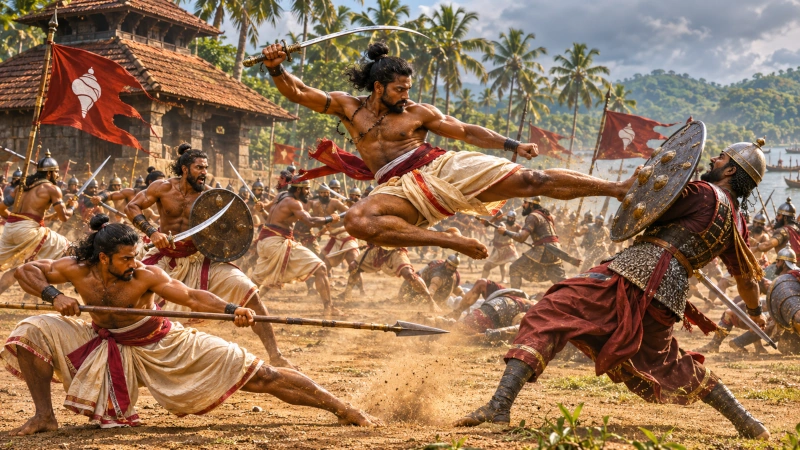
The military history of Kerala before the emergence of modern standing armies was shaped by an interconnected system of regional kingdoms, hereditary chiefs, landholding families and trained warrior communities. Among the most prominent participants in this system were the Nairs, who served as soldiers, armed retainers, military commanders and local authorities across different parts of Kerala. Their military traditions were closely associated with the kalari, a specialised institution for martial training that preserved methods of physical conditioning, weapons handling and combat discipline. Together, these arrangements contributed to the organisation of warfare and the exercise of political authority across the region for several centuries.
The Nair military system was not a single, centrally organised army operating throughout Kerala. Instead, it consisted of local military establishments connected through relationships between ruling houses, territorial chiefs and hereditary households. Military service was frequently associated with landholding rights, political allegiance and obligations inherited through established social institutions. The organisation of these forces differed between northern Malabar, central Kerala and the southern territories of Venad, which later developed into Travancore. These regional differences reflected the fragmented political structure of Kerala and the varying requirements of individual kingdoms.
The military system underwent substantial transformation between the medieval and early modern periods. The increasing use of firearms, artillery, fortified positions and coordinated infantry formations gradually altered the requirements of warfare. During the eighteenth century, rulers such as Marthanda Varma of Travancore introduced more centralised military institutions, while conflicts involving European powers and Mysore demonstrated the growing importance of disciplined armies and sustained logistical support. The history of the Nair military system therefore provides valuable insights into the relationship between military organisation, political authority, technological change and Kerala’s wider social history.
The Political Foundations of Kerala’s Military Organisation
The development of military institutions in medieval Kerala was closely connected with the political structures that emerged during and after the period of the Chera Perumal rulers of Mahodayapuram. Political authority during this era involved relationships between ruling institutions, territorial divisions, local elites and communities responsible for various administrative and military functions. The organisation of armed forces was influenced by these relationships rather than by the existence of a uniform military establishment extending across the entire region.
Following the weakening and eventual disappearance of the Chera Perumal political order during the twelfth century, Kerala became increasingly characterised by regional kingdoms and smaller principalities. The Kolathiris exercised authority in northern Kerala, the Zamorins emerged as prominent rulers of Kozhikode, the kingdom of Cochin developed in central Kerala, and the Venad dynasty controlled territories in the south. Numerous smaller chiefs and influential landholding families maintained authority within and between these larger political formations.
This political environment encouraged the development of decentralised military arrangements in which rulers depended upon local chiefs and their followers for armed support. Military forces were frequently assembled through established obligations associated with territory, hereditary status and political allegiance. Local authorities maintained armed retainers who could be mobilised when required for territorial defence, campaigns against rival principalities or the protection of political interests.
Nair families occupied important positions within many of these arrangements. Some served ruling houses directly, while others maintained armed followers or exercised authority over local territories. Their military responsibilities were therefore closely connected with the wider organisation of political power and landholding. However, Kerala’s military history was not confined exclusively to the Nairs, as members of other communities also participated in warfare and martial training. The Nair military system must consequently be understood within the broader political and social environment of the region.
The Nadu and Desam as Territorial Military Institutions
The territorial organisation of medieval Kerala influenced the recruitment, mobilisation and command of military forces. The nadu functioned as a regional territorial division, while the desam represented a smaller local unit within the wider political landscape. The precise administrative and military responsibilities associated with these divisions varied between kingdoms and historical periods, but they provided an important framework through which political authority could be exercised.
A naduvazhi held authority over a nadu, while a desavazhi could exercise responsibilities within a desam. These authorities participated in local administration and maintained relationships with armed households and military retainers. During periods of conflict, they could be expected to provide military assistance to superior rulers according to established political obligations.
The desam was particularly important in regions where military training and service were organised through local institutions. Chiefs maintained relationships with families whose members had received martial training, enabling them to assemble armed groups when military operations were required. These arrangements connected the availability of fighting men with the territorial organisation of political authority.
Military obligations were frequently associated with landholding rights and access to resources. Families that enjoyed particular privileges or held land under established arrangements could also be expected to provide military service. The system allowed rulers to obtain troops without maintaining every soldier as a permanent member of a centrally funded army.
However, this decentralised structure created difficulties when large forces had to be mobilised under unified command. The effectiveness of an army depended upon the cooperation of several chiefs whose political interests were not always identical. Rivalries, disputes over allegiance and changes in regional political relationships could affect the availability and reliability of military support.
The military importance of the nadu–desam system lay in its ability to connect territorial administration with the mobilisation of armed manpower. Its principal limitation was the difficulty of ensuring consistent command and coordination across forces supplied by different local authorities.
Nair Households and Hereditary Military Service
The Nair military tradition was closely connected with the social organisation of hereditary households and landholding families. In many parts of Kerala, Nair communities followed matrilineal systems of descent in which the taravad formed an important institution of family identity, property ownership and inheritance. These households could maintain relationships with local political authorities and contribute personnel to military service.
Influential taravads often possessed land and resources that supported their social position. Some maintained armed followers or supplied members for the service of ruling houses and territorial chiefs. The relationship between landholding and military obligations contributed to the development of a social environment in which particular families were associated with martial responsibilities.
Military service was not uniform across all Nair households. Some lineages occupied important administrative and command positions, while others provided soldiers or performed different duties within local military establishments. The nature of these obligations varied according to region, political circumstances and the resources available to individual families.
The prominence of armed service also influenced social identity. Families associated with military authority could acquire prestige through their relationship with ruling houses and their ability to provide trained fighters. However, this system operated within Kerala’s historically stratified social order, where caste status, hereditary rights and access to resources shaped political and economic opportunities.
An accurate understanding of the Nair military system therefore requires distinguishing between the military functions of particular groups and broad assumptions concerning the occupations of entire communities. The system reflected a historically specific relationship between military service, hereditary institutions and political authority rather than a uniform pattern of professional soldiering.
The Kalari as an Institution of Military Training
The kalari occupied an important position within Kerala’s traditional martial culture. It functioned as a specialised training space where students developed physical strength, flexibility, balance, coordination and proficiency in the use of weapons. In regions where military service was organised through local chiefs and hereditary households, kalaris provided an institutional setting for preparing individuals for armed combat.
The training establishment was generally supervised by a gurukkal, or martial instructor, who transmitted knowledge through direct instruction and repeated practice. The gurukkal was responsible for teaching physical exercises, supervising weapons training and maintaining the continuity of the training tradition. Students progressed through different stages of instruction according to their abilities and the methods followed within the particular training lineage.
The kalari was significant because it provided a structured environment for developing martial skills over an extended period. Physical conditioning helped students acquire the strength, agility and bodily control required for combat, while weapons training introduced techniques of attack, defence, movement and the management of distance between opponents.
The existence of such institutions helped preserve specialised martial knowledge within local communities. Training methods could be transmitted between generations, allowing families and military establishments to maintain familiarity with particular weapons and combat practices.
However, the kalari traditions practised today cannot automatically be regarded as exact reconstructions of every historical military technique. Teaching methods and institutional functions changed over time, particularly as the military significance of traditional weapons declined and Kalarippayattu increasingly survived as a cultural and physical-training practice.
The principal military contribution of the kalari was the maintenance of trained manpower through systematic physical preparation, weapons instruction and the transmission of martial knowledge.
Kalarippayattu and the Systematic Development of Combat Skills
Kalarippayattu developed into one of Kerala’s most recognisable martial traditions, combining physical conditioning with techniques involving wooden weapons, metal weapons and unarmed combat. Its training methods demonstrate the importance placed upon bodily control, repeated practice and progressive instruction.
Traditional training is commonly described through four broad disciplines known as Meythari, Kolthari, Angathari and Verumkai. These categories represent different stages of martial instruction, although their specific techniques and sequences vary between regional schools and teaching lineages.
Meythari emphasises physical movements intended to develop balance, flexibility, strength and coordination. Students practise controlled movements and postures that help improve mobility and their ability to respond to changing situations. The discipline establishes the bodily foundation required for more advanced weapons training.
Kolthari introduces the use of wooden weapons, including sticks and staffs of different lengths. These exercises develop timing, defensive movement, distance management and coordination between the body and the weapon. Training with wooden implements also provides opportunities to practise combat movements before progressing to more dangerous metal weapons.
Angathari involves instruction in metal weapons such as swords, daggers and spears. Students learn methods of attack and defence while developing the control required to handle weapons effectively. Verumkai focuses on unarmed combat, including striking, defensive movements and techniques intended to control an opponent without a weapon.
The progression from physical conditioning to weapons training demonstrates the systematic character of Kerala’s martial traditions. While the effectiveness of individual techniques depended upon the skill and experience of the practitioner, the broader training system emphasised discipline and the repeated development of physical capabilities.
Weapons of the Nair Military Tradition
The weapons associated with traditional Nair military service reflected the requirements of close combat, territorial defence and the forms of warfare practised during different historical periods. Swords, shields, spears, bows and other weapons formed part of Kerala’s martial environment, although their relative importance changed according to region, military organisation and technological developments.
The sword and shield became particularly prominent symbols of martial identity. The sword provided an offensive weapon suitable for close-range engagement, while the shield offered protection and could be used to control an opponent’s movements. Effective use of the combination required coordination between attack, defence and footwork.
Spears provided greater reach and could be employed in individual combat or collective formations. Their effectiveness depended upon the skill of the user and the ability of soldiers to maintain appropriate spacing and coordination. Bows and arrows were also associated with earlier military practices, allowing fighters to engage opponents at a distance.
Kalarippayattu traditions preserve techniques involving additional weapons, including the urumi, a flexible sword that requires considerable skill and control. Its presence in modern martial training demonstrates the diversity of weapons associated with Kerala’s martial heritage. However, the prominence of a weapon in contemporary demonstrations does not establish how frequently it was used in historical warfare.
The introduction and increasing importance of firearms and artillery gradually altered the balance between different categories of weapons. Traditional swords and spears continued to be used in various military contexts, but they increasingly operated alongside gunpowder weapons and organised infantry formations.
The history of these weapons demonstrates the relationship between individual martial skills and the changing technological requirements of warfare.
Physical Conditioning and the Importance of Combat Movement
Physical conditioning formed an important component of traditional martial training because armed combat required strength, endurance, balance and the ability to coordinate rapid movements. Students trained in the kalari developed these capabilities through repeated exercises intended to improve control over the body and familiarity with different combat positions.
Footwork was particularly important because the distance between opponents could determine the effectiveness of an attack or defence. A fighter needed to maintain stability while moving quickly, adjusting direction and responding to an opponent’s weapon. The ability to coordinate movement with weapon handling was therefore central to the training process.
Exercises also helped develop awareness of body position and the relationship between timing and movement. Repeated practice allowed students to perform techniques with greater confidence and consistency. Familiarity with weapons and defensive movements could provide advantages during close combat, where hesitation or poor coordination might expose a fighter to immediate danger.
However, the development of individual martial skills was only one component of military effectiveness. Soldiers operating within larger formations also required discipline, familiarity with commands and the ability to cooperate with others. The distinction between individual combat proficiency and collective military training became increasingly important as warfare evolved towards greater reliance on coordinated infantry and firearms.
The kalari system was well suited to developing specialised physical and weapons skills, while later military reforms increasingly emphasised collective organisation and standardised training. These different requirements help explain the changing relationship between traditional martial institutions and the development of modern armies.
Local Militias and the Mobilisation of Nair Warriors
The armed forces maintained by Nair chiefs and landholding families were often organised as local militias or groups of military retainers rather than permanent standing armies. Their mobilisation depended upon political obligations, hereditary relationships and the authority of individual chiefs.
During periods of conflict, local authorities could assemble armed followers to defend territories, support a superior ruler or participate in campaigns against rival principalities. The size of these groups varied considerably according to the resources and influence of the chief responsible for maintaining them.
This system provided political authorities with access to fighting men familiar with local conditions. Warriors operating within their own territories possessed knowledge of roads, river crossings, settlements and other geographical features that could influence military operations.
However, combining several local militias into a larger army presented organisational challenges. Different groups might possess varying levels of training, equipment and experience, while their immediate loyalties could remain attached to the chiefs who had mobilised them.
The effectiveness of larger military operations therefore depended upon the ability of commanders to coordinate these forces and maintain cooperation among participating authorities. Disputes over political allegiance or the distribution of responsibilities could weaken military unity.
Logistics also presented difficulties. Soldiers required food, weapons, transport and arrangements for sustaining themselves during prolonged operations. These requirements became increasingly demanding when campaigns extended beyond local territories.
The strength of the Nair militia system lay in the availability of locally trained fighters and established networks of military obligation. Its weakness was the difficulty of maintaining unified command and sustained logistical support during larger campaigns.
Warfare Among Kerala’s Regional Kingdoms
The political history of medieval and early modern Kerala was characterised by competition among regional kingdoms, subordinate chiefs and influential landholding families. Conflicts arose over territorial boundaries, succession, political allegiance, commercial revenues and control of strategically important locations.
Nair warriors participated in these struggles through their relationships with ruling houses and local military authorities. Their service could involve defending territories, supporting military campaigns or protecting the interests of particular chiefs.
Kerala’s geography influenced the conduct of warfare. Rivers, wetlands, forests, coastal settlements and the Western Ghats created different conditions for military movement and communication. Control of roads, river crossings, fortified positions and commercial centres could provide important strategic advantages.
The fragmented political structure also meant that alliances were subject to change. A local chief might support one ruler during a particular conflict while entering into a different relationship when political circumstances changed. Military organisation was therefore closely connected with political negotiation and the management of alliances.
Successful campaigns required more than individual battlefield skill. Commanders needed to coordinate troops, secure supplies, understand the terrain and maintain cooperation among participating forces. The effectiveness of the Nair military system consequently depended upon the wider political and organisational conditions within which its warriors operated.
Ankam and the Tradition of Regulated Combat
One of Kerala’s distinctive martial traditions is ankam, a form of regulated combat associated with the settlement of certain disputes. Historical and literary traditions describe situations in which selected fighters represented individuals or groups in contests intended to resolve disagreements.
The warriors associated with these encounters were known as Chekavars in northern Kerala’s martial traditions. Their reputation depended upon technical proficiency, courage and the ability to perform effectively under the conditions of regulated combat.
The tradition occupies an important place in the Vadakkan Pattukal, or northern ballads, which preserve narratives involving martial specialists, rivalries between families and questions of personal honour. Figures such as Aromal Chekavar and Thacholi Othenan became celebrated within these stories, while Unniyarcha occupies a prominent position in the literary memory of women associated with martial skills.
These ballads provide valuable evidence of how later generations understood and represented Kerala’s martial past. However, they combine historical themes with oral storytelling, literary conventions and heroic embellishment. Their narratives should therefore not be treated as direct records of every event they describe.
The ankam tradition demonstrates that martial expertise could perform social and political functions beyond warfare between kingdoms. Nevertheless, it would be inaccurate to assume that all disputes in historical Kerala were resolved through combat or that the practice operated uniformly throughout the region.
The Vadakkan Pattukal and Kerala’s Warrior Heritage
The Vadakkan Pattukal form an important part of Kerala’s cultural memory of martial life. These northern ballads preserve stories associated with warriors, family rivalries, personal reputation and the social significance of martial ability.
The narratives celebrate qualities such as courage, discipline, loyalty and technical proficiency. They also demonstrate the importance attached to martial reputation within particular social environments.
The heroes and heroines of the ballads are associated with different communities, including Nair and Thiyya traditions, reflecting the wider participation of several groups in Kerala’s martial culture. The presence of figures such as Unniyarcha demonstrates that the literary representation of martial skill was not restricted exclusively to male warriors.
Although the ballads contain historical themes, their interpretation requires caution. Oral narratives can change over time, and later versions may incorporate values, conflicts and ideals associated with the periods in which they were transmitted.
Their principal historical value therefore lies in the understanding they provide of cultural attitudes towards warfare, honour and martial expertise. When examined alongside inscriptions, administrative records and other historical evidence, the ballads can contribute to a fuller understanding of Kerala’s military heritage.
The continued popularity of these narratives has helped preserve the memory of traditional martial practices even after their original military functions declined.
Regional Variations in Kerala’s Martial Traditions
Kerala’s martial practices developed differently across northern Malabar, central Kerala and the southern regions associated with Venad and Travancore. These variations reflected differences in political organisation, training lineages and the requirements of local military establishments.
Modern Kalarippayattu traditions commonly distinguish between northern and southern styles. The northern style is particularly associated with elaborate body movements and progressive instruction involving wooden and metal weapons, while southern traditions employ somewhat different patterns of movement and combat techniques.
However, the characteristics of individual schools vary, and present-day distinctions should not automatically be projected unchanged into the medieval period. Martial practices developed through the activities of instructors and communities over long periods, adapting to changing social and military circumstances.
The participation of Thiyya and other communities in martial training also demonstrates that Kerala’s wider military culture cannot be reduced exclusively to Nair institutions. Different regional groups maintained their own traditions of physical training and armed service.
Certain Christian and Muslim communities also participated in military activities, particularly within the complex political and commercial environment of the Malabar Coast.
The Nair military system was therefore an important component of a broader martial landscape involving different communities, regional traditions and political institutions.
The Zamorins of Kozhikode and Military Organisation in Malabar
The kingdom of Kozhikode provides an important example of the relationship between political authority, local military groups and maritime commerce. Under the Zamorins, Kozhikode became a major trading centre with connections extending across the Indian Ocean.
The Zamorins relied upon military support from subordinate chiefs, influential households and armed retainers. Nair warriors participated in these arrangements, contributing to the military forces available to the ruling house.
The kingdom’s commercial importance created additional strategic responsibilities. Its prosperity depended partly upon access to overseas markets and the continued activity of merchant communities operating through the Malabar Coast.
The arrival of Portuguese ships in 1498 introduced new political and military pressures. Portuguese efforts to influence the spice trade and establish fortified coastal positions brought them into conflict with existing commercial interests and regional authorities.
The Zamorins resisted aspects of Portuguese expansion through military action and political alliances. Land operations involved locally organised military forces, while maritime resistance included the important contribution of the Marakkar naval commanders.
These conflicts demonstrate that military power in Malabar depended upon several forms of expertise. Traditional land forces remained important, but naval warfare, artillery and fortified positions created new strategic requirements.
The experience of Kozhikode illustrates how Kerala’s established military institutions encountered changing technologies and political conditions during the early modern period.
Cochin and the Military Traditions of Central Kerala
The kingdom of Cochin and the smaller principalities of central Kerala maintained military arrangements influenced by local chiefs, landholding families and hereditary political relationships. Nair retainers occupied important positions within several of these systems, providing armed support to rulers and participating in territorial defence.
The political environment of central Kerala was complex because the authority of larger kingdoms frequently overlapped with that of subordinate chiefs and influential local families. Military mobilisation therefore depended upon established obligations and the maintenance of political relationships.
Cochin’s position as a maritime trading centre connected its military history with the activities of European commercial powers. The Portuguese established a major presence in the region during the early sixteenth century, while the Dutch displaced them from Cochin in 1663.
These developments influenced the region’s military environment through the construction and use of fortifications, the increasing importance of firearms and the involvement of European military organisations.
However, the presence of European forces did not immediately eliminate indigenous military traditions. Local soldiers and commanders continued to participate in political and military activities, while regional rulers adapted their arrangements according to changing circumstances.
The history of Cochin therefore demonstrates the interaction between established Kerala military institutions and the technologies and political ambitions introduced through expanding European maritime involvement.
Venad and the Military Foundations of Travancore
In southern Kerala, the kingdom of Venad developed through political relationships involving hereditary chiefs, influential landholding families and local military establishments. Nair armed groups formed an important part of this system, particularly through their connections with territorial authorities and ruling institutions.
Before the centralising reforms of the eighteenth century, rulers faced limitations arising from the influence of powerful local elites. Their ability to mobilise forces and exercise authority could be affected by the competing interests of chiefs who maintained independent military resources.
These conditions became particularly important during the reign of Marthanda Varma, who ruled Travancore from 1729 to 1758. His political programme involved the consolidation of royal authority and the reduction of dependence upon hereditary military establishments controlled by subordinate chiefs.
Marthanda Varma developed a more centralised military organisation capable of supporting territorial expansion and sustained campaigns. The reforms involved changes in recruitment, command, training and the acquisition of weapons.
Nair soldiers continued to serve within the developing Travancore military establishment, but their role increasingly operated under more direct royal control.
This transformation represented a major development in Kerala’s military history because it reduced the dependence of royal authority upon politically fragmented military obligations.
The significance of Marthanda Varma’s reforms lay in the transition from decentralised military mobilisation towards an increasingly organised army capable of sustained operations under central command.
Marthanda Varma and the Reorganisation of Military Power
Marthanda Varma’s reign marked an important phase in the transformation of Kerala’s military institutions. His campaigns expanded Travancore’s territorial authority and required a military establishment capable of conducting operations across larger areas.
The older system of hereditary militias could provide experienced warriors, but it created difficulties for a ruler seeking greater political and administrative control. Forces supplied by local chiefs could remain influenced by the interests of those authorities, complicating the organisation of larger campaigns.
Marthanda Varma therefore strengthened the royal military establishment while reducing the independent authority of several powerful landed interests.
The resulting changes involved the organisation of troops, the development of command structures and the increased importance of firearms and artillery.
These reforms did not represent the complete abandonment of older martial traditions. Instead, established military manpower was incorporated into an evolving institutional system.
The transformation also had important political consequences. By strengthening direct control over military resources, the monarchy could reduce its dependence upon hereditary chiefs and pursue a more centralised form of government.
Travancore’s military reforms therefore illustrate the close relationship between the reorganisation of warfare and the consolidation of political authority.
The Battle of Colachel and Travancore’s Military Transformation
The Battle of Colachel in 1741 represents a major event in the military history of Travancore. During the conflict, Marthanda Varma’s forces defeated a Dutch military expedition near Colachel, on the coast of present-day Tamil Nadu.
The battle occurred within a wider struggle involving Dutch commercial interests, regional alliances and Travancore’s territorial expansion. The victory demonstrated the growing military capabilities of the Travancore state.
However, the encounter should not be understood simply as a battle between traditional sword-armed warriors and a modern European army. Warfare in eighteenth-century southern India already involved combinations of indigenous military practices, firearms, artillery and different organisational methods.
One of the important consequences of the battle was the capture of Eustachius de Lannoy, a Dutch military officer who subsequently entered Travancore service.
De Lannoy became associated with the development of Travancore’s military establishment, particularly in relation to European-style training, fortifications and the organisation of infantry.
The strategic importance of Colachel extended beyond the immediate victory. It demonstrated the ability of an expanding Indian kingdom to challenge European military interests and subsequently incorporate external technical expertise into its own military development.
The battle also illustrates how military encounters could influence the transfer of knowledge and the adaptation of organisational methods between different political and technological traditions.
Eustachius de Lannoy and the Modernisation of Travancore’s Army
Eustachius de Lannoy’s service in Travancore marked an important phase in the development of the kingdom’s military institutions. Following his capture at Colachel, he entered the service of Marthanda Varma and became involved in training and organising the state’s forces.
His contribution is associated with the adoption of European-style infantry methods and improvements in military organisation. These included greater emphasis on coordinated formations, firearms training and command procedures.
The increasing importance of gunpowder weapons required soldiers to develop skills different from those associated with individual sword and shield combat. Infantry formations needed to maintain discipline, respond to commands and coordinate the loading and firing of weapons.
Artillery introduced further requirements involving specialised personnel, ammunition supplies, transport and the selection of suitable firing positions.
These developments encouraged the growth of more formal military institutions capable of maintaining common procedures across different units.
The resulting army combined indigenous manpower and regional military experience with selected organisational methods associated with contemporary European warfare.
De Lannoy’s contribution should therefore be understood as part of the wider programme of military and political centralisation undertaken by Travancore rather than as the sole cause of its transformation.
Firearms and Artillery Change the Character of Warfare
The increasing importance of firearms and artillery substantially altered the requirements of warfare in Kerala. Gunpowder weapons had entered Indian military systems before the eighteenth century, but their growing use influenced tactics, training and the organisation of armed forces.
Muskets enabled soldiers to engage opponents at distances beyond the reach of traditional swords and spears. Their effectiveness depended upon the availability of ammunition, the reliability of weapons and the ability of troops to operate within coordinated formations.
Artillery allowed armies to engage enemy positions using heavier projectiles and became particularly important in operations involving fortified locations.
The adoption of gunpowder weapons created advantages for armies capable of maintaining trained infantry, specialised artillery units and dependable logistical systems.
Traditional weapons continued to be used in different circumstances, especially in close combat. However, their relative importance changed as battlefield effectiveness increasingly depended upon coordinated firepower and collective discipline.
The transformation also affected the role of traditional martial training. Individual skill in handling swords and spears remained valuable, but it could not substitute for the organisational requirements of an army operating with firearms and artillery.
The most important military change was not merely the introduction of new weapons but the growing necessity for standardised training, coordinated command, ammunition supply and sustained military administration.
Fortifications and the Strategic Importance of Geography
The changing character of warfare increased the importance of fortified positions and military engineering. Kerala’s geography presented a combination of coastal plains, rivers, wetlands, forests and mountain ranges that influenced the movement of armies and the selection of defensive locations.
Control of river crossings, roads and narrow passages could provide important advantages. Fortified positions allowed rulers to defend strategically valuable locations while supporting the movement and deployment of troops.
Travancore’s military development included the construction and maintenance of defensive works intended to protect important territories.
The Travancore Lines, commonly associated with the Nedumkotta defensive system, became particularly important during the later eighteenth century as the kingdom faced military threats from the north.
Such fortifications were not intended to operate independently of field armies. Their effectiveness depended upon the availability of trained troops, artillery, provisions and communication between defended positions.
The development of these systems demonstrates the increasing importance of military planning across larger geographical areas.
Traditional local defence remained relevant, but the protection of an expanding kingdom required coordination between mobile forces, fortified positions and logistical infrastructure.
Mysorean Expansion and the Military Challenges in Malabar
The expansion of Mysorean power into Malabar during the eighteenth century created major changes in Kerala’s political and military environment. Hyder Ali’s campaigns and the subsequent activities of Tipu Sultan brought regional principalities into conflict with a state possessing substantial military resources.
Mysorean forces employed infantry, cavalry, artillery and organisational methods that presented challenges to the smaller and politically fragmented military establishments of northern Kerala.
Local rulers and armed groups participated in resistance and changing political alliances, but their activities were influenced by the interests of individual chiefs and ruling houses.
Nair warriors formed part of the military landscape during these conflicts, although resistance to Mysorean expansion involved several communities and political groups.
The campaigns demonstrated the difficulties faced by decentralised military systems when confronting larger armies capable of sustaining operations over extensive territories.
The political disruption associated with Mysorean expansion also contributed to subsequent changes in the relationship between Malabar’s regional authorities and the British East India Company.
The experience illustrates the growing importance of coordinated military resources, command structures and logistical capabilities during the late eighteenth century.
Pazhassi Raja and the Continuing Value of Local Military Knowledge
The resistance associated with Kerala Varma Pazhassi Raja provides an important example of the continuing relevance of local military networks during the transition towards colonial rule.
Pazhassi Raja, associated with the Kottayam royal house in northern Kerala, became involved in resistance against Mysorean and subsequently British authority during different phases of his political career.
His military activities depended upon local supporters familiar with the terrain and political conditions of the region.
The resistance involved Nair warriors as well as members of other communities, including Kurichiya groups whose contribution was particularly important.
The forested hills and difficult terrain of northern Kerala influenced the conduct of these operations. Smaller forces familiar with local routes could undertake movements and engagements that challenged larger military organisations.
Local knowledge contributed to mobility and the ability to operate in areas where conventional military movement was more difficult.
The resistance associated with Pazhassi Raja is therefore an important example of the strategic value of terrain familiarity and local support.
However, the military system involved should not be understood as an exclusively Nair undertaking. Its effectiveness depended upon cooperation among different communities and political groups.
The episode also demonstrates the limitations faced by local resistance movements when confronting expanding states and colonial military institutions with greater financial and organisational resources.
The Decline of Hereditary Military Obligations
The development of centralised states and colonial military institutions gradually reduced the political importance of hereditary local militias. As rulers increasingly maintained permanent forces, they became less dependent upon troops supplied by subordinate chiefs.
Standing armies offered advantages in recruitment, training, command and military administration. Soldiers could be equipped according to common procedures and maintained under more consistent organisational control.
Such forces required substantial financial resources, but they provided rulers with greater authority over military deployment and planning.
The decline of hereditary military obligations also affected the political position of landholding families whose influence had previously depended partly upon their ability to mobilise armed followers.
The transformation did not occur uniformly across Kerala. Different kingdoms experienced changes through distinct sequences of military reform, political conflict and administrative reorganisation.
In British-controlled Malabar, colonial institutions altered the political environment within which older military arrangements had operated.
In Travancore, elements of the Nair military tradition continued within an increasingly regular military establishment.
The transition therefore involved both the weakening of decentralised military obligations and the adaptation of older traditions to new institutional structures.
The Travancore Nair Brigade and Nineteenth-Century Military Organisation
The history of the Travancore Nair Brigade demonstrates the continuation of older military traditions within a more formal military establishment during the nineteenth century.
Following major political disturbances in 1809, Travancore’s military establishment was substantially reduced. Historical accounts indicate that approximately 700 men of the first Nair battalion were retained as part of the reduced force.
During the regency of Gowri Parvati Bayi, efforts were undertaken to strengthen and reorganise the army.
In 1818, the British authorities permitted an increase in the military establishment, while European officers became involved in training and organisation.
The developing brigade incorporated more formal methods of command, discipline and administration.
Its organisation differed considerably from the earlier system in which local chiefs mobilised hereditary military followers.
The Nair Brigade therefore represents an important institutional transition. It preserved an association with Kerala’s older martial traditions while operating within the political and military conditions of the nineteenth-century princely state.
Its history demonstrates how military identities could continue even after the social and organisational foundations of warfare had substantially changed.
Military Service, Landholding and Political Authority
The relationship between military service and landholding was an important characteristic of Kerala’s older military institutions.
Certain chiefs and influential families exercised rights over land and maintained obligations towards superior political authorities.
Military service could form part of these arrangements, allowing rulers to obtain armed support through established territorial relationships.
The revenues associated with land also contributed to the maintenance of local military establishments.
This system connected warfare with the organisation of political authority, but it could also strengthen the independence of families capable of commanding armed followers.
Rulers who depended heavily upon these groups could face difficulties when local chiefs pursued competing political interests.
The development of centralised military institutions therefore had consequences extending beyond the battlefield.
By reducing dependence upon hereditary military retainers, rulers could strengthen their authority over recruitment, taxation and administration.
The transformation of Kerala’s military system was consequently part of the wider development of political centralisation and state formation.
Martial Honour and the Social Identity of Nair Families
Military service contributed to the historical identity of many Nair families and influenced their position within Kerala’s social hierarchy.
Association with ruling houses, familiarity with weapons and participation in martial training could reinforce the prestige of particular lineages.
The regional ballads of northern Kerala demonstrate the cultural importance attached to courage, personal reputation and martial skill.
However, military identity and actual military employment were not identical. Not every individual belonging to a traditionally military-associated community necessarily served as a soldier.
The nature of military obligations also changed across different historical periods.
Caste status and hereditary rights influenced access to particular positions and resources, making the system part of a broader structure of social inequality.
An accurate historical interpretation must therefore distinguish the military functions of particular groups from claims that entire communities possessed uniform martial characteristics.
The historical importance of Nair military service lies in its connection with specific political institutions, economic relationships and systems of military organisation.
Women in Kerala’s Martial Traditions
Kerala’s martial heritage also preserves traditions involving women associated with martial knowledge.
Unniyarcha, celebrated in the Vadakkan Pattukal, occupies an important position within the cultural memory of northern Malabar.
The ballads portray her as a woman possessing martial skill, personal courage and the ability to use weapons.
Her prominence demonstrates that the literary representation of martial ability was not confined exclusively to men.
However, the existence of such narratives does not establish that women routinely served in every category of historical Nair military organisation.
The cultural celebration of exceptional female warriors must be distinguished from evidence concerning the recruitment and composition of actual armies.
Modern Kalarippayattu institutions include women, allowing martial training to continue in a setting that differs substantially from the social arrangements of earlier centuries.
The history of women in Kerala’s martial traditions therefore involves both the preservation of cultural memory and the expansion of participation in modern martial education.
Kalarippayattu Survives as a Cultural and Martial Tradition
Although the original military functions of traditional kalaris declined with the emergence of modern armies, Kalarippayattu continued to survive as an important part of Kerala’s cultural heritage.
Training methods were preserved through instructors, family traditions and institutions that maintained knowledge of physical movements and weapons.
The tradition also influenced elements of Kerala’s performing arts, although the relationship between individual martial techniques and artistic practices varies and requires careful historical interpretation.
During the twentieth century, renewed interest in Kalarippayattu contributed to the growth of training institutions and public recognition of the art.
Modern practitioners may undertake training for physical fitness, martial education, cultural preservation or artistic performance.
The continuity of Kalarippayattu demonstrates how a tradition once closely associated with military service can acquire new functions while preserving elements of its historical knowledge.
The survival of the art also provides opportunities for scientific and historical research into traditional movement systems, physical conditioning and the transmission of specialised skills.
Military Lessons from the Nair System
The history of the Nair military system provides important insights into the relationship between military effectiveness and political organisation.
Its decentralised structure allowed local authorities to mobilise trained warriors through hereditary and territorial obligations. This arrangement could provide access to fighting men familiar with local conditions, but its effectiveness depended upon cooperation among chiefs and the stability of political relationships.
The kalari demonstrates the importance of sustained training and the institutional transmission of specialised skills. Physical conditioning and weapons instruction contributed to individual combat proficiency, providing an important foundation for traditional martial service.
However, the evolution of warfare demonstrated that individual skill alone was insufficient for success in larger military campaigns. Armies required unified command, dependable logistical systems, common procedures and the ability to coordinate different categories of troops.
The increasing importance of firearms and artillery reinforced these requirements. Military transformation involved not only the acquisition of new weapons but also changes in recruitment, training and administration.
The reforms undertaken by Marthanda Varma demonstrate how centralised military institutions could strengthen political authority and support territorial expansion.
The principal military lesson of Kerala’s Nair system is that effective warfare depends upon the integration of training, leadership, technology, logistics and political organisation. Strength in one area cannot fully compensate for weaknesses in the others.
Reassessing the Historical Significance of the Nair Military System
The Nair military system represents an important chapter in Kerala’s history because it connects the development of martial institutions with the organisation of political power.
Its foundations lay in relationships between ruling houses, territorial chiefs, hereditary households and locally trained warriors.
The kalari provided an institutional setting for the transmission of combat knowledge, while the nadu–desam framework contributed to the mobilisation of military manpower.
These arrangements supported warfare within the fragmented political environment of medieval Kerala.
Over time, however, changes in military technology and the growth of centralised states created new organisational demands.
The increasing importance of firearms, artillery and disciplined infantry formations encouraged rulers to develop more permanent military establishments.
Travancore’s reforms under Marthanda Varma represent a major turning point in this transformation, while the later history of the Nair Brigade demonstrates how older military identities could continue within changing institutional structures.
The history should not be reduced to an account of uninterrupted military superiority or inevitable decline. It is more accurately understood as a process of adaptation involving political authority, social institutions and technological change.
Preserving Kerala’s Military Heritage
The study of Kerala’s military history requires continued examination of inscriptions, administrative records, regional chronicles, martial literature and surviving material culture.
Historical documents associated with Travancore, Cochin, Kozhikode and the smaller principalities can provide information about military recruitment, command arrangements, political alliances and the changing organisation of armed forces.
The study of traditional kalaris also offers opportunities to investigate how martial knowledge was transmitted through local institutions.
However, contemporary martial practices must be examined alongside historical evidence rather than treated as exact representations of every technique employed in earlier centuries.
The Vadakkan Pattukal remain valuable sources for understanding the cultural memory of Kerala’s martial heritage, while their accounts require comparison with documentary and archaeological evidence.
The preservation of historical weapons, manuscripts, military sites and traditional training institutions can contribute to maintaining this heritage.
Educational institutions, museums and cultural organisations can also support historically grounded research recognising the contributions of different communities to Kerala’s military development.
Such efforts allow the achievements of the Nair military tradition to be appreciated within the broader political and social history of the region.
The Nair Military System and the Evolution of Warfare in Kerala
The Nair military system developed through a distinctive relationship between local political authority, hereditary households, military obligations and specialised martial training institutions. Its organisation reflected the decentralised political structure of medieval Kerala, where rulers depended upon networks of chiefs and armed followers to maintain their authority and conduct warfare.
The kalari played an important role in preserving techniques of physical conditioning and armed combat, while territorial institutions such as the nadu and desam provided a framework through which military manpower could be mobilised.
These arrangements contributed to Kerala’s military traditions over several centuries, but they also faced limitations arising from fragmented authority and dependence upon hereditary relationships.
The growth of centralised states and the increasing importance of gunpowder weapons transformed the requirements of warfare. Under Marthanda Varma, Travancore developed a more organised military establishment capable of supporting sustained campaigns and territorial expansion.
The Battle of Colachel in 1741 and the subsequent contribution of Eustachius de Lannoy illustrate the interaction between indigenous military capabilities and changing methods of training and organisation.
The later Travancore Nair Brigade demonstrates how older military identities continued within institutions that differed substantially from the hereditary militia system.
Although the original military functions of many traditional kalaris gradually declined, Kalarippayattu survived as an important element of Kerala’s cultural heritage.
The enduring significance of the Nair military system lies in its demonstration of how warfare, political authority, social organisation and technical training evolved together. Its history provides insights into the strengths of local military institutions, the challenges of decentralised command and the importance of adapting military organisation to changing strategic circumstances.
By preserving its surviving traditions and examining its history through reliable evidence, Kerala can maintain a deeper understanding of the institutions and communities that shaped its military heritage over several centuries.
References and Historical Sources
1. V. Nagam Aiya (1906). The Travancore State Manual, Volume I. Travancore Government Press, Trivandrum. A primary historical reference covering Travancore’s political and military history, Marthanda Varma’s campaigns, the Battle of Colachel and the development of the Travancore military establishment.
https://printing.kerala.gov.in/wp-content/uploads/2018/07/Travancore-State-Manual-1906.pdf
2. Government of Travancore. The Nayar Brigade of Travancore: A Short History. A historical account of the Travancore Nair Brigade, its military organisation, the influence of Eustachius de Lannoy and the transformation of the kingdom’s armed forces.
https://archive.org/details/nayarbrigadeoftr00madr
3. University of Calicut. Formation of Kerala Society and Culture. School of Distance Education, University of Calicut. Academic material examining Kerala’s medieval political institutions, hereditary military service, the Nadu–Desam administrative structure, local chieftains and the evolution of martial traditions.
https://sde.uoc.ac.in/sites/default/files/sde_videos/VIsem_formation_of_kerala_society_and_culture.pdf
4. University of Calicut. Historical Research on Naduvazhis, Desavazhis and Military Organisation in Medieval Kerala. Research examining the relationship between territorial authority, landholding, hereditary militias and the kalari as a centre of military training.
https://scholar.uoc.ac.in/server/api/core/bitstreams/130052d1-1aea-43c5-baff-78b9be89c63f/content
5. Kerala Tourism, Government of Kerala. Kalaripayattu: Disciplines and Training. Official documentation describing the four principal disciplines of Kalarippayattu: Meythari, Kolthari, Angathari and Verumkai.
https://www.keralatourism.org/kalaripayattu/disciplines
6. Kerala Tourism, Government of Kerala. Kalaripayattu: The Martial Art of Kerala. An overview of Kerala’s traditional martial art, its historical associations, training methods, weapons and cultural significance.
https://www.keralatourism.org/artforms/kalaripayattu-martial-art-kerala/27/
7. Kerala Tourism, Government of Kerala. Angathari: Training with Metal Weapons in Kalaripayattu. Official documentation of traditional weapons, including swords, shields, spears, daggers and the urumi.
https://www.keralatourism.org/kalaripayattu/disciplines/angathari
8. Kerala Tourism, Government of Kerala. Kalarippayattu: Traditional Martial Art of Malabar. An account of the kalari as a training institution, the role of the Gurukkal and the historical development of martial practices in Kerala.
https://www.keralatourism.org/islam-in-kerala/performing-arts/kalarippayattu
9. Kerala Tourism, Government of Kerala. Kalaripayattu: Folk Art and History. Documentation discussing the martial traditions preserved in the Vadakkan Pattukal and their cultural significance in northern Kerala.
https://www.keralatourism.org/kalaripayattu/origin/folk-art-history
10. Indian National Centre for the Arts (IGNCA). Kerala: A Portrait of the Malabar Coast. A historical and cultural study examining Kerala’s regional kingdoms, social institutions, military traditions and the role of the kalari.
https://ignca.gov.in/Asi_data/46497.pdf
11. Houses by the Sea: State-Formation Experiments in Malabar, 1760–1800. A scholarly study examining the changing political and military organisation of eighteenth-century Malabar, the role of armed retainers and the emergence of more centralised military institutions.
https://www.researchgate.net/publication/299203437_Houses_by_the_sea_-_State-formation_experiments_in_Malabar_1760-1800
12. Government of Kerala. Historical Documentation of the Battle of Colachel. Government publication covering Travancore’s victory over the Dutch in 1741 and the subsequent military role of Eustachius de Lannoy.
https://noticeboard.kerala.gov.in/documents/publications/file2112202116%3A44%3A07.pdf
13. Zarrilli, Phillip B. (1998). When the Body Becomes All Eyes: Paradigms, Discourses and Practices of Power in Kalarippayattu, a South Indian Martial Art. Oxford University Press. A scholarly examination of Kalarippayattu, martial training, political authority and the historical relationship between warfare and social institutions in Kerala.
14. Lannoy, Mark de (1997). The Kulasekhara Perumals of Travancore: History and State Formation in Travancore from 1671 to 1758. CNWS Publications, Leiden University. A scholarly study of Travancore’s political consolidation, Marthanda Varma’s expansion and the development of centralised state institutions.
15. Logan, William (1887). Malabar Manual. Government Press, Madras. An important historical source covering the political, administrative and social organisation of Malabar, including regional chieftains, military traditions and the changing relationship between local rulers and colonial authorities.
You may also like
-
The Sacred Groves of India: Traditional Protection and Modern Biodiversity Conservation
-
Indra Loses Svarga to Bali: Strategic Withdrawal, Political Defeat and the Preservation of Military Power
-
Rāma’s Approach to Rāvaṇa: The Role of Negotiation Before the Use of Force
-
Bali’s Conquest of Svarga: Military Leadership, Strategic Recovery and the Defeat of Indra’s Celestial Forces
-
Kumbhakarṇa’s Counsel: Strategic Realism in the Court of Rāvaṇa
