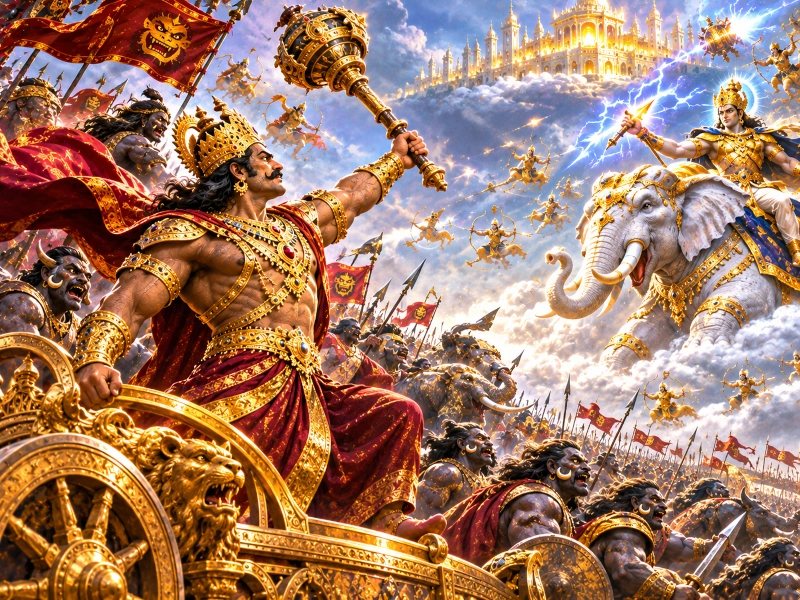
Ancient Warfare Strategies from the Purāṇas | Śrīmad Bhāgavata Purāṇa | Skandha 8, Chapters 10, 11 and 15
Introduction: The Daitya Commander Who Challenged Indra’s Supremacy
The Śrīmad Bhāgavata Purāṇa contains remarkable accounts of warfare between the Devas and Asuras, illustrating the importance of military leadership, battlefield tactics, strategic preparation and the ability to recover from defeat. Among these narratives, the campaigns of Mahābali, the powerful Daitya ruler and grandson of Prahlāda, present an important examination of offensive warfare, command organisation and the conquest of a strategically decisive political centre.
Bali emerged as one of the foremost commanders of the Asura forces during their prolonged struggle against the celestial armies led by Indra. His military career included direct confrontation with powerful adversaries, the employment of extraordinary weapons and supernatural illusions, and a remarkable restoration of military strength after suffering defeat. His subsequent campaign against Svarga culminated in the withdrawal of Indra and the occupation of the celestial kingdom by the Asuras.
The Bhāgavata Purāṇa presents these developments across separate but interconnected episodes. Chapters 10 and 11 describe the great battle following the distribution of Amṛta, during which Bali confronts Indra and is defeated. Chapter 15 describes his restoration, the rebuilding of his military capabilities and his successful advance upon Indra’s celestial capital.
The central military significance of Bali’s campaigns lies in the relationship between battlefield leadership, force regeneration, strategic concentration and the ability to compel an adversary to abandon a vital position without a final decisive battle.
Equally important is the conduct of Indra, who recognises the changed balance of power and accepts Bṛhaspati’s advice to withdraw rather than risk the destruction of his forces. The episode therefore offers enduring lessons in offensive military strategy, defensive judgment and the importance of informed counsel.
The Strategic Background: The Struggle for Celestial Supremacy
The conflict between the Devas and Asuras intensified following the Samudra Manthana, the churning of the Ocean of Milk. Both groups had participated in the extraordinary undertaking to obtain Amṛta, the nectar of immortality, but the eventual distribution of the nectar favoured the Devas through the intervention of Lord Viṣṇu in the form of Mohinī.
For the Asuras, the outcome represented a major strategic setback. Although they had contributed to the effort required to obtain Amṛta, they were deprived of the resource that could have substantially strengthened their position in the continuing struggle against the Devas.
The resulting confrontation developed into a large-scale battle involving powerful commanders, extraordinary weapons and extensive forces on both sides. Bali, the son of Virocana and grandson of Prahlāda, assumed command of the Asura army against Indra’s celestial forces.
The Bhāgavata Purāṇa describes armies equipped with chariots, elephants, horses and infantry, accompanied by formidable warriors mounted upon extraordinary creatures. The battlefield became the scene of simultaneous engagements involving numerous prominent commanders.
The strategic importance of the confrontation lay in its objective: the struggle was not merely for battlefield superiority but for control over the resources and authority that determined the balance of power between the Devas and Asuras.
Bali understood that military strength had to be concentrated against the principal source of Deva power. His leadership consequently placed him at the centre of a confrontation whose outcome could influence the wider celestial order.
Bali’s Command Structure: Organising the Asura Coalition
In Chapter 10, the Bhāgavata Purāṇa identifies Bali as the commander-in-chief of the Asura forces. He enters the battlefield aboard Vaihāyasa, an extraordinary aerial vehicle created by Maya. The vehicle is described as possessing remarkable capabilities, including the ability to become visible or invisible.
Bali’s command is supported by numerous powerful Asura warriors, including Namuci, Śambara, Bāṇa, Vipracitti, Praheti, Heti, Tāraka, Jambha and others. These commanders lead their respective formations into battle against the forces of the Devas.
The extensive assembly of warriors demonstrates the scale of the military coalition operating under Bali’s authority. His role extends beyond personal combat, requiring the coordination of multiple powerful leaders possessing different capabilities.
The presence of Vaihāyasa also provides an interesting military dimension. The supernatural vehicle places Bali in an elevated and mobile position, offering advantages that can be examined conceptually in relation to command mobility and battlefield observation.
The military principle illustrated by Bali’s command position is that an effective commander benefits from mobility, situational awareness and the ability to coordinate forces operating across different parts of the battlefield.
The varied Asura formations also demonstrate the importance of integrating different combat capabilities under a recognised command structure. Individual strength alone cannot guarantee the success of a large military force unless its constituent elements operate towards a common objective.
The effectiveness of a military coalition depends upon the ability of its supreme commander to organise subordinate forces, coordinate their capabilities and maintain unity of purpose during battle.
The Confrontation with Indra: Targeting the Enemy Command System
One of the most significant tactical incidents occurs when Bali confronts Indra, who enters battle mounted upon Airāvata, his magnificent celestial elephant.
The Bhāgavata Purāṇa, Chapter 10, Verse 41, provides a remarkably specific description of Bali’s attack. He releases ten arrows towards Indra, three towards Airāvata, four towards the mounted guards protecting the elephant and one towards its driver.
The distribution of these missiles reveals an important tactical consideration. Bali does not direct his entire attack exclusively against Indra. Instead, he attempts to strike several components that enable the celestial commander to function effectively on the battlefield.
Indra depends upon Airāvata for movement and an elevated fighting position, while the guards provide protection and the driver maintains control of the elephant. By attacking these elements simultaneously, Bali attempts to weaken the entire fighting arrangement surrounding his opponent.
The military significance of this tactic lies in the deliberate targeting of an enemy commander’s supporting capabilities rather than concentrating solely upon the commander himself.
In modern military analysis, this resembles the broader principle of disrupting the supporting systems that enable a major combat capability to remain operational. Mobility, protection, communications and command support can become important targets when attempting to reduce an adversary’s effectiveness.
However, Bali’s attack does not achieve its intended result. Indra demonstrates extraordinary defensive skill by intercepting the incoming arrows before they reach their targets.
The exchange illustrates that even a carefully directed attack can fail when the adversary possesses the ability to recognise and counter it.
The tactical lesson is that attacking an opponent’s supporting systems can create opportunities for disruption, but success depends upon overcoming the enemy’s defensive readiness and capacity for rapid response.
Bali’s Use of Māyā: Psychological Warfare and Battlefield Disruption
When his conventional attacks fail to overcome Indra, Bali turns towards an extraordinary form of warfare involving Māyā, or supernatural illusion.
The Bhāgavata Purāṇa describes terrifying manifestations appearing across the battlefield. An immense mountain seems to materialise above the Deva forces, while rocks, burning trees, dangerous creatures and other destructive objects descend upon them. Violent winds, threatening clouds, fire and overwhelming waters subsequently contribute to the confusion.
These events belong to the supernatural narrative of the Purāṇa and should not be interpreted as descriptions of historical military technology. Nevertheless, they provide a powerful illustration of the effects that unfamiliar and unpredictable threats can have upon organised fighting forces.
The Devas are confronted with dangers that appear to emerge from the surrounding environment rather than from conventional weapons. Their ability to understand the battlefield and respond coherently is challenged by the extraordinary conditions.
The military significance of Bali’s Māyā lies in its capacity to disrupt the enemy’s perception of the battlefield, create psychological pressure and interfere with coordinated defensive action.
Bali’s decision also demonstrates tactical adaptation. When conventional weapons prove ineffective, he employs an alternative method intended to overcome the enemy through confusion and overwhelming disruption.
However, the intervention of Lord Viṣṇu upon Garuḍa dispels the illusions and restores the Devas’ ability to confront the battle.
The enduring military principle is that unconventional methods can temporarily weaken an adversary, but their success depends upon whether the opponent possesses the ability to identify, withstand and neutralise the disruption.
Bali’s Defeat: The Vulnerability of Powerful Commanders
Despite Bali’s formidable military capabilities, the confrontation does not end in his favour. Chapter 11 describes the continuation of the battle between Bali and Indra, culminating in Indra striking the Asura ruler with his Vajra, the celestial thunderbolt.
Bali falls from his aerial vehicle to the battlefield, suffering a decisive defeat.
The incident demonstrates the vulnerability of even the most powerful commander when exposed to a decisive attack. Bali’s strength, weapons and extraordinary vehicle are insufficient to protect him from Indra’s final strike.
His defeat also carries wider implications for the Asura army. A force that depends heavily upon the authority and battlefield effectiveness of its principal commander can experience considerable disruption when that commander is incapacitated.
The strategic lesson is that the loss of a central commander can affect the effectiveness and cohesion of an entire military force, particularly when command arrangements depend heavily upon individual leadership.
Yet Bali’s military career does not conclude with this defeat. His restoration becomes the foundation for a renewed campaign that ultimately changes the balance of power between the Devas and Asuras.
The Restoration of Bali: Rebuilding Military Strength After Defeat
Chapter 15 begins by describing Bali’s restoration through the intervention of Śukrācārya and the descendants of Bhṛgu. Having suffered defeat and lost his former position, Bali is restored to life and once again becomes capable of exercising military authority.
He subsequently places himself under the guidance of the Bhṛgu priests, whose support becomes instrumental in preparing him for another campaign.
The priests conduct the Viśvajit sacrifice, through which Bali receives extraordinary military equipment. The narrative describes a magnificent chariot, a lion-emblazoned banner, a golden bow, inexhaustible quivers of arrows and celestial armour.
Bali also receives a garland from Prahlāda and a conch from Śukrācārya, strengthening the symbolic and spiritual foundations of his renewed campaign.
Within the Purāṇic narrative, these developments reflect the blessings and extraordinary powers associated with Bali’s advisers. From a military perspective, they can also be examined as an illustration of rebuilding combat capability following defeat.
The strategic importance of Bali’s restoration lies in the principle of force regeneration: military defeat need not become permanent when leadership, resources, equipment and organisational support can be successfully restored.
Bali’s preparations demonstrate that a renewed offensive requires more than determination. Military forces must recover their capabilities and obtain the resources necessary to undertake another campaign.
His relationship with Śukrācārya also reveals the importance of experienced advisers in strengthening political and military leadership.
The ability to recover from defeat depends not merely upon the personal courage of a commander but upon the institutions, advisers and resources capable of restoring his military effectiveness.
The March on Svarga: Concentrating Power Against a Decisive Objective
Having regained his strength, Bali assembles an immense army and advances towards Svarga, the celestial kingdom ruled by Indra.
The Bhāgavata Purāṇa describes the Asura ruler entering his magnificent chariot, protected by armour and equipped with powerful weapons. His forces accompany him in a formidable military formation, creating an overwhelming impression of strength.
The objective of the campaign is clear. Bali intends to seize Indra’s capital and establish Asura control over the celestial kingdom.
Unlike his earlier confrontation, which involved a great battle between opposing armies, the renewed campaign concentrates military power against the political centre of the enemy.
The central strategic principle demonstrated by Bali’s advance is the concentration of overwhelming military strength against an objective whose capture can transform the political and military balance of power.
The celestial capital represents more than a fortified city. It is the seat of Indra’s authority and the symbolic centre of Deva supremacy.
Capturing it would therefore achieve a political objective extending far beyond the immediate possession of territory.
Bali’s campaign also demonstrates the psychological effect of an approaching force whose strength appears exceptionally formidable.
An army can influence an adversary’s decisions before battle begins when its concentration, preparedness and apparent superiority make continued resistance increasingly dangerous.
Indra Seeks Bṛhaspati’s Advice: The Importance of Strategic Intelligence
As Bali’s army approaches and surrounds the celestial capital, Indra recognises the seriousness of the threat.
Rather than immediately committing his forces to battle, he consults Bṛhaspati, the spiritual preceptor of the Devas, seeking an explanation for Bali’s extraordinary strength.
This consultation becomes a decisive moment in the campaign.
Bṛhaspati explains that Bali’s power has been greatly enhanced through the blessings and support of the Bhṛgu priests. Under the prevailing circumstances, the Devas are not in a position to defeat him.
His assessment is based upon the recognition that the military balance has changed substantially since Bali’s earlier defeat.
The military significance of Bṛhaspati’s counsel is that effective defensive strategy must be based upon the enemy’s current capabilities rather than assumptions derived from previous victories.
Indra had defeated Bali in an earlier confrontation, but that success did not guarantee victory against the restored and strengthened Asura army.
The consultation also demonstrates the importance of experienced advisers who are willing to communicate an unfavourable assessment.
Bṛhaspati does not reassure Indra through exaggerated confidence or promises of certain victory. Instead, he recommends a course of action intended to preserve the Devas’ long-term position.
The strategic lesson is that accurate intelligence becomes valuable when political and military leaders are prepared to accept conclusions that challenge their expectations.
Strategic Withdrawal: Why Indra Abandoned Svarga
Bṛhaspati advises Indra and the Devas to withdraw from Svarga and remain concealed until circumstances become more favourable.
The recommendation reflects a careful distinction between the importance of defending a strategic centre and the feasibility of doing so successfully.
Svarga remains the seat of Indra’s authority, but defending it through immediate battle would expose the Devas to an adversary whose military strength they cannot presently overcome.
Indra accepts Bṛhaspati’s advice and withdraws with the celestial forces.
The fundamental military principle demonstrated by this decision is that preserving an army’s fighting capability can be more important than holding territory when continued resistance offers little prospect of success.
The withdrawal is not presented as the consequence of a decisive battlefield defeat during Bali’s final advance. Instead, it results from an informed assessment of the military situation.
This distinction is essential.
A commander may lose territory because his forces have been defeated, or he may deliberately abandon territory to avoid a battle whose probable consequences are unacceptable.
In the latter case, withdrawal can become an instrument of strategic preservation.
A planned retreat can serve a legitimate military purpose when it preserves the personnel, leadership and capabilities necessary for future operations.
Indra’s decision also contrasts with the conduct of rulers who reject unfavourable advice because it challenges their prestige.
By accepting Bṛhaspati’s assessment, Indra places the survival of his forces above the immediate appearance of political strength.
Bali’s Conquest of Svarga: Victory Without a Final Decisive Battle
Following the withdrawal of the Devas, Bali occupies Indra’s celestial capital.
The Bhāgavata Purāṇa records that the Asura ruler takes possession of the kingdom and establishes his authority over the heavenly realm.
The conquest represents the culmination of Bali’s military recovery, the restoration of his resources and his successful concentration of power against a strategically decisive objective.
Importantly, the final campaign does not end with Bali defeating Indra in direct combat. Indra’s earlier victory is followed by Bali’s restoration, while the subsequent occupation of Svarga occurs after the defenders withdraw.
The principal strategic achievement of Bali’s conquest is that overwhelming military superiority compels the enemy to relinquish a vital political centre without requiring the destruction of its defending army.
This distinction illustrates an important principle of military strategy. Victory can result from changing the adversary’s calculations rather than physically eliminating every opposing force.
An attacker who creates a situation in which the defender considers battle too dangerous may obtain control of a strategic objective through the threat of superior force.
Bali’s success therefore demonstrates the relationship between military preparedness, psychological pressure and political outcomes.
The most effective military operations are those in which the application or credible threat of force produces the desired strategic result with the minimum additional expenditure of military resources.
However, the Purāṇic narrative also distinguishes between the acquisition of power and its long-term preservation.
Bali’s subsequent story, particularly his encounter with Lord Viṣṇu in the form of Vāmana, introduces wider questions concerning sovereignty, duty, generosity and the limits of political authority.
Modern Military Parallel: The Dunkirk Evacuation and the Preservation of Forces
An instructive modern comparison can be found in the evacuation of Allied troops from Dunkirk during the Second World War.
In May 1940, German forces advanced rapidly through Western Europe, creating a serious military crisis for British and Allied armies operating in France and Belgium.
Large numbers of Allied soldiers became concentrated near the French coast, where continued attempts to defend their positions threatened the destruction or capture of substantial military forces.
Operation Dynamo, conducted between 26 May and 4 June 1940, resulted in the evacuation of more than 338,000 British and Allied personnel from Dunkirk and surrounding beaches.
The operation did not reverse Germany’s military successes or prevent the subsequent defeat of France. It also required the abandonment of considerable equipment.
Nevertheless, the evacuation preserved a substantial body of trained personnel who remained available for Britain’s continuing war effort.
The comparison with Indra’s withdrawal from Svarga is strategic rather than historical. The events involved different circumstances, objectives and military capabilities.
However, both demonstrate the importance of preserving fighting strength when the immediate military situation becomes untenable.
The common strategic principle is that the temporary abandonment of territory need not constitute permanent defeat when withdrawal preserves the forces required to continue military resistance.
The Dunkirk evacuation also demonstrates the importance of distinguishing political prestige from military necessity.
A decision to remain in an indefensible position may appear courageous, but it can destroy the very resources upon which future military operations depend.
Effective command requires the judgment to recognise when continued resistance protects a strategic objective and when it merely increases losses without changing the eventual outcome.
Strategic Lessons from Bali’s Military Campaigns
Bali’s campaigns provide several lessons concerning military leadership, battlefield tactics and the relationship between political objectives and military operations.
The first concerns the organisation of forces. Bali commanded an extensive coalition of powerful Asura warriors, supported by extraordinary vehicles and diverse combat capabilities. His leadership illustrates the importance of coordinating multiple formations under a common command. Military strength becomes strategically effective when individual combat capabilities are integrated into a coherent force directed towards a clearly defined objective.
The second lesson concerns targeting an opponent’s supporting capabilities. Bali’s attack against Indra, Airāvata, the guards and the elephant’s driver demonstrates an attempt to weaken the entire fighting arrangement surrounding the enemy commander. Disrupting mobility, protection and command support can reduce an adversary’s effectiveness even when the principal combatant remains capable of resistance.
The third lesson concerns tactical adaptation. Bali’s employment of Māyā demonstrates the use of unconventional methods when direct attacks prove ineffective. The ability to introduce surprise and disrupt an enemy’s understanding of the battlefield can create opportunities that conventional combat methods may not provide.
The fourth lesson concerns recovery after defeat. Bali’s restoration through the support of Śukrācārya and the Bhṛgu priests enables him to rebuild his strength and undertake another campaign. A defeated military force can regain strategic initiative when its leadership successfully restores resources, organisation and fighting capability.
The fifth lesson concerns offensive concentration. Bali directs his renewed strength against Indra’s capital rather than dispersing his forces across numerous unrelated objectives. The concentration of superior military power against a politically decisive centre can produce results disproportionate to the number of battles actually fought.
The sixth lesson concerns the role of intelligence and consultation. Indra seeks Bṛhaspati’s assessment before committing his forces to a major confrontation. The willingness to accept accurate and unfavourable strategic advice is an essential quality of responsible military leadership.
Finally, the episode illustrates the importance of strategic restraint. Indra’s withdrawal preserves the Devas from a potentially destructive engagement, while Bali achieves his immediate territorial objective without a final decisive battle. Successful military judgment requires understanding not only when to attack and concentrate forces, but also when to avoid battle and preserve strength for more favourable circumstances.
Conclusion: The Commander Who Transformed Defeat into Conquest
Mahābali’s rise from battlefield defeat to the conquest of Svarga represents one of the most instructive military narratives in the Śrīmad Bhāgavata Purāṇa.
His earlier confrontation with Indra demonstrates courage, tactical initiative and the employment of extraordinary methods of warfare. Yet these capabilities are insufficient to prevent his defeat by Indra’s Vajra.
His subsequent restoration reveals a different dimension of military leadership. Supported by Śukrācārya and the Bhṛgu priests, Bali rebuilds his strength, acquires powerful equipment and prepares a renewed campaign against the celestial kingdom.
The final offensive succeeds not through the destruction of Indra’s army but through the concentration of superior power against the political centre of the Devas.
Recognising the unfavourable military situation, Indra accepts Bṛhaspati’s advice and withdraws, allowing Bali to occupy Svarga.
The central lesson of Bali’s conquest is that strategic victory depends not merely upon battlefield courage but upon the ability to recover from defeat, rebuild military power, concentrate strength and compel the adversary to abandon a decisive objective.
At the same time, Indra’s decision demonstrates that withdrawal can be an expression of informed military judgment rather than weakness.
The opposing decisions of Bali and Indra illustrate two complementary principles of warfare: the offensive concentration of superior strength and the defensive preservation of forces when the balance of power becomes unfavourable.
The enduring military principle preserved in this Purāṇic episode is that the greatest commanders must understand the changing relationship between force, timing, objectives and political consequences.
Through Bali’s campaigns and Bṛhaspati’s counsel, the Bhāgavata Purāṇa presents a conception of warfare in which victory and defeat are shaped not only by weapons and personal strength but by preparation, recovery, intelligence and the quality of strategic decisions.
True military leadership lies in knowing how to rebuild after defeat, when to concentrate power against a decisive objective, when to advance and when the preservation of an army is more important than the immediate possession of territory.
Scriptural References: Śrīmad Bhāgavata Purāṇa, Skandha 8, Chapter 10, particularly Verses 16–24 and 41–55, describing Bali’s command structure, his confrontation with Indra and the use of Māyā; Chapter 11, particularly Verse 12, describing Bali’s defeat by Indra’s Vajra; and Chapter 15, particularly Verses 3–33, describing Bali’s restoration, military preparations, advance upon Svarga, Bṛhaspati’s strategic assessment and the withdrawal of the Devas.
You may also like
-
Kumbhakarṇa’s Counsel: Strategic Realism in the Court of Rāvaṇa
-
Ṣāḍguṇya: The Six Measures of Foreign Policy in Kauṭilya’s Arthaśāstra
-
Rāvaṇa’s Council of Ministers: The Failure of Collective Decision-Making Before War
-
Bali’s Conquest of Svarga: Military Leadership, Strategic Recovery and the Defeat of Indra’s Celestial Forces
-
The Saptāṅga Theory: Why Kauṭilya Considered the State a System of Seven Interdependent Elements
