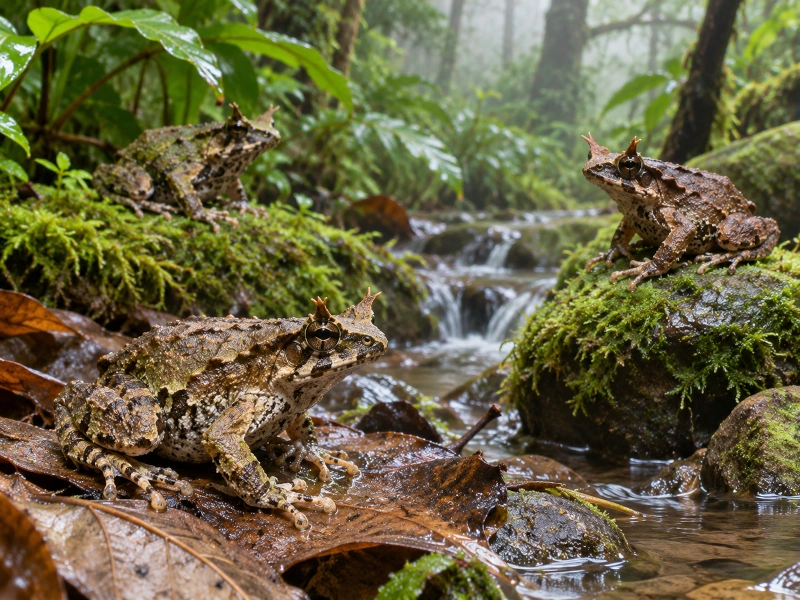
Scientists from the University of Delhi and Harvard University have discovered five previously undescribed species of diminutive horned frogs in Arunachal Pradesh, revealing previously undocumented amphibian diversity in the Eastern Himalayas. The discoveries resulted from five years of field investigations and were published in the scientific journal Royal Society Open Science on 11 November 2026.
The newly identified species belong to the genus Jingophrys, a group of small frogs characterised by distinctive projections of skin around their eyes that resemble tiny horns. The findings significantly expand scientific knowledge of this relatively poorly studied group of amphibians and highlight the importance of the Eastern Himalayas as a centre of biodiversity and evolutionary diversification.
The research was led by Dr Sonali Garg, who conducted the study while serving as a Biodiversity Postdoctoral Fellow at Harvard University’s Museum of Comparative Zoology. The research team included Professor S. D. Biju of the University of Delhi, Tage Tajo, K. Radhakrishna Upadhyaya and Professor James Hanken of Harvard University.
Five New Species Identified
The researchers identified five previously unknown species during extensive field investigations across the mountainous landscapes of Arunachal Pradesh. The newly described amphibians are Jingophrys taniitatii, Jingophrys tanogogo, Jingophrys siangensis, Jingophrys hrdy and Jingophrys wularsoni.
The Tanii Horned Frog, Jingophrys taniitatii, was named in recognition of the Tanii indigenous community of Arunachal Pradesh. Its name also incorporates a word from the Apatani language referring to frogs and toads, acknowledging the cultural and linguistic heritage of the region.
The Siang Horned Frog, Jingophrys siangensis, takes its name from the Siang region of Arunachal Pradesh, where the species was discovered. The names Jingophrys hrdy and Jingophrys wularsoni recognise individuals associated with support for herpetological research and conservation.
The fifth species, Jingophrys tanogogo, has attracted particular scientific attention because of its unusual feeding behaviour. Its name is derived from the Apatani word associated with snails, reflecting a dietary characteristic that distinguishes it from previously studied members of the frog family.
India’s First Documented Snail-Eating Frog
One of the most important findings of the research concerns Jingophrys tanogogo, which scientists identified as the first frog species in India with documented snail-eating behaviour.
Using advanced three-dimensional micro-computed tomography imaging, researchers examined the internal structures of the frog and discovered intact land-snail shells within its digestive tract. The finding provided direct evidence that the species consumes land snails, including their shells.
The observation is particularly significant because it represents the first documented instance of this feeding behaviour within the family Megophryidae, to which the newly discovered frogs belong.
Although frogs consume a wide variety of invertebrates, their feeding preferences vary considerably between species. The discovery of snail consumption in Jingophrys tanogogo provides new information about dietary specialisation among horned frogs.
The finding demonstrates how the discovery of previously unknown species can reveal ecological behaviours that have not been documented within an entire group of animals.
Five Years of Research in Remote Himalayan Forests
The discoveries resulted from approximately five years of field investigations across the Eastern Himalayan region. Researchers surveyed remote mountainous forests, often working under difficult conditions to locate amphibians that remain concealed for much of the year.
Several of the newly identified species are nocturnal and secretive, making them difficult to observe during conventional daytime wildlife surveys. Some are encountered primarily during relatively short breeding periods, further restricting opportunities for scientific documentation.
The research team conducted field investigations under challenging weather conditions, including temperatures below freezing in mountainous locations. The scientists relied on detailed field observations, specimen examination and advanced laboratory analysis to distinguish the newly discovered species from previously described frogs.
The investigation combined morphological comparisons, molecular genetic analysis and examination of acoustic characteristics associated with frog calls. These methods helped establish differences between populations that might otherwise have appeared similar because of their small size and subdued physical characteristics.
The research highlights the importance of combining long-term field exploration with modern scientific techniques to document species that remain hidden in remote and biologically complex habitats.
Eastern Himalayas as a Centre of Amphibian Evolution
Beyond identifying new species, the study provides insights into the evolutionary history of horned frogs in the Eastern Himalayas.
The researchers used DNA-based analysis to investigate relationships among members of the genus Jingophrys and examine how the group diversified over time.
Their findings indicate that the evolutionary diversification of these frogs was associated with major geological and climatic developments, including the uplift of the Himalayan mountain ranges and changes in the Asian monsoon system millions of years ago.
The formation of mountain valleys, changing elevations and differences in rainfall created varied environmental conditions across the region. Such geographical and climatic changes can influence the separation of animal populations and contribute to the evolution of distinct species.
The discoveries therefore provide evidence of the role played by the Himalayan landscape in shaping amphibian biodiversity.
The study strengthens the scientific understanding of the Eastern Himalayas as an important region for the evolution and diversification of amphibian species.
Indigenous Communities Contribute to Scientific Discoveries
The researchers acknowledged the important contribution of indigenous communities in Arunachal Pradesh, whose local knowledge and field assistance supported scientific investigations in remote forest landscapes.
Community members helped researchers navigate difficult terrain and identify areas suitable for amphibian surveys. Their familiarity with local environments provided valuable assistance during investigations involving secretive species and challenging field conditions.
The decision to name some of the newly discovered frogs after indigenous communities, local languages and geographical regions reflects the relationship between scientific research and the cultural heritage of Arunachal Pradesh.
The recognition of the Tanii community and the incorporation of Apatani words into scientific names demonstrate how local knowledge and cultural identity can be acknowledged in biodiversity research.
Such collaboration is particularly valuable in remote regions where scientific exploration depends upon an understanding of local geography, seasonal conditions and natural habitats.
Conservation Significance of the Discovery
The identification of five new amphibian species highlights the importance of continued biodiversity research in the Eastern Himalayas, where many forest habitats remain comparatively underexplored.
Amphibians are important components of forest ecosystems, contributing to food webs and participating in the regulation of invertebrate populations. Many species also respond sensitively to changes in moisture, temperature and habitat conditions, making them relevant to ecological monitoring.
The newly described Jingophrys species inhabit environments that require further study to establish their distribution, population characteristics and ecological requirements.
Researchers have emphasised the need for additional investigations to understand the biology and conservation needs of these frogs. Their secretive behaviour and restricted periods of activity make comprehensive population assessments particularly challenging.
The discovery underscores the importance of protecting the natural habitats of the Eastern Himalayas while strengthening scientific surveys of lesser-known amphibian species.
A Major Addition to India’s Amphibian Biodiversity
The discovery of five new horned frog species represents a significant contribution to India’s growing record of amphibian diversity. It also demonstrates that even relatively well-defined groups of animals may contain previously unrecognised species, particularly in geographically complex and insufficiently surveyed regions.
The identification of Jingophrys tanogogo and its snail-eating behaviour adds an important ecological dimension to the research, revealing a feeding characteristic not previously documented in the frog family Megophryidae.
The study also highlights the value of collaboration between Indian and international scientific institutions, combining field expertise, genetic research, advanced imaging and the contributions of indigenous communities.
The findings reinforce Arunachal Pradesh’s importance as a centre of biological diversity and demonstrate the continuing potential for scientific discoveries in India’s Himalayan ecosystems.
Through sustained research, habitat conservation and cooperation with local communities, studies of this nature can contribute to a more comprehensive understanding of India’s natural heritage and support the protection of its remarkable amphibian diversity.
You may also like
-
Rare Spotted Flycatcher Recorded in Gadag, Reported as North Karnataka’s First Sighting
-
Bar-headed Geese Return to Maharashtra’s Nandur Madhmeshwar Wildlife Sanctuary
-
Three Butterfly Species Recorded for First Time in Kerala’s Silent Valley National Park
-
Rare Willow Warbler Recorded for First Time in Karnataka at Mangaluru Grasslands
-
Scientists Discover New Flowering Plant Disporopsis crispata in Arunachal Pradesh, First Record of Genus in India
