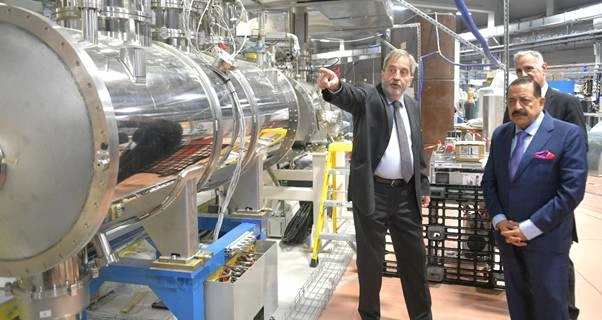
India has announced an investment commitment of more than €7 million towards the development of next-generation synchrotron research facilities under the Elettra 2.0 programme in Italy. The investment, spread over five years beginning in the financial year 2026–27, will support the redevelopment of advanced scientific beamlines and human resource development, strengthening research cooperation between India and Italy in physics, chemistry, advanced materials and structural biology.
Union Minister of State (Independent Charge) for Science and Technology and Earth Sciences, Dr. Jitendra Singh, announced India’s commitment during his visit to Elettra Sincrotrone Trieste in Italy on November 13, 2026. The initiative marks a new phase in the scientific partnership between the two countries, building upon more than 25 years of collaboration involving Indian research institutions and the Italian synchrotron facility.
India will participate as a co-partner in upgrading existing research infrastructure under the Elettra 2.0 programme. The planned facilities will provide advanced experimental capabilities for Indian scientists and researchers from other countries, supporting investigations into the structure, composition and properties of materials at microscopic and atomic scales.
Elettra 2.0 to Strengthen Advanced Scientific Research
Elettra Sincrotrone Trieste is an international multidisciplinary research facility in Italy that uses synchrotron radiation to investigate the properties of materials. Synchrotron facilities accelerate electrons to high energies and use the resulting radiation to generate highly intense beams of light, including X-rays, which are directed towards specialised experimental stations known as beamlines.
These beamlines enable researchers to examine the atomic and molecular structures of materials, study chemical processes and investigate biological systems with a level of detail that is difficult to achieve using conventional laboratory instruments. Synchrotron radiation is widely used in materials science, structural biology, chemistry, physics and several other scientific disciplines.
The Elettra 2.0 programme involves upgrading the existing synchrotron infrastructure to provide improved experimental capabilities. India’s participation will focus on the redevelopment of beamlines associated with its longstanding scientific collaboration with Elettra, allowing researchers to undertake more specialised investigations using advanced X-ray techniques.
Two New Beamlines to Replace Existing Research Facilities
Under the Elettra 2.0 programme, the existing India-centric XRD2 and Xpress beamlines will be decommissioned and replaced with two advanced research beamlines designed to support specialised scientific experiments.
The first facility, designated micro-XRD (μXRD), will be a microfocus beamline for macromolecular crystallography. This technique is used to determine the three-dimensional structures of biological molecules, particularly proteins and other macromolecular complexes, by analysing the diffraction patterns produced when X-rays interact with crystalline samples.
The microfocus capability will allow researchers to investigate small crystalline samples and support structural studies of biologically important molecules. Such research contributes to understanding molecular interactions, protein structures and biological processes, providing fundamental scientific information relevant to structural biology and related disciplines.
The second facility, Xpress Superbend (Xpress-SB), will be developed for high-pressure diffraction experiments. This beamline will enable researchers to examine how the crystal structures and physical properties of materials change when subjected to elevated pressures.
High-pressure diffraction is particularly important for studying the behaviour of materials under extreme conditions. It is used in condensed matter physics, materials science, mineral physics and related fields to investigate structural transformations and the properties of substances exposed to intense pressure.
The two proposed beamlines will replace India’s existing collaborative research infrastructure at Elettra while introducing enhanced capabilities for specialised scientific investigations.
India-Elettra Scientific Collaboration Spans More Than 25 Years
India’s association with Elettra Sincrotrone Trieste dates back to 1998, when Indian research groups began conducting experiments at the Italian facility. Over the subsequent decades, the collaboration developed into an established scientific partnership involving Indian universities, research laboratories and specialised scientific institutions.
According to the Department of Science and Technology, India is currently the second-largest user of Elettra after Italy. Indian research groups have submitted more than 1,100 experimental proposals to the facility, reflecting sustained demand for access to advanced synchrotron research infrastructure.
The participation of Indian researchers has also been supported through dedicated scientific cooperation arrangements between the two countries. Approximately 50 to 60 Indian scientists have been visiting Elettra annually to conduct experimental investigations using its specialised beamlines.
The longstanding collaboration has enabled Indian researchers to access sophisticated instrumentation and experimental capabilities while participating in international scientific programmes involving advanced materials, molecular structures and other areas of fundamental research.
Earlier Indian Investment Supported Two Synchrotron Beamlines
The Department of Science and Technology had previously collaborated with the Italian side in establishing two sophisticated diffraction beamlines at Elettra, designated XRD2 and XPRESS.
India contributed approximately ₹22 crore towards the construction of these facilities, which were jointly inaugurated on October 20, 2016, during the visit of the Secretary of the Department of Science and Technology to Italy.
The XRD2 beamline was developed to support crystallographic investigations, while XPRESS provided experimental capabilities for high-pressure diffraction studies. Both facilities became important components of India’s research engagement with the Italian synchrotron centre.
Since their commissioning, the beamlines have been used by Indian scientists undertaking experiments requiring advanced X-ray diffraction techniques. Their development established a foundation for the next phase of cooperation under Elettra 2.0.
The proposed redevelopment will build upon this earlier investment by replacing the existing facilities with advanced beamlines suited to the upgraded synchrotron infrastructure.
Department of Science and Technology Supports Indian Researchers
The Department of Science and Technology has facilitated Indian researchers’ access to Elettra through the Indo-Italian Executive Programme of Cooperation, which supports scientific exchanges and experimental research at the facility.
Under the Executive Programme of Cooperation for 2022–2024, the department sanctioned ₹2 crore over three years to support visits by Indian scientists. The arrangement provided for approximately 50 researchers annually, with 25 visits during each semester, to conduct experiments using allocated beamtime at Elettra.
The programme helped researchers from Indian institutions undertake specialised experiments without requiring equivalent large-scale infrastructure at their home laboratories.
The subsequent Executive Programme of Cooperation for 2025–2027 also includes a proposal to support Indian researchers conducting experiments at Elettra. The proposed financial allocation under this arrangement is ₹1.5 crore over three years.
These programmes complement India’s investments in collaborative research infrastructure by supporting scientific mobility, experimental access and the development of expertise among Indian researchers.
India Reaffirms Participation in Elettra 2.0
The Department of Science and Technology had already conveyed its agreement to participate in the redevelopment of India-centric beamlines under Elettra 2.0, and a Letter of Intent had been signed to formalise the proposed collaboration.
During his visit to Trieste on November 13, Dr. Jitendra Singh reaffirmed India’s participation by announcing an investment commitment exceeding €7 million over five years beginning in 2026–27.
The commitment covers advanced research infrastructure development and human resource capacity building. It represents a continuation of India’s participation in the Italian facility rather than the establishment of an entirely new scientific relationship.
The investment will support the replacement of existing beamlines, the development of enhanced experimental capabilities and the continuation of research cooperation between Indian institutions and Elettra.
Expanding India’s Access to Global Research Infrastructure
Large synchrotron facilities require substantial capital investment, specialised engineering capabilities and highly trained scientific personnel. International cooperation provides researchers with access to sophisticated experimental infrastructure while allowing participating countries to share scientific expertise and development costs.
India’s involvement in Elettra 2.0 reflects this collaborative approach to advanced scientific research. By investing in upgraded beamlines, the country is strengthening its participation in international experimental programmes that support investigations across multiple scientific disciplines.
The redevelopment is particularly relevant to structural biology, high-pressure physics and advanced materials research, where access to high-intensity X-ray beams and specialised experimental instruments is essential for many investigations.
The programme also includes a human resource development component, supporting the broader objective of strengthening scientific expertise and international research cooperation.
India’s commitment of more than €7 million to Elettra 2.0, announced on November 13 and detailed by the Ministry of Science and Technology on November 14, 2026, represents a further step in the longstanding scientific partnership between India and Italy. The investment will support the planned development of advanced synchrotron beamlines while maintaining opportunities for Indian researchers to participate in specialised scientific investigations at the Trieste facility.
You may also like
-
Vibhīṣaṇa’s Defection: Rāma’s Decision to Grant Asylum to an Enemy Prince
-
Indian Scientists Discover New Deep-Sea Bramble Shark Species off Kerala Coast
-
Indian Armed Forces Contingent Arrives in Sri Lanka for 12th Edition of Exercise Mitra Shakti
-
IIT Madras Identifies Unique Microbial Signature in Chennai Metro, Reveals New Insights into Urban Microbiology
-
India and Indonesia Strengthen Counter-Terrorism Cooperation at Seventh Joint Working Group Meeting
