Rāmāyaṇa Diplomacy Series | Diplomatic Missions, Strategic Communication and Political Leadership
Primary Text: Vālmīki Rāmāyaṇa — Yuddha Kāṇḍa, Sarga 41
Diplomatic negotiations do not always fail because the opposing parties lack opportunities for communication or because their differences are impossible to resolve. Sometimes, diplomacy fails because a political leader refuses to acknowledge the circumstances in which negotiations are taking place. When personal pride becomes inseparable from political authority, accepting a reasonable settlement may appear more threatening to a ruler than continuing a conflict that could destroy the state itself. The inability to distinguish personal prestige from national interest can transform an avoidable confrontation into a devastating war.
The encounter between Aṅgada and Rāvaṇa in the Yuddha Kāṇḍa of the Vālmīki Rāmāyaṇa presents a striking illustration of this failure of political judgement. By the time Aṅgada enters Rāvaṇa’s court, the strategic situation has changed fundamentally. Śrī Rāma has crossed the ocean, assembled a powerful military coalition, secured the support of Vibhīṣaṇa and positioned his forces around Laṅkā. Rāvaṇa no longer faces a distant adversary whose capabilities he can dismiss. He confronts an organised army prepared for battle outside his capital, with the military consequences of continued resistance becoming increasingly apparent.
Despite possessing the military capability to begin the assault, Rāma chooses to send another messenger before the decisive fighting commences. Aṅgada is entrusted with communicating Rāma’s position directly to Rāvaṇa, demanding the restoration of Sītā and making the consequences of continued defiance unmistakable. The mission represents a final diplomatic communication from a leader whose demands are supported by credible military power and whose willingness to act has already been demonstrated through the successful crossing of the ocean.
Rāvaṇa‘s response reveals the central diplomatic failure. Rather than examining the message, reassessing his strategic position or considering the consequences for Laṅkā, he reacts with anger and orders the envoy’s seizure and death. His conduct transforms a final opportunity to avoid military confrontation into another demonstration of the arrogance and miscalculation that have brought his kingdom to the brink of destruction. The episode offers enduring lessons concerning strategic communication, coercive diplomacy, political leadership, the treatment of envoys and the dangers of refusing to recognise reality.
Strategic Background: Laṅkā Faces a New Military Reality
The diplomatic circumstances preceding Aṅgada’s mission differ considerably from those surrounding Hanumān’s earlier visit to Laṅkā. During Hanumān’s mission, Rāma’s forces were still separated from the island kingdom by the ocean, allowing Rāvaṇa to place considerable confidence in Laṅkā’s geographical isolation and formidable defensive arrangements. The possibility of invasion existed, but the military challenge had not yet materialised at the gates of the capital. Rāvaṇa could continue to believe that distance, fortifications and the strength of his warriors would prevent an opposing army from reaching his kingdom.
Those assumptions have been decisively challenged by the time Aṅgada arrives. Rāma’s coalition has crossed the ocean through an extraordinary engineering effort, established positions around Laṅkā and prepared for an assault against the city’s principal defensive approaches. The geographical barrier that had previously protected Rāvaṇa’s kingdom has been overcome, while the military coalition confronting him has demonstrated organisation, determination and the capacity to execute an exceptionally difficult operation. The threatened invasion is no longer a distant possibility but an immediate military reality.
Vālmīki describes the deployment of Rāma’s forces around the principal gates of Laṅkā, demonstrating the systematic preparation preceding the confrontation. Nīla, accompanied by Mainda and Dvivida, takes position near the eastern entrance, while Aṅgada and his commanders occupy the southern approaches. Hanumān is stationed near the western gate, and Rāma, accompanied by Lakṣmaṇa, confronts the northern entrance associated with Rāvaṇa’s principal defences. Sugrīva remains positioned with the central forces, maintaining his role in the wider military deployment. The arrangement demonstrates that Rāma’s coalition has moved beyond the stage of preparation and possesses the ability to initiate coordinated military operations.
For Rāvaṇa, these developments create an urgent strategic dilemma. Continuing to resist would mean confronting an organised coalition that has already overcome Laṅkā’s most important natural defensive barrier, while accepting Rāma’s demand would require reversing the decision that originally produced the crisis. The situation demands a realistic assessment of military capabilities, political objectives and the likely consequences of each available course of action. Instead, Rāvaṇa remains attached to the assumptions and personal commitments that have shaped his earlier decisions.
The importance of this strategic background lies in the relationship between changing circumstances and political judgement. Effective leadership requires the ability to recognise when previous assumptions are no longer valid and to revise policies accordingly. A ruler may possess considerable military strength and political authority, but these advantages become liabilities when they encourage excessive confidence and prevent an objective assessment of emerging threats. Rāvaṇa’s failure begins with his unwillingness to acknowledge that the strategic balance surrounding Laṅkā has changed.
Rāma’s Leadership: Consultation Before Confrontation
An important feature of the episode appears before Aṅgada is dispatched, when Rāma demonstrates that military courage must remain subject to consultation, judgement and political responsibility. At the beginning of Sarga 41, Rāma addresses Sugrīva following the latter’s impulsive confrontation with Rāvaṇa. Although Sugrīva has displayed extraordinary bravery, Rāma criticises him for acting without consultation and unnecessarily exposing himself to danger. The criticism establishes an important distinction between personal courage and the responsibilities of political leadership.
Vālmīki expresses Rāma’s warning through the following verse:
असम्मन्त्र्य मया सार्धं तदिदं साहसं कृतम् ।
एवं साहसयुक्तानि न कुर्वन्ति जनेश्वराः ॥
Asammantrya mayā sārdhaṃ tad idaṃ sāhasaṃ kṛtam ।
Evaṃ sāhasayuktāni na kurvanti janeśvarāḥ ॥
Yuddha Kāṇḍa 6.41.2
The verse conveys Rāma’s criticism that Sugrīva has undertaken a dangerous action without consulting him and that rulers should not act through such recklessness. The warning is significant because Sugrīva is not merely an individual warrior seeking personal distinction. He is the ruler of Kiṣkindhā, the commander of an important allied force and an indispensable participant in the coalition assembled against Laṅkā. His personal decisions therefore carry consequences extending far beyond his own safety.
Rāma’s response reflects an understanding that the responsibilities of a ruler differ from those of an individual combatant. A warrior may demonstrate exceptional courage by confronting an enemy, but a sovereign or military commander must consider how an individual action affects the wider political and strategic situation. Unnecessary risks undertaken for personal glory can endanger alliances, undermine military planning and create consequences that cannot easily be reversed. Rāma’s criticism establishes consultation and collective responsibility as essential requirements of effective leadership.
This principle becomes particularly relevant when Rāma subsequently considers his next action. Rather than allowing anger, excitement or the confidence generated by military deployment to determine his decision, he consults his advisers and acts with Vibhīṣaṇa’s concurrence before selecting Aṅgada as his envoy. The narrative thus presents a deliberate contrast between the conduct of the two opposing rulers. Rāma subjects military power to consultation and political judgement, while Rāvaṇa responds to an unwelcome diplomatic communication through anger and impulsive coercion.
Why Rāma Selects Aṅgada as His Diplomatic Envoy
Aṅgada’s selection as Rāma’s envoy carries political significance beyond his physical strength and reputation as a formidable warrior. As the son of Vāli, the former ruler of Kiṣkindhā, Aṅgada occupies an important position within the Vānara leadership and represents continuity between the kingdom’s previous ruling family and its present political arrangement under Sugrīva. His participation in Rāma’s campaign demonstrates that the alliance is supported by prominent figures across Kiṣkindhā’s political establishment rather than resting exclusively upon a personal agreement between two rulers.
The appointment also conveys the internal cohesion of Rāma’s coalition. The son of Vāli, whose conflict with Sugrīva had previously divided Kiṣkindhā, now serves as an important commander and diplomatic representative within the same alliance. His mission therefore symbolises the ability of Rāma’s coalition to integrate former political divisions into a common strategic purpose. For Rāvaṇa, the presence of Aṅgada communicates that the opposing alliance possesses political depth, military unity and a leadership structure capable of acting collectively.
Aṅgada’s physical strength is another important consideration, particularly because the mission requires him to enter the court of a hostile ruler. He possesses the courage and capability to confront intimidation without compromising his responsibilities as an envoy. Nevertheless, his diplomatic authority does not arise from his personal strength. It derives from his appointment by Rāma, whose political position he has been instructed to communicate. This distinction is fundamental to diplomatic representation because an envoy acts on behalf of the authority that commissions the mission rather than exercising an independent right to determine policy.
Vālmīki emphasises Aṅgada’s fidelity to his instructions when describing his conduct before Rāvaṇa. The envoy delivers Rāma’s message without altering its substance, demonstrating that courage and discipline must operate together in effective diplomacy. A representative who modifies a warning to satisfy personal preferences, impress an audience or avoid discomfort risks changing the policy of the authority he represents. Aṅgada’s task is therefore to ensure that Rāvaṇa understands Rāma’s position accurately and without ambiguity.
The Final Diplomatic Message: A Clear Demand and Defined Consequences
Rāma’s message to Rāvaṇa is not an open-ended invitation to negotiate every aspect of the dispute. It is a final demand delivered after previous opportunities for peaceful resolution have failed and after the opposing military forces have reached Laṅkā. The essential requirement remains the restoration of Sītā, whose abduction has created the confrontation. Rāvaṇa is informed that continued refusal will bring military consequences, while compliance offers an alternative to the destruction that war may produce.
The message also challenges the political assumptions underlying Rāvaṇa’s resistance. His previous military victories, extraordinary personal powers and confidence in Laṅkā’s fortifications cannot indefinitely protect him from the consequences of his actions. Rāma’s coalition has already demonstrated that the ocean and the kingdom’s geographical isolation are insufficient barriers against a determined adversary. The warning is therefore grounded in the existing military situation rather than in an uncertain promise of future retaliation.
Rāma’s declaration is expressed through the following verse:
अराक्षसमिमं लोकं कर्तास्मि निशितैः शरैः ।
न चेत् शरणमभ्येषि मामुपादाय मैथिलीम् ॥
Arākṣasam imaṃ lokaṃ kartāsmi niśitaiḥ śaraiḥ ।
Na cet śaraṇam abhyeṣi mām upādāya Maithilīm ॥
Yuddha Kāṇḍa 6.41.68
The verse communicates Rāma’s warning that if Rāvaṇa does not seek his protection by returning Sītā, he will employ his weapons against the Rākṣasa forces. The condition is explicit, and the consequences of rejection are presented without ambiguity. Rāvaṇa is not left to speculate about the action required to avoid the impending confrontation or the response that continued defiance will provoke.
This distinction is important when examining the encounter as an example of diplomatic practice. Negotiation ordinarily allows the parties to exchange proposals and explore mutually acceptable arrangements, while an ultimatum communicates a required action together with the consequences of non-compliance. Aṅgada’s mission belongs predominantly to the latter category. Its purpose is not to discover what Rāvaṇa might offer in exchange for retaining Sītā, but to communicate that her restoration remains the essential condition for avoiding military action.
Credible Military Power and the Effectiveness of Diplomatic Warnings
Diplomatic warnings are frequently ineffective when the receiving party believes that the sender lacks the capability or determination to enforce them. Political leaders may dismiss threats as rhetorical gestures, particularly when the opposing authority has not demonstrated an ability to translate its declarations into practical action. The credibility of a warning therefore depends partly upon whether the military and political circumstances support the consequences being communicated.
By the time Aṅgada arrives in Laṅkā, Rāma has already established the credibility of his military position. His army surrounds the capital, the ocean crossing has demonstrated exceptional engineering and organisational capabilities, and the alliance with Sugrīva provides a substantial military force. Vibhīṣaṇa’s participation further strengthens the coalition by contributing knowledge of Laṅkā’s political and strategic circumstances. These developments collectively demonstrate that the coalition possesses both the intention and the ability to undertake military operations.
Aṅgada consequently does not need to convince Rāvaṇa that Rāma might eventually become a serious adversary. The opposing army is already present, and the threatened military response can be initiated without requiring another major strategic preparation. This gives the diplomatic message a degree of credibility that would have been absent if Rāma’s forces remained separated from Laṅkā by the ocean.
The mission therefore illustrates coercive diplomacy, in which credible military pressure is employed to encourage a political decision without necessarily requiring the immediate use of force. Such diplomacy depends upon a clear demand, a believable capacity for enforcement and an identifiable alternative through which the receiving party can avoid the threatened consequences. Rāma’s message contains these elements, but its effectiveness ultimately depends upon Rāvaṇa’s willingness to evaluate them.
Military strength can make a warning credible, but it cannot compel a ruler to interpret that warning rationally. When political judgement becomes subordinate to pride, even overwhelming evidence of danger may fail to produce reconsideration. Rāvaṇa’s conduct reveals this limitation by demonstrating that the credibility of a threat does not guarantee the acceptance of a reasonable settlement.
Aṅgada Enters Rāvaṇa’s Court: Authority Without Submission
Aṅgada enters Laṅkā and proceeds to Rāvaṇa’s palace, where the ruler is seated among his ministers and attendants. The setting is politically significant because the envoy is not communicating privately with an isolated individual. He is addressing the sovereign authority of Laṅkā in the presence of the establishment that supports and implements its decisions. The message is therefore delivered before the ruler and those responsible for advising him, creating an opportunity for the court to consider the consequences of continued resistance.
Before conveying Rāma’s warning, Aṅgada identifies himself and the political authority he represents:
दूतोऽहं कोसलेन्द्रस्य रामस्याक्लिष्टकर्मणः ।
वालिपुत्रोऽङ्गदो नाम यदि ते श्रोत्रमागतः ॥
Dūto’haṃ Kosalendrasya Rāmasyākliṣṭakarmaṇaḥ ।
Vāliputro’ṅgado nāma yadi te śrotram āgataḥ ॥
Yuddha Kāṇḍa 6.41.78
Aṅgada declares that he is the son of Vāli and has come as the messenger of Rāma, the ruler of Kosala. This identification establishes his personal identity, clarifies the authority under which he has been dispatched and distinguishes his diplomatic role from that of an independent warrior entering the court for a personal confrontation.
The declaration also demonstrates that diplomatic representation does not require personal submission to the receiving ruler. Aṅgada remains respectful of the formal purpose of his mission without allowing intimidation to compromise the message he has been entrusted to deliver. His authority comes from his principal, while his personal courage enables him to communicate that authority confidently in a hostile environment.
The narrative emphasises that Aṅgada faithfully conveys Rāma’s words rather than altering the message to satisfy the expectations of Rāvaṇa’s court. This conduct reflects a fundamental principle of diplomatic representation: an envoy must communicate the position of the sending authority accurately, regardless of whether that position is welcomed by the recipient. Aṅgada’s effectiveness lies not in creating an independent political proposal but in ensuring that Rāvaṇa receives a clear and authoritative statement of the terms and consequences before him.
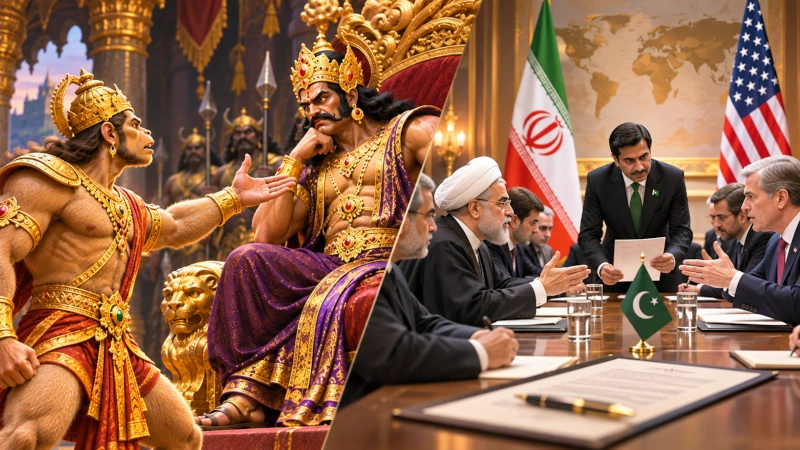
Modern-Day Parallel: Pakistan’s Mediation Between Iran and the United States — When Diplomatic Language Changes
The diplomatic exchanges between Iran and the United States during the Middle East conflict of 2026 provide a contemporary example of the importance of precision, authority and transparency in diplomatic communication. Pakistan played an intermediary role between Washington and Tehran, transmitting proposals and attempting to reconcile opposing positions during negotiations intended to secure a ceasefire and establish the basis for a lasting settlement.
In early April 2026, the United States and Iran remained deeply divided over the conditions required to end hostilities. Their disagreements included Iran’s nuclear programme, the reopening of the Strait of Hormuz, economic sanctions and the sequencing of military and diplomatic commitments. Pakistan emerged as an important communication channel, carrying messages between the two governments while attempting to prevent the collapse of negotiations.
According to a report published by The Times of Israel on April 9, citing two government officials familiar with the negotiations, Pakistan prepared a revised bridging proposal after Washington rejected an earlier Iranian ten-point framework. The Pakistani proposal reportedly retained several elements of Iran’s position but modified the language to make the terms more acceptable to the United States. Both governments subsequently accepted the revised framework as a basis for a temporary ceasefire.
A complication arose when Iran publicly presented a ten-point proposal that, according to the officials cited in the report, differed from the bridging document accepted during the negotiations. The published version reportedly resembled Iran’s earlier position more closely than the revised framework prepared by Pakistan. This created uncertainty in public accounts of precisely which terms had formed the basis of the diplomatic understanding.
The distinction between transmitting an authorised message and developing an alternative proposal is central to understanding the episode. A diplomatic envoy entrusted with delivering the position of a government is expected to communicate that position accurately, without independently changing its substance. A mediator, however, may propose different formulations, suggest compromises and develop bridging documents intended to reconcile the positions of opposing parties. Such modifications are not inherently improper when they are transparent to, and accepted by, the governments concerned.
Revised language reportedly created substantial disagreements over the interpretation and implementation of the wider settlement. Reuters reported in June that disagreements had sometimes concerned individual words in draft agreements, demonstrating how seemingly minor differences in diplomatic language can carry significant political consequences.
The comparison with Aṅgada’s mission in the Vālmīki Rāmāyaṇa lies in the distinction between a representative faithfully communicating an established position and an intermediary attempting to formulate an agreement between opposing authorities. Aṅgada does not independently revise Rāma’s demands or invent alternative conditions. He identifies himself as Rāma’s messenger and communicates the instructions entrusted to him without changing their substance.
The episode demonstrates why diplomatic legitimacy depends upon every party understanding which proposals are original demands, which are intermediary suggestions and which have received formal acceptance.
The broader lesson is that successful diplomacy requires not only the ability to bring opposing sides together but also the precise communication of what each side has agreed to accept. A proposed settlement can become vulnerable when governments attach different meanings to the same language or publicly describe their commitments in incompatible terms.
Aṅgada’s conduct illustrates the discipline required of an envoy carrying an established message. The Iran–United States negotiations demonstrate the additional responsibility placed upon mediators who seek to reconcile competing demands without creating uncertainty about the commitments of the parties involved.
In both situations, diplomatic credibility ultimately depends upon fidelity to authorised positions, clarity of communication and the distinction between conveying a message and negotiating a new agreement.
Rāvaṇa’s Central Failure: Treating an Unwelcome Message as an Insult
The decisive diplomatic failure occurs when Rāvaṇa reacts to Aṅgada’s warning. Instead of examining the military situation, considering the demand or exploring the possibility of compliance, he becomes enraged by the envoy’s words. The ruler’s immediate response is shaped by the humiliation of being challenged rather than by the strategic implications of the warning.
Vālmīki records Rāvaṇa’s reaction through the following verse:
ततः सरोषताम्राक्षः शशास सचिवांस्तदा ।
गृह्यतामेष दुर्मेधा वध्यतामिति चासकृत् ॥
Tataḥ saroṣatāmrākṣaḥ śaśāsa sacivāṃs tadā ।
Gṛhyatām eṣa durmedhā vadhyatām iti cāsakṛt ॥
Yuddha Kāṇḍa 6.41.84
The verse describes Rāvaṇa, his eyes reddened by anger, repeatedly commanding his attendants to seize and kill the envoy. His reaction demonstrates a profound failure to distinguish the content of a diplomatic communication from the emotional discomfort created by receiving it. Aṅgada’s message provides information about Rāma’s intentions, the military consequences of continued refusal and the possibility of avoiding war. These are matters requiring careful consideration by a ruler facing an immediate threat to his kingdom.
Rāvaṇa instead interprets the warning as an attack upon his personal authority. The distinction between an unwelcome message and an insult disappears, while the importance of understanding the adversary’s position is replaced by the desire to punish the individual who communicates it. His anger does not remove the army surrounding Laṅkā, weaken Rāma’s coalition or restore the defensive advantages that have already been overcome. It merely prevents him from responding intelligently to the circumstances confronting his kingdom.
The episode illustrates a recurring danger in political leadership. When rulers begin treating criticism as disloyalty, disagreement as hostility and negotiation as weakness, their ability to receive accurate information deteriorates. Advisers and diplomatic representatives may still communicate facts, but those facts lose their practical value when the leadership evaluates them according to personal preference rather than strategic relevance. Rāvaṇa’s conduct demonstrates how the rejection of uncomfortable information can become a direct cause of political and military failure.
Personal Pride and the Interests of the State
Rāvaṇa’s response reveals the danger of allowing the personal interests of a ruler to become indistinguishable from the interests of the state. Returning Sītā would require him to reverse the decision that created the crisis, acknowledge the consequences of his conduct and accept a settlement demanded by an adversary. Such a reversal might damage his personal prestige and undermine his claim to unquestioned authority. Continuing the confrontation, however, exposes Laṅkā, its defenders and its population to the consequences of war.
The fundamental political error lies in assuming that protecting the ruler’s pride is equivalent to protecting the dignity or security of the kingdom. These interests may occasionally coincide, but they are not inherently identical. A compromise that appears humiliating to an individual ruler may preserve the state, while a decision that temporarily protects personal prestige may produce irreversible destruction. Responsible political leadership requires the ability to distinguish between these outcomes and to prioritise the long-term welfare of the political community.
Rāvaṇa’s conduct demonstrates the consequences of failing to make that distinction. His determination to retain Sītā no longer serves any plausible requirement of Laṅkā’s security, yet abandoning that position would require him to acknowledge that his earlier decision was mistaken. The original objective becomes inseparable from his personal sense of authority, preventing him from reassessing whether continuing the conflict serves the interests of his kingdom.
The episode therefore raises an important question of statecraft: whose interests are protected when a ruler rejects a settlement? If the principal objective is the preservation of personal infallibility, diplomacy loses its ability to prevent unnecessary conflict. The state becomes increasingly vulnerable to decisions made for the psychological security of its ruler rather than for its own survival.
The Failure of Advisers and the Dangers of Political Isolation
Rāvaṇa’s rejection of Aṅgada’s message must also be understood within the wider political environment of his court. A ruler ordinarily possesses access to ministers, military commanders, advisers and officials capable of presenting alternative assessments of a crisis. These individuals can identify dangers, question assumptions and recommend changes in policy when the circumstances require them. Their effectiveness, however, depends upon whether the ruler is willing to listen to advice that contradicts his preferences.
Earlier episodes of the Rāmāyaṇa demonstrate that Rāvaṇa has already received warnings concerning the consequences of his actions. Vibhīṣaṇa, in particular, urges a course that would avoid the destruction of Laṅkā, but his counsel is rejected. His subsequent departure and decision to join Rāma represent both a political loss and an intelligence disadvantage for Rāvaṇa’s kingdom. A senior figure familiar with Laṅkā’s leadership and internal circumstances has been alienated and has become an adviser to the opposing coalition.
This development illustrates how intolerance of dissent can weaken political and military institutions. When leaders repeatedly punish or reject uncomfortable advice, their advisers may begin to prioritise agreement over accuracy. Officials learn that confirming the ruler’s assumptions is safer than challenging them, while information contradicting established policy may be minimised, delayed or suppressed. Over time, the leadership becomes increasingly insulated from the actual consequences of its decisions.
Aṅgada’s mission demonstrates the ultimate danger of this political isolation. Even when the opposing leader communicates his intentions directly, Rāvaṇa remains unwilling to undertake a meaningful reassessment. The problem is no longer a lack of information, because the relevant military and diplomatic facts are available. It is the absence of a functioning decision-making environment in which those facts can challenge the ruler’s established beliefs. The court possesses political authority, but its capacity for strategic correction has been severely weakened.
The Attempt to Seize an Envoy: A Breakdown of Diplomatic Restraint
Rāvaṇa’s order to seize and kill Aṅgada marks a further deterioration in diplomatic conduct. An envoy occupies a distinctive position in relations between opposing political authorities because he communicates the instructions and intentions of the ruler who has sent him. Although the message may be threatening, unpleasant or politically unacceptable, the representative remains separate from the substance of the dispute. Punishing an envoy for accurately delivering an official communication undermines the possibility of maintaining communication between adversaries.
The protection of messengers is an important principle within the political and ethical framework of the Rāmāyaṇa. During Hanumān’s earlier appearance before Rāvaṇa, Vibhīṣaṇa argues against killing a messenger and invokes the principles governing the treatment of diplomatic representatives. The episode demonstrates that even hostile relations do not automatically justify the destruction of the channels through which political authorities communicate.
Rāvaṇa’s response to Aṅgada reveals that he has failed to absorb this earlier lesson. His anger again overwhelms the restraint required in diplomatic dealings, and the messenger becomes the target of retaliation for delivering an unwelcome warning. The action is strategically irrational because harming Aṅgada cannot eliminate Rāma’s army or reverse the military circumstances surrounding Laṅkā. It can only destroy another opportunity for communication and intensify the confrontation.
The episode illustrates why diplomatic channels must remain protected even when political relations have deteriorated to the threshold of war. Communication allows adversaries to clarify intentions, communicate conditions and identify opportunities for avoiding escalation. When rulers attack those responsible for carrying messages, they increase the likelihood that future decisions will be made under conditions of uncertainty, anger and mistrust. Rāvaṇa’s attempt to punish Aṅgada therefore represents not strength but a further failure of political judgement.
Aṅgada’s Demonstration of Strength and the Failure of Intimidation
Following Rāvaṇa’s order, his attendants attempt to seize Aṅgada, but the envoy remains in control of the situation. Vālmīki describes how Aṅgada allows four Rākṣasas to grasp him and then leaps into the air, carrying them with him. The force of his movement throws the attackers to the ground, demonstrating his extraordinary strength in the presence of Rāvaṇa’s court. Aṅgada subsequently ascends the palace roof and damages part of its elevated structure before returning to Rāma’s forces.
The sequence reverses the psychological effect that Rāvaṇa intended to produce. By ordering the seizure of the envoy, Rāvaṇa seeks to reassert authority over an individual who has publicly challenged his position. Instead, the attempted arrest exposes the inability of his attendants to restrain the messenger and demonstrates that intimidation cannot compensate for defective strategic judgement.
Aṅgada’s actions also reinforce the credibility of Rāma’s military coalition. If a single representative can resist the ruler’s immediate security forces, the defenders must consider the capabilities of the much larger army positioned outside the city. The encounter thus exposes the gap between Rāvaṇa’s confidence in his authority and the practical limits of his ability to enforce it.
Nevertheless, Aṅgada’s display of strength is secondary to the diplomatic purpose of his mission. His principal responsibility was to deliver Rāma’s warning faithfully, and that responsibility had already been fulfilled. The subsequent confrontation arises from Rāvaṇa’s attempt to punish the envoy rather than from a failure by Aṅgada to communicate his instructions. The episode therefore demonstrates that coercion against a messenger cannot erase the strategic realities contained in the message.
Why the Diplomatic Mission Fails
The confrontation between Aṅgada and Rāvaṇa reveals several interconnected causes of diplomatic failure. The first is Rāvaṇa’s unwillingness to update his understanding of the strategic situation. The crossing of the ocean, the presence of Rāma’s army around Laṅkā and the defection of Vibhīṣaṇa demonstrate that the circumstances have changed substantially. Yet Rāvaṇa continues to behave as though his authority and defensive advantages remain beyond effective challenge. His refusal to incorporate new information into his calculations prevents him from recognising the increasing costs of continued resistance.
The second cause is the identification of political compromise with personal humiliation. Returning Sītā would require Rāvaṇa to abandon a position to which he has become personally committed, while accepting Rāma’s warning would involve acknowledging the strength and determination of an adversary he has repeatedly underestimated. These considerations affect his pride, but they do not alter the objective interests of Laṅkā. His failure lies in allowing personal prestige to determine decisions with consequences for the entire kingdom.
The third cause is the deterioration of the advisory environment surrounding the ruler. Rāvaṇa has already demonstrated that he is unwilling to accommodate dissenting assessments, and the rejection of Vibhīṣaṇa has weakened the possibility of effective internal correction. By the time Aṅgada arrives, the court lacks the political conditions required to transform an external warning into a serious reassessment of policy. The messenger can communicate the facts, but he cannot compel the receiving leadership to examine them.
The fourth cause is the breakdown of diplomatic restraint. Rāvaṇa’s attempt to seize and kill Aṅgada transforms an official communication into a confrontation between the envoy and the ruler’s attendants. Instead of preserving a channel through which the crisis might still be resolved, he responds with coercion and further damages the possibility of peaceful settlement.
Underlying all these failures is Rāvaṇa’s inability to distinguish between the authority to reject an ultimatum and the capability to survive the consequences of rejection. A ruler may possess the political power to refuse a demand, but that power does not guarantee that the state possesses the resources required to withstand the resulting confrontation. The diplomatic failure in Sarga 41 therefore arises not from ambiguity in Rāma’s message but from Rāvaṇa’s unwillingness to separate personal pride from strategic reality.
Strategic Interpretation: Negotiation Cannot Change Reality
A central lesson of Aṅgada’s mission concerns the relationship between diplomatic communication and the objective circumstances surrounding a conflict. Negotiation can clarify intentions, identify common interests and create agreements that alter political relationships. It cannot, however, make material realities disappear merely because one party refuses to acknowledge them. An army positioned outside a capital does not cease to exist because the defending ruler rejects its demands, and a military disadvantage does not become an advantage simply because admitting it would be politically embarrassing.
Effective diplomacy therefore requires more than the willingness to exchange messages. It requires a realistic understanding of the circumstances within which decisions must be made and a willingness to reconsider previous assumptions when new evidence becomes available. Political leaders must distinguish between what they would prefer to be true and what the available information demonstrates. When these two considerations become confused, diplomatic decisions may be driven by expectation rather than reality.
This principle does not imply that every ultimatum should be accepted or that military power automatically establishes the justice of a political demand. Threats can be unjust, exaggerated or strategically misleading, and responsible rulers must examine them critically. The essential distinction lies between principled resistance supported by a realistic assessment and obstinate refusal sustained by wishful thinking. A leader may reasonably reject an unacceptable demand while recognising the costs and preparing for the consequences, but rejection based upon denial of the existing circumstances represents a failure of judgement.
Rāvaṇa’s conduct illustrates the second problem. He does not demonstrate that Rāma’s military preparations are ineffective or that Laṅkā possesses a reliable strategy for defeating the coalition. Instead, he rejects the warning while allowing anger to determine his response. His confidence becomes detached from evidence, and his political authority prevents rather than facilitates a serious examination of the danger facing his kingdom.
Modern-Day Parallel: The 1990–1991 Gulf Crisis and the Final Ultimatum to Iraq
A significant modern historical parallel can be found in the diplomatic and military developments preceding the 1991 Gulf War. Following Iraq’s invasion of Kuwait on August 2, 1990, the United Nations Security Council adopted Resolution 660, demanding Iraq’s immediate and unconditional withdrawal from Kuwaiti territory. The invasion created a major international crisis, prompting diplomatic efforts, economic sanctions and the gradual deployment of multinational military forces to the region.
Iraq did not comply with the initial demand, and the Security Council subsequently adopted additional resolutions addressing the occupation. On November 29, 1990, the Council adopted Resolution 678, authorising member states cooperating with Kuwait to use all necessary means to implement the relevant resolutions if Iraq failed to comply by January 15, 1991. The resolution established a clear demand, a defined deadline and the consequences of continued non-compliance, transforming the diplomatic position into an ultimatum supported by the possibility of military enforcement.
At the same time, a multinational coalition assembled substantial military forces in the region. The growing deployment demonstrated that the demand for withdrawal was not merely a diplomatic statement unsupported by practical capability. The coalition possessed the resources and organisational capacity to undertake major military operations if negotiations failed, making the military consequences of continued occupation increasingly credible.
Diplomatic efforts nevertheless continued before the deadline. High-level discussions between the United States and Iraq took place in January 1991, while international attempts to secure a peaceful withdrawal persisted. However, Iraqi President Saddam Hussein’s government did not withdraw its forces from Kuwait. Following the expiration of the deadline established by the Security Council, coalition military operations began on January 17, 1991.
The comparison with Aṅgada’s mission lies in the relationship between a clearly communicated demand, visible military preparations and the receiving leadership’s refusal to accept the required political settlement. In both situations, the opposing side had communicated its position before the decisive military confrontation, and the warning was supported by substantial military capabilities. The consequences of continued refusal were made explicit, while compliance offered a means of avoiding the threatened military action.
The two situations were not identical, and their historical and political circumstances must be distinguished. The Gulf Crisis involved modern sovereign states, international law, United Nations resolutions and a multinational military coalition, while Aṅgada’s mission belongs to the ethical and political world of the Rāmāyaṇa. The legitimacy, institutional structures and legal frameworks governing the two conflicts differed considerably, and the analogy should therefore be understood as a comparison of strategic decision-making rather than an assertion that the conflicts were equivalent.
Nevertheless, the historical parallel illustrates how a leadership’s refusal to revise an established political position can allow a crisis to develop into a devastating military confrontation. A government may possess the formal authority to reject external demands, but the exercise of that authority does not eliminate the consequences of rejection. When leaders confuse political determination with an accurate assessment of military realities, diplomacy may fail even when the opposing position and its consequences have been communicated with exceptional clarity.
Diplomatic Lessons from Aṅgada’s Mission
Diplomatic Credibility Requires a Realistic Assessment of Power
Aṅgada’s mission demonstrates that diplomatic communication becomes more credible when the sender’s declared intentions are supported by practical capabilities. Rāma does not deliver his final warning from a distant position while relying entirely upon verbal threats. His coalition has crossed the ocean, established positions around Laṅkā and demonstrated its readiness to initiate military operations. The warning therefore reflects the existing strategic circumstances, strengthening the relationship between diplomatic communication and military capability.
The broader lesson is that political leaders must evaluate diplomatic warnings according to the intentions and capabilities of the opposing party rather than dismissing them because they are unwelcome. A threat unsupported by realistic means of enforcement may lack credibility, but one supported by visible preparations and demonstrated capability requires serious consideration. Rāvaṇa’s failure arises from his refusal to incorporate this distinction into his strategic calculations.
Personal Pride Must Not Determine the Interests of the State
Rāvaṇa’s conduct demonstrates the danger of confusing personal prestige with the security and welfare of the kingdom. Returning Sītā would require him to acknowledge the consequences of his earlier decision, but continued resistance exposes Laṅkā to a destructive military confrontation. His refusal is shaped by the personal humiliation associated with reversing course rather than by a realistic evaluation of the kingdom’s interests.
Responsible political leadership requires the ability to reconsider previous decisions when circumstances change. A ruler who regards every compromise as a personal defeat may sacrifice long-term national interests to preserve the appearance of consistency. The preservation of political authority should not become more important than the survival and stability of the political community that authority is intended to protect.
Advisers Must Be Free to Communicate Uncomfortable Truths
The rejection of Vibhīṣaṇa and the hostile reception given to Aṅgada demonstrate the consequences of a leadership environment that discourages dissenting assessments. A ruler surrounded by advisers who fear expressing disagreement may receive information that reinforces existing assumptions while concealing important risks. Over time, this can create a dangerous separation between the leadership’s understanding of events and the actual circumstances confronting the state.
Effective political institutions require channels through which ministers, military commanders and advisers can question policies, identify weaknesses and recommend changes without automatically being treated as disloyal. Strategic judgement improves when decisions are tested against competing assessments rather than protected from criticism. Rāvaṇa’s court illustrates the dangers of allowing personal authority to overwhelm institutional correction.
Diplomatic Envoys Must Communicate Their Instructions Faithfully
Aṅgada’s conduct establishes the importance of disciplined diplomatic representation. He identifies himself, states the authority under which he has been sent and communicates Rāma’s message without modifying its substance. His role is not to invent new conditions or pursue an independent settlement, but to ensure that the receiving ruler accurately understands the position of the authority responsible for the mission.
The principle remains relevant to diplomatic practice because representatives must distinguish personal preferences from official instructions. Political negotiations depend upon confidence that envoys accurately communicate the intentions, commitments and limitations of the governments or authorities they represent. Aṅgada demonstrates that personal courage strengthens diplomatic effectiveness when it is accompanied by fidelity to the mission.
Attacking the Messenger Cannot Eliminate the Problem
Rāvaṇa’s attempt to seize and kill Aṅgada reveals the irrationality of directing hostility towards the bearer of an unwelcome warning. The action does nothing to alter Rāma’s military capability, remove the coalition surrounding Laṅkā or reverse the consequences of Rāvaṇa’s earlier decisions. It merely transforms the diplomatic encounter into another confrontation and further reduces the possibility of peaceful resolution.
The protection of diplomatic representatives serves a practical strategic purpose because it preserves communication between opposing authorities, particularly during periods of severe hostility. When rulers punish messengers for delivering official warnings, they undermine the mechanisms through which misunderstandings can be clarified and escalation potentially avoided. The episode demonstrates that diplomatic restraint is not a sign of weakness but an essential component of responsible political conduct.
Military Strength Cannot Compensate for Defective Political Judgement
Rāvaṇa possesses formidable military resources, fortified defences and extraordinary personal power, but these advantages cannot compensate for his refusal to assess the changing strategic situation. His principal weakness is not simply the strength of Rāma’s coalition but his inability to recognise the implications of that strength. Military capabilities become strategically useful only when political leaders understand their limitations and employ them in pursuit of achievable objectives.
Confidence unsupported by realistic assessment can encourage decisions that expose the state to unnecessary destruction. A ruler may command powerful armies and possess extensive resources, but these assets cannot guarantee success when strategic decisions are governed by pride rather than evidence. Rāvaṇa’s conduct illustrates how political miscalculation can undermine military advantages that might otherwise have supported a negotiated settlement or a more realistic defensive strategy.
Final Opportunities for Peace Must Be Evaluated Seriously
Aṅgada’s mission takes place when Rāma’s forces are already prepared for battle, making the warning especially significant. The opportunity for peaceful resolution has become limited, but it has not entirely disappeared. Rāvaṇa is given another opportunity to avoid the impending confrontation, yet he responds without adequately examining the military and political consequences of his refusal.
The episode illustrates why final diplomatic communications deserve careful consideration even when relations between opposing parties have deteriorated severely. Rejecting an ultimatum may sometimes be justified, but doing so without evaluating the circumstances and preparing for the consequences can transform a recoverable political crisis into an irreversible military disaster. Rāvaṇa’s failure demonstrates that the final opportunity for peace is often lost not because its terms are unclear but because the receiving leadership refuses to consider them.
Conclusion: Diplomacy Fails When Authority Becomes More Important Than Reality
The confrontation between Aṅgada and Rāvaṇa is one of the Rāmāyaṇa’s most revealing examinations of diplomatic communication at the threshold of war. Rāma has assembled the military capability necessary to confront Laṅkā, yet he chooses to communicate his position through an envoy before the decisive engagement. His conduct demonstrates the relationship between consultation, strategic preparation and the disciplined employment of political authority. The decision to send Aṅgada shows that the possession of military strength does not eliminate the value of diplomacy, particularly when a final communication may still provide an alternative to conflict.
Aṅgada fulfils his responsibility by entering the hostile court without fear, identifying his diplomatic status and faithfully delivering the message entrusted to him. His conduct demonstrates that effective diplomatic representation requires both courage and discipline. He neither alters Rāma’s position to satisfy the receiving ruler nor allows intimidation to prevent him from communicating the warning. His mission establishes that a representative’s effectiveness depends upon the accurate transmission of political intent rather than the pursuit of personal recognition.
Rāvaṇa, by contrast, responds through anger instead of judgement. He refuses to examine the changing military situation, rejects another opportunity to reconsider his position and attempts to punish the envoy for conveying circumstances he is unwilling to accept. His reaction reveals the dangers of leadership in which personal prestige becomes more important than the survival of the political community. The ruler possesses authority, but that authority becomes an obstacle to recognising the realities upon which responsible decisions must be based.
The tragedy of Rāvaṇa’s leadership lies in his refusal to acknowledge that the circumstances surrounding Laṅkā have moved beyond the assumptions underlying his earlier decisions. The ocean has been crossed, his advisers have warned him, an important member of his own family has joined the opposing coalition, and an army stands prepared for battle outside his capital. Yet Rāvaṇa continues to behave as though accepting these developments would diminish his authority rather than improve his understanding of the danger confronting his kingdom.
The enduring lesson of Aṅgada’s mission is that diplomacy requires more than messengers, warnings and declarations of intent. It requires political leaders capable of distinguishing personal pride from public responsibility, established preferences from changing strategic circumstances and firmness of purpose from destructive obstinacy. A ruler may command armies, control institutions and silence advisers, but none of these powers can transform an incorrect strategic assessment into reality.
Ultimately, the greatest danger facing a kingdom is not always the enemy assembled outside its walls. Sometimes, it is the ruler within those walls who refuses to recognise why the enemy has arrived.
References
Vālmīki Rāmāyaṇa — Yuddha Kāṇḍa, Sarga 41
The principal narrative is drawn from Sarga 41, which describes Rāma’s warning to Sugrīva concerning impulsive military action, the deployment of the allied forces around Laṅkā, the consultation preceding Aṅgada’s selection as an envoy, Rāma’s final warning to Rāvaṇa, Aṅgada’s appearance in the royal court and the confrontation resulting from Rāvaṇa’s attempt to seize the messenger.
The Sanskrit passages discussed in the article include Verse 6.41.2, concerning the responsibilities of leadership and consultation; Verse 6.41.68, communicating Rāma’s warning and the consequences of continued refusal; Verse 6.41.78, establishing Aṅgada’s diplomatic identity; and Verse 6.41.84, describing Rāvaṇa’s angry order to seize and kill the envoy.
The wider diplomatic context is informed by the earlier Sundara Kāṇḍa account of Hanumān’s appearance before Rāvaṇa, Vibhīṣaṇa’s defence of the principle that an envoy should not be killed and the subsequent rejection of Vibhīṣaṇa’s advice concerning the restoration of Sītā.
Modern Historical Reference: United Nations Security Council Resolutions 660 and 678, adopted in 1990, concerning Iraq’s invasion of Kuwait, the demand for withdrawal and the authorisation of military measures following the expiration of the January 15, 1991 deadline.
You may also like
-
Shiva versus Jalandhara: Siege Warfare, Strategic Deception and the Destruction of an Invincible Asura
-
India and Japan Strengthen Naval Cooperation as Japanese Warships Visit Mumbai
-
India and Ecuador Hold Sixth Foreign Office Consultations to Strengthen Bilateral Relations
-
India and Norway Explore Joint Technologies to Transform Industrial Waste into Sustainable Construction Resources
-
India and Italy to Expand Scientific Cooperation in Space, Aerospace, Biotechnology and Advanced Research
