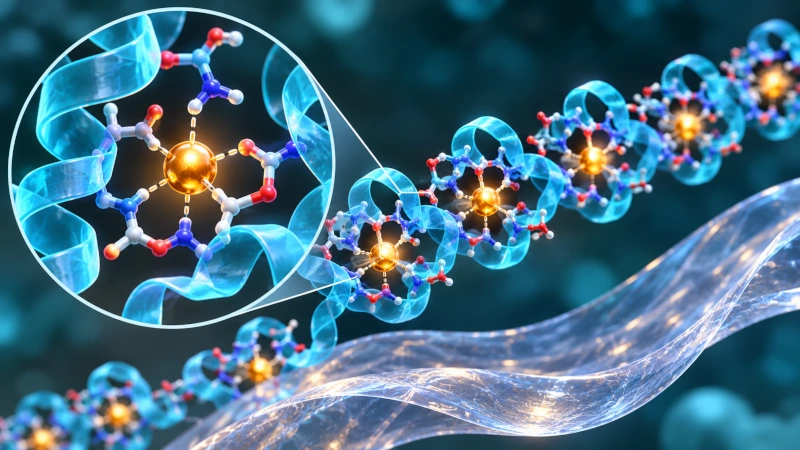
Researchers at the Indian Institute of Technology Hyderabad (IIT Hyderabad) have developed an innovative biomolecular material that uses zinc ions to improve the stability, mechanical strength and adhesive properties of molecular structures. The research demonstrates how carefully controlled interactions between metal ions and organic molecules can produce materials with characteristics resembling those of advanced polymers, opening new possibilities in biomolecular engineering, materials science and catalysis.
The findings, highlighted in a research report published on November 10, 2026, are based on a study published in the peer-reviewed Journal of Colloid and Interface Science. The researchers demonstrated that incorporating zinc ions into a specially designed molecular system could extend the lifetime of liquid droplets before they transformed into gel-like structures. The resulting material also exhibited significantly greater mechanical strength and adhesion than the same molecular system without zinc.
The discovery is significant because it demonstrates how the properties of relatively simple molecular assemblies can be modified through metal coordination. By controlling the interactions between zinc ions and organic molecules, the researchers were able to influence both the formation of the material and its subsequent mechanical and chemical behaviour.
Understanding How Biomolecules Organise into Liquid Droplets
The research focuses on a phenomenon known as liquid-liquid phase separation, a process through which molecules within a solution spontaneously organise into concentrated liquid droplets that remain distinct from the surrounding liquid. This process occurs naturally in living cells, where proteins and other biological molecules form specialised compartments without requiring conventional membranes.
These molecular compartments, often described as biomolecular condensates, perform important functions by concentrating particular molecules and creating environments that support biological reactions. Their ability to assemble, reorganise and exchange molecules with the surrounding environment makes them an important subject of research in chemistry, biology and materials science.
Scientists have increasingly investigated whether the principles governing these biological structures can be adapted to create synthetic materials with useful properties. However, reproducing the stability and dynamic behaviour of natural biomolecular condensates presents several challenges. Artificial molecular droplets may gradually lose their liquid-like characteristics and transform into fibrous or solid structures, limiting their ability to support controlled chemical reactions or other functions.
The IIT Hyderabad researchers examined whether interactions between metal ions and a specially designed organic molecule could regulate this transformation. Their objective was to understand how molecular coordination could prolong the stability of liquid droplets while improving the properties of the material formed during their eventual transition into a hydrogel.
Researchers Develop a Molecular System Using Cystine-Based Compounds
The research team developed its experimental system using a molecule known as N,N′-difluorenylmethoxycarbonyl-L-cystine, abbreviated as DFC. This molecule contains structural features that encourage spontaneous molecular organisation through non-covalent interactions, allowing individual molecules to associate with one another without requiring permanent chemical bonds between every component.
The molecular design incorporates interacting terminal groups separated by a cystine-based structure. This arrangement resembles certain features of naturally occurring proteins, where different molecular regions contribute to the formation of organised structures. The terminal groups promote molecular association, while the central region influences how the molecules interact and assemble within a solution.
Under suitable experimental conditions, DFC molecules spontaneously form concentrated liquid droplets through liquid-liquid phase separation. These droplets initially retain fluid-like characteristics but gradually undergo structural changes as their constituent molecules organise into more extensive networks.
To determine whether metal coordination could influence this process, the researchers introduced different metal ions into the molecular system and examined their effects on droplet formation, stability and subsequent gel development. The experiments revealed that zinc ions produced a particularly favourable combination of prolonged droplet stability and enhanced mechanical properties.
Zinc Ions Extend Molecular Droplet Stability from 24 to 48 Hours
One of the most important findings was the ability of zinc ions to extend the lifetime of the molecular droplets before they transformed into gel-like structures. Under the experimental conditions, droplets formed from DFC alone gradually lost their liquid-like characteristics and developed into more rigid structures within approximately 24 hours.
When zinc ions were incorporated into the system at a ratio of two DFC molecules to one zinc ion, the transformation was delayed to approximately 48 hours. This represented a substantial improvement in droplet longevity, demonstrating that zinc coordination could regulate the speed of molecular assembly and prolong the period during which the material retained its fluid-like properties.
Microscopic observations provided further evidence of this stabilising effect. Droplets formed without zinc began losing their spherical appearance within approximately four hours and developed visible fibrous structures by 24 hours. In contrast, zinc-containing droplets retained a comparatively smooth and spherical appearance for a longer period, indicating that the metal ions influenced the organisation of the molecular network.
The researchers found that this extended stability was closely associated with the nature of the interactions between zinc ions and DFC molecules. Rather than permanently preventing gel formation, zinc delayed the transformation while allowing the molecular structures to continue reorganising. This ability to regulate the timing of molecular assembly is particularly relevant to the development of soft materials whose properties depend on controlled structural changes.
Zinc Coordination Produces Better Results Than Other Metal Ions
To understand whether the stabilising effect was unique to zinc, the researchers investigated several other metal ions, including copper, iron, gold and silver. The experiments demonstrated that these alternatives did not reproduce the same combination of droplet longevity and hydrogel formation observed in the zinc-containing system under the conditions studied.
The research team employed computational modelling based on density functional theory to examine the molecular interactions responsible for this behaviour. This technique allows scientists to investigate electronic structures and estimate the strength of chemical interactions between atoms and molecular groups.
The calculations indicated that zinc ions could coordinate with oxygen-containing groups on neighbouring DFC molecules, creating interactions that stabilised the assembly while remaining sufficiently reversible to preserve molecular movement. The calculated binding energy for the zinc-associated arrangement was approximately −28.9 kilocalories per mole, providing insight into the strength of the interactions supporting the molecular structure.
The researchers concluded that the balance between molecular stability and reversibility was an important factor in determining the material’s behaviour. Interactions that are too weak may fail to maintain the molecular network, while excessively strong interactions can restrict the dynamic rearrangements required during droplet formation and transformation. Zinc provided a favourable balance, allowing the system to retain its liquid-like characteristics for longer before developing into a stronger hydrogel.
Resulting Hydrogel Demonstrates Nearly Sevenfold Increase in Mechanical Strength
In addition to extending droplet stability, the incorporation of zinc significantly improved the mechanical properties of the resulting hydrogel. Hydrogels are water-containing materials formed by interconnected molecular networks, and their strength, flexibility and elasticity depend on the interactions between their constituent molecules.
The researchers measured a mechanical modulus of approximately 245 pascals for the DFC material without zinc. When zinc ions were incorporated, the corresponding value increased to approximately 1,695 pascals, representing an improvement of nearly seven times under the experimental conditions.
The substantial increase in mechanical strength was attributed to changes in the organisation of the molecular network. Zinc coordination encouraged the formation of a denser and more uniformly distributed fibrous structure, creating additional interactions between neighbouring molecular assemblies and improving the material’s resistance to deformation.
These findings demonstrate that relatively simple modifications at the molecular level can produce substantial changes in the mechanical behaviour of soft materials. Instead of relying exclusively on complex synthetic polymers or extensive chemical modification, the researchers showed that metal coordination could provide an effective mechanism for strengthening a self-assembled biomolecular system.
The discovery is relevant to the wider field of supramolecular materials, where scientists seek to control the properties of larger structures through carefully designed interactions between smaller molecular components.
Zinc-Based Material Exhibits Fourfold Improvement in Adhesion
The research team also investigated the adhesive properties of the molecular system to determine whether the changes produced by zinc coordination improved its ability to attach to other surfaces. Adhesion is an important property in many natural and synthetic materials, particularly those used in specialised coatings, gels and bonding systems.
In laboratory experiments involving glass surfaces, the researchers compared the load-bearing capacity of the DFC material with and without zinc. The hydrogel formed without zinc supported a load of approximately 400 grams, while the zinc-containing material supported approximately 1.6 kilograms under the tested conditions.
This represented a fourfold improvement in load-bearing adhesion, demonstrating that zinc coordination enhanced not only the internal strength of the material but also its interaction with external surfaces.
The researchers associated the improved adhesion with the longer-lasting liquid phase and the subsequent formation of a denser molecular network. During its liquid-like stage, the material can spread across a surface and establish close molecular contact. As the molecular assembly gradually develops into a stronger gel, these interactions contribute to the material’s ability to remain attached to the surface.
The findings provide an example of how the timing of molecular transformation can influence the practical characteristics of a material. By allowing the droplets to remain fluid for a longer period before strengthening, the zinc-containing system combines improved surface contact with greater mechanical stability after gel formation.
Molecular Droplets Create Environments That Support Chemical Reactions
Another important finding concerns the ability of the molecular droplets to function as specialised environments for chemical reactions. The researchers investigated whether concentrating molecules within the droplets could influence catalytic activity and improve reaction efficiency.
Catalysis involves accelerating chemical reactions through the action of substances that facilitate molecular transformations. In biological systems, reactions frequently occur within organised environments that bring particular molecules together and regulate their interactions.
The liquid droplets developed by the IIT Hyderabad researchers provide a simplified model of this type of molecular organisation. Because the droplets concentrate certain chemical components within a confined environment, they can influence the frequency and nature of interactions between reacting molecules.
The researchers observed enhanced catalytic behaviour within the zinc-stabilised droplets. In one experimental measurement, the system demonstrated approximately 2.5 times higher absorbance associated with a model chemical reaction, indicating increased formation of the measured reaction product under those conditions.
The results suggest that prolonging the stability of molecular droplets can help preserve environments favourable to selected chemical reactions. This finding is significant because it connects the physical stability of the material with its ability to support chemical processes.
The study therefore demonstrates that metal coordination can influence several properties of the same molecular system, including droplet longevity, mechanical strength, adhesion and catalytic behaviour.
Advanced Microscopy Reveals How Molecules Move Within the Material
The researchers employed several advanced analytical techniques to examine the structure and behaviour of the molecular droplets. These included optical microscopy, confocal laser scanning microscopy, electron microscopy and fluorescence recovery after photobleaching, a method used to measure molecular mobility within materials.
Fluorescence recovery after photobleaching involves exposing a small region of a fluorescently labelled sample to intense light, reducing its fluorescence. Scientists then observe how fluorescence returns as molecules move into the affected region, allowing them to assess molecular movement within the material.
In the zinc-containing droplets, the researchers observed approximately 70% fluorescence recovery after 30 minutes. This indicated that molecular movement continued within the droplets despite the interactions responsible for maintaining their structural organisation.
The finding was important because it demonstrated that the zinc-containing system did not immediately become a completely rigid structure. Instead, the molecules retained a degree of mobility while remaining associated within the stabilised assembly.
This balance between molecular movement and structural stability is a defining characteristic of many biological condensates and synthetic soft materials. Understanding how to regulate it could help scientists design materials that remain dynamic during formation but develop stronger properties when required.
The combination of microscopy, mechanical testing, computational modelling and chemical analysis enabled the researchers to connect molecular-level interactions with the larger-scale properties of the resulting material.
Potential Applications in Functional Polymers and Advanced Materials
The IIT Hyderabad study contributes to the growing field of biomimetic materials, which draws inspiration from the organisation and behaviour of biological systems to develop new synthetic structures. The ability to regulate molecular assembly through zinc coordination offers a possible approach for designing materials with controllable properties.
The findings may support future research into functional hydrogels, specialised adhesive materials and molecular environments capable of facilitating selected chemical reactions. Materials that gradually transform from liquid-like structures into stronger networks are particularly interesting because their properties can change during the assembly process.
The research also provides insights into supramolecular chemistry, where large and complex structures emerge through interactions between smaller molecules. By demonstrating that metal ions can influence both the stability and mechanical behaviour of a self-assembled system, the study offers a foundation for investigating other molecular combinations with potentially useful characteristics.
However, the material remains an experimental laboratory system. The research does not establish that it is ready for industrial manufacturing, medical use or commercial applications. Additional studies would be necessary to determine its long-term stability, performance under different environmental conditions, manufacturing scalability and suitability for specific uses.
The significance of the present discovery lies primarily in demonstrating a molecular design principle that could guide the development of future materials.
IIT Hyderabad Research Combines Chemistry, Molecular Modelling and Materials Science
The study was conducted by researchers from the Department of Chemistry at IIT Hyderabad, including Gayatri Mishra, Vivek Vishwanath Adole, Deepsikha Kalita, Libun Pradhan, Debasish Koner and Priyadarshi Chakraborty.
The investigation brought together expertise in synthetic chemistry, molecular self-assembly, computational modelling and experimental materials characterisation. By combining these approaches, the researchers were able to examine not only how the molecular system behaved but also why zinc coordination produced the observed improvements.
Computational calculations helped explain the interactions between zinc ions and DFC molecules, while microscopy and spectroscopy provided information about the formation and organisation of the molecular structures. Mechanical and adhesion tests demonstrated how these molecular interactions translated into measurable material properties.
This interdisciplinary approach reflects the increasing importance of combining chemistry, physics, biology and computational methods in advanced materials research. Such investigations allow scientists to design and study materials whose properties arise from coordinated molecular interactions rather than conventional large-scale manufacturing processes alone.
Indian Scientists Advance Research into Biomolecular Materials
The IIT Hyderabad research demonstrates how carefully selected metal ions can transform the behaviour of a relatively simple molecular system. By incorporating zinc into a cystine-based molecular assembly, the researchers extended the lifetime of liquid droplets, substantially improved the mechanical strength of the resulting hydrogel and enhanced its adhesive properties.
The study also revealed that the stabilised droplets could support enhanced catalytic activity, establishing a relationship between molecular organisation and chemical functionality. These findings show how individual interactions at the molecular level can influence several interconnected properties of an advanced material.
The ability to control the transition between liquid-like and gel-like states is particularly important for understanding biological condensates and developing synthetic systems inspired by natural molecular organisation. Zinc coordination provides one possible mechanism for regulating this transformation while improving the properties of the resulting material.
Although further research is required to determine practical applications, the findings offer valuable insights into the design of functional hydrogels, supramolecular assemblies and biomimetic materials.
Published in the Journal of Colloid and Interface Science, the research represents a contribution by IIT Hyderabad to the understanding of metal-directed molecular self-assembly. It establishes a scientific foundation for exploring how simple biomolecular building blocks can be engineered into stronger, more stable and multifunctional materials through controlled chemical interactions.
You may also like
-
BITS Pilani Develops ₹2,500 System to Convert Food Waste into Animal Feed
-
IIT Madras and Gauhati University Develop New Climate Network Method to Identify Monsoon Onset Across India
-
India Advances MATSYA-6000 Deep Ocean Mission
-
ISRO Successfully Completes Cryogenic Engine Acceptance Test for GSLV-F19 Mission Carrying NVS-04
-
IIT Gandhinagar Develops Two Promising Compounds to Target Drug-Resistant Brain Cancer
