GI Heritage of India Series | Goa | Agricultural Products
In the coastal agricultural landscape of northern Goa, a small, reddish-brown chilli has preserved a distinctive place in the region’s farming traditions and culinary heritage. Known as Harmal Chilli, or Harmalchi Mirsang in Konkani, this indigenous chilli variety is celebrated for its medium-to-high pungency, characteristic colour, smooth skin and exceptional suitability for traditional Goan spice preparations.
Cultivated primarily in Harmal, also known as Arambol, in Pernem taluka of North Goa, the chilli has been maintained by local farming families for generations. Its distinctive characteristics are associated with the region’s lateritic soils, warm and humid climate, and traditional cultivation practices developed by agricultural communities.
Harmal Chilli occupies an important position in Goan cuisine, particularly in the preparation of Xacuti masala, Recheado masala and other traditional spice mixtures. Its concentrated pungency and strong colouring properties allow relatively small quantities to contribute substantial flavour and colour to food preparations.
The chilli received Geographical Indication recognition on 14 September 2021, formally establishing its protected geographical identity. Registered under GI Application No. 642, this recognition represents an important milestone in preserving Goa’s traditional agricultural varieties and strengthening their commercial potential.
Historical Origins and Agricultural Heritage
Harmal Chilli belongs to the species Capsicum annuum L., a member of the Solanaceae family. Although chilli peppers originated in the Americas, they became established in India following the expansion of maritime trade during the early modern period.
Goa played an important role in this agricultural transformation. Following the arrival of the Portuguese in the early sixteenth century, several crops originating outside the Indian subcontinent gradually entered local farming systems. Chillies became particularly important because they adapted successfully to Goa’s tropical climate and were incorporated into regional culinary traditions.
Over time, different chilli varieties developed distinct regional identities through local cultivation, seed selection and adaptation to environmental conditions. Harmal Chilli emerged as one of the speciality varieties associated with the agricultural communities of northern Goa.
Traditional accounts indicate that Harmal Chilli has been cultivated in the region for more than two centuries. Some heritage descriptions trace its cultivation history back several hundred years, although the precise date when the present cultivar became established has not been conclusively documented.
The variety derives its name from Harmal village in Pernem taluka. Its local name, Harmalchi Mirsang, reflects its association with the village, while mirsang is a Konkani term used for chilli.
For generations, farming households in Harmal cultivated the chilli primarily for drying and processing into spice powders. Its strong flavour and characteristic colour made it particularly valuable in traditional Goan food preparations.
The preservation of Harmal Chilli demonstrates how local agricultural communities can maintain distinctive crop varieties through traditional seed-selection practices and continued cultivation within a particular geographical environment.
Geographical Origin and Cultivation Region
Harmal Chilli is traditionally cultivated in Harmal village, commonly known as Arambol, in Pernem taluka of North Goa district.
The village lies within Goa’s coastal agricultural belt, where farming is influenced by the tropical monsoon climate, warm temperatures, seasonal rainfall and lateritic soils.
Although the official GI Registry lists Goa as the geographical area associated with the registered product, its traditional cultivation and distinctive agricultural identity are particularly linked to Harmal and adjoining parts of Pernem.
The region’s lateritic soils are important to the chilli’s cultivation. Agricultural documentation identifies soil pH values generally ranging from 5.5 to 6.5 in traditional growing areas.
These soils contain mineral nutrients that influence plant growth and fruit development. The combination of local soil conditions, seasonal moisture and the region’s warm climate provides a suitable environment for cultivating the variety.
Harmal Chilli is traditionally grown as an irrigated crop following the harvesting of kharif paddy. This agricultural sequence allows farmers to utilise land after the principal monsoon rice crop has been harvested.
The geographical association of Harmal Chilli reflects the interaction of locally adapted planting material, environmental conditions and cultivation practices.
Its recognised identity is therefore linked not merely to its place of production but also to the agricultural knowledge maintained by farming communities in the Harmal region.
Distinctive Characteristics of Harmal Chilli
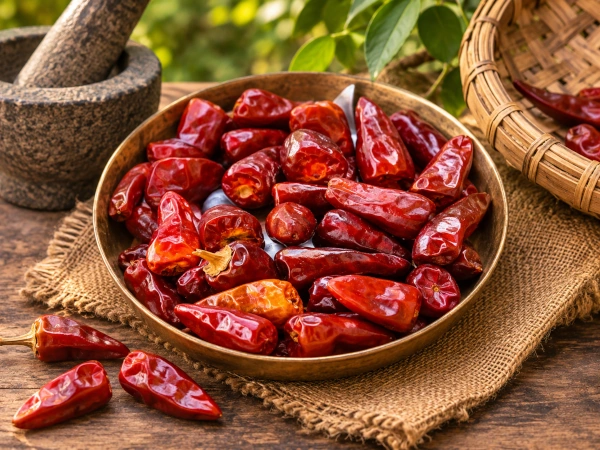
Harmal Chilli is distinguished by its comparatively small fruits, reddish-brown colour, medium-to-high pungency and smooth, non-wrinkled skin.
The plant belongs to the species Capsicum annuum and grows as a small herbaceous or sub-shrub-type chilli plant. Its fruits develop into short, narrow structures that differ considerably from the elongated chillies commonly found in commercial agricultural markets.
The average fruit length ranges from approximately 2.7 to 3.7 centimetres, while the diameter generally measures between 1.1 and 1.4 centimetres.
The mature dried chillies possess a characteristic reddish-brown colour. Their relatively smooth surface distinguishes them from several wrinkled chilli varieties cultivated elsewhere.
The chilli has a thin outer covering but a comparatively strong stalk, a combination associated with its good keeping quality.
Harmal Chilli is particularly valued for its pungency. Analytical information published by the Spices Board of India records an average pungency of approximately 28,200 Scoville Heat Units (SHU), placing it within the medium-to-high pungency range.
The same documentation identifies a capsaicin content of approximately 0.18 per cent. Capsaicin is one of the principal naturally occurring compounds responsible for the pungent sensation produced by chilli peppers.
The chilli’s colouring properties are also important. Scientific testing has recorded an American Spice Trade Association colour value of approximately 48.8 ASTA units, indicating its capacity to impart colour to food preparations.
Another distinguishing feature is the relatively large number of seeds within the fruits. This characteristic contributes to the composition of the dried chilli and the spice powder prepared from it.
The combination of concentrated pungency, strong colouring properties, smooth texture and good storage characteristics establishes Harmal Chilli as a distinctive traditional spice of Goa.
Traditional Cultivation Practices
Harmal Chilli cultivation is closely connected with the seasonal agricultural practices of northern Goa.
Farmers traditionally cultivate the chilli as an irrigated rabi crop after harvesting the kharif paddy crop. This allows agricultural land to remain productive beyond the monsoon rice-growing season.
The cultivation cycle generally begins during the post-monsoon months, with land preparation and nursery establishment followed by transplanting and crop management.
Local farming practices involve preparing the soil through ploughing and levelling, followed by the application of organic material such as compost, farmyard manure or other locally available agricultural inputs.
One of the most important traditional practices is seed preservation. Farmers carefully select suitable chilli fruits based on characteristics such as size, colour, appearance and overall quality.
The selected fruits are dried, and their seeds are preserved for the following cultivation season. Traditional accounts describe the storage of selected planting material in carefully sealed containers to protect it from moisture and deterioration.
This farmer-led system of seed selection has played an important role in maintaining the distinctive characteristics of Harmal Chilli across generations.
During cultivation, farmers undertake irrigation, weeding, soil management and crop protection to support healthy plant development.
The chilli is generally ready for harvesting after approximately three to three-and-a-half months, depending upon growing conditions and the cultivation schedule.
The continuation of these traditional practices has contributed to preserving Harmal Chilli as a locally adapted agricultural variety.
Harvesting, Drying and Traditional Processing
Harmal Chilli is primarily cultivated for dry use, making harvesting and post-harvest processing particularly important to its commercial quality.
Farmers traditionally harvest the fruits after they have ripened sufficiently and begun developing their characteristic reddish-brown colour.
Harvesting is generally carried out by hand to reduce physical damage to the fruits and preserve their appearance.
Following collection, the chillies are carefully handled and prepared for drying. Traditional processing methods involve spreading the fruits under sunlight for several days to reduce their moisture content.
Agricultural descriptions of the variety indicate that sun-drying may continue for approximately seven to eight days, depending upon weather conditions and the moisture content of the harvested fruits.
Proper drying is essential for maintaining the chilli’s quality during storage. Excessive moisture can encourage deterioration, while careful drying helps preserve its colour, flavour and pungency.
Once dried, the chillies may be stored whole or processed into powder.
The relatively thin skin, strong stalk and good keeping quality of Harmal Chilli make it suitable for longer-term storage when appropriate drying and storage conditions are maintained.
Traditional processing therefore contributes significantly to the value of the crop by allowing farmers and spice processors to preserve the harvest and market it beyond the immediate growing season.
Harmal Chilli in Traditional Goan Cuisine
Harmal Chilli occupies a distinctive position in Goa’s culinary traditions, particularly in the preparation of spice mixtures used in traditional household cooking.
Its concentrated pungency and strong colouring properties make it suitable for recipes requiring a combination of heat, flavour and characteristic red coloration.
One of its important applications is the preparation of Chicken Xacuti, a traditional Goan dish prepared using a complex mixture of roasted spices, coconut and other ingredients.
Harmal Chilli contributes pungency and colour to the spice mixture, complementing ingredients such as coriander, cumin, pepper, cloves and other aromatic spices.
The chilli is also used in Recheado masala, a traditional Goan spice paste commonly associated with fish and other food preparations.
Recheado masala generally contains dried red chillies, vinegar, garlic and a combination of aromatic spices. The colouring properties and pungency of Harmal Chilli make it suitable for this preparation.
Other culinary applications include garam masala, fish masala and traditional vegetable dishes such as Khatkhatem.
The chilli is frequently used in powdered form, either independently or blended with other spices.
Because of its pungency, relatively small quantities can provide substantial heat, allowing the remaining ingredients in a traditional spice mixture to contribute their complementary flavours.
Harmal Chilli’s connection with these preparations demonstrates how individual agricultural varieties become closely associated with regional food traditions.
Its preservation therefore supports not only agricultural diversity but also the continuation of Goa’s distinctive culinary heritage.
Economic Importance and Rural Livelihoods
Harmal Chilli has traditionally provided a source of agricultural income for farming households in the Harmal-Arambol region.
Its cultivation is particularly important within small-scale agricultural systems where farmers grow crops according to seasonal conditions and available land.
The chilli’s suitability for drying and storage provides commercial advantages because dried agricultural products can be marketed over longer periods than highly perishable fresh produce.
Its concentrated flavour and recognised regional identity also create opportunities for differentiated marketing.
Unlike conventional chilli varieties traded primarily as bulk agricultural commodities, Harmal Chilli can be promoted as a speciality spice associated with traditional Goan cuisine.
Its Geographical Indication recognition provides a foundation for this differentiation by formally protecting the product’s geographical identity.
A Government of India factsheet published in 2025 identified Harmal Chilli as part of Goa’s spice and sauce value chain, estimating that the associated cultivation, grinding and cottage-processing activities supported approximately 500 people.
The same publication highlighted the product’s presence in speciality retail markets and online platforms, demonstrating its potential beyond local agricultural markets.
The commercial development of Harmal Chilli can therefore contribute to agricultural livelihoods, small-scale food processing and the preservation of traditional farming practices.
The Role of Farmers and Producer Organisations
The Geographical Indication recognition of Harmal Chilli was secured through the efforts of the Harmal-Pernem Chilli (Mirchi) Growers Association.
The association was established to represent local cultivators and support the formal protection of the chilli’s geographical identity.
Its registration initiative required documentation demonstrating the relationship between the product’s distinctive characteristics and the geographical environment in which it is traditionally cultivated.
This included information concerning the chilli’s physical appearance, pungency, colouring properties, cultivation practices and association with the Harmal region.
Scientific testing provided measurable evidence of its distinctive characteristics, including fruit dimensions, capsaicin content, pungency and colour value.
The involvement of local cultivators was equally important because traditional knowledge concerning seed selection, cultivation and processing formed part of the evidence supporting the product’s geographical identity.
The association’s efforts eventually resulted in formal registration under India’s Geographical Indications of Goods (Registration and Protection) Act, 1999.
The registration established a legal framework through which authorised producers can identify and market genuine Harmal Chilli while protecting its geographical reputation.
Commercial Potential and Value Addition
Harmal Chilli possesses considerable potential for value-added processing because of its strong colour, pungency and established connection with Goan culinary traditions.
Its principal commercial applications include dried whole chillies, chilli powder, spice blends, traditional masala preparations, pickles and chilli-based sauces.
The chilli’s suitability for Xacuti and Recheado masala offers opportunities for speciality spice manufacturers and small food-processing enterprises.
Packaged spice mixtures prepared using genuine Harmal Chilli can be marketed as products associated with Goa’s regional culinary heritage, provided their origin and composition are represented accurately.
Improved processing infrastructure can further strengthen the product’s commercial potential.
Hygienic drying, moisture-controlled storage, grading and suitable packaging can help maintain the quality of dried chillies and spice powders.
Traceability is particularly important for GI products because authorised use of the geographical indication depends upon compliance with the relevant legal and registration requirements.
The development of organised farmer groups and processing enterprises can help producers obtain greater value from their agricultural output.
Commercial expansion can also encourage younger farming households to continue cultivating traditional crop varieties that might otherwise face competition from more widely marketed commercial alternatives.
GI Tag Journey of Harmal Chilli
The Geographical Indication recognition of Harmal Chilli represents an important milestone in preserving Goa’s traditional agricultural heritage. Cultivated for generations in Harmal village of Pernem taluka, the chilli developed a distinctive identity through its medium-to-high pungency, characteristic reddish-brown colour, smooth skin and traditional use in Goan spice preparations.
The formal registration process began on 14 January 2019, when the Harmal-Pernem Chilli (Mirchi) Growers Association submitted GI Application No. 642 under Class 30. Following administrative examination, submission of supporting documents and publication in the Geographical Indications Journal, Harmal Chilli received Certificate No. 387 on 14 September 2021. The registration established its protected geographical identity and recognised its association with Goa’s traditional agricultural practices.
Historical and GI Registration Milestones
| Year / Date | Milestone | Historical and Agricultural Significance |
|---|---|---|
| Early sixteenth century onwards | Chilli peppers were introduced into Goa through maritime trade during the Portuguese period. | Chillies gradually became established in regional agriculture and were incorporated into traditional Goan cuisine. |
| Traditional agricultural period | Harmal Chilli cultivation became established in the Harmal-Arambol region. | Local farming communities maintained a distinctive chilli variety suited to the area’s lateritic soils and tropical climate. |
| Generations of traditional cultivation | Preservation of Harmal Chilli through traditional seed selection. | Farmers selected and stored seeds from desirable fruits, maintaining the variety’s characteristic appearance, pungency and colouring properties. |
| Traditional culinary development | Harmal Chilli became an important ingredient in Goan spice preparations. | The chilli gained recognition for its use in Xacuti masala, Recheado masala and other traditional culinary preparations. |
| Modern agricultural development | Scientific documentation established the chilli’s distinctive physical and biochemical characteristics. | Testing identified its characteristic fruit dimensions, colour value, capsaicin content and pungency. |
| 14 January 2019 | Harmal-Pernem Chilli (Mirchi) Growers Association filed GI Application No. 642. | The application initiated formal geographical protection under Class 30 for Harmal Chilli. |
| 18 January 2019 | Formality Check Report issued by the GI Registry. | The Registry conducted its initial examination of the application documents. |
| 19 February 2019 | Applicant submitted a response to the Formality Check Report. | Additional information was provided to support the registration process. |
| 18 February 2020 | GI Registry issued its examination report. | The application underwent further examination concerning the product’s geographical association and supporting evidence. |
| 4 May 2020 | Applicant responded to the examination report. | The growers’ association provided additional clarifications during the registration process. |
| 29 May 2020 | Harmal Chilli appeared in Geographical Indications Journal No. 137. | Official publication marked an important stage in the process of obtaining geographical protection. |
| 14 September 2021 | GI Certificate No. 387 issued for Harmal Chilli. | The chilli received formal geographical indication recognition, protecting its association with Goa. |
| 17 December 2021 | India Post released a special postal cover celebrating Harmal Chilli. | The commemorative recognition highlighted the cultural and agricultural importance of the traditional Goan chilli. |
| December 2022 | Spices Board of India highlighted Harmal Chilli in its official spice publication. | The publication documented its distinctive characteristics, cultivation conditions and traditional culinary applications. |
| 2025 | Government of India highlighted Harmal Chilli in Goa’s spice and food-processing value chain. | The official assessment recognised its contribution to small-scale agriculture, spice processing and speciality food markets. |
| 13 January 2029 | Current GI registration validity date. | Harmal Chilli remains registered until this date, subject to renewal under the applicable GI legislation. |
The registration journey demonstrates the importance of cooperation between local farming communities and institutional mechanisms for protecting traditional agricultural products. The Harmal-Pernem Chilli (Mirchi) Growers Association played the central role in obtaining formal recognition, while scientific documentation established the distinguishing characteristics of the variety and its association with the Harmal region.
The Geographical Indication recognition also provides a foundation for strengthening the commercial identity of Harmal Chilli. Its distinctive pungency, strong colouring properties and importance in traditional Goan cuisine create opportunities for authorised producers to develop speciality spice products while preserving the agricultural knowledge maintained by local farming communities.
GI Details at a Glance
| Particular | Details |
|---|---|
| Geographical Indication | Harmal Chilli |
| State | Goa |
| District | North Goa |
| Taluka | Pernem |
| Other Names | Harmalchi Mirsang, Harmal Mirsang, Harmal Mirchi |
| Botanical Name | Capsicum annuum L. |
| Botanical Family | Solanaceae |
| Product Category | Agricultural |
| GI Class | 30 |
| GI Goods Description | Agricultural product – Chilli |
| Application Number | 642 |
| Date of Filing | 14 January 2019 |
| Registered Proprietor | The Harmal-Pernem Chilli (Mirchi) Growers Association |
| Registered Proprietor’s Address | H. No. 164, Deulwada, Harmal, Pernem – 403524, Goa |
| Geographical Area | Goa |
| Traditional Cultivation Region | Harmal (Arambol), Pernem taluka, North Goa |
| GI Journal | No. 137 |
| GI Journal Publication Date | 29 May 2020 |
| GI Certificate Number | 387 |
| GI Certificate Date | 14 September 2021 |
| Registration Valid Until | 13 January 2029 |
| Current GI Status | Registered |
| Plant Type | Herbaceous or sub-shrub-type chilli plant |
| Fruit Shape | Short, narrow and approximately triangular |
| Fruit Colour | Characteristic reddish-brown when mature and dried |
| Fruit Length | Approximately 2.7–3.7 cm |
| Fruit Diameter | Approximately 1.1–1.4 cm |
| Fruit Skin | Thin, smooth and non-wrinkled |
| Pungency | Approximately 28,200 Scoville Heat Units |
| Capsaicin Content | Approximately 0.18% |
| Colour Value | Approximately 48.8 ASTA units |
| Characteristic Flavour | Medium-to-high pungency with strong colouring properties |
| Traditional Soil Type | Lateritic soil |
| Reported Soil pH | Approximately 5.5–6.5 |
| Traditional Cultivation System | Irrigated rabi cultivation following kharif paddy |
| Traditional Seed Preservation | Selection, drying and storage of seeds from desirable fruits |
| Principal Harvesting Practice | Hand harvesting of ripe fruits followed by sun-drying |
| Traditional Uses | Xacuti masala, Recheado masala, garam masala, fish masala and Khatkhatem |
| Commercial Applications | Dried chillies, chilli powder, spice blends, pickles, sauces and speciality Goan masalas |
The registration details are based on the official records of the Geographical Indications Registry, Intellectual Property India, while the botanical characteristics, cultivation conditions, physical properties and biochemical measurements are supported by the Spices Board of India and geographical indication reference documentation.
The official registration identifies Goa as the geographical area of Harmal Chilli, with the Harmal-Pernem Chilli (Mirchi) Growers Association serving as its registered proprietor. The recognised identity is based upon the distinctive qualities of the chilli and its traditional association with the Harmal-Arambol agricultural region.
Preserving Harmal Chilli’s Agricultural Heritage
The long-term preservation of Harmal Chilli depends upon maintaining the locally adapted planting material and traditional agricultural knowledge that have sustained its cultivation across generations.
Traditional seed-selection practices are particularly important because they enable farmers to preserve the characteristics associated with the variety’s geographical identity.
The continuation of cultivation also depends upon the economic viability of small-scale agriculture in the Harmal region. Changes in land use, rising cultivation costs and the availability of alternative livelihoods can influence whether farming households continue growing traditional crops.
Geographical Indication recognition can contribute to preservation by providing a legally protected identity that distinguishes genuine Harmal Chilli from similar varieties grown elsewhere.
However, the success of this protection depends upon effective participation by local farmers, appropriate quality standards and marketing arrangements that recognise the speciality value of the crop.
Agricultural institutions and producer organisations can support these objectives through improved seed management, cultivation guidance, processing infrastructure and market development.
The combination of traditional agricultural knowledge and modern institutional support can help maintain Harmal Chilli as an economically viable crop while preserving its regional identity.
A Fiery Expression of Goa’s Agricultural and Culinary Heritage
Harmal Chilli represents an important part of Goa’s indigenous agricultural diversity. Its characteristic reddish-brown colour, concentrated pungency, smooth skin and long association with traditional spice preparations have established its identity as a distinctive regional chilli.
The granting of Geographical Indication recognition in 2021 formally acknowledged the agricultural knowledge preserved by farming communities in the Harmal-Arambol region.
As interest in authentic regional foods and speciality spices continues to develop, Harmal Chilli offers opportunities for improved cultivation, value-added processing and wider commercial recognition.
Its continued preservation will depend upon the farming communities that maintain the variety and the institutions supporting its agricultural and commercial development.
Harmal Chilli is more than a traditional Goan spice. It is a living expression of the state’s agricultural heritage, culinary traditions and the enduring relationship between local farming knowledge and regional identity.
You may also like
-
NSE Becomes World’s Third-Largest Listed Exchange Operator
-
India Tracks ₹38.11 Lakh Crore Infrastructure Investment Pipeline
-
Suzlon Energy Lays Foundation Stone for 1 GW AI-Enabled Wind Turbine Blade Factory in Tamil Nadu
-
Avore Electric Reports 90 Per Cent Domestic Component Sourcing for Electric Motorcycles
-
Indian Nuclear Startup SUK-M Secures Funding to Develop Indigenous Thorium Microreactor
