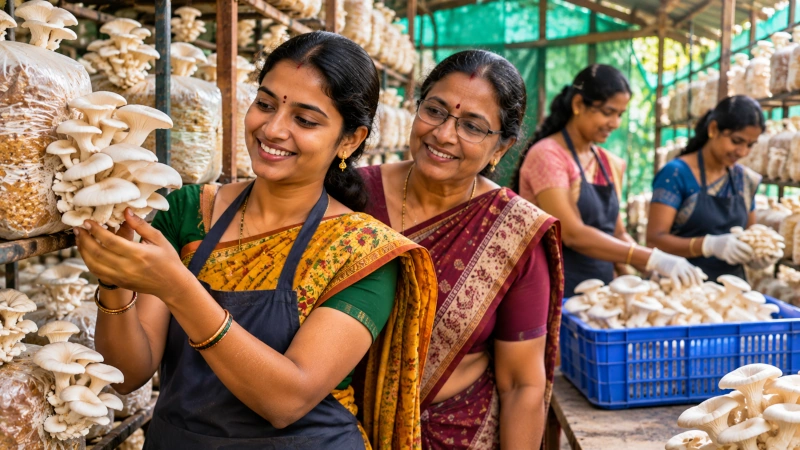
Mushroom cultivation is emerging as an important source of supplementary income, rural entrepreneurship and employment generation across India, with women, small farmers and young entrepreneurs increasingly adopting the activity as a commercially viable agricultural enterprise. Supported by government training programmes, agricultural research institutions and improved market access, mushroom farming is helping individuals establish independent livelihoods while making productive use of agricultural residues and limited land resources.
According to the Ministry of Agriculture and Farmers Welfare, mushroom cultivation offers considerable potential for livelihood diversification because it requires relatively little land and can be undertaken in rural, urban and peri-urban environments. Mushrooms also provide nutritional benefits, containing protein, dietary fibre, vitamins and minerals while generally being low in calories and fat.
A series of successful enterprises documented by the Government demonstrates how targeted training, access to quality inputs and institutional support are enabling individuals to transform small cultivation units into sustainable businesses.
Andhra Pradesh Woman Transforms Mushroom Cultivation into ₹35,000 Monthly Income
In Ippatam village of Guntur district, Andhra Pradesh, a young woman named Ruthu has demonstrated how agricultural skill development can create opportunities for economic independence.
At the age of 20, Ruthu was working as a waste picker when she began exploring alternative livelihood opportunities. Her circumstances changed after she participated in a short-term mushroom cultivation training programme organised by Krishi Vigyan Kendra (KVK), Guntur, under the Skill Training for Rural Youth (STRY) initiative.
The programme, supported by the State Agricultural Management and Extension Training Institute (SAMETI), Andhra Pradesh, and the National Institute of Agricultural Extension Management (MANAGE), Hyderabad, provided practical instruction in mushroom production. Participants received training in composting, spawning, casing, crop development and harvesting.
Applying these skills, Ruthu established a milky mushroom cultivation unit and began supplying her produce to the local market. Her production subsequently reached approximately 8 kilograms per day, generating a monthly income of around ₹35,000.
Her experience also highlighted the importance of selecting clean, disease-free paddy straw, using quality mushroom spawn and maintaining suitable temperature and moisture conditions throughout cultivation.
The success of her enterprise encouraged three to four other members of her community to begin mushroom cultivation on a small scale, with Ruthu providing guidance based on her practical experience.
Bihar’s Mushroom Village Demonstrates the Power of Women-Led Entrepreneurship
In Anantpur village of Nalanda district, Bihar, mushroom cultivation has evolved from an individual livelihood activity into a community-based enterprise involving hundreds of women.
The transformation began with Anita Devi, who pursued mushroom cultivation as a means of establishing an independent income. Training at Dr. Rajendra Prasad Central Agricultural University and GB Pant University helped her acquire technical knowledge, while guidance from Krishi Vigyan Kendra, Harnaut, in 2010 strengthened her entrepreneurial capabilities.
Anita initially began cultivating oyster and milky white mushrooms, varieties that could be grown using locally available agricultural residues. Her success encouraged other women in Anantpur and neighbouring villages to adopt similar practices.
As mushroom cultivation expanded, the Bihar State Agriculture Department declared Anantpur a Mushroom Village in 2012, recognising the growing participation of local households in the activity.
Anita subsequently became known as the Mushroom Mahila, reflecting her role in promoting mushroom cultivation among rural women.
Recognising the importance of reliable access to quality mushroom spawn, she established a spawn production laboratory with assistance under the National Horticulture Mission, receiving a subsidy of ₹15 lakh.
She also established Madhopur Farmers Producers Company Limited to strengthen coordination among mushroom cultivators and sellers, improve market access and facilitate connections with government schemes.
By 2023, more than 250 women associated with Jeevika Self-Help Groups were participating in mushroom-based livelihood activities in Nalanda.
The initiative demonstrates how individual entrepreneurship, when supported by institutional assistance and collective organisation, can develop into a broader rural economic activity.
Gujarat Engineer Builds Profitable Mushroom Enterprise Through Technical Training
Mushroom cultivation is also attracting educated professionals interested in establishing independent agricultural enterprises.
In Tapi district of Gujarat, civil engineer Anjanaben Gamit began exploring oyster mushroom cultivation after reading an article published by Krishi Vigyan Kendra, Tapi, in its Agro-Sandesh publication.
Recognising that mushroom cultivation could be undertaken without extensive agricultural land, she attended a four-day entrepreneurship training programme organised by the KVK.
With technical assistance from agricultural scientists, Anjanaben began cultivating oyster mushrooms in 2017 using a modest 15 × 10-foot shed constructed with bamboo and green shade net.
Her first cultivation cycle produced approximately 140 kilograms of mushrooms within two and a half months. The harvest generated ₹28,000 against a production cost of ₹11,000, demonstrating the commercial potential of the enterprise.
Encouraged by these results, she expanded her mushroom production facility in 2019 to approximately 23 × 80 feet, investing an additional ₹1.72 lakh.
Between April and December 2019, she utilised 250 kilograms of mushroom spawn to produce 1,234 kilograms of mushrooms. The enterprise generated a gross income of ₹3.09 lakh and a net profit of ₹2.20 lakh after production costs.
Anjanaben also developed local marketing channels by packaging mushrooms in 100–200 gram quantities and supplying them through Anganwadi workers, retailers and vegetable vendors in Vyara. Telephone-based orders and sales through the district’s organic market provided additional opportunities to reach consumers.
Her experience illustrates the importance of combining agricultural training with practical marketing strategies to establish commercially sustainable mushroom enterprises.
Uttarakhand Entrepreneur Builds One-Tonne-Per-Day Mushroom Production Facility
In Uttarakhand, IT professional Hiresha Verma has developed mushroom cultivation into a diversified agricultural enterprise with substantial production capacity and employment potential.
Hiresha began cultivating oyster mushrooms in Charba village of Dehradun district in 2013, starting with just 25 mushroom cultivation bags in a small residential space.
Her initial investment of ₹2,000 generated returns of approximately ₹5,000, encouraging her to explore mushroom cultivation as a larger commercial opportunity.
She subsequently established Han Agrocare, a mushroom enterprise based in Dehradun, and strengthened her technical knowledge through training at Krishi Vigyan Kendra, Dehradun, and the ICAR-Directorate of Mushroom Research, Solan.
With institutional assistance and access to agricultural inputs, she initially established three bamboo cultivation huts, each capable of accommodating approximately 500 mushroom bags.
The enterprise gradually expanded into a technology-supported production facility with ten air-conditioned cultivation rooms and an installed production capacity of approximately 1,000 kilograms of mushrooms per day.
According to the Government’s account, Han Agrocare currently employs 15 people, while Hiresha has trained more than 2,000 women and farmers in the hill regions.
Her enterprise has also diversified into specialty mushrooms, including shiitake and Ganoderma, alongside value-added products such as mushroom pickles, cookies, nuggets, soups, protein powders, tea and papad.
The development of processed mushroom products has helped broaden the enterprise beyond fresh mushroom sales, demonstrating opportunities for value addition and agricultural entrepreneurship.
Hiresha has also provided technical guidance to growers from Tehri, Pauri and Garhwal, helping extend mushroom cultivation practices to other communities in Uttarakhand.
Mushroom Cultivation Helps Uttarakhand Farmer Nearly Double Income
Another example comes from Uderkhani village in Bageshwar district, Uttarakhand, where farmer Madan Mohan adopted mushroom cultivation alongside protected vegetable farming.
His participation began through an initiative undertaken by the ICAR-Directorate of Mushroom Research, Almora, under the Scheduled Caste Sub Plan during 2020–21.
Although interested in adopting mushroom cultivation, Madan Mohan initially lacked the financial resources required to establish production infrastructure.
Institutional support helped him establish a portable polyhouse in 2022, along with access to five quintals of pasteurised compost for mushroom cultivation. Krishi Vigyan Kendra, Kafligair, provided technical training and guidance.
Using recommended cultivation practices, he harvested approximately one quintal of marketable button mushrooms.
The 62.4-square-metre polyhouse also supported the cultivation of vegetables, including tomatoes, capsicum, cabbage, cauliflower and French beans, producing approximately 7.5 quintals of vegetables.
The ability to cultivate crops during the off-season provided additional market advantages when local supplies were limited.
Together, mushroom and vegetable cultivation generated an income of approximately ₹41,250, nearly doubling his earlier farm income.
His experience demonstrates how protected cultivation structures and diversified agricultural activities can improve income opportunities for small farmers, particularly in geographically challenging hill regions.
Agricultural Residues Become Resources for Rural Enterprise
One of the important advantages of mushroom cultivation is its ability to utilise agricultural residues as growing substrates, creating productive applications for materials such as paddy straw and other suitable farm by-products.
Unlike several conventional agricultural activities, mushroom cultivation can be undertaken in relatively small spaces under controlled growing conditions. Depending on the mushroom variety, growers can establish production units using sheds, cultivation bags, protected structures or specialised rooms.
The activity also provides opportunities for farmers to diversify their income without necessarily acquiring additional agricultural land.
However, successful production requires technical knowledge of mushroom varieties, substrate preparation, spawn quality, temperature regulation, humidity management and hygienic cultivation practices.
Agricultural institutions, particularly Krishi Vigyan Kendras and ICAR research organisations, are playing an important role in providing the technical training and practical support required by new growers.
Value Addition and Market Access Strengthen Mushroom Entrepreneurship
The expansion of mushroom cultivation is creating opportunities beyond primary agricultural production.
Entrepreneurs are increasingly exploring mushroom processing and value-added products, including dried mushrooms, pickles, soups, snacks and other food preparations. Such diversification can help enterprises expand their product range and access additional consumer markets.
The experiences documented across Andhra Pradesh, Bihar, Gujarat and Uttarakhand also demonstrate the importance of establishing dependable local distribution channels.
Direct sales, retailer networks, farmer producer organisations, community institutions and local markets are helping cultivators connect with consumers and reduce dependence on intermediaries.
Access to quality mushroom spawn, training facilities, processing infrastructure and reliable marketing networks remains important for enabling small producers to expand their enterprises sustainably.
Strengthening Rural Livelihoods Through Skill-Based Agriculture
The growing adoption of mushroom cultivation reflects the potential of skill-based agricultural entrepreneurship to generate employment and improve rural incomes.
The experiences of Ruthu, Anita Devi, Anjanaben Gamit, Hiresha Verma and Madan Mohan demonstrate that individuals from different educational, professional and economic backgrounds can successfully undertake mushroom cultivation when supported by appropriate technical knowledge and institutional assistance.
These enterprises also highlight the wider economic benefits of agricultural diversification, particularly for women, rural youth and small farmers seeking additional income sources.
By encouraging the productive use of agricultural residues, strengthening technical training and expanding opportunities for processing and marketing, mushroom cultivation can contribute to more diversified and resilient rural economies.
As agricultural research institutions and government programmes continue supporting entrepreneurship, mushroom cultivation offers an increasingly valuable opportunity to connect sustainable resource utilisation with income generation, employment and nutritional security across India.
You may also like
-
India Records Highest-Ever 15.62 Crore E-Way Bills in October 2026, Registering 23.14% Annual Growth
-
India’s Worker Population Ratio Rises to 52.7% as Latest Labour Survey Shows Employment Gains
-
Alleppey Green Cardamom of Kerala and Tamil Nadu: The GI-Tagged Heritage of India’s Queen of Spices
-
Y Combinator-Backed Archgen Labs Develops AI Agent to Automate Advanced Semiconductor Design
-
India Positions Lakshadweep and Andaman & Nicobar Islands as Major Hubs for Blue Economy Growth
