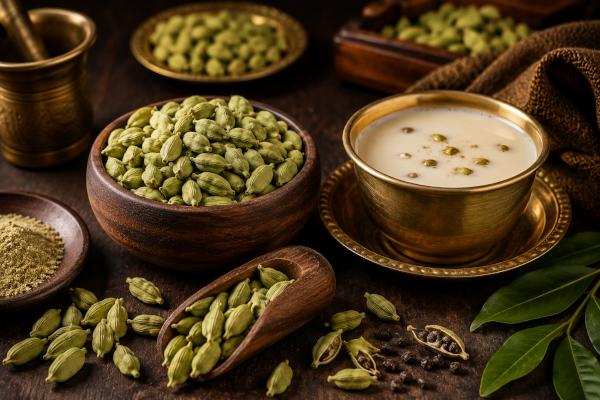
In the mist-covered hills of the southern Western Ghats, where tropical evergreen forests meet the fertile slopes of Kerala and Tamil Nadu, grows one of India’s most celebrated aromatic spices. Alleppey Green Cardamom, renowned for its rich green colour, delicate fragrance and distinctive flavour, represents an agricultural heritage deeply connected with the history of the Malabar Coast and the development of India’s international spice trade. Known as the Queen of Spices, cardamom has been valued for centuries in Indian households, traditional medicine, culinary preparations and commercial exchanges extending across the Arabian Sea.
Obtained from the dried capsules of Elettaria cardamomum (L.) Maton, Alleppey Green Cardamom is distinguished by its uniform green appearance, characteristic three-sided capsules and sweet, fruity, floral aroma. Its cultivation is closely associated with the high-rainfall mountain environments of the Western Ghats, where suitable temperatures, forest shade and generations of agricultural expertise support the growth of this valuable perennial crop. Although the name Alleppey refers to the historic commercial identity of Alappuzha in Kerala, the recognised geographical production area extends across specified districts of Kerala and Tamil Nadu.
Alleppey Green Cardamom received Geographical Indication (GI) registration on 28 March 2008, formally recognising its distinctive geographical identity under India’s Geographical Indications of Goods (Registration and Protection) Act, 1999. The registration was obtained by the Spices Board, operating under the Ministry of Commerce and Industry, Government of India. Official records confirm that the registration was renewed in June 2026 and is now valid until 13 September 2036, providing continued legal protection for one of southern India’s most recognisable agricultural products.
Historical Origins and the Spice Heritage of Alleppey Green Cardamom
Green cardamom is indigenous to the evergreen forests of the southern Western Ghats, making southwestern India an important centre of origin and traditional cultivation for the crop. The Spices Board identifies this region as the natural home of small cardamom, whose aromatic capsules attracted commercial interest long before the development of modern plantation agriculture. The plant’s association with shaded tropical forests helps explain why its cultivation became concentrated in the mountain environments of Kerala and adjoining parts of southern India.
Cardamom has occupied an important place in Indian food traditions, perfumery and traditional systems of medicine for centuries. Historical commercial networks carried aromatic spices from the southwestern coast of India towards West Asian and Mediterranean markets, where they were valued for culinary and other applications. Although the antiquity of the wider spice trade is well established, the specific commercial designation Alleppey Green Cardamom should be distinguished from the much older history of cardamom itself.
The Malabar Coast developed into a significant centre of maritime commerce through its connections with merchants operating across the Arabian Sea. Ports and trading settlements in Kerala facilitated the movement of pepper, cardamom, ginger and other valuable commodities from agricultural regions to domestic and overseas markets. The development of these networks created enduring commercial associations between southwestern India and the international spice trade.
Alleppey, now officially known as Alappuzha, emerged as an important commercial centre during the development of organised port and canal infrastructure in the eighteenth and nineteenth centuries. Under the administration of Travancore, the town’s waterways and maritime facilities supported the movement of agricultural commodities between inland producing areas and coastal trading networks. The commercial name Alleppey subsequently became associated with a recognised type and grading tradition of Indian green cardamom.
The historical importance of Alleppey Green Cardamom therefore reflects two interconnected developments: the long-established cultivation of aromatic cardamom in the Western Ghats and the commercial systems through which southern Indian spices reached wider markets. Its continued international recognition demonstrates how geographical names associated with trading centres can become enduring identities for agricultural products grown across a broader hinterland.
Geographical Origin and Cultivation Areas
The geographical identity of Alleppey Green Cardamom is associated with selected hill districts of Kerala and Tamil Nadu, particularly the humid mountain environments of the southern Western Ghats. These regions provide the combination of rainfall, temperature, vegetation and shaded growing conditions required for successful cultivation of small cardamom.
According to the Spices Board’s official GI specifications, the recognised production area in Kerala includes Idukki, Palakkad, Wayanad and Thiruvananthapuram districts. The registered area also extends into Tamil Nadu, covering Tirunelveli, Dindigul, Coimbatore, Theni and the Nilgiris districts. These specified districts establish the geographical scope of the GI, although not every locality within them necessarily provides suitable conditions for commercial cardamom cultivation.
Idukki occupies a particularly important position in Kerala’s cardamom economy. The highlands surrounding Vandanmedu, Kumily, Nedumkandam and other plantation settlements have developed strong associations with cardamom production. Their elevation, rainfall and shaded agricultural landscapes support extensive cultivation, while the presence of growers, traders and processing facilities contributes to the region’s commercial importance.
In Tamil Nadu, the mountain landscapes of Theni, Dindigul and adjoining districts form part of the broader southern Western Ghats cardamom-growing belt. The interconnected geography of these districts and neighbouring Kerala reflects the agricultural continuity of mountain environments that extend across present-day administrative boundaries.
The Spices Board identifies the geographical coordinates associated with Alleppey Green Cardamom as approximately 8°–12° north latitude and 74°–77° east longitude. These coordinates describe the broad geographical setting, while the district-level specifications define the recognised production locations.
The GI designation consequently represents a specialised agricultural region rather than the municipal boundaries of Alappuzha. Its geographical identity combines the historic commercial reputation of Alleppey with the actual cultivation landscapes of the Western Ghats.
Unique Characteristics of Alleppey Green Cardamom
Alleppey Green Cardamom is produced from the dried fruit capsules of Elettaria cardamomum, a perennial herbaceous plant belonging to the family Zingiberaceae. The plant develops from underground rhizomes and produces clusters of leafy shoots, with flowering structures arising close to the base of the plant. Its capsules contain small, aromatic seeds that contribute substantially to the spice’s characteristic flavour.
The official GI specification identifies uniform green colour as one of the distinguishing features of Alleppey Green Cardamom. The capsules are described as having a three-cornered shape with a ribbed exterior, generally measuring approximately 5–8 millimetres in diameter. The specification records a capsule length of approximately 21 millimetres and a bulk density ranging from 260 to 435 grams per litre.
Its aroma is described as sweet, fruity and floral, distinguishing it from the comparatively camphoraceous character identified in the official specification for Coorg Green Cardamom. These sensory characteristics contribute to the commercial reputation of Alleppey Green Cardamom, particularly in markets where attractive green colour and pronounced fragrance are important quality considerations.
The aromatic qualities of cardamom are associated with its volatile essential oil. The GI specification records volatile oil content of approximately 7.5–11.3%, with characteristic constituents including 1,8-cineole, α-terpinyl acetate, linalool and linalyl acetate. These compounds contribute to the distinctive aroma of the spice, although their actual concentrations can vary with planting material, growing conditions, harvesting maturity and post-harvest processing.
The appearance and flavour of Alleppey Green Cardamom also depend on careful handling during drying and storage. Preservation of the green capsule colour is commercially important, while suitable moisture levels and protection from excessive heat help maintain the desirable aroma of the finished product.
The combination of physical appearance, aromatic composition and established geographical reputation provides the foundation for the product’s GI identity. Scientific quality assessment complements these characteristics by allowing the commercial attributes of the spice to be evaluated through recognised measurements.
Traditional Commercial Grades of Alleppey Green Cardamom
One of the defining features of Alleppey Green Cardamom is its established grading system, which classifies capsules according to their size and commercial presentation. The Spices Board recognises three principal grades under the Alleppey Green designation, reflecting longstanding market preferences for well-developed, attractive green cardamom capsules.
Alleppey Green Extra Bold (AGEB) represents the larger commercial grade, consisting of capsules measuring more than 7 millimetres in diameter. These bold capsules are particularly valued in markets where uniformity, appearance and size influence purchasing decisions. Their classification reflects physical grading, while aroma, cleanliness and proper curing remain important components of overall quality.
Alleppey Green Bold (AGB) comprises capsules measuring more than 6 millimetres in diameter. This grade provides a recognised commercial category for relatively large capsules that meet the relevant specifications, making it an important part of the wider Alleppey cardamom grading system.
Alleppey Green Superior (AGS) includes capsules measuring more than 5 millimetres in diameter. The grade accommodates smaller capsules within the recognised classification, while retaining the geographical and sensory identity associated with Alleppey Green Cardamom.
These designations are commercially significant because capsule size influences grading and presentation in domestic and international markets. The existence of clearly defined categories also assists traders, processors and buyers in communicating product requirements.
The grading system demonstrates that the reputation of Alleppey Green Cardamom depends not simply on geographical origin but also on the careful preparation and classification of harvested capsules. Proper harvesting, curing, cleaning and sorting help producers supply consistent products while maintaining the distinctive identity of the registered spice.
Traditional Cultivation and Agricultural Practices
Alleppey Green Cardamom is cultivated in shaded plantation environments that reproduce important features of its natural forest habitat. Unlike crops requiring full sunlight, small cardamom is adapted to growing beneath a suitable tree canopy, where moderated temperatures, atmospheric humidity and filtered sunlight support its development. This characteristic has contributed to the establishment of cardamom plantations within the forested landscapes of the Western Ghats.
The plant is a perennial herb that develops from underground rhizomes and produces multiple leafy shoots. According to the Spices Board, three principal cultivated types are traditionally recognised based on their flowering structures: Malabar, Mysore and Vazhukka. The Malabar type has prostrate panicles, the Mysore type possesses erect panicles, and Vazhukka displays intermediate characteristics. These are botanical cultivation types and should not be confused with the commercial GI grades of Alleppey Green Cardamom.
Propagation traditionally involves seeds and vegetative suckers, while modern cultivation also makes use of carefully raised planting material and tissue-culture techniques. Healthy plants are established in prepared fields where suitable spacing, shade regulation and drainage allow the crop to develop. Farmers must pay particular attention to the management of soil moisture because cardamom requires humid conditions but is vulnerable to damage from prolonged waterlogging.
The Spices Board identifies elevations of approximately 800–1,300 metres above mean sea level as characteristic of many traditional cardamom-growing environments. These highland conditions provide relatively moderate temperatures and substantial rainfall, while the surrounding vegetation helps maintain a suitable microclimate.
Cardamom harvesting requires considerable care because capsules develop and mature at different times. Farmers therefore undertake repeated picking rounds rather than harvesting the entire crop at once. In Kerala and Tamil Nadu, harvesting generally extends from June or July into January or February, although the precise period varies according to altitude, rainfall, crop variety and local growing conditions.
Capsules are normally harvested when they reach physiological maturity but before full ripening causes undesirable changes in colour. The Spices Board identifies dark-green capsule skin and well-developed dark seeds as useful indicators of maturity. Premature harvesting can produce shrivelled or uneven capsules, while overripe fruits may split or lose the attractive green appearance expected in premium commercial grades.
Traditional Curing and Preservation of Green Colour
The processing of harvested cardamom is among the most important activities determining the commercial quality of Alleppey Green Cardamom. Fresh capsules contain substantial moisture and must undergo controlled drying, traditionally known as curing, before they can be stored or marketed.
Cardamom curing involves reducing the moisture content of freshly harvested capsules to approximately 10–12%. This process helps preserve the spice while maintaining the physical appearance and aromatic characteristics required by commercial buyers. Successful curing depends on the maturity of the harvested capsules, drying temperature, airflow and the duration of processing.
Traditional methods included drying under natural conditions, while improved curing systems employ controlled indirect heating. The Spices Board recommends maintaining temperatures of approximately 40–45°C during the principal drying stages to support retention of the desirable green colour. Temperatures may be increased carefully towards the end of curing to facilitate the removal of dried floral remnants and improve the appearance of the product.
Excessive heat can cause capsules to develop brownish streaks and may accelerate losses of volatile aromatic compounds. Similarly, slow or unsuitable drying can affect colour, encourage deterioration and reduce the commercial value of the spice. Proper curing therefore requires a combination of technical knowledge, experience and attention to the condition of individual batches.
After drying, cardamom undergoes cleaning and grading. Floral remnants and unsuitable material are removed, and capsules are separated according to size, colour and other commercial requirements. The finished product must then be stored under appropriate conditions to protect it from moisture, excessive heat and deterioration of aroma.
These processing operations explain why the commercial reputation of Alleppey Green Cardamom reflects more than the characteristics of the growing environment. It also depends on the specialised knowledge of farmers and processors who transform freshly harvested capsules into a stable, aromatic and visually attractive agricultural product.
The Role of the Western Ghats and Monsoon Climate
The Western Ghats form the ecological foundation of Alleppey Green Cardamom cultivation. Stretching along the western side of peninsular India, this mountain system influences rainfall patterns, vegetation, temperature and soil conditions across the traditional cardamom-growing regions of Kerala and Tamil Nadu.
Small cardamom is particularly suited to humid tropical environments with substantial rainfall and moderate temperatures. The highland forests of the southern Western Ghats provide these conditions, with tree cover creating the filtered-light environment required by the crop. The management of plantation shade consequently remains an important aspect of cultivation.
Monsoon rainfall supports soil moisture and vegetative growth, while seasonal changes influence flowering, fruit development and harvesting. Farmers must adapt plantation management to changing weather conditions because both inadequate moisture and excessive rainfall can affect productivity and crop health.
The relationship between cardamom and forest vegetation is especially significant. Traditional plantations frequently retain shade trees, creating agricultural landscapes in which commercial spice production coexists with selected elements of the natural vegetation. Responsible shade management can support soil conservation and contribute to more favourable growing conditions.
The geographical character of Alleppey Green Cardamom is therefore rooted in the interaction between the Western Ghats, monsoon-influenced agriculture and specialised cultivation practices. Its reputation has developed through generations of farming in an environment whose ecological conditions are closely associated with the aromatic qualities and commercial identity of Indian green cardamom.
Scientific Characteristics and Aromatic Composition
The fragrance of Alleppey Green Cardamom originates principally from the volatile essential oil contained in its seeds. This oil comprises several aromatic compounds that collectively produce the sweet, floral, fruity and mildly camphoraceous characteristics associated with small cardamom.
The official GI specification records volatile oil content ranging from approximately 7.5% to 11.3%, identifying α-terpinyl acetate and 1,8-cineole as major constituents. The recorded representative composition includes approximately 34.5% α-terpinyl acetate and 34.2% 1,8-cineole, together with smaller proportions of linalool and linalyl acetate.
α-Terpinyl acetate contributes pleasant sweet and aromatic notes, while 1,8-cineole is associated with a fresh, penetrating aroma. The combined activity of these and other volatile substances produces the characteristic fragrance of the spice. Their relative proportions vary depending on the plant material, cultivation environment, maturity and post-harvest handling.
The preservation of essential oil is particularly important because cardamom’s commercial value is strongly influenced by its fragrance. Exposure to excessive heat, moisture and unsuitable storage conditions can cause changes in aromatic quality, making careful curing and packaging essential components of production.
Scientific quality assessment also considers capsule size, uniformity, colour, moisture, cleanliness and freedom from contamination. These parameters are important for commercial grading and export quality, providing objective measurements that complement the traditional assessment of aroma and appearance.
Research into the chemical composition and quality characteristics of small cardamom helps explain the continuing importance of the crop’s geographical environment and traditional processing methods. It also provides opportunities for developing improved technologies that preserve desirable characteristics throughout harvesting, curing and storage.
Culinary Importance and Traditional Uses
Alleppey Green Cardamom occupies an important place in Indian culinary traditions, where its fragrance contributes to sweets, rice preparations, beverages and a wide variety of savoury dishes. Its concentrated aroma means that relatively small quantities can influence the flavour of a preparation, making the spice particularly valuable in foods where aromatic complexity is desired.
In Kerala, cardamom is used in traditional preparations such as payasam, sweet rice dishes, milk-based desserts and selected festive foods. Its fragrance is especially familiar in preparations involving milk, jaggery, coconut and rice, where the spice complements the natural sweetness of other ingredients.
Tamil Nadu’s culinary traditions also make extensive use of cardamom in sweets, flavoured beverages and festive preparations. The spice appears in milk-based desserts, traditional confectionery and selected rice dishes, reflecting its established place in regional food cultures.
Across India, green cardamom is an important ingredient in masala chai, biryani, pulao, kheer and various spice mixtures. Its aromatic qualities have contributed to its widespread use in household kitchens and commercial food preparation.
Internationally, cardamom has an especially strong association with West Asian markets, where it is used to flavour coffee, tea, confectionery and traditional dishes. Cardamom-flavoured Arabic coffee, often known as gahwa, demonstrates the long-established culinary relationship between Indian aromatic spices and food cultures across the Arabian Peninsula.
Cardamom also holds an important place in Ayurveda, where it is commonly known as Ela or Elaichi. Classical Ayurvedic traditions use the spice in preparations associated with digestion, aromatic formulations and general dietary practices. These traditional uses form part of India’s medicinal heritage, although medicinal claims require appropriate scientific evaluation and should not be confused with the established culinary value of cardamom.
The continued use of cardamom across Indian and international cuisines reflects its versatility as an aromatic ingredient. Its role in food, beverages and traditional knowledge has helped sustain demand for high-quality green cardamom cultivated in the Western Ghats.
Geographical Indication Recognition of Alleppey Green Cardamom
Alleppey Green Cardamom received formal recognition under India’s Geographical Indications of Goods (Registration and Protection) Act, 1999, following an application submitted by the Spices Board.
The application was filed on 14 September 2006 under Application No. 72, seeking protection for the geographical identity of Alleppey Green Cardamom as an agricultural product associated with specified regions of Kerala and Tamil Nadu. The registration documentation described the product’s physical characteristics, aromatic composition, geographical origin and established commercial grading system.
The Geographical Indications Registry examined the application through its formal procedures, including scrutiny of the supporting documentation and consultations concerning the geographical and commercial characteristics of the product.
The official registry records consultative proceedings during August and October 2007, followed by an examination report dated 5 December 2007. The application was published in Geographical Indications Journal No. 22, which the registry records as available on 24 December 2007.
Following completion of the registration process, Certificate No. 59 was issued on 28 March 2008, formally recognising Alleppey Green Cardamom as a registered Geographical Indication under Class 30.
The registered proprietor is the Spices Board, headquartered at Sugandha Bhavan, Palarivattom, Kochi. As the registered custodian, the Board plays an important role in facilitating authorised-user participation and supporting the protection of the geographical indication.
Official records show that the registration was subsequently renewed, with the latest renewal documentation dated 10 June 2026. The current registration remains valid until 13 September 2036, subject to further renewal under the applicable legislation.
The GI registration provides a legal framework for protecting the name Alleppey Green Cardamom and supporting its use by eligible producers and authorised users who meet the relevant geographical and commercial requirements.
GI Tag Journey of Alleppey Green Cardamom
The Geographical Indication recognition of Alleppey Green Cardamom reflects the formal protection of an agricultural and commercial tradition developed over centuries in the Western Ghats. Its journey combines the natural heritage of small cardamom, the growth of the Malabar spice trade and modern efforts to safeguard the identity of premium Indian agricultural products.
| Period / Date | Milestone |
|---|---|
| Ancient period | Small cardamom became established as an aromatic spice indigenous to the evergreen forests of the southern Western Ghats. |
| Historical maritime trade | Cardamom formed part of the wider spice commerce connecting southwestern India with West Asian and other international markets. |
| 18th–19th centuries | Alleppey developed as an important commercial centre in Travancore, strengthening the trade infrastructure through which agricultural commodities reached coastal markets. |
| 14 September 2006 | The Spices Board filed GI Application No. 72 for Alleppey Green Cardamom. |
| 3 August 2007 | The Geographical Indications Registry conducted consultative proceedings concerning the application. |
| 12 October 2007 | Further consultative proceedings took place as part of the registration process. |
| 5 December 2007 | The GI Registry issued its examination report. |
| 24 December 2007 | The application appeared in Geographical Indications Journal No. 22, according to the registry’s availability record. |
| 4 January 2008 | The applicant submitted its response to the examination report. |
| 28 March 2008 | Alleppey Green Cardamom received GI Certificate No. 59. |
| 6 May 2021 | The Spices Board issued guidelines for producers and traders seeking authorised-user registration for its GI-protected spices. |
| 10 June 2026 | The GI Registry recorded the latest renewal documentation for Alleppey Green Cardamom. |
| 13 September 2036 | The current GI registration remains valid until this date, subject to further renewal. |
The registration timeline demonstrates the role of the Spices Board in obtaining and maintaining legal recognition for the product. The renewal completed in 2026 is particularly significant because it ensures continuity of geographical protection for a spice whose commercial identity remains closely associated with southern India’s agricultural heritage.
GI Details at a Glance
| Particular | Details |
|---|---|
| Geographical Indication | Alleppey Green Cardamom |
| States | Kerala and Tamil Nadu |
| Botanical Name | Elettaria cardamomum (L.) Maton |
| Botanical Family | Zingiberaceae |
| Product Category | Agricultural |
| GI Class | 30 |
| Application Number | 72 |
| Date of Filing | 14 September 2006 |
| Registered Proprietor | Spices Board, Ministry of Commerce and Industry, Government of India |
| Registered Proprietor’s Address | Sugandha Bhavan, Palarivattom, Kochi, Kerala |
| GI Journal | No. 22 |
| GI Journal Availability Date | 24 December 2007 |
| Certificate Number | 59 |
| GI Certificate Date | 28 March 2008 |
| Kerala GI Areas | Idukki, Palakkad, Wayanad and Thiruvananthapuram |
| Tamil Nadu GI Areas | Tirunelveli, Dindigul, Coimbatore, Theni and Nilgiris |
| Principal Grades | Alleppey Green Extra Bold, Alleppey Green Bold and Alleppey Green Superior |
| Capsule Colour | Uniform green |
| Capsule Diameter | Approximately 5–8 mm |
| Volatile Oil Content | Approximately 7.5–11.3% |
| Characteristic Aroma | Sweet, fruity and floral |
| Current GI Status | Registered |
| Latest Renewal Record | 10 June 2026 |
| Registration Valid Until | 13 September 2036 |
Farmer Participation and Traditional Agricultural Knowledge
The continued production of Alleppey Green Cardamom depends on growers and agricultural workers whose experience sustains cultivation across the southern Western Ghats. Cardamom plantations require careful attention throughout the year, from the maintenance of shade trees and soil conditions to the repeated harvesting of mature capsules.
Small and medium-scale farmers form an important part of the cardamom sector, alongside larger plantation enterprises. The perennial nature of the crop requires long-term investment in planting material, soil management, irrigation, plantation maintenance and disease prevention. Farmers must also respond to variations in seasonal rainfall and temperature, which can influence flowering, capsule development and harvest quality.
Traditional knowledge is particularly important during harvesting and curing. Workers must identify capsules at the appropriate stage of maturity and handle them carefully to preserve their commercial value. The drying process requires attention to temperature, airflow and moisture reduction, making post-harvest expertise an essential component of cardamom production.
The GI system provides opportunities for eligible growers to obtain authorised-user registration. The Spices Board’s guidelines require applicants to establish their connection with the notified geographical area and provide information concerning cultivation, production and post-harvest practices. The Board verifies these details before recommending eligible applicants to the Geographical Indications Registry.
Authorised-user participation is important because geographical indications derive their commercial credibility from the relationship between a product, its recognised place of origin and the communities responsible for maintaining its distinctive characteristics. Stronger producer participation can help preserve the identity of Alleppey Green Cardamom while improving access to authenticated markets.
Scientific Research and Agricultural Development
Scientific research has contributed significantly to the development of small cardamom cultivation in India. The Indian Cardamom Research Institute, operating under the Spices Board, and the ICAR-Indian Institute of Spices Research have undertaken work concerning crop improvement, planting material, disease management, cultivation practices and post-harvest technologies.
Research programmes have focused on improving productivity while preserving desirable commercial characteristics such as capsule size, green colour and aromatic quality. These characteristics are particularly important for premium grades of Alleppey Green Cardamom because appearance and fragrance influence market demand.
The development of improved cardamom varieties has been an important area of research. The Indian Cardamom Research Institute developed ICRI-5, a Malabar-type hybrid intended for cultivation in suitable regions of Kerala and Tamil Nadu. The variety was reported to produce a high proportion of bold capsules, demonstrating the potential of crop improvement to address both productivity and commercial quality.
Plant health remains another major research priority. Cardamom can be affected by fungal diseases, viral infections, insect pests and environmental stresses that reduce crop performance. Scientific recommendations address these challenges through improved planting material, plantation sanitation, shade management, soil care and integrated pest-management practices.
Advances in curing technology have also contributed to better colour retention and preservation of aroma. Controlled drying systems can reduce losses associated with excessive heating and unsuitable processing conditions, while improved grading and packaging practices support greater consistency in commercial markets.
The combination of scientific research and traditional agricultural knowledge provides a foundation for strengthening the cardamom sector. By supporting growers with suitable technologies and cultivation guidance, agricultural institutions contribute to the continued production of high-quality cardamom within its recognised geographical environment.
Economic Importance and India’s Cardamom Trade
Small cardamom occupies an important position in India’s spice economy because of its high commercial value, extensive domestic demand and established international markets. Kerala remains the principal producing state, while Tamil Nadu and Karnataka also contribute to national production.
According to the Spices Board’s provisional figures for 2025–26, India’s small cardamom production reached approximately 24,715 metric tonnes from a cultivated area of about 70,835 hectares.
Kerala accounted for approximately 22,105 tonnes, while Tamil Nadu produced around 1,661 tonnes and Karnataka approximately 949 tonnes. These figures demonstrate the continuing dominance of Kerala in national small cardamom production, supported by the extensive cultivation areas of its highland districts.
These statistics represent total small cardamom production in the respective states and should not be interpreted as the production volume of GI-certified Alleppey Green Cardamom. The GI covers specified geographical areas and products meeting the relevant requirements rather than every cardamom crop harvested within a state.
Cardamom marketing in southern India is supported by established trading systems, including organised electronic auctions. The Spices Board introduced e-auction facilities at Puttady in Kerala and Bodinayakanur in Tamil Nadu in 2007, replacing the traditional open-outcry auction system at these centres. The system was subsequently upgraded to a cloud-based live e-auction platform in 2021, enabling licensed dealers to participate more efficiently in trading operations.
These centres are particularly relevant to the agricultural economy of the Kerala–Tamil Nadu highlands because they connect growers, auctioneers and buyers through an organised marketing framework. Electronic auctions provide a mechanism for price discovery and facilitate commercial transactions involving different grades of small cardamom.
Alleppey Green Cardamom’s established commercial grading system adds another dimension to this trade. The recognised Extra Bold, Bold and Superior categories allow producers and traders to differentiate products according to capsule size, while quality and geographical authentication offer further opportunities for premium marketing.
International demand for aromatic green cardamom remains important in markets where the spice is used in beverages, sweets and traditional cuisine. The combination of recognised grading, suitable processing and reliable geographical traceability can strengthen opportunities for Indian producers seeking to distinguish high-quality cardamom in competitive markets.
Protecting Authenticity and Product Quality
The commercial reputation of Alleppey Green Cardamom makes authenticity an important consideration for producers, traders and consumers. The GI registration establishes a protected geographical identity, but maintaining that identity also requires appropriate documentation, quality management and compliance with the conditions governing authorised use.
The Spices Board provides procedures through which eligible producers and producer groups can seek authorised-user registration. These procedures include verification of cultivation locations, production practices and supporting documents. The Board also outlines requirements for buyers and exporters seeking to handle registered GI spices.
Traceability is particularly important because cardamom is traded through multiple commercial channels, including plantations, local traders, auctions, processors and exporters. Reliable records of production, procurement, grading and sale help establish the geographical origin of marketed products.
Quality assurance begins at the plantation and continues through harvesting, curing, cleaning, grading and storage. Capsules must be protected from excessive moisture, contamination and unsuitable temperatures that could affect their colour and aroma. Maintaining appropriate storage conditions is especially important because cardamom contains volatile compounds that contribute to its commercial value.
The GI system and scientific quality assessment therefore perform complementary functions. Geographical registration protects the recognised identity of Alleppey Green Cardamom, while laboratory testing, grading and traceability help establish the physical and commercial characteristics of the product.
For farmers, these measures can support participation in organised markets and help distinguish authentic regional produce. For consumers and commercial buyers, they provide a stronger foundation for confidence in the origin and quality of a premium Indian spice.
Alleppey Green Cardamom and India’s GI Agricultural Heritage
India’s Geographical Indications system recognises agricultural products whose characteristics, reputation or distinctive qualities are associated with particular regions. These include traditional rice varieties, fruits, plantation crops, spices and other commodities reflecting the country’s varied climatic and agricultural environments.
Alleppey Green Cardamom holds a distinctive position within this heritage because its identity combines a geographically defined cultivation area with a historic commercial name. Although the spice is known internationally through the Alleppey designation, its cultivation takes place across specified districts of Kerala and Tamil Nadu, reflecting the agricultural continuity of the southern Western Ghats.
The product also illustrates the relationship between India’s biodiversity and its agricultural traditions. Small cardamom originated in the evergreen forests of the Western Ghats, and its successful cultivation continues to depend on environmental conditions closely resembling those of its natural habitat.
Its recognition alongside other GI-protected Indian spices, including Malabar Pepper and Coorg Green Cardamom, demonstrates the diversity of aromatic crops originating from southern India. Each possesses a distinct registered identity, geographical association and set of commercial characteristics.
Alleppey Green Cardamom is especially significant because its reputation rests on both sensory quality and specialised post-harvest knowledge. The preservation of green colour, development of characteristic fragrance and classification into recognised grades require expertise extending beyond the cultivation of the plant itself.
The GI registration formally acknowledges these connections, placing Alleppey Green Cardamom within India’s wider framework for protecting regional agricultural knowledge and commercially significant traditional products.
Future Prospects for Alleppey Green Cardamom
The future development of Alleppey Green Cardamom is closely connected with sustainable plantation management, scientific cultivation practices, improved processing infrastructure and stronger opportunities for authenticated marketing.
The protection of suitable growing environments in the Western Ghats remains an important priority. Cardamom depends on shaded, humid conditions, making plantation vegetation, soil conservation and effective water management essential elements of long-term cultivation.
Scientific advances in planting material, crop nutrition and disease management offer opportunities to improve productivity while maintaining desirable commercial characteristics. The development of suitable varieties and improved agricultural practices can support farmers working under different environmental conditions across Kerala and Tamil Nadu.
Post-harvest improvements provide further opportunities for value addition. Energy-efficient curing systems, better moisture management, hygienic processing and appropriate packaging can help preserve the attractive green appearance and aromatic qualities associated with premium cardamom.
The expansion of authenticated marketing channels can also strengthen the value of the GI registration. Authorised-user participation, accurate labelling and traceable supply chains allow the geographical identity of Alleppey Green Cardamom to be communicated more effectively to domestic and international buyers.
Organised producer groups can play an important role in this development by improving access to processing facilities, technical guidance and commercial markets. The continued involvement of younger generations in cardamom cultivation and processing will also contribute to preserving the knowledge associated with this specialised agricultural tradition.
Alleppey Green Cardamom represents a remarkable combination of botanical heritage, geographical identity and commercial expertise. Its distinctive green capsules and sweet, floral fragrance reflect the natural conditions of the southern Western Ghats and the skills of farmers who have cultivated the crop over generations.
The Geographical Indication registration granted in March 2008 formally recognised this agricultural heritage, while the renewal recorded in June 2026 extended its legal protection until September 2036. The continued development of scientific research, quality management and organised trade provides opportunities to strengthen the connection between traditional production and modern markets.
From the evergreen mountain forests of Kerala and Tamil Nadu to the historic spice markets of the Malabar Coast, Alleppey Green Cardamom remains a living expression of India’s agricultural knowledge, maritime heritage and enduring reputation as the home of some of the world’s finest aromatic spices.
References
1. Geographical Indications Registry, Government of India — Alleppey Green Cardamom, Application No. 72.
Official registration record confirming the filing date, registered proprietor, geographical area, Certificate No. 59, registration date and validity until 13 September 2036.
https://search.ipindia.gov.in/GIRPublicSearch/Application/Details/72
2. Spices Board India, Ministry of Commerce and Industry — Guidelines for Obtaining GI Authorised User Certificate, 6 May 2021.
Official specifications for Alleppey Green Cardamom, including geographical coverage, capsule characteristics, essential-oil composition, commercial grades and authorised-user procedures.
https://indianspices.com/sites/default/files/GI_Guidelines_for_release.pdf
3. Spices Board India — Cardamom (Small).
Official botanical description of Elettaria cardamomum, traditional cultivation types, commercial grades and uses.
https://www.indianspices.com/node/788.html
4. Spices Board India — Cultivation Practices for Small Cardamom.
Technical guidance concerning growing conditions, propagation, plantation management, harvesting, curing and post-harvest processing.
https://www.indianspices.com/sites/default/files/cultivation_practices-Cardamom.pdf
5. Spices Board India — Major Spice-Wise State-Wise Area and Production Statistics.
Official statistical publication containing provisional small cardamom production estimates for 2025–26.
https://www.indianspices.com/sites/default/files/Major%20spice%20state%20wise%20area%20production%202024-25%20web.pdf
6. Spices Board India — Electronic Auction of Cardamom.
Official information concerning the e-auction centres at Puttady and Bodinayakanur, including the introduction of electronic auctions in 2007 and the cloud-based system in 2021.
https://www.indianspices.com/indianspices/marketing/e-auction.html
7. ICAR — Horticultural Technologies Ready for Commercialization, Volume II.
Government agricultural research publication describing improved cardamom varieties, including ICRI-5, and their agronomic characteristics.
https://icar.gov.in/sites/default/files/2023-02/Horticulturevolume-IIreadytocomm.pdf
8. Spices Board India — Annual Report 2024–25.
Official documentation of India’s cardamom cultivation, production, marketing, research and spice-sector development.
https://www.indianspices.com/sites/default/files/Spices%20Annual%20Report%202024-25%20final%20%282%29%20%281%29.pdf
9. Kerala Bureau of Industrial Promotion — Geographical Indication Products of Kerala.
Official state-level identification of Alleppey Green Cardamom among Kerala’s registered GI agricultural products.
https://www.gikerala.in/about
Tags: Alleppey Green Cardamom, GI Tag, Kerala, Tamil Nadu, Idukki, Western Ghats, Queen of Spices, Indian Agricultural Heritage, Cardamom Cultivation, Indian Spice Trade, Geographical Indications
You may also like
-
Y Combinator-Backed Archgen Labs Develops AI Agent to Automate Advanced Semiconductor Design
-
India Positions Lakshadweep and Andaman & Nicobar Islands as Major Hubs for Blue Economy Growth
-
Indian Spacetech Startup PierSight’s Varuna 2.0 Satellite Clears Key Structural Qualification Test
-
GAIL Commissions 1.25 Million Tonne PTA Plant in Mangalore, Expanding India’s Petrochemical Manufacturing Capacity
-
Morepen Laboratories Enters US Prescription Generics Market with Desloratadine Launch
