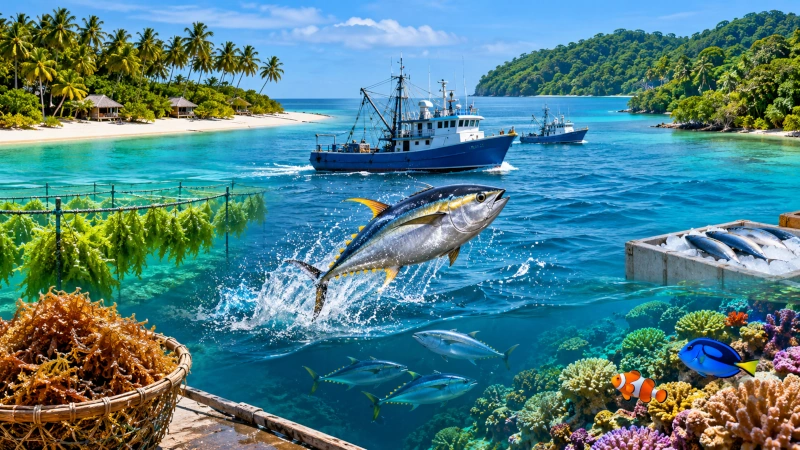
India is advancing an ambitious strategy to transform Lakshadweep and the Andaman & Nicobar Islands into major centres for high-value marine fisheries, seaweed cultivation and ornamental fish production. The initiative seeks to harness the considerable fisheries potential of India’s island territories while strengthening seafood exports, developing modern infrastructure and creating new economic opportunities for coastal communities.
According to the Ministry of Fisheries, Animal Husbandry and Dairying, the Government has envisaged investments of ₹393 crore under the Pradhan Mantri Matsya Sampada Yojana (PMMSY) for fisheries development in the two island territories. Of this, ₹218 crore has been allocated to the Andaman & Nicobar Islands and ₹175 crore earmarked for Lakshadweep.
The initiative forms part of India’s broader Blue Economy strategy, which aims to transform marine resources into sustainable sources of economic growth through scientific management, infrastructure development, technological modernisation and value-added production.
Island Territories Hold Nearly 40% of India’s Exclusive Economic Zone
Lakshadweep and the Andaman & Nicobar Islands occupy a strategically important position in India’s maritime geography. Together, they account for nearly 40% of the country’s Exclusive Economic Zone (EEZ), providing access to extensive fishing grounds across the Arabian Sea and the Bay of Bengal.
India possesses a coastline extending approximately 11,099 kilometres and an EEZ covering nearly 24 lakh square kilometres. The country’s estimated marine fisheries potential within this zone stands at 58.6 lakh metric tonnes, providing considerable opportunities for expanding sustainable fishing activities.
The fisheries sector currently supports the livelihoods of nearly 50 lakh fishers and contributes substantially to India’s food security, employment and export earnings. During FY 2025–26, India’s seafood exports were valued at approximately ₹73,890 crore, reflecting the growing importance of marine products in international trade.
Since 2015, the Government has committed approximately ₹39,272 crore through various fisheries development schemes and programmes, supporting the transformation of the sector through infrastructure modernisation, improved production capabilities and expanded market access.
Lakshadweep Targets 50,000 Tonnes of Tuna Production
Tuna fisheries constitute a central component of the Government’s island development strategy, particularly because the surrounding oceanic waters support commercially valuable species such as Yellowfin, Skipjack and Bigeye tuna.
In Lakshadweep, a five-year development plan aims to double tuna production to approximately 50,000 tonnes. The proposed expansion will be supported by the introduction of modern deep-sea fishing vessels, mother vessels, improved onboard preservation facilities and upgraded processing infrastructure.
The strategy also seeks to strengthen Lakshadweep’s traditional pole-and-line tuna fishery, a selective fishing method recognised for its relatively low environmental impact. By combining traditional fishing practices with modern technology, the Government intends to improve productivity while maintaining sustainable harvesting practices.
Better cold-chain infrastructure, processing facilities and export connectivity are expected to increase the commercial value of tuna harvested in the islands. These improvements would also help reduce post-harvest losses and enable island-based fishing enterprises to participate more effectively in domestic and international seafood markets.
Andaman & Nicobar Islands to Develop Dedicated Tuna Cluster
The Andaman & Nicobar Islands are being developed as another major centre for high-value tuna fisheries under PMMSY. A dedicated Tuna Cluster is intended to strengthen fishing capabilities, modernise existing fleets and establish the infrastructure required for commercial seafood processing and exports.
The programme includes the introduction of new fishing vessels, modernisation of operational fleets and expansion of cold storage and preservation facilities. These investments are intended to enable local fishing enterprises to access offshore resources more efficiently while maintaining the quality standards required by international markets.
The Marine Products Export Development Authority (MPEDA) is also strengthening its presence in the islands to improve market connectivity and facilitate direct seafood exports. This approach could reduce dependence on mainland processing and distribution centres while allowing a greater share of value addition to remain within the island economy.
The islands’ location near important Southeast Asian maritime routes provides additional opportunities for developing export-oriented marine industries, particularly when supported by reliable logistics, processing capabilities and internationally accepted quality standards.
Lakshadweep Identified as Dedicated Seaweed Production Cluster
Alongside tuna fisheries, seaweed cultivation is emerging as another important component of India’s island-based Blue Economy strategy.
Lakshadweep has been notified as a dedicated Seaweed Cluster, with plans to expand cultivation through organised production systems, seed banks, hatcheries and technical training programmes. The initiative seeks to develop an integrated seaweed value chain capable of supporting cultivation, processing and commercial applications.
Seaweed is an increasingly valuable marine resource used in food products, nutraceuticals, cosmetics, pharmaceuticals and several bio-industrial applications. Its cultivation offers opportunities for diversifying marine livelihoods without depending exclusively on conventional capture fisheries.
The sheltered lagoon systems of Lakshadweep and suitable marine habitats around the Andaman & Nicobar Islands provide opportunities for scientifically managed seaweed cultivation. The Government’s development approach places emphasis on capacity building and infrastructure support to enable local communities and entrepreneurs to participate in this emerging industry.
Establishing processing and value-addition facilities within the islands could further improve the commercial potential of seaweed production, encouraging the development of small enterprises and marine-based manufacturing activities.
Ornamental Fisheries Offer New Opportunities for Island Communities
The Government is also exploring the commercial potential of ornamental fisheries, particularly in Lakshadweep, where marine ecosystems support more than 300 reef-associated ornamental species.
The development strategy envisages establishing medium-scale ornamental fish rearing units, improving market access and promoting regulated collection practices that safeguard sensitive marine habitats.
Ornamental fish are used in the aquarium trade, creating opportunities for specialised breeding, rearing and distribution enterprises. Developing these activities through scientifically managed systems could provide additional livelihood opportunities for island communities.
However, the programme places importance on conservation-based production and responsible management of marine biodiversity. Expanding captive rearing and regulating the collection of wild species will be essential to ensuring that commercial activities do not damage the fragile coral reef ecosystems supporting these resources.
Modern Infrastructure to Strengthen Fisheries and Seafood Exports
Infrastructure modernisation is another major component of the Government’s fisheries development programme for the island territories.
Planned investments cover fish landing centres, ice plants, cold-chain networks, onboard preservation systems, fish aggregating devices, boat-building facilities and seafood value-addition units. These facilities are intended to strengthen the entire fisheries value chain, from harvesting and handling to processing, storage and export distribution.
Improved infrastructure is particularly important for island territories, where geographical isolation and transportation constraints can increase operational costs and limit access to larger markets.
Expanding local preservation and processing capabilities would allow fishermen and marine enterprises to retain product quality, reduce wastage and improve profitability. It would also support the development of employment opportunities in vessel operations, seafood processing, refrigeration, logistics and related services.
The Government’s approach reflects a broader transition from increasing fish production alone towards developing a modern marine economy capable of generating higher value from available resources.
Blue Economy Development Gains Strategic Importance
The development of fisheries in Lakshadweep and the Andaman & Nicobar Islands also carries considerable importance for India’s wider maritime economy.
The Union Budget 2025–26 outlined a framework for sustainably harnessing fisheries resources within India’s Exclusive Economic Zone and the High Seas, with special emphasis on the two island territories.
Their geographical locations provide India with access to important oceanic fishing grounds and opportunities to expand its commercial presence across both the Arabian Sea and the eastern Indian Ocean.
Developing fishing fleets, marine infrastructure, processing facilities and associated services can strengthen the economic foundations of these territories while supporting India’s wider ambitions in sustainable ocean-resource development.
At the same time, the integration of scientific fisheries management, selective fishing practices and marine ecosystem protection will be important in ensuring that commercial expansion remains compatible with long-term environmental sustainability.
Towards a More Diversified Marine Economy
India’s island-focused fisheries strategy represents an important shift towards developing integrated marine industries rather than relying primarily on traditional fishing activities.
By combining high-value tuna production, seaweed cultivation, ornamental fisheries, cold-chain development and export infrastructure, the Government aims to create a more diversified economic base for Lakshadweep and the Andaman & Nicobar Islands.
The proposed investments under PMMSY, together with targeted cluster development and improved market connectivity, provide a framework for expanding economic activity while creating opportunities for local fishing communities and entrepreneurs.
As these initiatives progress, India’s island territories are positioned to play an increasingly important role in strengthening seafood exports, encouraging marine-based industries and advancing the country’s long-term Blue Economy objectives.
You may also like
-
Indian Spacetech Startup PierSight’s Varuna 2.0 Satellite Clears Key Structural Qualification Test
-
GAIL Commissions 1.25 Million Tonne PTA Plant in Mangalore, Expanding India’s Petrochemical Manufacturing Capacity
-
Morepen Laboratories Enters US Prescription Generics Market with Desloratadine Launch
-
HSBC Upgrades Indian Equities to Overweight, Citing Resilient Earnings and Attractive Valuations
-
India’s Startup Ecosystem Crosses 2.62 Lakh Recognised Enterprises, Creates Over 25 Lakh Jobs
