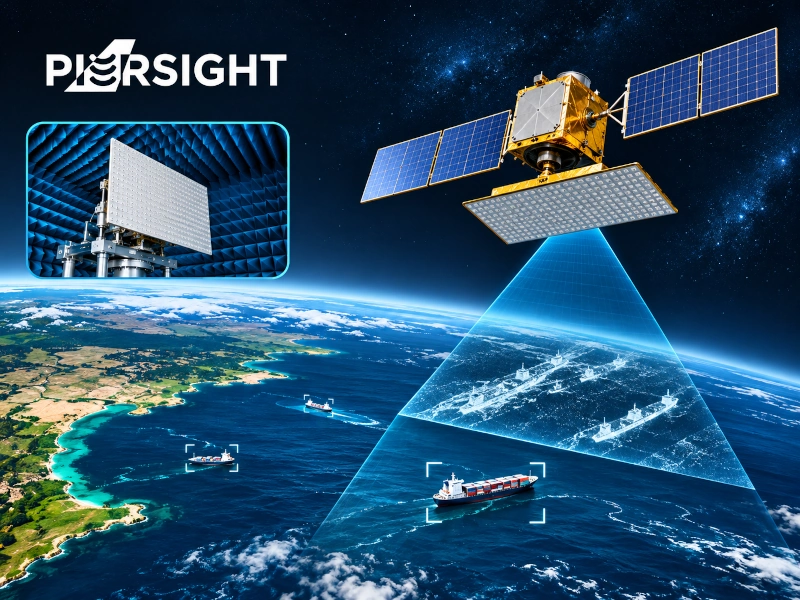
Ahmedabad-based spacetech startup PierSight Technologies has achieved an important milestone in India’s indigenous satellite development capabilities, with the Structural Qualification Model (SQM) of its Varuna 2.0 satellite successfully completing integration and vibration testing at the Indian Space Research Organisation’s Space Applications Centre (SAC) in Ahmedabad.
The development, confirmed by PierSight in a company update on 9 November 2026, represents a significant step towards the company’s first commercial satellite combining Synthetic Aperture Radar (SAR) and Automatic Identification System (AIS) capabilities. The spacecraft is being developed to provide advanced maritime surveillance through all-weather radar imaging and vessel-tracking information.
The successful vibration test demonstrates that the satellite’s structural qualification model has met the requirements of this phase of environmental testing. The milestone brings PierSight closer to developing flight hardware for a satellite system intended to support maritime security, shipping intelligence, illegal fishing detection, and ocean monitoring.
Varuna 2.0 Structural Qualification Model Completes Vibration Testing
PierSight announced that the Structural Qualification Model of Varuna 2.0 had been successfully integrated and cleared vibration testing at ISRO’s Space Applications Centre.
The Structural Qualification Model is a full-scale engineering prototype designed to represent the spacecraft’s structural and functional configuration before the final flight hardware is manufactured and qualified.
Such models allow engineers to evaluate the performance of a satellite’s structure, mechanical assemblies, and interfaces under conditions simulating the stresses encountered during launch and space operations.
Vibration testing is a particularly important component of satellite qualification because launch vehicles subject their payloads to substantial mechanical forces. These include vibrations generated by rocket engines, aerodynamic forces, and the dynamic behaviour of the launch vehicle during ascent.
Satellite structures must withstand these conditions while maintaining the integrity of their mechanical assemblies and critical subsystems.
By successfully completing the vibration test, PierSight has demonstrated progress in validating the structural design of Varuna 2.0. The achievement follows the earlier assembly and integration of the qualification model, which the company had prepared for environmental testing.
The qualification model also provides a platform for assessing thermal behaviour and electrical interfaces before the spacecraft design progresses towards flight-model development.
Combining SAR and AIS for Advanced Maritime Surveillance
Varuna 2.0 is being developed as a commercial maritime surveillance satellite integrating two complementary technologies: Synthetic Aperture Radar and Automatic Identification System.
Synthetic Aperture Radar is an active remote-sensing technology that transmits microwave signals towards the Earth’s surface and analyses the returning reflections to generate images.
Unlike conventional optical imaging systems, SAR does not depend upon sunlight and can operate during both day and night. Radar signals can also penetrate cloud cover, providing a significant advantage for observing ocean regions where persistent clouds and adverse weather limit optical satellite coverage.
Automatic Identification System technology provides information transmitted by participating vessels, including identification details, position, course, and speed.
By combining these two sources of information, Varuna 2.0 is intended to provide a more comprehensive understanding of maritime activity.
SAR imagery can reveal vessels present in a monitored region, while AIS information helps identify ships broadcasting their position and identity.
Comparing radar detections with AIS records can help identify discrepancies, including vessels that are visible to radar but are not transmitting corresponding identification signals.
Such capabilities are particularly important for monitoring maritime activity across extensive ocean areas where continuous physical surveillance by ships and aircraft is difficult.
Detecting Dark Vessels and Illegal Maritime Activity
One of the principal applications of PierSight’s planned satellite system is the detection of vessels operating without transmitting identification information.
These vessels are sometimes described as dark vessels because they are not visible through conventional AIS-based monitoring systems.
Although the absence of an AIS signal does not automatically indicate illegal activity, it can warrant further examination when combined with radar observations and other maritime intelligence.
Illegal fishing, unauthorised maritime activity, trafficking, and violations of exclusive economic zone regulations are among the activities that can benefit from improved surveillance.
A satellite equipped with both SAR and AIS capabilities can help identify vessels whose presence does not correspond with available tracking information.
The technology also has potential applications in monitoring shipping routes, studying vessel movement patterns, detecting maritime pollution, and supporting search-and-rescue operations.
For countries with extensive coastlines and large exclusive economic zones, space-based surveillance can supplement traditional monitoring capabilities by providing information from regions that may be difficult to observe continuously using conventional assets.
Building a 32-Satellite Maritime Surveillance Constellation
Varuna 2.0 forms part of PierSight’s wider ambition to establish a constellation of 32 satellites integrating SAR and AIS technologies.
The proposed constellation is designed to provide persistent maritime situational awareness by enabling repeated observations of ocean regions from multiple spacecraft.
A single Earth observation satellite can monitor a particular region only when its orbital path brings it within viewing range. A constellation distributes observation capabilities across multiple satellites, potentially reducing the interval between successive observations.
PierSight’s proposed system targets approximately one-metre radar resolution and a revisit interval of around 30 minutes when the planned constellation is operational.
The company also describes a wide-area surveillance architecture intended to support monitoring across extensive maritime regions.
These are performance objectives associated with the planned constellation rather than capabilities already demonstrated by Varuna 2.0 in orbit.
The development of such a system would strengthen the availability of commercial maritime intelligence services, particularly for organisations requiring regular information about shipping movements, offshore activity, and maritime security.
Building on the Success of India’s First Varuna Demonstrator
Varuna 2.0 builds upon PierSight’s earlier Varuna technology demonstration mission, which was launched aboard ISRO’s PSLV-C60 mission on 30 December 2024.
The first Varuna payload was carried on the PSLV Orbital Experimental Module-4 (POEM-4) platform as part of the SpaDeX mission.
The technology demonstrator was designed to evaluate important subsystems required for future Synthetic Aperture Radar satellites.
These included an indigenously developed deployable reflectarray antenna, software-defined radar and radio systems, a solid-state power amplifier, electronic power-conditioning equipment, and associated radar transmission and reception components.
The mission provided an opportunity to test these technologies in the space environment and gather information relevant to subsequent satellite development.
According to PierSight, the mission successfully completed its principal objectives and demonstrated Technology Readiness Level 9 for its tested subsystems.
The experience gained from the demonstrator has supported the company’s progression towards Varuna 2.0, which is intended to integrate radar imaging and maritime vessel-tracking capabilities into a commercial spacecraft.
The transition from technology demonstration to an integrated commercial satellite is an important stage in the development of indigenous space hardware.
Indigenous Satellite Engineering and Advanced Payload Development
PierSight’s satellite development programme involves several specialised engineering capabilities, including radar electronics, antenna systems, power management, mechanical structures, and thermal engineering.
Synthetic Aperture Radar satellites are particularly demanding because they require precise coordination between radio-frequency components, signal-generation systems, antennas, onboard electronics, and spacecraft operations.
The radar payload must transmit signals towards the Earth’s surface, receive the returning echoes, and support their processing into usable observations.
Power-management systems must provide the electrical energy required by these components, while mechanical and thermal subsystems protect the spacecraft during launch and operation.
PierSight has also reported progress in the development and qualification testing of individual Varuna 2.0 components, including its payload controller and power electronics.
The company’s earlier testing of its reflectarray antenna at ISRO’s Compact Antenna Test Range Facility in Ahmedabad demonstrated agreement between measured antenna performance and engineering simulations.
Together, these activities illustrate the range of technologies involved in developing an indigenous radar satellite.
The successful vibration test of the integrated Structural Qualification Model represents another stage in bringing these systems together within a spacecraft architecture.
Importance for India’s Maritime Security
India’s extensive coastline, island territories, and maritime interests create substantial requirements for ocean surveillance and maritime domain awareness.
The Indian Ocean is among the world’s most strategically important maritime regions, carrying major international shipping routes and supporting significant commercial, energy, and fishing activities.
Monitoring these waters requires information from multiple sources, including coastal radar networks, ships, maritime patrol aircraft, satellites, and vessel-reporting systems.
Space-based radar imaging can complement these capabilities by providing wide-area observations independent of daylight and many adverse weather conditions.
Combining radar imagery with AIS information can help maritime authorities identify vessels, monitor movement patterns, and investigate discrepancies between reported positions and observed activity.
Such systems can support maritime law enforcement, fisheries protection, offshore infrastructure monitoring, and security assessments.
Commercial satellite providers can contribute to this ecosystem by developing specialised observation capabilities and data services that can be integrated with existing maritime surveillance platforms.
PierSight’s Varuna programme is therefore relevant not only to India’s commercial space industry but also to the country’s broader maritime technology and security capabilities.
Strengthening India’s Private Space Manufacturing Ecosystem
The progress of Varuna 2.0 reflects the expanding role of Indian private companies in satellite design, payload engineering, testing, and commercial space services.
India’s space-sector reforms have created opportunities for startups to develop independent satellite systems while accessing the country’s established scientific and engineering infrastructure.
ISRO’s Space Applications Centre has played an important role in developing India’s satellite payload capabilities, including remote sensing, communication, and advanced sensing technologies.
The use of SAC’s testing infrastructure for Varuna 2.0 demonstrates how established national facilities can support the development of commercial spacecraft.
Such cooperation enables Indian startups to undertake specialised engineering and environmental tests without independently establishing every major testing facility required for satellite development.
PierSight’s progression from its earlier technology demonstrator to the Varuna 2.0 qualification programme illustrates the increasing technical sophistication of India’s private spacetech ecosystem.
The development is also relevant to the broader objective of strengthening domestic capabilities in advanced electronics, satellite payloads, precision manufacturing, and space-based data services.
Towards an Indigenous Maritime Intelligence Constellation
The successful integration and vibration testing of the Varuna 2.0 Structural Qualification Model marks another milestone in PierSight’s efforts to develop an indigenous commercial maritime surveillance system.
The achievement demonstrates progress in validating the spacecraft’s structural design and supports the engineering work required before the final flight satellite can proceed through its remaining development and qualification stages.
Varuna 2.0 is intended to combine two complementary sources of maritime intelligence, allowing radar-based vessel detection to be integrated with identification and tracking information.
The company’s proposed 32-satellite constellation would extend this capability through repeated observations of ocean regions, supporting more continuous monitoring of maritime activity.
For India’s emerging private space industry, the project represents an important example of a domestic startup developing specialised satellite hardware for commercial and strategic applications.
The milestone also reflects the increasing participation of Indian companies in technologically demanding segments of the global space economy.
As PierSight advances its Varuna programme, the development contributes to India’s growing expertise in radar satellite engineering, space-based maritime intelligence, and indigenous commercial spacecraft manufacturing.
References
1. PierSight Technologies
Company announcement confirming successful integration and vibration testing of the Varuna 2.0 Structural Qualification Model at ISRO’s Space Applications Centre.
Published: 9 November 2026.
2. PierSight Technologies – Varuna Satellite Programme
Official technical information concerning the company’s planned SAR–AIS maritime surveillance constellation, radar capabilities, and commercial applications.
3. Indian Space Research Organisation
POEM-4 Payloads – PSLV-C60 / SpaDeX Mission.
Official mission documentation identifying PierSight’s original Varuna technology demonstrator and its radar subsystem objectives.
4. PierSight Technologies – Varuna Mission
Official technical description of the first Varuna mission, including its in-orbit technology demonstrations, engineering subsystems, and mission objectives.
5. StartupPedia
Ahmedabad Space-Tech Startup PierSight Completes Integration and Testing of Varuna 2.0 Satellite Model.
Published: 6 November 2026.
Company: PierSight Technologies, Ahmedabad, Gujarat
Sector: Space Technology | Satellite Manufacturing | Synthetic Aperture Radar | Maritime Surveillance | Defence Technology
Development Status: Structural Qualification Model integrated and vibration testing completed.
Announcement: 9 November 2026.
You may also like
-
GAIL Commissions 1.25 Million Tonne PTA Plant in Mangalore, Expanding India’s Petrochemical Manufacturing Capacity
-
Morepen Laboratories Enters US Prescription Generics Market with Desloratadine Launch
-
HSBC Upgrades Indian Equities to Overweight, Citing Resilient Earnings and Attractive Valuations
-
India’s Startup Ecosystem Crosses 2.62 Lakh Recognised Enterprises, Creates Over 25 Lakh Jobs
-
Paras Semiconductors Partners with US Firm BroadPak to Develop Advanced Chip Packaging Capabilities in India
