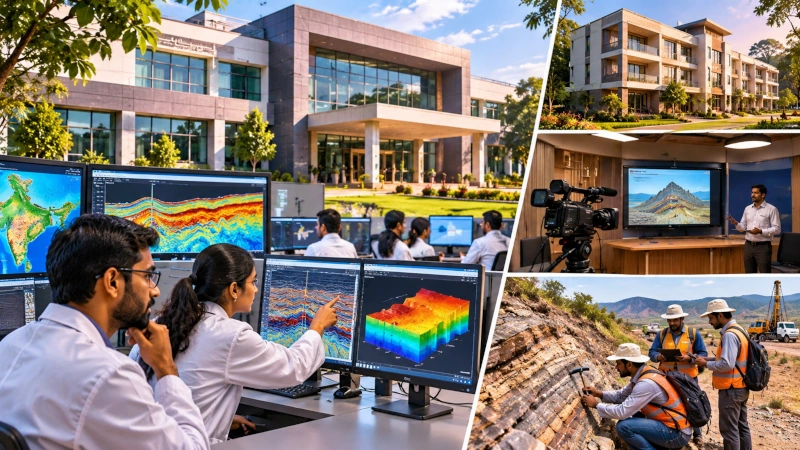
The Geological Survey of India (GSI) is strengthening India’s geoscientific research and mineral exploration capabilities with the establishment of an Advanced Geophysical Data Processing Laboratory at its Training Institute in Hyderabad. The new facility, equipped with high-performance computing systems and specialised software, will support advanced geological data analysis, mineral exploration, and the training of geoscientists.
Union Minister for Coal and Mines G. Kishan Reddy is scheduled to inaugurate the laboratory on 10 November 2026 at the Geological Survey of India Training Institute (GSITI) in Bandlaguda-Nagole, Hyderabad. The inauguration will also include an International Hostel and a Digital Studio, representing a combined infrastructure investment of ₹9.12 crore.
The three facilities are intended to enhance India’s technical capabilities in mineral resource assessment, advanced geophysical modelling, international scientific cooperation, and digital education. The expansion is particularly significant as India strengthens domestic mineral exploration and develops the scientific capabilities required to identify resources important to manufacturing, energy, infrastructure, and advanced technologies.
Advanced Geophysical Laboratory Equipped with High-Performance Computing Systems
The Advanced Geophysical Data Processing Laboratory has been established at a cost of ₹4.55 crore, with financial support from the National Mineral Exploration and Development Trust (NMEDT) and the Geological Survey of India.
The laboratory contains 25 high-end computer systems equipped with specialised software for geophysical data processing, modelling, inversion, and interpretation. These capabilities will enable geoscientists to analyse complex datasets obtained through geological and geophysical surveys and develop more detailed representations of subsurface geological structures.
Geophysical exploration involves studying the physical properties of rocks and geological formations to identify structures and potential mineral deposits beneath the Earth’s surface. Techniques involving gravity, magnetic, electrical, electromagnetic, and seismic measurements provide information that can help scientists understand geological conditions without relying exclusively on direct excavation or drilling.
Advanced data processing is essential for interpreting these measurements. Geological datasets often contain complex signals influenced by multiple subsurface structures, requiring sophisticated computational techniques to distinguish meaningful geological features from background variations.
The new laboratory will strengthen the institute’s ability to provide practical training in these techniques while supporting the technical capabilities required for mineral exploration and geological assessment.
Strengthening India’s Mineral Exploration Capabilities
The establishment of the facility comes as India places increasing emphasis on identifying and assessing domestic mineral resources, including minerals required for strategic industries and advanced manufacturing.
Modern mineral exploration depends increasingly on the integration of geological observations, geophysical measurements, geochemical information, and computational analysis. These methods help scientists identify promising geological structures and prioritise locations for further investigation.
One of the important applications of geophysical modelling is the investigation of mineral deposits that may not be immediately visible at the Earth’s surface. Such deposits can occur beneath soil cover, sedimentary formations, or other geological layers, making their identification dependent upon indirect measurements and detailed interpretation.
Geophysical inversion is particularly relevant to this process. It involves using observed physical measurements to estimate the properties and structure of the subsurface. By combining field observations with mathematical models, researchers can develop improved interpretations of geological formations and assess areas that warrant further exploration.
The Hyderabad laboratory will strengthen the availability of computational infrastructure and technical training required for these activities. Its facilities will contribute to building expertise in the scientific methods used to support modern mineral exploration programmes.
Supporting Exploration for Critical and Strategic Minerals
India’s growing requirements for advanced manufacturing, renewable energy, electric mobility, electronics, and defence technologies have increased the importance of developing reliable access to mineral resources.
Minerals such as lithium, cobalt, nickel, copper, graphite, and rare earth elements are important inputs for a wide range of technologies. Identifying economically recoverable resources requires detailed geological investigation supported by modern exploration methods.
Advanced geophysical analysis can contribute to this effort by helping scientists investigate subsurface structures and identify geological environments that may contain mineral deposits.
The Geological Survey of India plays an important role in generating geoscientific information and carrying out mineral resource assessments across the country. Its work provides scientific information that supports exploration planning by government agencies and the wider mineral sector.
By strengthening specialised training in geophysical interpretation and computational modelling, the new laboratory will contribute to India’s expanding mineral exploration capabilities.
International Hostel to Expand Geoscientific Cooperation
Alongside the laboratory, the Geological Survey of India Training Institute will inaugurate a new International Hostel developed at a cost of ₹4.27 crore.
The facility, named Nalanda and Takshashila, contains 32 fully furnished suites with modern amenities, including dining facilities, recreational spaces, a gymnasium, a mini-library, and laundry services.
Developed in accordance with suggestions from the Ministry of External Affairs, the hostel is intended to accommodate international trainees participating in programmes conducted by GSITI.
The institute has an established role in providing technical training to geoscientists from India and other countries, including programmes covering geological mapping, mineral exploration, remote sensing, and geospatial technologies.
The new residential infrastructure will strengthen its ability to host international participants and facilitate interaction among scientists and technical professionals from different geological institutions.
The initiative also supports India’s broader scientific cooperation activities by providing infrastructure for international training, professional exchanges, and the sharing of geoscientific expertise.
Digital Studio to Strengthen Geoscience Education and Training
The third facility scheduled for inauguration is a Digital Studio established at a cost of ₹30 lakh with support from the Capacity Building Commission (CBC) and the Geological Survey of India.
The studio will support the production of digital learning resources, including video lectures, podcasts, webinars, and other educational materials.
These resources will be developed for the iGOT Karmayogi platform as part of Mission Karmayogi, the Government of India’s initiative to strengthen capacity building among public-sector personnel.
Digital training infrastructure is particularly relevant to scientific organisations whose personnel require continuous exposure to new analytical methods, technological developments, and specialised technical procedures.
The studio will allow GSITI to expand access to structured educational resources and support professional development beyond conventional classroom training.
Together with the new laboratory and international hostel, the facility will contribute to a more comprehensive training environment combining advanced computational tools, residential learning, and digital education.
Geological Survey of India’s Role in National Resource Development
Established in 1851 to investigate coal deposits required for railway development, the Geological Survey of India has evolved into one of the country’s principal geoscientific organisations.
Operating under the Ministry of Mines, GSI is responsible for generating and updating geological information, conducting mineral exploration, assessing geological resources, and undertaking multidisciplinary investigations into India’s geological environment.
Its work also encompasses fundamental geoscientific research and investigations relating to natural hazards.
The Geological Survey of India Training Institute, established in 1976, serves as an important centre for developing the technical capabilities of geoscientists and other professionals working in geological and mineral exploration activities.
The institute provides specialised training across disciplines such as geology, geophysics, geochemistry, remote sensing, and geospatial analysis.
Its programmes support personnel from the Geological Survey of India, state geological organisations, other government agencies, and participating international institutions.
The addition of the Advanced Geophysical Data Processing Laboratory will expand the technical infrastructure available for training professionals in computational methods that are becoming increasingly important to modern geoscientific investigations.
Building Scientific Capacity for India’s Mineral Future
The establishment of the Advanced Geophysical Data Processing Laboratory represents an investment in the scientific infrastructure required for India’s mineral exploration and geological research programmes.
As exploration activities increasingly rely upon sophisticated instruments and complex datasets, the ability to process, model, and interpret geophysical information becomes essential to identifying promising geological structures.
The new laboratory will provide the computational infrastructure needed to strengthen specialised training in these fields, while the International Hostel and Digital Studio will expand opportunities for scientific cooperation and professional development.
Together, the three facilities will reinforce the Geological Survey of India Training Institute’s role as a centre for advanced geoscientific education and technical capacity building.
The expansion reflects India’s continuing efforts to strengthen domestic scientific expertise, improve mineral exploration capabilities, and develop the knowledge infrastructure needed to support the country’s manufacturing, energy, and technological ambitions.
Official Source: Ministry of Mines, Government of India – Press Information Bureau, Hyderabad.
Announcement: Inauguration of International Hostel, Advanced Geophysical Data Processing Laboratory and Digital Studio at Geological Survey of India, Training Institute, Hyderabad by Shri G. Kishan Reddy, Hon’ble Union Minister of Coal and Mines, Govt. of India.
Published: 9 November 2026, 12:37 PM.
Scheduled Inauguration: 10 November 2026, 9:30 AM.
Institution: Geological Survey of India Training Institute, Bandlaguda-Nagole, Hyderabad.
Sector: Geoscience | Mineral Exploration | Advanced Computing | Geological Research | Scientific Infrastructure
You may also like
-
Pune University Scientists Discover How Immune Cells Influence Ovarian Cancer Progression
-
India and EU Conclude Horizon Europe Negotiations, Opening New Opportunities for Scientific Research
-
IIT Guwahati Uses Drone Data from 36,000 Vehicles to Develop Indian Traffic Models
-
Wildlife Institute of India Study Reveals How Lightning Helps Andaman Mangrove Forests Regenerate
-
Indian and Russian Scientists Develop Solar-Powered Ammonia Production Method for Greener Fertilisers
