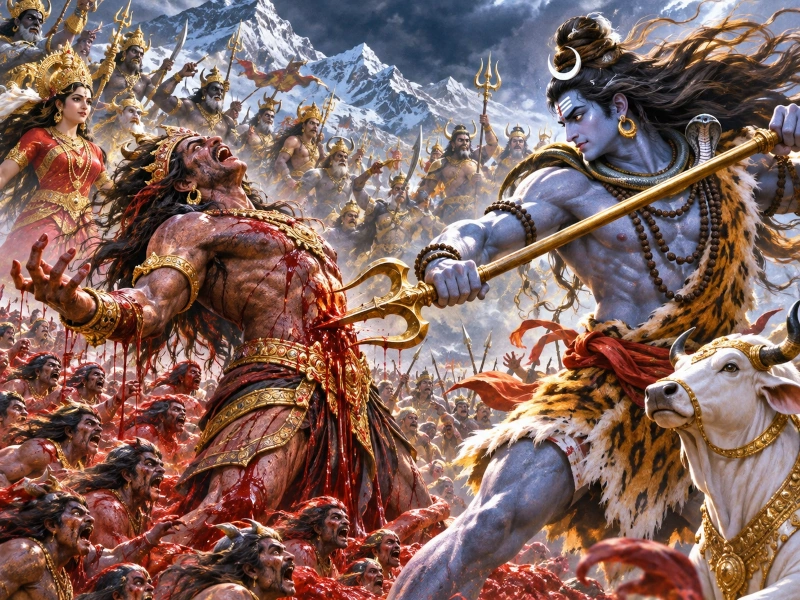
Warcraft Strategies from the Puranas | Shiva Purana – Rudra Samhita, Yuddha Khanda
The war between Lord Shiva and Andhakasura is among the most extraordinary military confrontations described in the Puranas. What begins as an ambitious demon king’s campaign against Shiva’s mountain stronghold develops into a prolonged conflict involving enormous armies, powerful commanders, supernatural weapons, battlefield deception, and an adversary whose strength appears to increase even as his forces suffer devastating losses.
The confrontation presents a remarkable military dilemma. Andhaka commands formidable armies and possesses extraordinary personal strength, but his most dangerous advantage emerges when his blood generates additional warriors during battle. Conventional attacks, which should progressively weaken an opponent, instead threaten to multiply the enemy’s strength. The divine coalition must therefore discover how to defeat an adversary whose regenerative capabilities render ordinary battlefield victories insufficient.
The Shiva Purana, particularly the Yuddha Khanda of the Rudra Samhita, provides an extensive account of this confrontation. Related narratives appear in the Linga Purana, Matsya Purana, and Skanda Purana, although the traditions differ in certain battlefield details and the divine forces involved.
Beyond its religious significance, Andhaka’s campaign offers a fascinating study of defensive warfare, force regeneration, command resilience, coalition operations, strategic adaptation, and the fundamental distinction between destroying an enemy’s deployed forces and neutralising the mechanisms that sustain them.
The Rise of Andhaka: Military Power Without Strategic Restraint
According to the Shiva Purana, Andhaka’s origins are closely connected with Shiva and Parvati. The narrative describes his extraordinary birth and subsequent adoption into the family of Hiranyaksha, the powerful Daitya ruler. Raised among the Asuras, Andhaka eventually becomes a formidable sovereign whose strength is enhanced through severe austerities and boons obtained from Brahma. His growing power allows him to extend his authority and command armies capable of challenging even the celestial forces.
However, Andhaka’s military expansion is accompanied by increasing arrogance and the conviction that his extraordinary protection makes him virtually invincible. His ambitions eventually lead him towards Parvati, whom he desires without recognising the true nature of his relationship with Shiva. Rather than exercising political judgment or respecting the consequences of confronting Mahadeva, Andhaka chooses military aggression as the instrument through which he intends to achieve his objective.
The resulting campaign illustrates a recurring theme in Puranic accounts of warfare: military power becomes dangerous when separated from wisdom and restraint. Andhaka possesses enormous resources, powerful commanders, and extraordinary personal capabilities, yet the objective driving his campaign is fundamentally unsound. His confidence in military superiority prevents him from recognising that the conflict he initiates may ultimately exceed his ability to control it.
Strategic Principle: Military superiority cannot compensate for flawed political objectives. A ruler who mistakes extraordinary resources for unlimited strategic freedom risks initiating a conflict in which even substantial battlefield successes cannot produce a sustainable victory.
The Assault on Shiva’s Mountain Stronghold
Andhaka launches his campaign against Shiva’s mountain residence with a formidable Daitya army. Unlike an invasion directed towards territorial conquest, the operation focuses upon a specific and heavily defended objective. The mountain setting, protected approaches, and restricted access to Shiva’s residence give the defenders considerable advantages despite the numerical superiority of the attacking force.
The entrance to the mountain cavern is defended by Viraka, a powerful guardian whose determination becomes central to the opening phase of the campaign. The Shiva Purana describes successive engagements in which Andhaka and prominent Daitya warriors attempt to overcome this resistance. The attackers employ swords, maces, missiles, uprooted trees, and other destructive weapons, but their repeated assaults fail to secure an immediate breakthrough.
As the fighting intensifies, the Daitya forces press towards the entrance of Shiva’s residence and damage its surroundings. Parvati participates in organising the defence with powerful divine female forces, while Viraka continues to command resistance against the invading army. The defenders are compelled to confront an enemy possessing greater numbers and considerable destructive power, yet the attacking formations remain unable to achieve their central objective.
The engagement demonstrates the military importance of controlling strategically significant approaches. A numerically superior army cannot always translate its strength into decisive results when terrain restricts movement and the defenders maintain control of the principal access routes. Viraka’s resistance also illustrates how capable local commanders can preserve a position long enough for the wider military situation to change.
Strategic Principle: Defensive terrain, restricted approaches, and determined commanders can impose disproportionate costs upon a superior attacking army. Effective defence does not always require matching the enemy’s numerical strength; it requires preventing that strength from being employed decisively.
Shiva Mobilises a Vast Divine Coalition
As Andhaka’s campaign expands, Shiva mobilises a powerful coalition comprising divine forces with different capabilities and battlefield roles. The Shiva Purana describes an immense assembly that includes Shiva’s Ganas, Bhutas, and other supernatural beings, together with the forces of Vishnu and prominent celestial deities. The arriving warriors possess formidable weapons and are accompanied by chariots, elephants, horses, bulls, lions, and numerous other mounts.
This mobilisation transforms the conflict from a defensive engagement around a mountain stronghold into a major confrontation between opposing coalitions. Shiva’s forces possess considerable numerical strength, but the diversity of the assembled army also creates the need for coordination among formations with different fighting methods. The effective employment of these capabilities becomes essential because Andhaka’s commanders possess extraordinary powers that cannot always be countered through conventional attacks.
Viraka continues to play an important role in the campaign, while Shiva provides overall strategic direction. The combination of powerful individual warriors, large formations, and specialised capabilities enables the divine coalition to respond to threats that would overwhelm a smaller or less adaptable force. Nevertheless, the subsequent battle demonstrates that even an immense army remains vulnerable when confronted by an unfamiliar form of warfare.
The mobilisation reflects an important principle of coalition warfare. Military strength is enhanced when complementary capabilities are brought together under a common objective, but numerical superiority alone does not guarantee success. The effectiveness of a coalition depends upon the ability of its commanders to coordinate operations, preserve battlefield awareness, and respond collectively to emerging threats.
Strategic Principle: Coalition forces gain strength through the integration of specialised capabilities, but their effectiveness ultimately depends upon unified command, operational coordination, and the ability to adapt to threats that individual formations cannot defeat independently.
Vighasa’s Counterattack: The Sudden Neutralisation of an Army
One of the most unusual episodes in the campaign involves the demon Vighasa, whose extraordinary ability allows him to swallow opposing warriors and remove them from the battlefield. During the fighting, Vighasa engulfs major elements of Shiva’s coalition, including Vishnu, Brahma, Indra, and other divine forces, creating an immediate operational crisis for the defenders.
The sudden disappearance of these powerful warriors effectively neutralises formations that had previously provided the coalition with overwhelming strength. The episode is particularly significant because Vighasa does not defeat the army through a conventional contest of weapons or numbers. Instead, his unusual capability temporarily removes its principal combatants from the engagement, demonstrating how an unexpected battlefield threat can overturn the advantages of a much stronger opponent.
Viraka, who remains outside Vighasa’s control, reports the situation to Shiva. Recognising the gravity of the disruption, Shiva employs divine knowledge to compel Vighasa to release the warriors he has swallowed. The captured forces subsequently emerge and return to battle, restoring the coalition’s combat strength and allowing operations against Andhaka’s army to continue.
From a military perspective, the episode highlights the importance of command resilience and the preservation of operational continuity. An army may suffer a severe temporary setback without necessarily losing the campaign if surviving commanders retain the capacity to identify the threat and organise an effective response. Viraka’s continued presence ensures that the crisis is communicated, while Shiva’s intervention provides the countermeasure needed to restore the fighting force.
Strategic Principle: Unexpected threats can temporarily neutralise even powerful armies. The survival of capable commanders, reliable battlefield communication, and the availability of effective countermeasures are essential for preventing an operational disruption from becoming a strategic defeat.
Shukracharya and the Challenge of Enemy Force Regeneration
The next phase of the confrontation introduces Shukracharya, the preceptor of the Asuras, whose knowledge of Mritasanjivani enables him to restore fallen warriors to life. As Shiva’s forces inflict casualties upon the Daitya army, Shukracharya revives the dead combatants and returns them to the battlefield, effectively reversing the immediate consequences of the defenders’ military successes.
This capability fundamentally changes the nature of the war. Under ordinary circumstances, sustained casualties gradually reduce an army’s strength, exhaust its reserves, and weaken its capacity to continue offensive operations. Andhaka’s forces, however, possess a means of restoring combatants who have already been defeated. Consequently, the divine coalition discovers that successful engagements do not necessarily produce a corresponding reduction in the enemy’s effective strength.
The repeated revival of Daitya warriors creates a dangerous imbalance between battlefield effort and strategic results. Shiva’s forces continue expending energy and resources to defeat enemy formations, but the losses inflicted upon those formations are repeatedly reversed. The problem is no longer simply the strength of the attacking army; it is the extraordinary capability that allows the army to recover from destruction.
Recognising the importance of this regenerative mechanism, Shiva’s Ganas capture Shukracharya and bring him before Shiva, who swallows him and temporarily removes his ability to restore the fallen warriors. With the source of battlefield resurrection neutralised, casualties inflicted upon Andhaka’s army become more consequential, allowing the divine coalition to weaken the attacking formations more effectively.
The episode illustrates the distinction between attacking an enemy’s frontline forces and disrupting the system through which those forces are replenished. So long as Shukracharya remains operational, repeated battlefield victories produce limited strategic benefits. Once his capability is neutralised, the same military actions begin to generate more lasting results.
Strategic Principle: An army’s ability to sustain operations depends upon the systems that replace casualties and restore combat strength. Neutralising an adversary’s regeneration capability may therefore prove more decisive than repeatedly defeating the frontline formations it supports.
Andhaka’s Counteroffensive and the Limits of Conventional Destruction
Despite the destruction of large portions of his army and the temporary loss of Shukracharya’s regenerative support, Andhaka refuses to abandon the campaign. Protected by extraordinary boons and possessing immense personal strength, he continues confronting Shiva and the divine coalition with powerful weapons and deceptive battlefield methods.
The Shiva Purana describes Andhaka surviving attacks that would ordinarily destroy an opponent. His endurance allows him to continue fighting even after the wider military situation has turned against his forces. This persistence creates a difficult problem for the defenders, who must confront an adversary whose personal resilience prevents conventional attacks from producing a decisive conclusion.
As the battle intensifies, an even more dangerous capability emerges. Andhaka’s blood and bodily exudations give rise to additional manifestations resembling him, allowing new hostile forces to appear as the original combatant and his multiplying forms suffer injuries. The battlefield becomes increasingly crowded with enemies whose emergence is directly connected to the destructive attacks directed against them.
The consequences are extraordinary. Each successful strike may eliminate an individual manifestation while simultaneously creating the conditions for additional enemies to emerge. Instead of reducing the scale of the confrontation, conventional attacks risk expanding it, compelling Shiva’s forces to fight an increasingly complicated and potentially endless battle.
The central military problem is therefore transformed. The divine coalition cannot achieve lasting success merely by increasing the intensity of its attacks, because the existing method of destruction contributes to the enemy’s capacity for regeneration. The defenders must identify a different approach that addresses the mechanism responsible for the multiplication rather than repeatedly confronting its consequences.
Strategic Principle: When an adversary derives additional strength from the effects of conventional attacks, increasing destructive force may worsen the military situation. Effective commanders must recognise when established methods are producing unintended consequences and adapt their strategy accordingly.
The Multiplication of Andhaka: An Enemy Sustained by Battlefield Attrition
The multiplication of Andhaka represents the defining military challenge of the campaign. The Shiva Purana describes numerous manifestations of the demon emerging during the confrontation, with additional enemies appearing as Shiva destroys the existing forms. What should have been a progressive reduction in hostile strength becomes a recurring cycle of destruction and regeneration.
The battlefield consequently develops characteristics of a self-sustaining conflict. The defenders possess extraordinary weapons and powerful warriors, yet their superiority cannot produce decisive results while each successful attack risks generating fresh opponents. The immediate destruction of a target no longer guarantees a reduction in the overall threat, because the process responsible for creating replacement forces remains active.
This situation exposes the limitations of attritional warfare when the enemy possesses an effective mechanism for replenishing losses. Attrition normally seeks to weaken an opponent by progressively reducing manpower, equipment, and operational capacity. In Andhaka’s case, however, the consequences of attrition are reversed because the destruction of enemy manifestations can contribute to the appearance of additional combatants.
The divine coalition must therefore change the basis upon which it measures military effectiveness. The number of enemies destroyed is no longer a sufficient indicator of success. What matters is whether the defenders can prevent the creation of additional forces and convert their battlefield superiority into a permanent reduction in hostile strength.
This shift in thinking becomes central to the eventual outcome. The defenders move beyond the immediate objective of eliminating visible enemies and begin addressing the process that allows the enemy to remain seemingly inexhaustible.
Strategic Principle: Battlefield success must be measured by its effect upon an adversary’s sustained combat capability, not merely by the number of targets destroyed. When losses generate replacements, the decisive objective becomes disruption of the regenerative mechanism itself.
The Divine Countermeasure: Preventing the Regeneration of Andhaka’s Forces
Recognising the danger created by Andhaka’s multiplication, the divine coalition adopts a fundamentally different approach. In the Shiva Purana, Vishnu assumes a fierce female manifestation through divine power, enabling the blood and multiplying Daitya forces to be consumed before they can generate further enemies.
Other Puranic traditions, particularly those associated with the Matsya Purana, describe the intervention of the Matrikas, the powerful divine mother goddesses who prevent Andhaka’s blood from producing additional warriors. Although the traditions differ in their descriptions of the participating divine forces, the central battlefield solution remains consistent: the blood responsible for generating new enemies must be intercepted before the regenerative process can continue.
The countermeasure fundamentally alters the military balance. Previously, attacks upon Andhaka created the danger of additional hostile manifestations appearing on the battlefield. Once the blood is prevented from generating further enemies, the same attacks begin to reduce the adversary’s fighting strength rather than replenish it.
The intervention also demonstrates the importance of employing specialised capabilities against unconventional threats. Shiva’s coalition possesses overwhelming destructive power, but that power becomes strategically effective only after the regenerative process has been brought under control. The decisive breakthrough arises not from the introduction of a more destructive weapon, but from the development of a capability that prevents the enemy from exploiting the consequences of ordinary attacks.
This is the turning point of the campaign. By neutralising the process sustaining Andhaka’s multiplication, the divine forces transform a potentially endless confrontation into a battle in which the enemy can finally be weakened and defeated.
Strategic Principle: An apparently inexhaustible enemy becomes vulnerable when the mechanism sustaining its regeneration is identified and neutralised. Effective strategy targets the source of continuing strength rather than repeatedly confronting its visible manifestations.
Shiva’s Trident: The Decisive Engagement
With Andhaka’s regenerative advantage overcome and his armies progressively weakened, the confrontation enters its final phase. Despite the destruction of his forces and the loss of the capabilities that previously sustained his campaign, Andhaka continues resisting Shiva with extraordinary determination.
Shiva ultimately pierces Andhaka with his trident, the Trishula, and raises him above the battlefield. The Shiva Purana describes the demon remaining impaled upon the weapon while enduring prolonged suffering, with the heat of the sun and the effects of wind and rain acting upon his body. His military resistance has been decisively broken, yet the narrative does not conclude with his immediate destruction.
Instead, Andhaka undergoes a profound transformation. Having lost the arrogance that drove his campaign, he begins contemplating Shiva and offering prayers. His defeat creates the conditions for repentance, and he comes to recognise the supreme nature of the deity against whom he had launched his aggression.
Shiva ultimately responds with compassion, releases Andhaka from the trident, and grants him a position among his Ganas. The defeated demon is therefore transformed from a hostile aggressor into a devotee and attendant of the very power he had attempted to challenge. Other Puranic traditions preserve variations concerning his eventual fate, including accounts connecting him with Bhringi.
The conclusion introduces an important distinction between military victory and the political or moral settlement that follows it. Shiva eliminates Andhaka’s ability to continue aggression, but the ultimate resolution extends beyond the destruction of his military power. The defeated adversary is transformed and incorporated into a new order, bringing the confrontation to a conclusion in which further hostility is no longer necessary.
Strategic Principle: Decisive military victory removes an adversary’s capacity to continue aggression, but lasting stability may require an appropriate post-conflict settlement. Reconciliation and transformation can sometimes establish a more enduring outcome than destruction alone.
The Military Significance of Shiva’s Victory
The campaign against Andhaka presents a sequence of interconnected military problems, each requiring a different response from Shiva and the divine coalition. The initial engagements demonstrate the value of strong defensive positions and capable local commanders, as Viraka prevents a numerically superior invading army from achieving an immediate breakthrough. The subsequent mobilisation of divine forces illustrates the advantages of coalition warfare and the importance of combining diverse capabilities under unified strategic direction.
The encounter with Vighasa introduces the danger posed by unexpected battlefield capabilities capable of temporarily neutralising even powerful military formations. Shiva’s successful recovery of the swallowed warriors demonstrates the value of command resilience, reliable communication, and the ability to restore combat effectiveness after a major operational setback.
Shukracharya’s power of resurrection reveals another critical dimension of sustained warfare. So long as defeated Daitya warriors can be revived and returned to battle, the divine coalition cannot convert tactical successes into lasting strategic results. The neutralisation of Shukracharya demonstrates that an army’s ability to replenish its losses may be as important as the strength of its deployed formations.
Andhaka’s multiplication presents the most formidable challenge because it transforms conventional destruction into a source of additional enemy strength. The decisive countermeasure emerges only when the divine forces identify the process enabling this regeneration and prevent it from continuing. Once that mechanism is suppressed, Shiva’s superior combat capabilities can finally produce a decisive outcome.
Taken together, these episodes demonstrate that victory does not arise from superior strength alone. Each battlefield challenge requires an understanding of the adversary’s particular capabilities, followed by the selection of an appropriate response. The campaign illustrates how commanders who rely exclusively upon destructive power may become trapped in prolonged conflict, while those who understand the systems sustaining an opponent can fundamentally change the course of war.
A Modern Military Parallel: Attrition, Drone Warfare and Industrial Regeneration
The strategic problem presented by Andhaka’s multiplication has a striking conceptual parallel in modern conflicts involving mass-produced weapons, particularly inexpensive unmanned aerial systems. Contemporary armed forces increasingly confront situations in which destroying individual drones, missiles, or other expendable systems does not necessarily eliminate the underlying threat. When an adversary possesses the industrial capacity to manufacture replacements at a rate that sustains continued operations, successful battlefield interception may coexist with persistent or increasing military pressure.
The Russia–Ukraine war provides an important contemporary example. Russia’s expanding production and employment of Shahed-type one-way attack drones has placed sustained demands upon Ukrainian air defences. Although Ukrainian forces intercept large numbers of incoming systems, the continued availability of replacement drones allows repeated attacks against military targets and critical infrastructure.
The Center for Strategic and International Studies reported in May 2025 that Russian Shahed launches had increased from approximately 200 per week in September 2024 to more than 1,000 per week by March 2025. The figures demonstrate how the scale of an aerial threat can expand when production capabilities allow an attacker to maintain a high operational tempo despite substantial interception rates.
This creates a strategic challenge extending beyond the destruction of individual incoming weapons. Defensive operations remain essential for protecting populations, military installations, and critical infrastructure, but the wider contest also involves industrial production, component supply chains, logistical networks, launch systems, and the organisational capabilities that allow the attacker to sustain operations.
The conceptual parallel with Andhaka lies in the distinction between eliminating deployed threats and disrupting the systems responsible for replacing them. In the Puranic account, supernatural regeneration creates additional enemies when Andhaka’s blood reaches the battlefield. In modern warfare, manufacturing capacity and supply networks allow replacement weapons to enter service after earlier systems have been destroyed. Although the mechanisms are entirely different, both situations illustrate the limitations of relying upon attrition without considering an opponent’s capacity for regeneration.
Modern military planning must therefore account for the relationship between offensive production, defensive interception, logistical resilience, and the economic costs of sustained operations. The destruction of deployed systems remains necessary, but the wider strategic contest is influenced by the relative ability of opposing forces to replace losses and maintain combat effectiveness.
Strategic Adaptation: The Central Lesson of Andhaka’s Campaign
Andhaka’s war against Shiva illustrates how military conflicts can develop beyond their original objectives and confront commanders with threats that cannot be resolved through conventional methods alone. What begins as an assault upon a defended mountain stronghold expands into a prolonged confrontation involving enormous coalition armies, unusual battlefield capabilities, repeated resurrection of defeated warriors, and the uncontrolled multiplication of the principal adversary.
The defenders encounter a succession of problems that require different forms of military adaptation. Viraka’s determined resistance demonstrates the importance of defensive positions, while the intervention of Vighasa exposes the vulnerability of powerful armies to unexpected threats. Shukracharya’s resurrection of fallen Daityas reveals the limitations of attrition against an opponent possessing effective force-regeneration capabilities, and Andhaka’s multiplication presents the most extreme example of an enemy whose numbers increase as a consequence of attacks against him.
The decisive breakthrough comes when the divine coalition recognises that Andhaka’s apparent inexhaustibility depends upon a specific process and develops a countermeasure that prevents it from continuing. Once the regenerative mechanism is neutralised, the battlefield balance changes decisively, enabling Shiva to bring the military confrontation to an end.
The campaign therefore establishes a central principle of effective warfare: commanders must understand the systems that sustain an adversary rather than focusing exclusively upon the forces immediately visible on the battlefield. Superior weapons and numerical strength remain important, but their strategic value depends upon the ability to employ them against the enemy’s actual sources of power.
The Final Lesson: Victory Beyond Destruction
The conclusion of Andhaka’s campaign provides a final dimension that distinguishes it from an ordinary account of battlefield victory. Shiva’s triumph does not end merely with the destruction of the invading army or the impalement of Andhaka upon the trident. The narrative continues towards repentance, forgiveness, and the transformation of a defeated enemy into a devotee and attendant of Shiva.
This conclusion reflects the distinction between defeating an adversary and establishing a durable settlement after the fighting has ended. Military power can remove an immediate threat, but the conditions that follow victory determine whether the conflict has truly been resolved. Andhaka’s transformation represents an outcome in which the original source of aggression ceases to exist, not because the individual is simply destroyed, but because his intentions and relationship with Shiva are fundamentally changed.
The war consequently presents two complementary lessons. The first concerns the conduct of military operations: an adversary sustained by regenerative capabilities cannot be defeated effectively until those capabilities are neutralised. The second concerns the purpose of victory: the elimination of hostile intent can create a more enduring resolution than the destruction of hostile forces alone.
Andhaka’s war against Shiva ultimately demonstrates that lasting victory depends not merely upon overcoming an enemy’s immediate military strength, but upon understanding and neutralising the mechanisms that sustain aggression while establishing conditions in which renewed conflict is no longer necessary.
References
Primary Source
Shiva Purana, Rudra Samhita, Yuddha Khanda, Chapters 42–49. The principal narrative concerning Andhaka’s campaign against Shiva, the defence of Parvati, the involvement of Viraka and the divine armies, Shukracharya’s resurrection of the Daitya warriors, Andhaka’s multiplication, the use of Shiva’s trident, and the demon’s eventual transformation.
Additional Puranic Traditions
Linga Purana, Purva Bhaga, Chapter 93. The confrontation between Shiva and Andhaka, the destruction of the Daitya forces, and the defeat of Andhaka through Shiva’s trident.
Matsya Purana, Andhakasura narrative. The battle against Shiva, the multiplication of Andhaka through his blood, and the intervention of the Matrikas in preventing the emergence of additional enemies.
Skanda Purana, Nagara Khanda, Chapter 151. The confrontation between Andhaka and Shiva, his impalement upon the trident, and his subsequent prayers.
Textual Note: The Puranas preserve different versions of the Andhaka narrative. The principal account presented here follows the Shiva Purana, while related traditions are identified where they provide different descriptions of battlefield events and divine interventions.
Series: Warcraft Strategies from the Puranas
Strategic Theme: Attritional Warfare, Force Regeneration, Coalition Operations, Command Resilience, Strategic Adaptation and Post-Conflict Reconciliation
You may also like
-
The Immunity of Diplomatic Envoys: Vibhīṣaṇa’s Defence of Hanumān Before Rāvaṇa
-
Traditional Indian Artisans Record ₹55 Lakh Sales at Shilp Samagam Mela in Delhi
-
Tārā’s Diplomacy: How Wise Counsel Prevented a Political Crisis Between Allies
-
Hanumān in Rāvaṇa’s Court: Courage, Strategic Messaging and the Responsibilities of an Envoy
-
Lakṣmaṇa’s Mission to Kiṣkindhā: Enforcing Alliance Commitments Without Breaking the Partnership
