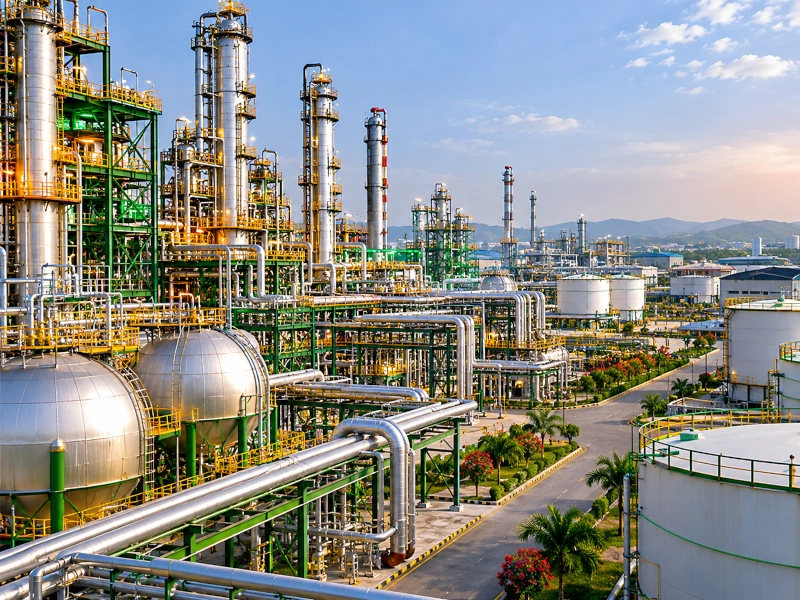
India’s chemicals and petrochemicals industry, currently valued at approximately $220 billion, is projected to expand to $300 billion by 2030 and reach $1 trillion by 2040, reflecting the growing importance of chemical manufacturing in the country’s industrial development. According to a comprehensive assessment released by the Ministry of Chemicals and Fertilizers on 7 November 2026, expanding production capacity, dedicated industrial infrastructure, research investment and technological innovation are strengthening India’s position in global chemical markets.
India is currently the world’s sixth-largest chemical producer and the fourth-largest in Asia. The industry comprises approximately 13,000 large manufacturing units and 4.45 lakh micro, small and medium enterprises, supplying essential materials to pharmaceuticals, agriculture, automobiles, textiles, electronics, construction and consumer goods.
The government’s assessment highlights substantial progress in petrochemical investment regions, chemical manufacturing parks, research infrastructure and industrial skills. These initiatives are intended to expand domestic production, attract international investment and strengthen India’s participation in global value chains.
India Emerges as a Major Global Chemical Manufacturing Centre
India’s chemical industry occupies an important position in the country’s manufacturing economy because of its extensive connections with downstream industries. Chemical products form essential inputs for pharmaceutical production, agricultural chemicals, synthetic fibres, paints, plastics, automobiles, electronics and construction materials.
The sector has also developed considerable international competitiveness in specialised product categories. India is the world’s second-largest manufacturer and exporter of dyes and the third-largest exporter of agrochemicals, reflecting its established industrial capabilities in chemical synthesis, formulation and processing.
The industry’s manufacturing base includes large integrated chemical complexes alongside hundreds of thousands of smaller enterprises engaged in intermediate chemicals, speciality products, industrial formulations and downstream processing.
This combination of large-scale manufacturing and specialised MSME production provides a foundation for expanding chemical value addition. It also creates opportunities for domestic manufacturers to supply higher-value intermediates and advanced materials to industries that previously depended on imported products.
Chemical and Petrochemical Production Records Substantial Growth
India has expanded the production of major chemicals and petrochemicals over the past decade, supported by industrial investment, rising domestic consumption and improvements in manufacturing infrastructure.
According to government figures, production increased from 45.638 million metric tonnes in 2015–16 to 58.617 million metric tonnes in 2024–25. This represents an increase of approximately 28.4% over the period.
The expansion reflects the growing requirements of India’s manufacturing sector, particularly in industries consuming polymers, chemical intermediates, industrial chemicals and speciality materials.
Petrochemical production supports numerous industrial applications, including packaging, automotive components, medical devices, textiles, electrical equipment and construction materials. Increasing domestic output can strengthen supply chains and create additional opportunities for downstream manufacturers.
The government has also highlighted the importance of encouraging advanced chemical manufacturing, where specialised production technologies and higher-value products can improve India’s industrial competitiveness.
Petrochemical Investment Regions Attract ₹3.4 Lakh Crore
One of the most significant achievements highlighted in the government assessment is the expansion of India’s Petroleum, Chemicals and Petrochemicals Investment Regions, commonly known as PCPIRs.
Three operational investment regions have been established at Dahej in Gujarat, Visakhapatnam–Kakinada in Andhra Pradesh and Paradeep in Odisha.
Together, these industrial regions have attracted approximately ₹3.4 lakh crore in cumulative investment, generated 3.7 lakh jobs and facilitated the establishment of more than 2,200 chemical manufacturing units.
The PCPIR model promotes integrated industrial development by bringing chemical manufacturers, processing facilities and supporting industries into geographically concentrated manufacturing regions.
These clusters provide access to shared infrastructure, including roads, railways, ports, water supply systems, steam generation facilities, sewage disposal networks and common effluent treatment plants.
Such integrated infrastructure is particularly important for chemical manufacturing because production facilities frequently require specialised utilities, safe material handling and reliable logistics.
By locating complementary industries within common industrial regions, PCPIRs can support more efficient material movement, stronger supplier networks and the development of downstream manufacturing activities.
₹3,030 Crore BHAVYA Rasayan Scheme to Establish Three Chemical Parks
The government is also advancing the Bharat Audyogik Vikas Yojana Rasayan, or BHAVYA Rasayan, scheme to develop three dedicated chemical manufacturing parks.
Approved in July 2026, the programme has a total financial outlay of ₹3,030 crore and will operate from FY2026–27 to FY2030–31.
Each proposed chemical park will cover at least 2,000 acres, creating large industrial zones equipped with specialised infrastructure and common services.
The Central Government will provide financial assistance of up to ₹1,000 crore for each park, subject to a minimum contribution of ₹500 crore from the respective state government.
Of the total scheme allocation, ₹3,000 crore has been earmarked for common infrastructure and essential utilities, while ₹30 crore will cover administrative expenditure.
The parks are intended to provide ready-to-use industrial infrastructure, including common effluent treatment plants, hazardous-waste management systems and storage and disposal facilities.
This model will enable chemical manufacturers to establish production facilities within integrated industrial ecosystems instead of independently developing every supporting utility.
The programme is expected to encourage domestic investment, improve logistics efficiency and support the establishment of new chemical manufacturing capabilities.
Ten Plastic Parks Approved to Strengthen Downstream Manufacturing
India is also expanding specialised industrial infrastructure through the Scheme for Setting up of Plastic Parks, which supports the development of integrated plastic-processing clusters.
The government has approved ten Plastic Parks across the country, of which four have achieved complete infrastructure development. Three of these parks reached full infrastructure completion during 2025–26.
Under the programme, the Central Government provides financial assistance covering up to 50% of eligible project costs, subject to a maximum contribution of ₹40 crore per project.
The parks are intended to encourage investment in downstream polymer processing, industrial manufacturing and value-added plastic products.
By bringing processing enterprises into common industrial locations, the scheme supports shared infrastructure, improved logistics and closer relationships between polymer producers and downstream manufacturers.
The government has also incorporated waste management and recycling considerations into the development of these industrial clusters, recognising the importance of responsible material processing.
₹1 Lakh Crore Research Scheme Opens New Opportunities for Advanced Chemicals
Research and technological innovation represent another important component of India’s chemical industry development strategy.
The government’s ₹1 lakh crore Research, Development and Innovation Scheme, launched in November 2025, provides long-term financing and refinancing support for private-sector research and advanced technological development.
Effective 8 October 2026, advanced chemicals, petrochemicals and material technologies became an additional eligible technology area under the programme.
This expansion creates financing opportunities for research-intensive enterprises developing advanced chemical products, speciality materials and indigenous industrial technologies.
Chemical research is particularly important for sectors such as semiconductors, electronics, electric mobility, aerospace, pharmaceuticals and advanced manufacturing, where material performance and production precision are essential.
The inclusion of advanced chemicals within the RDI scheme can support greater cooperation between research institutions, industrial manufacturers and deep-technology companies.
It also creates opportunities for domestic development of specialised materials that contribute to India’s broader technological and manufacturing capabilities.
India’s Chemical Research Centres Develop 105 New Technologies
The Ministry’s assessment also highlights the contribution of specialised research institutions and Centres of Excellence to chemical and petrochemical innovation.
Eighteen Centres of Excellence have collectively filed 85 patent applications, published more than 600 research papers and developed 105 new technologies and products.
These achievements demonstrate the growing role of institutional research in supporting domestic chemical manufacturing and advanced industrial applications.
The Central Institute of Petrochemicals Engineering and Technology, or CIPET, has also expanded its national training and research network.
CIPET now operates 51 centres across India, including 19 established since 2014. Three centres are dedicated to plastic-waste management.
The institution has trained approximately 6.72 lakh skilled professionals and completed 8.53 lakh technology support service assignments during the period covered by the government’s assessment.
Its activities include polymer engineering, product testing, industrial research, material development and technical training.
The expansion of this institutional infrastructure strengthens the availability of specialised technical expertise required by India’s growing chemicals and petrochemicals industries.
Foreign Investment Supports Chemical Manufacturing Expansion
Foreign investment has contributed substantially to the expansion of India’s chemicals and petrochemicals sector.
According to the government, foreign direct investment inflows into the industry reached ₹1,04,895 crore during 2014–2026, compared with ₹45,240 crore during 2004–2014.
The more recent period therefore recorded more than twice the investment received during the preceding decade.
India permits 100% foreign direct investment through the automatic route in most chemical industry segments, allowing eligible international investors to establish or expand manufacturing operations without requiring prior government approval.
This framework encourages international chemical manufacturers to participate in India’s expanding industrial market through manufacturing facilities, technology partnerships and supply-chain investments.
Foreign investment can also support access to specialised production equipment, technical expertise and international markets, complementing domestic manufacturing capabilities.
India Chem 2026 Highlights International Industrial Cooperation
The government also highlighted the successful organisation of the 14th India Chem exhibition and conference, held in Mumbai from 22 to 24 October 2026.
The three-day event brought together chemical manufacturers, investors, technology companies and policymakers to examine opportunities in India’s expanding chemicals and petrochemicals sector.
Organised under the theme Advantage Bharat: An Emerging Global Chemicals Hub, the event attracted more than 5,000 visitors and included international business forums, executive discussions and specialised industry roundtables.
The exhibition showcased chemical processing technologies, manufacturing equipment and investment opportunities while encouraging greater cooperation between Indian companies and international industrial partners.
A notable addition was the India Chem Youth Innovation Challenge, which encouraged students to develop research-based solutions addressing practical industry requirements.
The event demonstrated the importance of combining industrial investment with research, technical education and international cooperation as India seeks to expand its chemical manufacturing capabilities.
Strengthening Industrial Safety and Environmental Standards
The government’s industrial development strategy also includes measures to improve chemical quality, workplace safety and hazardous-material management.
As of August 2026, 37 Quality Control Orders were in force, requiring specified chemical and petrochemical products to comply with applicable Bureau of Indian Standards requirements.
These regulations support product quality, consumer protection and greater standardisation across domestic manufacturing and imports.
The government has also introduced a nationwide training initiative for personnel working in Major Accident Hazardous industrial units.
The programme aims to cover all 2,393 identified units over five years, strengthening awareness of safe chemical handling and industrial risk management.
By August 2026, 21 training programmes had been conducted, with participation from 1,376 industrial units and training provided to 2,441 personnel.
The initiative complements the expansion of common hazardous-waste management and effluent treatment infrastructure within dedicated industrial parks.
Towards a $1 Trillion Chemical Manufacturing Industry
India’s ambition to develop a $1 trillion chemicals and petrochemicals industry by 2040 reflects the sector’s importance to the country’s long-term manufacturing strategy.
The growth outlook is supported by expanding domestic demand, established production capabilities, rising investment, specialised industrial infrastructure and opportunities in advanced chemical technologies.
The ₹3.4 lakh crore already attracted by operational petrochemical investment regions demonstrates the scale of industrial development achieved through integrated manufacturing clusters.
New initiatives such as the BHAVYA Rasayan chemical parks programme, expanded research financing and specialised technical training are intended to strengthen the industry’s capacity for further growth.
The development of advanced chemicals and materials also connects the sector with India’s ambitions in electronics, semiconductors, electric mobility, pharmaceuticals and other strategic industries.
With a substantial domestic manufacturing base, growing research capabilities and increasing international engagement, India’s chemicals and petrochemicals industry is positioning itself for a larger role in global manufacturing and industrial supply chains.
The Ministry of Chemicals and Fertilizers’ latest assessment demonstrates how investment in infrastructure, technology and skills is creating the foundation for the industry’s next phase of expansion.
You may also like
-
Indian Railways Plans Four-Track Expansion on Seven Major Corridors to Add Over 1,000 Trains
-
AstraZeneca to Introduce Advanced Breast Cancer Medicine Datverzo in India in November
-
India Confirms E20 Petrol Quality Compliance Across 27 States After Testing 893 Samples
-
IIT Kanpur-Incubated ScaNxt Secures Investment to Expand AI-Powered Soil Testing and Precision Agriculture
-
Indore Agritech Startup Pragyanik AI Develops Autonomous Agricultural Robot for Precision Weeding and Spraying
