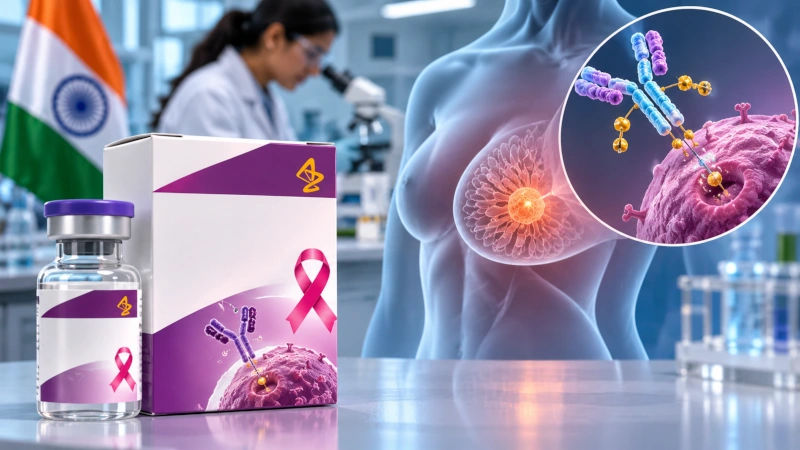
AstraZeneca Pharma India Limited has announced plans to introduce Datverzo (datopotamab deruxtecan), an advanced antibody-drug conjugate for the treatment of certain forms of breast cancer, in the Indian market during November 2026. The development will expand the availability of targeted oncology treatments for adult patients with advanced breast cancer who have previously undergone endocrine-based therapy and chemotherapy.
The pharmaceutical company confirmed the planned launch through a regulatory filing submitted to the Bombay Stock Exchange (BSE) and National Stock Exchange (NSE) on November 7, 2026. The announcement follows the receipt of import and marketing permission from the Drugs Controller General of India (DCGI) in December 2025.
Datverzo belongs to a newer generation of cancer medicines that combine the targeting capabilities of monoclonal antibodies with potent anti-cancer agents. The technology is designed to deliver chemotherapy directly to cancer cells expressing specific molecular targets, representing an important advancement in the development of precision oncology treatments.
Datverzo Approved for Advanced Breast Cancer Treatment
Datverzo has received regulatory permission in India for the treatment of adult patients with unresectable or metastatic hormone receptor-positive (HR-positive), human epidermal growth factor receptor 2-negative (HER2-negative) breast cancer.
The approved indication covers patients whose tumours are classified as HER2-negative through immunohistochemistry testing, including IHC 0, IHC 1+ or IHC 2+ with a negative in-situ hybridisation result.
The medicine is intended for patients who have already received endocrine-based therapy and chemotherapy for unresectable or metastatic disease. This places Datverzo within the treatment pathway for individuals whose cancer has progressed despite earlier systemic treatment.
Unresectable breast cancer refers to disease that cannot be removed surgically, while metastatic breast cancer occurs when cancer cells spread beyond the breast and surrounding tissues to other parts of the body.
Patients with advanced HR-positive, HER2-negative breast cancer may receive several forms of systemic treatment depending on their previous therapies, molecular characteristics and overall clinical condition. The introduction of Datverzo provides an additional treatment option within this specialised area of oncology.
How Datverzo Uses Antibody-Drug Conjugate Technology
Datverzo is an antibody-drug conjugate, or ADC, developed to combine the selective targeting properties of an antibody with the cancer-killing activity of a cytotoxic medicine.
The treatment consists of a monoclonal antibody directed against trophoblast cell-surface antigen 2 (TROP2), a protein expressed on the surface of several types of cancer cells. The antibody is connected through a specialised chemical linker to deruxtecan, a topoisomerase I inhibitor designed to interfere with processes essential for cancer-cell survival.
After the antibody binds to TROP2 on a target cell, the antibody-drug conjugate can be internalised. The cytotoxic component is subsequently released, interfering with DNA replication and contributing to cancer-cell death.
This approach differs from conventional chemotherapy, which circulates throughout the body and can affect rapidly dividing healthy cells alongside cancer cells. Antibody-drug conjugates are designed to direct a greater proportion of their cytotoxic activity towards cells expressing the intended molecular target.
However, targeted delivery does not eliminate the possibility of adverse effects. Treatment with antibody-drug conjugates requires appropriate clinical assessment and monitoring because the medicines can still produce significant systemic toxicities.
The technology has become an important area of pharmaceutical research as companies develop increasingly specialised treatments for different molecular subtypes of cancer.
Regulatory Approval Received in December 2025
AstraZeneca Pharma India had previously informed the stock exchanges on December 17, 2025, that it had received permission from the Central Drugs Standard Control Organisation to import Datverzo for sale and distribution in India.
The approval concerned datopotamab deruxtecan powder for concentrate for solution for infusion, supplied in a 100 mg presentation. The permission was granted for the specified breast cancer indication and provided the regulatory basis for introducing the medicine into the Indian market.
The drug’s approval date was December 16, 2025, as subsequently recorded in the recommendations of CDSCO’s Subject Expert Committee for Oncology.
The company’s November 7, 2026 announcement represents the next commercial milestone following that regulatory approval. AstraZeneca has indicated that Datverzo will be introduced during November, although the filing does not specify an exact commercial availability date.
The company has also not disclosed the medicine’s proposed selling price in the launch announcement.
Expanding Treatment Options in Precision Oncology
Breast cancer treatment has undergone substantial changes over the past two decades as advances in molecular diagnostics have enabled physicians to classify tumours according to their biological characteristics.
Two important markers used in clinical decision-making are hormone receptor status and HER2 expression. Hormone receptor-positive cancers are influenced by oestrogen or progesterone signalling, while HER2 testing helps determine whether a tumour may respond to treatments targeting that protein.
These classifications allow oncologists to select medicines according to the molecular characteristics of the disease rather than relying exclusively on conventional chemotherapy.
For patients with HR-positive, HER2-negative breast cancer, endocrine-based treatment remains an important component of therapy. Depending on the disease stage and clinical circumstances, treatment can also involve targeted medicines, chemotherapy and other systemic approaches.
However, advanced breast cancers may eventually develop resistance to previously effective treatments. The development of new medicines for patients who have already received several lines of therapy is therefore an important focus of oncology research.
Datverzo introduces another antibody-drug conjugate option into this evolving treatment landscape. Its approved indication specifically addresses patients who have previously undergone endocrine-based therapy and chemotherapy for advanced disease.
The availability of additional treatment options can help oncologists individualise subsequent therapy according to patient characteristics, prior treatment history and applicable clinical guidance.
AstraZeneca Strengthens Its Oncology Portfolio in India
The planned launch of Datverzo forms part of AstraZeneca’s continuing expansion in specialised oncology medicines.
The company has developed an international portfolio spanning several cancer treatment areas, including breast cancer, lung cancer, ovarian cancer and other solid tumours. Its research activities encompass targeted therapies, immunotherapies and antibody-drug conjugates.
In India, AstraZeneca Pharma India has been introducing new treatments and additional indications for established medicines following approvals from the country’s drug regulatory authorities.
The company reported a 30 per cent increase in revenue from operations during the second quarter of FY2026–27, reflecting the expansion of its pharmaceutical business and specialised therapeutic portfolio.
The introduction of Datverzo will add another advanced oncology medicine to its Indian product portfolio, particularly within the rapidly developing field of antibody-drug conjugate therapy.
It also reflects the growing importance of molecularly targeted cancer treatment within India’s pharmaceutical and healthcare sectors.
Antibody-Drug Conjugates Represent a Growing Area of Cancer Research
Antibody-drug conjugates are attracting increasing attention in pharmaceutical research because they offer a method of combining biological targeting with highly potent cytotoxic medicines.
Traditional chemotherapy remains an important treatment for many cancers, but its effects on healthy tissues can limit tolerability. The development of targeted drug-delivery approaches seeks to improve the concentration of treatment activity at tumour sites while managing exposure elsewhere in the body.
Modern antibody-drug conjugates use advances in protein engineering, linker chemistry and cytotoxic drug development to improve the delivery of therapeutic agents.
Researchers are also investigating how molecular characteristics influence treatment response, including variations in target-protein expression, resistance mechanisms and interactions within the tumour environment.
The growing use of antibody-drug conjugates has increased the importance of molecular pathology and diagnostic testing in clinical oncology. Accurate assessment of tumour characteristics helps physicians determine which approved treatments may be appropriate for individual patients.
For India’s healthcare system, the introduction of such medicines represents an expansion of the technologies available for treating complex cancers and supports the continuing adoption of precision medicine.
A New Treatment Option for Indian Breast Cancer Patients
AstraZeneca Pharma India’s decision to introduce Datverzo during November 2026 marks an important commercial milestone for an advanced breast cancer medicine that received Indian regulatory approval in December 2025.
The medicine is intended for a defined group of adults with unresectable or metastatic HR-positive, HER2-negative breast cancer who have previously received endocrine-based therapy and chemotherapy.
Its antibody-drug conjugate technology reflects the increasing role of molecular targeting and specialised drug-delivery systems in modern oncology.
The planned introduction expands the range of approved treatment options available to Indian oncologists and represents another step in bringing advanced cancer therapies into the country’s pharmaceutical market.
You may also like
-
India’s $220 Billion Chemical Industry Targets $1 Trillion by 2040 as Manufacturing Capacity Expands
-
Indian Railways Plans Four-Track Expansion on Seven Major Corridors to Add Over 1,000 Trains
-
India Confirms E20 Petrol Quality Compliance Across 27 States After Testing 893 Samples
-
IIT Kanpur-Incubated ScaNxt Secures Investment to Expand AI-Powered Soil Testing and Precision Agriculture
-
Indore Agritech Startup Pragyanik AI Develops Autonomous Agricultural Robot for Precision Weeding and Spraying
