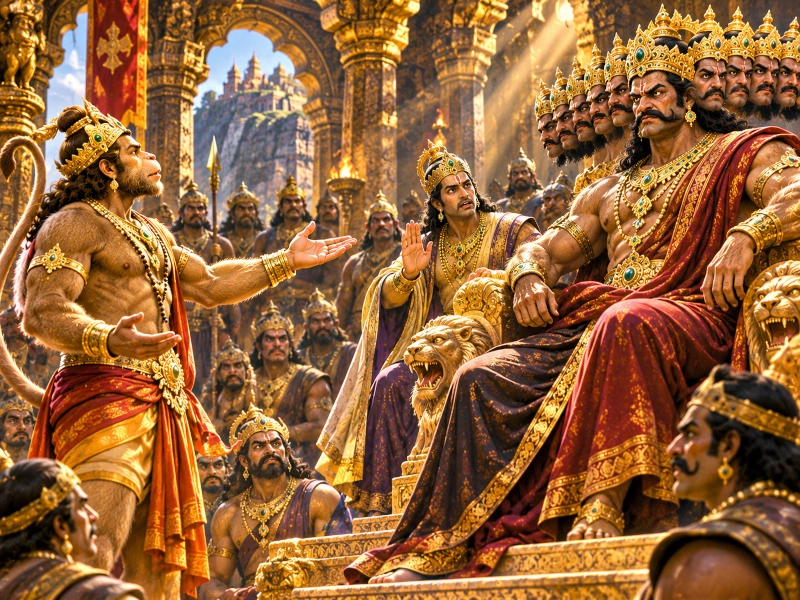
Ramayana Diplomacy Series | II. Diplomatic Missions and Envoys | Sundara Kāṇḍa, Sargas 50–52
Diplomatic missions become particularly demanding when an envoy must communicate with a hostile ruler who possesses considerable military power and has little inclination to accept the demands being presented. Under such circumstances, the representative must demonstrate courage without allowing personal emotions to compromise the mission, communicate the position of his principals accurately, and distinguish between negotiating a peaceful settlement and abandoning essential interests.
One of the most remarkable illustrations of these responsibilities appears in Vālmīki’s Rāmāyaṇa, when Hanumān stands before Rāvaṇa in the royal court of Laṅkā. The encounter, narrated in the Sundara Kāṇḍa, Sargas 50–52, combines diplomatic communication, intelligence gathering, strategic warnings and questions concerning the treatment of envoys. Hanumān’s conduct demonstrates how a representative can communicate from a position of strength while offering an adversary the opportunity to avoid a destructive confrontation.
The episode also introduces an important principle of political conduct through Vibhīṣaṇa’s intervention when Rāvaṇa orders Hanumān’s execution. His argument that a messenger must not be killed establishes a distinction between hostility towards the message and the obligations governing the treatment of its bearer.
The Strategic Background: A Mission into Enemy Territory
Hanumān’s journey to Laṅkā forms part of the larger effort undertaken by Rāma and Sugrīva to locate Sītā after her abduction by Rāvaṇa. Following the mobilisation of the Vānara forces, search parties are dispatched in different directions, with Hanumān eventually undertaking the extraordinary task of crossing the ocean to investigate the island kingdom.
His immediate objective is to establish whether Sītā is being held in Laṅkā, determine her condition and obtain reliable information that can be conveyed to Rāma. These responsibilities require him to enter hostile territory without military support, overcome the kingdom’s defences and operate in an unfamiliar political environment.
Hanumān successfully locates Sītā in the Aśoka grove and communicates with her, establishing his identity as Rāma’s representative and reassuring her of Rāma’s determination to secure her release. Having accomplished this essential objective, he considers how to obtain additional information about the enemy’s strength and communicate the consequences of Rāvaṇa’s actions.
His subsequent destruction of parts of the grove and confrontation with Laṅkā’s warriors lead to his capture by Indrajit. Although Hanumān possesses the strength to resist his captors, he recognises that being brought before Rāvaṇa offers an opportunity to address the ruler directly.
This decision changes the character of his mission. Having completed the principal task of locating Sītā, Hanumān now gains access to the highest political authority in the enemy kingdom, where he can deliver a warning and assess the response of its ruler.
The Royal Court: Establishing Identity and Diplomatic Authority
In Sarga 50, Rāvaṇa examines the unusual prisoner brought before him and orders his minister Prahasta to determine the stranger’s identity and intentions. The questions reflect the uncertainty surrounding Hanumān’s arrival, particularly his ability to penetrate Laṅkā’s defences and inflict substantial damage upon its military personnel.
Prahasta asks whether Hanumān has been sent by one of the celestial powers or has entered Laṅkā as an agent of another formidable opponent. The inquiry demonstrates that Rāvaṇa’s court initially regards the intruder as a potential instrument of a larger hostile power rather than an ordinary prisoner.
Hanumān responds by identifying himself as a Vānara and explaining the circumstances of his arrival. He makes clear that he has come in connection with the search for Sītā and that his confrontation with Laṅkā’s defenders arose during the course of his mission.
Most importantly, Hanumān declares his relationship with Sugrīva and Rāma. He does not conceal his political allegiance or attempt to disguise his purpose through misleading explanations. By identifying the authority behind his mission, he establishes the basis upon which his subsequent communication must be understood.
This is an important diplomatic distinction. An envoy does not speak merely as an individual expressing personal opinions, but as a representative communicating the interests and decisions of those who have entrusted him with the mission.
Hanumān’s declaration therefore transforms the encounter from the interrogation of an unidentified intruder into a confrontation involving the representatives of two opposing political powers.
Delivering the Message: Clarity Before Confrontation
Sarga 51 contains the central diplomatic communication of the episode. Hanumān addresses Rāvaṇa directly and explains that he has arrived bearing a message from Sugrīva, the Vānara king who has entered into an alliance with Rāma.
Rather than beginning with an immediate demand for submission, Hanumān establishes the background of the dispute. He recounts the circumstances surrounding Rāma’s exile, Sītā’s disappearance and the subsequent alliance between Rāma and Sugrīva.
He also explains how Rāma fulfilled his commitment to Sugrīva by defeating Vāli and restoring the Vānara kingdom to its rightful ruler. The account establishes the credibility of the alliance and demonstrates that Rāma possesses both the determination and military capability to fulfil his undertakings.
This sequence is strategically important because it provides Rāvaṇa with a coherent explanation of the political circumstances confronting him. Hanumān is not merely delivering a threat; he is presenting the facts necessary for the ruler of Laṅkā to understand the interests, commitments and capabilities of his adversaries.
By placing the demand within this larger political narrative, Hanumān makes it clear that the search for Sītā is no longer an isolated undertaking by Rāma. It is supported by an alliance capable of mobilising substantial forces and conducting operations across distant territories.
His communication therefore combines the functions of explanation, warning and deterrence. Rāvaṇa is given an opportunity to understand the seriousness of his position before the threatened military consequences become unavoidable.
Strategic Messaging: Demonstrating Strength Without Immediate War
A particularly significant feature of Hanumān’s address is his deliberate reference to the military strength of Rāma and Sugrīva.
He reminds Rāvaṇa that Vāli, whose extraordinary strength was widely recognised, had been defeated by Rāma with a single arrow. This example serves as evidence of Rāma’s capabilities rather than an abstract declaration of superiority.
Hanumān also describes the extensive mobilisation undertaken by Sugrīva, whose warriors have been dispatched across different regions in search of Sītā. The message indicates that the alliance possesses the resources and determination necessary to pursue its objective beyond the immediate reach of Rāma himself.
The reference to Hanumān’s own journey across the ocean further reinforces the credibility of this warning. His presence in Laṅkā demonstrates that the kingdom’s geographical isolation does not make it inaccessible to the forces supporting Rāma.
These statements form a carefully constructed message about the changing strategic balance. Rāvaṇa may command a powerful kingdom, but the abduction of Sītā has brought him into conflict with an opponent whose capabilities cannot be dismissed.
At the same time, Hanumān does not present military confrontation as the only available outcome. His warning is accompanied by a specific action that could remove the immediate cause of hostilities.
The resulting diplomatic message is clear: Rāvaṇa must recognise the consequences of his conduct, but he still possesses the opportunity to prevent war by returning Sītā.
The Opportunity for Peace: Returning Sītā as the Essential Condition
Hanumān’s central demand is that Rāvaṇa release Sītā and restore her to Rāma. This is presented not merely as an expression of Rāma’s personal wishes, but as the course of action consistent with righteousness, political prudence and the preservation of Laṅkā’s security.
In Sarga 51, Hanumān appeals to Rāvaṇa’s learning and past austerities, urging him to recognise that forcibly detaining another man’s wife is inconsistent with the principles he ought to understand. The argument connects moral responsibility with practical political consequences.
Hanumān’s reasoning is significant because it does not separate ethical conduct from strategic calculation. He maintains that Rāvaṇa’s wrongful action has created a danger capable of destroying the very power and prosperity he has accumulated.
The warning also offers Rāvaṇa a clear means of avoiding that outcome. By returning Sītā, he can address the central grievance responsible for the confrontation and remove the immediate justification for Rāma’s military intervention.
This is an important characteristic of effective coercive diplomacy. A warning becomes more useful when the recipient understands not only the consequences of continued defiance, but also the specific action required to prevent them.
Hanumān’s message leaves little ambiguity regarding the objective. The purpose of the mission is not the conquest of Laṅkā for its own sake, nor the humiliation of its ruler, but the restoration of Sītā and the correction of the injustice committed against her.
The Envoy’s Courage: Speaking Truth in a Hostile Court
Hanumān’s conduct is especially remarkable because he delivers his message while physically vulnerable within the enemy’s political centre. He is surrounded by Rāvaṇa’s ministers and warriors, with no immediate prospect of receiving assistance from Rāma or Sugrīva.
Despite these circumstances, he does not modify the essential content of his message to secure favourable treatment. His speech remains direct, substantial and uncompromising on the question of Sītā’s release.
However, his courage is not expressed through uncontrolled hostility. He appeals to Rāvaṇa’s judgment, refers to the political and moral consequences of his actions, and explains why compliance would serve the ruler’s own interests.
The combination of firmness and reasoned argument distinguishes an effective diplomatic warning from mere provocation. Hanumān’s purpose is to make Rāvaṇa understand the consequences of his choices, not simply to demonstrate personal fearlessness.
His speech also reflects an important responsibility of diplomatic representatives: to communicate difficult realities even when the recipient possesses the authority to retaliate. The value of an envoy depends partly upon his willingness to convey information that the receiving ruler may find uncomfortable or threatening.
By maintaining the substance of his message under these circumstances, Hanumān demonstrates that diplomatic courage is measured not only by physical bravery, but also by fidelity to the interests and instructions of those being represented.
Diplomacy and Intelligence: Two Functions Within a Single Mission
Hanumān’s appearance before Rāvaṇa also demonstrates the relationship between intelligence gathering and diplomatic communication in the preparation of military operations.
Before reaching the royal court, Hanumān has already entered Laṅkā, observed its defences, searched its buildings and gardens, located Sītā and engaged several of the kingdom’s military formations. These experiences provide valuable information about the political and military environment confronting Rāma.
His encounter with Rāvaṇa adds another dimension to this intelligence. It allows him to observe the ruler’s court, understand the reaction of senior officials and assess the willingness of Laṅkā’s leadership to consider the demands being presented.
The mission thus combines reconnaissance with strategic communication, although these activities arise at different stages of Hanumān’s journey. His initial purpose is to locate Sītā, while the confrontation with Rāvaṇa creates an additional opportunity to deliver a warning.
This distinction matters because diplomatic engagement can reveal information unavailable through observation alone. The responses of political leaders, the conduct of their advisers and their willingness to consider alternative courses of action may all influence subsequent strategic decisions.
Hanumān’s mission demonstrates that gathering information and communicating policy are closely connected functions, particularly when an alliance is preparing for the possibility of war.
Rāvaṇa’s Response: When Anger Overrides Political Judgment
Despite Hanumān’s warnings, Rāvaṇa reacts with intense anger. The envoy’s references to Rāma’s strength and the consequences of retaining Sītā challenge the authority and confidence of the ruler of Laṅkā.
In Sarga 52, Rāvaṇa responds by ordering Hanumān’s execution. The decision marks a significant deterioration in the diplomatic encounter because it transforms hostility towards the message into an attempt to destroy the messenger.
From a political perspective, the order demonstrates the danger of allowing personal anger to determine the treatment of an adversary’s representative. Hanumān has conveyed demands and warnings that Rāvaṇa finds unacceptable, but executing him would neither resolve the dispute nor eliminate the military threat posed by Rāma.
The decision also threatens to damage Rāvaṇa’s reputation as a ruler capable of exercising judgment according to established principles of political conduct.
At this critical moment, Vibhīṣaṇa intervenes to oppose the order and remind his brother of the obligations governing the treatment of envoys.
Vibhīṣaṇa’s Intervention: The Principle of Diplomatic Protection
Vibhīṣaṇa’s argument introduces one of the most important principles of diplomatic conduct found in the episode: a messenger must not be killed merely because the message he carries is offensive or hostile.
He approaches Rāvaṇa respectfully and urges him to control his anger. His objection is not based on sympathy for Rāma or agreement with Hanumān’s demands, but on the established standards of conduct expected from rulers.
Vibhīṣaṇa argues that wise and righteous kings do not execute envoys, even when those representatives have committed serious offences. He distinguishes the individual delivering the communication from the political authority responsible for sending him.
The reasoning demonstrates an awareness that communication between hostile powers requires certain restraints. If rulers routinely executed representatives carrying unwelcome messages, opportunities for negotiation, warning and peaceful settlement would become considerably more difficult.
Vibhīṣaṇa also appeals to Rāvaṇa’s reputation and political judgment. A powerful king should not allow anger to drive him towards conduct inconsistent with the responsibilities of sovereignty.
His intervention succeeds in preventing Hanumān’s immediate execution, although Rāvaṇa subsequently orders the punishment of his tail, leading to the events described in the following sarga.
The episode therefore distinguishes between the recognition of a rule against killing envoys and the broader question of how representatives should be treated. The punishments discussed in the ancient narrative must be understood within its historical and literary setting rather than equated with acceptable modern diplomatic practice.
Diplomatic Immunity: An Ancient Principle and Its Modern Development
Vibhīṣaṇa’s defence of Hanumān provides an important historical and philosophical parallel to the modern principle of diplomatic inviolability.
Contemporary diplomatic relations are governed by legal frameworks that recognise the special status of accredited diplomatic agents and the obligation of receiving states to respect their persons. The Vienna Convention on Diplomatic Relations of 1961 establishes that diplomatic agents are inviolable and must not be subjected to arrest or detention, while receiving states are required to protect them against attacks upon their person, freedom or dignity.
The circumstances surrounding Hanumān’s mission differ substantially from the modern system of accredited diplomatic relations. He enters Laṅkā covertly, conducts reconnaissance and engages in destructive combat before appearing in Rāvaṇa’s court. His position therefore cannot be treated as legally equivalent to that of a contemporary accredited ambassador.
Nevertheless, the principle invoked by Vibhīṣaṇa is recognisable: the transmission of political messages requires restraints upon the receiving ruler, even when relations between the parties are hostile.
The comparison illustrates how the protection of communication has long been recognised as an important concern of political conduct. Modern international law has developed this concern into a much more extensive legal framework governing diplomatic privileges, immunities and state responsibilities.
The episode’s relevance lies in the distinction between opposing an adversary’s demands and punishing the individual entrusted with communicating them.
The Limits of Power: Why Rāvaṇa’s Decision Was Strategically Damaging
Rāvaṇa’s reaction to Hanumān demonstrates how the possession of military power can encourage rulers to underestimate the political significance of restraint.
Laṅkā possesses formidable defences, experienced commanders and considerable military resources. Rāvaṇa’s confidence in these advantages contributes to his unwillingness to accept the implications of Hanumān’s warning.
However, the envoy’s message identifies a danger that cannot be resolved by displaying authority within the royal court. Rāma and Sugrīva have established an alliance, Sītā’s location has been discovered, and the forces supporting her recovery are preparing for further action.
Rāvaṇa’s anger does not alter these circumstances. Ordering Hanumān’s death would remove a messenger without addressing the threat he has described.
Vibhīṣaṇa’s intervention introduces the strategic alternative of exercising judgment rather than acting impulsively. Even if Rāvaṇa refuses to accept the demand for Sītā’s release, he must recognise that decisions concerning an envoy have implications beyond the immediate encounter.
This distinction between coercive power and political wisdom forms one of the central lessons of the episode. A ruler may possess the capacity to punish an adversary’s representative, but the consequences of exercising that power must be considered in relation to the larger political objective.
Strategic Communication: Combining Deterrence with an Alternative to War
Hanumān’s address offers a useful illustration of how deterrence and diplomacy can operate together.
His references to Rāma’s military strength, Sugrīva’s mobilisation and his own ability to reach Laṅkā communicate that the opposing alliance possesses the means to act against Rāvaṇa. These statements establish the credibility of the warning.
At the same time, Hanumān identifies the action that could prevent confrontation: returning Sītā to Rāma. His message therefore includes both a description of the danger and a clear means of avoiding it.
This combination is essential to understanding the diplomatic character of the encounter. Hanumān is not simply announcing that Rāma possesses superior power. He is attempting to influence Rāvaṇa’s decision by demonstrating that continued defiance will produce consequences far more damaging than compliance.
The encounter also illustrates why warnings must be grounded in credible capabilities. Rāvaṇa is confronted by an envoy who has already crossed the ocean, penetrated the kingdom’s security and survived combat with powerful warriors. These accomplishments give practical weight to the military consequences described in Hanumān’s speech.
His communication thus combines moral argument, political explanation, demonstrated capability and a clearly defined demand. Together, these elements form a coherent strategy intended to influence the decisions of a hostile ruler.
Modern-Day Parallel: The 1991 Gulf Crisis and the Final Diplomatic Warning to Iraq
A modern parallel to Hanumān’s diplomatic mission to Rāvaṇa’s court can be found in the Gulf Crisis of 1990–1991, when the United States and an international coalition sought Iraq’s withdrawal from Kuwait before launching military operations. Following Iraq’s invasion of Kuwait in August 1990, the United Nations Security Council authorised the use of force if Iraqi troops failed to withdraw by 15 January 1991.
On 9 January 1991, US Secretary of State James Baker met Iraqi Foreign Minister Tariq Aziz in Geneva to deliver a final diplomatic warning. Baker communicated President George H. W. Bush’s demand that Iraq withdraw from Kuwait or face military action by the coalition. The warning was supported by substantial military deployments, demonstrating that the diplomatic message was backed by credible military capabilities. However, Aziz rejected the American position and refused to accept a letter addressed to Saddam Hussein.
The episode offers a parallel to Hanumān’s address to Rāvaṇa in the Sundara Kāṇḍa. Hanumān warns Rāvaṇa of the military strength of the Rāma–Sugrīva alliance while offering him an opportunity to avoid war by returning Sītā. Similarly, Baker communicated the consequences of continued Iraqi occupation while identifying withdrawal from Kuwait as the path towards a peaceful resolution. Although the Geneva negotiations failed and coalition military operations began on 17 January 1991, both episodes illustrate an important principle of diplomacy: a credible warning must clearly communicate the consequences of defiance while preserving an opportunity for peaceful settlement.
Lessons for Diplomatic Missions and Envoys
The first lesson concerns the importance of clearly identifying the authority and purpose behind a diplomatic mission. Hanumān explains his relationship with Sugrīva and Rāma, establishes the background of the dispute and communicates a specific demand. His example demonstrates that the effectiveness of an envoy depends upon the ability to present a coherent position rather than merely express anger or issue threats.
The second lesson is the necessity of courage combined with judgment. Hanumān delivers an uncompromising message inside a hostile court, but supports his warning with political reasoning and evidence of military capability. His conduct illustrates how representatives can remain faithful to their objectives without relying exclusively upon provocative language.
The third lesson concerns the importance of offering an adversary a practical alternative to confrontation. Hanumān explains that returning Sītā would remove the central cause of the dispute. The warning is therefore linked to an achievable demand, allowing the recipient to understand what action could prevent further escalation.
The fourth lesson is the significance of diplomatic protection. Vibhīṣaṇa’s intervention demonstrates that hostility towards a political message should not automatically justify violence against its bearer. The distinction is fundamental to preserving communication between opposing powers, particularly when the risk of armed conflict is considerable.
Finally, the episode demonstrates that diplomatic missions can provide important information about the political character of an adversary. Hanumān’s encounter reveals not only Rāvaṇa’s refusal to accept the warning, but also the willingness of Vibhīṣaṇa to oppose a decision he considers contrary to proper conduct. Such observations become important in understanding the internal dynamics of the opposing kingdom.
Conclusion: The Courage to Warn and the Wisdom to Listen
Hanumān’s encounter with Rāvaṇa in the Sundara Kāṇḍa presents a sophisticated examination of diplomacy conducted under conditions of hostility, uncertainty and considerable personal danger.
Hanumān fulfils the responsibilities of his mission by identifying his political allegiance, explaining the circumstances of the dispute, communicating the strength of the Rāma–Sugrīva alliance and presenting a clear demand for Sītā’s release. His warning is forceful, but it also offers Rāvaṇa an opportunity to avoid the military consequences of continued defiance.
Rāvaṇa’s response demonstrates the dangers of allowing anger and wounded authority to override political judgment. His order to execute Hanumān threatens to violate the established norms governing messengers, prompting Vibhīṣaṇa to intervene in defence of diplomatic restraint.
The episode therefore presents two complementary responsibilities of political communication. The envoy must possess the courage to deliver difficult truths, while the receiving ruler must exercise the judgment necessary to hear those truths without allowing personal anger to determine his response.
Through Hanumān and Vibhīṣaṇa, the Rāmāyaṇa establishes a lasting principle of statecraft: diplomacy requires the courage to communicate from a position of strength, the wisdom to preserve an opportunity for peace, and the restraint to protect the channels through which adversaries can still communicate.
You may also like
-
India and EU Conclude Horizon Europe Negotiations, Opening New Opportunities for Scientific Research
-
Tārā’s Diplomacy: How Wise Counsel Prevented a Political Crisis Between Allies
-
Guyana Offers to Supply Up to 20% of India’s Crude Oil Needs, Eyes Deeper Energy Partnership
-
India, Philippines in Advanced Talks for $800 Million BrahMos Missile Deal
-
Lakṣmaṇa’s Mission to Kiṣkindhā: Enforcing Alliance Commitments Without Breaking the Partnership
