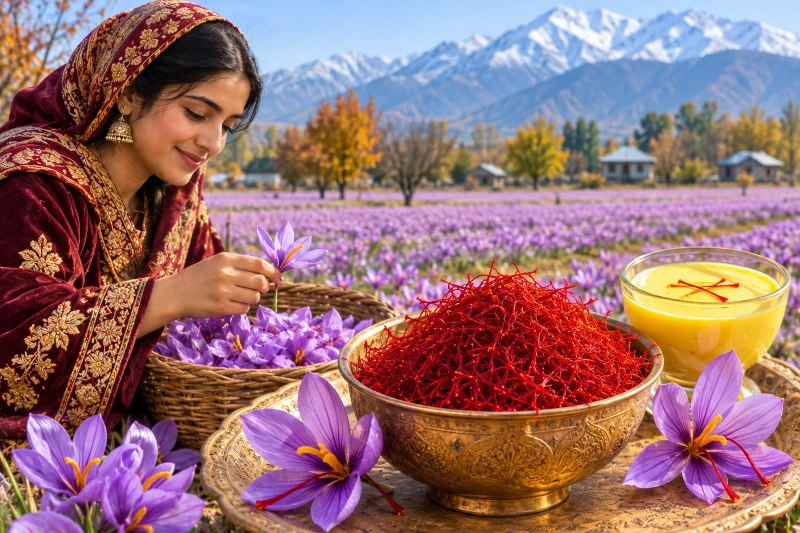
In the autumn landscapes of Kashmir, when the surrounding mountains begin preparing for winter, the elevated agricultural fields of Pampore are transformed by the delicate purple blossoms of the saffron crocus. For generations, farmers have cultivated this remarkable flowering plant, carefully harvesting its crimson stigmas to produce one of the world’s most valuable spices. Known as Kashmir Saffron, or Kashmiri Kesar, the product represents an agricultural tradition closely associated with the geography, culture and economy of Jammu and Kashmir.
Derived from the flowers of Crocus sativus L., Kashmir Saffron is distinguished by its deep-red colour, pronounced aroma, relatively long and thick stigmas, and characteristic flavour. Unlike crops valued primarily for their yield, saffron derives its importance from a tiny portion of each flower. Every blossom produces only three stigmas, which must be carefully separated, dried and preserved before the spice reaches consumers.
The cultivation of saffron is particularly associated with the Karewa uplands of Kashmir, where distinctive soils, seasonal climatic conditions and generations of farming knowledge have sustained this specialised agricultural activity. Pampore in Pulwama district remains the best-known centre of production, while saffron cultivation also has an established presence in Budgam, Srinagar and Kishtwar.
Kashmir Saffron received Geographical Indication (GI) registration on 1 May 2020, formally recognising its geographical identity under India’s Geographical Indications of Goods (Registration and Protection) Act, 1999. The recognition established a legal framework for protecting its traditional reputation and distinguishing authentic Kashmir Saffron from products without the required geographical association.
Historical Origins and Traditional Heritage of Kashmir Saffron
The history of saffron cultivation in Kashmir extends across many centuries, although accounts of its earliest introduction differ considerably. Historical writings, regional traditions and agricultural records associate saffron with the Kashmir Valley long before it emerged as a modern commercial commodity.
The official GI documentation records several traditions concerning the origins of saffron cultivation. One account associates the crop with the ancient settlement of Padampur, the historical name connected with present-day Pampore. According to a local legend, a physician received saffron corms as a reward after treating a supernatural being associated with a spring, eventually leading to the establishment of saffron cultivation in the region.
Another tradition attributes the introduction of saffron to two travelling Sufi saints, Khwaja Masood Wali and Sheikh Sharif-ud-din Wali, who are remembered in local folklore. These accounts form part of Kashmir’s cultural memory, although they cannot establish a precise historical date for the introduction of the crop.
References to saffron also appear in accounts of Kashmir’s historical trade and agricultural economy. The GI documentation cites the writings of Abul Fazl, the court historian of Emperor Akbar, who described extensive saffron cultivation around Pampore. References associated with Emperor Jahangir similarly indicate that saffron was an important and highly valued agricultural product during the Mughal period.
The crop’s significance extended beyond agricultural production. Saffron became associated with royal households, traditional medicine, religious practices, food preparation and the exchange of valuable commodities. Its colour and fragrance contributed to its reputation, while the labour required for harvesting and processing reinforced its economic value.
The survival of this tradition reflects the contribution of generations of Kashmiri farmers. Their knowledge of corm selection, soil preparation, flowering patterns, stigma separation and drying practices has helped maintain the identity of a crop that remains closely connected with the region’s agricultural heritage.
Geographical Origin and Cultivation Areas
Kashmir Saffron is cultivated in selected parts of Jammu and Kashmir, particularly in the elevated Karewa landscapes of the Kashmir Valley. These upland formations are among the region’s distinctive agricultural environments and provide important conditions for cultivating Crocus sativus.
Pampore, situated in Pulwama district near Srinagar, is the principal centre associated with Kashmir Saffron. The surrounding villages and agricultural settlements have developed a long-standing reputation for producing high-quality saffron, making Pampore an important centre of cultivation, processing and trade.
Saffron cultivation also occurs in parts of Budgam and Srinagar districts. Kishtwar, located in the Jammu division, possesses its own historic saffron-growing tradition and is associated with the production of Guchhi saffron, a traditional form in which dried threads are tied into small bundles.
The GI documentation identifies cultivation at elevations of approximately 1,600–1,800 metres above mean sea level as an important geographical characteristic of Kashmir Saffron. These upland growing conditions distinguish the regional production system from many other saffron-producing areas.
Karewa soils, seasonal rainfall, drainage conditions and temperature variations influence crop establishment and flowering. Saffron cultivation requires careful management because excessive soil moisture, prolonged water stress and unsuitable growing conditions can affect the development of the underground corms and the production of flowers.
The geographical identity of Kashmir Saffron therefore extends beyond a place name. It represents the interaction between a particular agricultural landscape, local environmental conditions and the specialised knowledge developed by farming communities over generations.
Unique Characteristics of Kashmir Saffron
Kashmir Saffron belongs to the species Crocus sativus L., a perennial flowering plant cultivated for its red stigmas. The plant produces delicate purple flowers, each containing three crimson stigmas that form the commercially valuable spice after drying.
The official GI specification identifies several characteristics associated with Kashmir Saffron, including its deep-red appearance, comparatively long and thick threads, strong fragrance and distinctive bitter flavour. These features contribute to its reputation in domestic and international markets.
The colour of saffron is principally associated with crocin, a group of naturally occurring carotenoid pigments. Crocin contributes to the golden-yellow colour released when saffron is infused in water or milk, making it important for both culinary applications and quality assessment.
Another significant compound is picrocrocin, which contributes to saffron’s characteristic bitter taste. Safranal is particularly associated with its aroma and develops through processes connected with drying and the transformation of certain compounds in the harvested stigmas.
The proportions of these constituents influence saffron quality, although they vary according to cultivation conditions, harvesting practices, processing and storage. Scientific quality assessment therefore considers measurable chemical characteristics rather than relying exclusively on appearance or reputation.
The long and thick stigmas associated with Kashmir Saffron also have commercial importance. Their physical characteristics, natural pigmentation and aromatic properties help distinguish properly processed products in specialised spice markets.
Traditional Forms of Kashmir Saffron: Mongra, Lachha and Guchhi
One of the distinctive features recorded in the GI documentation is the classification of Kashmir Saffron into three traditional commercial forms: Mongra, Lachha and Guchhi. These forms differ primarily in the treatment, separation and presentation of the harvested saffron stigmas.
Mongra Saffron consists of the red portions of the stigmas, separated from the yellow styles through a traditional processing method. Farmers remove the yellow portions by hand, retaining the highly valued red threads. This additional labour, together with the reduction in final weight, contributes to Mongra’s premium market position.
The traditional separation process is locally known as Lout Czhtun, meaning tail cutting. It requires considerable manual skill because the delicate threads must be handled carefully to preserve their desirable characteristics. The GI documentation identifies Mongra as a particularly valued form of Kashmir Saffron.
Lachha Saffron consists of dried stigmas that retain their attached yellow portions. Unlike Mongra, the threads are not subjected to the additional separation process, making Lachha a more complete presentation of the harvested stigma and style.
Guchhi Saffron is traditionally prepared by arranging saffron threads into small bundles secured with thread. This form is particularly associated with Kishtwar and surrounding areas, where the practice has historically formed part of local saffron marketing traditions.
These three forms demonstrate that the heritage of Kashmir Saffron includes not only cultivation but also specialised post-harvest knowledge. Processing methods influence the appearance, presentation and commercial value of the final product, while preserving traditional techniques helps maintain the diversity of the region’s saffron trade.
Traditional Cultivation and Agricultural Practices
Kashmir Saffron is cultivated from underground structures known as corms rather than conventional seeds. Healthy corms are selected and planted in prepared fields, where they develop roots, foliage and flowers under suitable seasonal conditions.
Corm selection is an important part of cultivation because the size, health and physiological condition of planting material influence flowering and crop productivity. Farmers traditionally select suitable corms from established fields, while scientific recommendations emphasise the use of healthy planting material and appropriate disease management.
Field preparation involves loosening the soil, improving drainage and preparing suitable planting beds. Traditional saffron farming has often depended on rainfall, making the timing and distribution of seasonal moisture particularly important.
Planting generally takes place during the late summer period, while flowering occurs in autumn. According to the original GI specification, Kashmir Saffron commonly flowers during the second half of October and continues into early November, although weather and soil moisture can affect the precise timing.
The harvesting process is labour-intensive. Farmers and family members collect saffron flowers during the flowering season, traditionally undertaking much of the work during the morning. The harvested blossoms are then carefully handled to protect their delicate internal structures.
Each flower contains only three stigmas, which must be separated manually. The harvested material undergoes drying to reduce moisture and develop the characteristics required for storage and commercial use.
Traditional cultivation practices also include field maintenance, the management of competing vegetation, protection against pests and periodic renewal of planting material. Scientific improvements in these activities have become increasingly important for sustaining productivity and maintaining the quality associated with Kashmir Saffron.
The Importance of Karewa Soils and Kashmir’s Climate
The Karewa uplands are central to the agricultural identity of Kashmir Saffron. These elevated formations contain soils and landscape features that support a distinctive pattern of cultivation within the Kashmir Valley.
Saffron requires a suitable balance between soil moisture and drainage. Although the crop can tolerate relatively dry conditions during parts of its annual growth cycle, moisture availability at critical stages influences flowering and the development of healthy corms.
The climatic conditions of Kashmir contribute to the crop’s seasonal rhythm. The saffron plant passes through distinct phases of underground development, flowering, leaf growth and dormancy, with temperature and moisture playing important roles in these processes.
The region’s autumn flowering season is particularly significant because it coincides with changing temperatures and the transition towards winter. Farmers must manage the crop according to these environmental conditions, which differ considerably from those governing many conventional agricultural commodities.
The Karewa landscape also contributes to the cultural character of saffron cultivation. During the flowering season, the purple blossoms create a distinctive agricultural scene that has become closely associated with Pampore and its surrounding villages.
Protecting these agricultural landscapes is important for preserving the geographical identity of Kashmir Saffron. The value of the product is connected not simply with the saffron plant but with the particular environment and traditional production system in which it is cultivated.
Scientific Characteristics and Quality Assessment
Modern research into saffron has examined its chemical composition, pigment concentration, aroma-producing compounds and responses to processing conditions. Such investigations provide a scientific basis for understanding the characteristics traditionally associated with premium saffron.
Crocin, picrocrocin and safranal are among the principal compounds considered in saffron quality assessment. Crocin contributes colouring strength, picrocrocin influences bitterness, and safranal is associated with aroma.
The international standard ISO 3632 provides a framework for classifying saffron quality using defined analytical parameters. These include measurements associated with colouring strength, bitterness and aromatic characteristics.
The quality of saffron is influenced by several factors beyond geographical origin. Harvesting maturity, drying temperature, exposure to moisture, packaging and storage conditions can all affect the chemical composition of the finished product.
The GI specification for Kashmir Saffron highlights the importance of traditional processing while also discussing improvements in post-harvest handling. The use of controlled drying methods and more systematic handling can help preserve desirable characteristics and reduce losses associated with unsuitable processing conditions.
Scientific assessment is particularly valuable for premium agricultural products because it allows quality claims to be supported by measurable evidence. For Kashmir Saffron, laboratory testing can complement geographical authentication and traditional knowledge by providing objective information about the characteristics of marketed products.
Culinary Importance and Traditional Uses
Kashmir Saffron occupies an important place in the culinary heritage of Jammu and Kashmir. Its distinctive fragrance, golden colour and delicate flavour make it an important ingredient in several traditional preparations.
One of its best-known uses is in Kashmiri Kahwa, an aromatic beverage commonly prepared using green tea, saffron and selected spices, sometimes accompanied by almonds or other ingredients. Saffron contributes colour and fragrance, while the beverage remains closely associated with Kashmiri hospitality and household traditions.
The spice is also used in rice preparations, festive dishes, traditional sweets and milk-based foods. Its concentrated flavour means that small quantities are generally sufficient to influence the appearance and aroma of a preparation.
Kashmiri Wazwan, the region’s elaborate culinary tradition, includes dishes and cooking practices in which saffron may be used to contribute colour and fragrance. Its inclusion reflects the status of saffron as a valued ingredient rather than an ordinary household spice.
Across India, saffron is also associated with sweets, flavoured milk, desserts and ceremonial foods. Its use in these preparations connects Kashmir’s specialised agricultural production with wider Indian food traditions.
Beyond cooking, saffron has historically appeared in cosmetics, perfumery and traditional medicinal preparations. In Ayurveda, it is known as Kumkuma and appears in classical formulations and discussions of medicinal plants. These historical uses are part of its cultural heritage, although they should not be interpreted as proof that ordinary dietary consumption treats specific medical conditions.
Geographical Indication Recognition of Kashmir Saffron
Kashmir Saffron received formal Geographical Indication registration under the Geographical Indications of Goods (Registration and Protection) Act, 1999.
The application was submitted by the Agriculture Production Department of Jammu and Kashmir through the Directorate of Agriculture, Kashmir. The application sought legal recognition of Kashmir Saffron’s distinctive characteristics, geographical association and established reputation.
The application was filed on 3 December 2018 under Application No. 635. Supporting documentation described the crop’s historical background, cultivation areas, distinctive qualities, traditional production methods and commercial forms.
The registration process involved examination by the Geographical Indications Registry and publication of the application in the official GI Journal. Kashmir Saffron appeared in Geographical Indications Journal No. 127, dated 1 January 2020, as part of the statutory examination and public-notification process.
Following completion of the registration procedure, the registry issued Certificate No. 366 on 1 May 2020, formally recognising Kashmir Saffron as a registered Geographical Indication under Class 30.
The recognition provides a legal framework for protecting the registered name against unauthorised commercial use that does not comply with the applicable geographical indication requirements.
The registered geographical area is Jammu and Kashmir, with the traditional production identity particularly associated with the saffron-growing regions of Pampore and other established cultivation centres.
The registration remains valid until 2 December 2028, subject to renewal under India’s geographical indications legislation.
GI Tag Journey of Kashmir Saffron
The journey of Kashmir Saffron towards Geographical Indication recognition reflects the efforts of traditional farming communities, agricultural institutions and government agencies to preserve the geographical identity of one of India’s most valuable agricultural products.
- Centuries of Traditional Cultivation: Saffron developed into an important agricultural commodity in Kashmir, with historical references connecting its cultivation to Pampore and other established growing areas.
- Mughal Period – Historical Agricultural Records: Writings associated with Abul Fazl and Jahangir documented the importance of saffron cultivation and production in Kashmir.
- Traditional Processing Heritage: Farming communities preserved specialised methods of harvesting and processing saffron, including the production of Mongra, Lachha and Guchhi.
- National Saffron Mission: Government-supported initiatives introduced measures to improve saffron cultivation, irrigation, planting material, crop management and post-harvest infrastructure.
- 3 December 2018 – GI Application Filed: The Agriculture Production Department of Jammu and Kashmir submitted Application No. 635 seeking registration of Kashmir Saffron.
- 15 October 2019 – Examination Report: The Geographical Indications Registry issued its examination report relating to the application.
- 19 November 2019 – Applicant’s Response: The applicant submitted its response to the examination report as part of the statutory process.
- 1 January 2020 – GI Journal Publication: Kashmir Saffron appeared in Geographical Indications Journal No. 127, documenting its geographical identity and distinctive characteristics.
- 1 May 2020 – GI Certificate Issued: The Geographical Indications Registry issued Certificate No. 366, formally registering Kashmir Saffron under Class 30.
- March–April 2021 – International Export Promotion: APEDA-supported export activities included shipments of GI-certified Kashmir Saffron from Srinagar to Dubai and other Middle Eastern markets.
- 19 August 2025 – Agricultural Heritage Recognition Reaffirmed: The Ministry of Agriculture and Farmers Welfare identified the Saffron Heritage of Kashmir among India’s Globally Important Agricultural Heritage Systems recognised by the Food and Agriculture Organization.
- 2 December 2028 – Registration Validity: The current GI registration remains valid until this date, subject to renewal.
GI Details at a Glance
- Geographical Indication: Kashmir Saffron
- Union Territory: Jammu and Kashmir
- Botanical Name: Crocus sativus L.
- Product Category: Agricultural
- Class: 30
- Application Number: 635
- Date of Filing: 3 December 2018
- GI Journal: No. 127
- GI Journal Date: 1 January 2020
- Certificate Number: 366
- GI Certificate Date: 1 May 2020
- Registered Proprietor: Agriculture Production Department, Jammu and Kashmir
- Applicant’s Address: Directorate of Agriculture, Lal Mandi, Srinagar, Jammu and Kashmir – 190008
- Geographical Area: Jammu and Kashmir
- Principal Cultivation Centre: Pampore, Pulwama district
- Other Traditional Cultivation Areas: Budgam, Srinagar and Kishtwar
- Traditional Commercial Forms: Mongra, Lachha and Guchhi
- Registration Valid Until: 2 December 2028
Farmer Participation and Traditional Knowledge
The cultivation and processing of Kashmir Saffron depend heavily on the knowledge and labour of local agricultural households. Unlike many mechanised crops, saffron requires substantial manual involvement during harvesting and stigma separation.
Families traditionally participate in collecting flowers, separating the stigmas and preparing the harvested material for drying. These activities demand careful handling because the valuable portion of each flower is extremely delicate.
Traditional knowledge also extends to the identification of suitable planting material, soil preparation, recognition of flowering conditions and the timing of agricultural operations. Such experience remains valuable even as scientific cultivation practices are introduced.
The GI registration provides a mechanism through which eligible producers can participate in the protected geographical indication system. Authorised-user registration allows qualifying producers to use the registered name in accordance with the applicable legal requirements.
The participation of farmers is essential because geographical indications derive their meaning from the connection between a product, its place of origin and the communities responsible for maintaining its distinctive characteristics.
Strengthening producer participation, quality management and collective marketing can help farming communities obtain greater value from authentic Kashmir Saffron while protecting the reputation established through generations of cultivation.
National Saffron Mission and Agricultural Development
The National Saffron Mission represents an important government initiative aimed at strengthening saffron cultivation in Jammu and Kashmir. The programme has addressed several agricultural challenges associated with the traditional production system.
Its objectives have included improving productivity, strengthening irrigation infrastructure, promoting suitable planting material and introducing more scientific approaches to cultivation and post-harvest management.
Water availability has been a significant consideration because saffron cultivation in Kashmir has traditionally relied heavily on rainfall. Irrigation infrastructure and improved water management are intended to support crop development during critical periods when insufficient moisture can affect flowering.
The programme has also encouraged improvements in corm selection, planting techniques and the management of agricultural pests and diseases. These measures seek to address factors that can reduce productivity in established saffron fields.
Post-harvest management is another important component. Modern drying and processing infrastructure can help farmers preserve the colour, aroma and other quality characteristics that determine the commercial value of saffron.
The development of organised trading and quality-assessment facilities also provides opportunities for farmers to participate more effectively in formal markets. These interventions complement the GI framework by connecting geographical recognition with improvements in cultivation, processing and commercial distribution.
Kashmir Saffron and Global Agricultural Heritage
The significance of Kashmir Saffron extends beyond its commercial value as a spice. Its cultivation forms part of a distinctive agricultural landscape in which traditional farming practices, local ecological conditions and cultural knowledge have developed together.
The Food and Agriculture Organization recognises the Saffron Heritage of Kashmir as one of India’s Globally Important Agricultural Heritage Systems (GIAHS). This designation highlights the wider agricultural heritage associated with saffron cultivation rather than the commercial product alone.
The Government of India reaffirmed this recognition in August 2025, identifying the Saffron Heritage of Kashmir alongside the Koraput agricultural system of Odisha and the Kuttanad farming system of Kerala.
Agricultural heritage recognition draws attention to the relationship between farming communities and the environments in which they operate. In Kashmir, saffron cultivation reflects knowledge of upland soils, seasonal climatic conditions, specialised planting material and labour-intensive harvesting practices.
The GI registration and agricultural heritage recognition serve related but distinct purposes. The GI protects the geographical identity of the product under intellectual property legislation, while GIAHS recognition acknowledges the wider importance of the traditional agricultural system.
Together, these forms of recognition strengthen the visibility of Kashmir’s saffron-growing heritage and provide a foundation for conserving the agricultural practices associated with it.
Economic Importance and Opportunities for Farmers
Kashmir Saffron is a high-value agricultural commodity whose commercial importance is influenced by its limited yield, labour-intensive harvesting and established reputation.
Each flower produces only three stigmas, and large numbers of flowers are required to obtain relatively small quantities of dried saffron. The careful collection, separation, drying and grading of these threads contribute to the substantial labour involved in production.
The premium reputation of Kashmir Saffron offers opportunities for farmers and agricultural enterprises to develop specialised markets based on authenticated geographical origin and consistent quality.
GI recognition can support this process by distinguishing qualifying Kashmir Saffron from products that lack the required geographical association. Clear identification, reliable packaging and traceability can help consumers make informed purchasing decisions.
APEDA has supported efforts to introduce GI-certified Kashmir Saffron into international markets. In October 2021, the Ministry of Commerce and Industry reported that shipments of GI-certified saffron had been exported from Srinagar to Dubai and other Middle Eastern markets during March and April of that year.
These developments demonstrate the commercial opportunities created when traditional agricultural products are combined with institutional support, recognised geographical identity and access to export markets.
Value addition through grading, controlled drying, quality testing and appropriate packaging can also strengthen market participation. Organised producer groups and agricultural institutions can assist farmers in developing reliable supply chains while preserving the identity of authentic Kashmir Saffron.
Protecting Authenticity and Product Quality
The commercial value of saffron makes authenticity an important consideration for both producers and consumers. The high price of the spice creates incentives for adulteration, misrepresentation and the marketing of products under geographical names to which they are not entitled.
Authentic Kashmir Saffron should be distinguished through appropriate geographical traceability, compliance with GI requirements and reliable quality-assessment practices. Appearance and aroma can provide useful indications, but they are not sufficient on their own to establish geographical origin.
Laboratory testing can evaluate colouring strength and other chemical characteristics, while documentary traceability helps establish whether a product originates from the recognised geographical area.
The GI registration provides an institutional framework for protecting the registered name. Its effectiveness is strengthened when eligible producers, processors, traders and regulatory authorities maintain clear records and follow appropriate commercial standards.
Quality management also begins at the farm level. Healthy corms, suitable cultivation practices, careful harvesting and appropriate drying all contribute to preserving the characteristics for which Kashmir Saffron is valued.
For consumers, purchasing properly identified products from reliable sources supports greater transparency in the market. For farmers, stronger authentication and quality assurance can help protect the commercial value of their traditional agricultural heritage.
Kashmir Saffron and India’s GI Agricultural Heritage
India possesses a diverse collection of agricultural products recognised under the Geographical Indications system, reflecting the country’s varied climates, soils, farming traditions and regional food cultures.
Kashmir Saffron occupies a distinctive position within this heritage because its identity is closely associated with a specialised flowering crop cultivated in the upland conditions of Jammu and Kashmir.
Unlike many GI-recognised agricultural products valued for their fruits, grains or seeds, saffron is produced from the dried stigmas of flowers. Its cultivation and processing therefore require a different combination of agricultural knowledge, harvesting practices and post-harvest skills.
The GI system recognises such differences by protecting products whose qualities, reputation or characteristics are essentially attributable to their geographical origin.
For Kashmir Saffron, the registered identity encompasses its geographical association, traditional cultivation, distinctive physical characteristics and established commercial reputation.
Its recognition also highlights the importance of preserving specialised agricultural systems that might otherwise be evaluated solely according to conventional measures of productivity.
By protecting the geographical identity of Kashmir Saffron, the GI framework contributes to the wider recognition of India’s regional agricultural diversity and the farming communities responsible for maintaining it.
Future Prospects for Kashmir Saffron
The future of Kashmir Saffron is closely connected with the continued cultivation of its traditional growing areas and the development of agricultural practices that support productivity, quality and farmer incomes.
Improved irrigation, healthy planting material and scientific crop management provide opportunities to strengthen the resilience of saffron cultivation. Research into soil health, flowering conditions, corm development and post-harvest processing can further support farmers working within the region’s distinctive agricultural environment.
Preserving the Karewa landscape is particularly important because the geographical identity of Kashmir Saffron is inseparable from the upland areas in which it has traditionally been cultivated. Protecting suitable agricultural land and maintaining the conditions required for saffron production contribute directly to the conservation of this heritage.
The GI registration creates opportunities for stronger product authentication, organised marketing and the development of premium domestic and international markets. Investments in processing infrastructure, laboratory testing and traceability can help ensure that the commercial value of the registered name is supported by consistent product quality.
Agricultural heritage tourism also offers opportunities to introduce visitors to the traditional saffron-growing landscape of Pampore. Carefully managed activities centred on flowering seasons, cultivation practices and regional food traditions can increase public appreciation of the communities responsible for producing Kashmir Saffron.
The continued participation of younger generations in saffron farming will be important for preserving the knowledge associated with this specialised crop. Agricultural education, research support and commercially sustainable production systems can help maintain the connection between traditional practices and modern opportunities.
Kashmir Saffron represents an exceptional combination of agricultural knowledge, geographical identity and cultural heritage. Its distinctive crimson threads, aromatic qualities and traditional processing methods reflect centuries of farming experience in one of India’s most recognisable agricultural landscapes.
The Geographical Indication registration of 2020 formally protected this identity, while the recognition of Kashmir’s saffron-growing landscape as a globally important agricultural heritage system acknowledged its wider significance.
With continued farmer participation, scientific agricultural support and expanding opportunities for authenticated trade, Kashmir Saffron can strengthen its position as a premium Indian agricultural product while preserving the distinctive heritage of the communities that have cultivated it for generations.
References
1. Geographical Indications Registry, Government of India — Kashmir Saffron, Application No. 635. Official registration record confirming Certificate No. 366, dated 1 May 2020, the registered proprietor, product classification, geographical area and registration validity.
https://search.ipindia.gov.in/GIRPublicSearch/Application/Details/635
2. Geographical Indications Registry, Government of India — Geographical Indications Journal No. 127, 1 January 2020. Original GI specification documenting Kashmir Saffron’s historical background, geographical association, traditional forms, cultivation practices, distinctive qualities and processing techniques. Available through the official registry under Application No. 635.
https://search.ipindia.gov.in/GIRPublicSearch/Application/Details/635
3. Agricultural and Processed Food Products Export Development Authority (APEDA), Ministry of Commerce and Industry — Jammu and Kashmir GI Products. Official record identifying Kashmir Saffron as a registered Geographical Indication of Jammu and Kashmir.
https://apeda.gov.in/J%26K
4. Press Information Bureau, Ministry of Commerce and Industry — Agri Export Activities Pick Up in UTs of Jammu & Kashmir and Ladakh, 8 October 2021. Official documentation of APEDA-supported exports of GI-certified Kashmir Saffron to Dubai and other Middle Eastern markets.
https://www.pib.gov.in/Pressreleaseshare.aspx?PRID=1762138
5. Press Information Bureau, Ministry of Agriculture and Farmers Welfare — National Policy to Promote Globally Important Agricultural Heritage Systems (GIAHS) Sites in India, 19 August 2025. Government confirmation that the Saffron Heritage of Kashmir is among India’s FAO-recognised Globally Important Agricultural Heritage Systems.
https://www.pib.gov.in/PressReleasePage.aspx?PRID=2158029
6. India Brand Equity Foundation (IBEF), Ministry of Commerce and Industry — Kashmir Saffron. Overview of the geographical origin, historical background, traditional uses and distinguishing characteristics of Kashmir Saffron.
https://www.ibef.org/experience-india/products/kashmir-saffron
7. Press Information Bureau, Government of India — Mann Ki Baat, 27 December 2020. Official discussion of Kashmir Saffron’s GI recognition, distinctive physical characteristics, cultural heritage and opportunities for international marketing.
https://www.pib.gov.in/PressReleseDetailm.aspx?PRID=1683956
8. Press Information Bureau, Ministry of Ayush — Protecting India’s Medicinal Plant Heritage Through GI Tags, March 2026. Government documentation identifying Kashmir Saffron (Crocus sativus L.) as a GI-recognised product and recording its traditional Ayurvedic identity as Kumkuma.
https://www.pib.gov.in/PressReleasePage.aspx?PRID=2234951
You may also like
-
IIT Kanpur-Incubated ScaNxt Secures Investment to Expand AI-Powered Soil Testing and Precision Agriculture
-
Indore Agritech Startup Pragyanik AI Develops Autonomous Agricultural Robot for Precision Weeding and Spraying
-
ONGC Reports Two New Hydrocarbon Discoveries in Assam and Gujarat, Strengthening India
-
Guyana Offers to Supply Up to 20% of India’s Crude Oil Needs, Eyes Deeper Energy Partnership
-
Tata Motors Acquires Italy’s Iveco Group, Creates World’s Fourth-Largest Commercial Vehicle Enterprise
