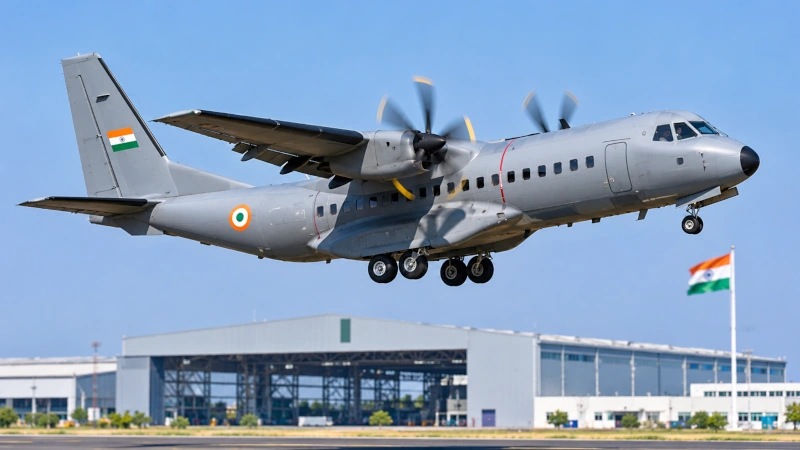
Airbus has confirmed that India’s first domestically manufactured C-295 military transport aircraft is undergoing an extended validation and flight-testing programme before its delivery to the Indian Air Force (IAF). The aircraft, manufactured by Tata Advanced Systems Limited (TASL) in partnership with Airbus Defence and Space at Vadodara, Gujarat, represents a significant milestone in India’s efforts to establish indigenous military aircraft manufacturing capabilities through the private sector.
According to a statement attributed to Airbus in reporting published on November 5, the company is working closely with Tata Advanced Systems and its Indian industrial partners to complete the aircraft’s validation and flight-testing requirements. The programme involves extensive evaluation of aircraft systems, manufacturing quality and operational performance, reflecting the technical requirements associated with establishing an entirely new military aircraft production ecosystem in India.
The first Indian-manufactured C-295 successfully completed its maiden test flight from Vadodara on June 10, 2026. The aircraft subsequently entered post-production evaluation, with Airbus and Tata undertaking the necessary procedures to establish compliance with applicable aerospace standards before delivery to the Indian Air Force.
Airbus and Tata Advance Aircraft Validation Programme
The ongoing validation programme represents an important phase in India’s first private-sector military transport aircraft manufacturing initiative. Airbus has emphasised that developing the C-295 production capability in India involves considerably more than assembling an established aircraft design, requiring the creation of manufacturing infrastructure, specialised engineering capabilities, trained personnel and comprehensive quality-assurance processes.
In its statement reported on November 5, Airbus described the C-295 India programme as a distinctive industrial undertaking requiring sustained attention to the development of local aerospace manufacturing capabilities. The company confirmed that it was working with Tata Advanced Systems and Indian partners to complete the extended validation and flight-testing phase, with particular emphasis on ensuring the quality of the aircraft before delivery.
Aircraft validation involves evaluating the performance and integration of onboard systems, including flight controls, propulsion, avionics, electrical equipment and other critical components. Flight testing provides an opportunity to assess how these systems perform under operational conditions, while ground-based evaluations help verify manufacturing quality and the reliability of aircraft equipment.
For the first aircraft emerging from a newly established production line, these activities also contribute to validating manufacturing and assembly procedures. The experience gained during the initial aircraft’s testing programme can support improvements in production processes and quality assurance for subsequent aircraft manufactured at the same facility.
The extended testing phase therefore forms part of the wider effort to establish a sustainable military aircraft manufacturing capability in India, bringing together production, systems integration, technical evaluation and aircraft delivery within a domestic industrial framework.
First Made-in-India C-295 Completed Maiden Flight in June 2026
The successful maiden flight of India’s first domestically manufactured C-295 on June 10, 2026, marked an important achievement for the country’s aerospace industry. The aircraft took off from the Tata-Airbus Final Assembly Line facility at Vadodara, demonstrating progress in the programme established to manufacture 40 military transport aircraft in India.
The milestone was acknowledged by Union Civil Aviation Minister K. Rammohan Naidu on June 11. Congratulating Airbus, Tata Advanced Systems, the Indian Air Force and the engineers and technicians involved in the programme, the Minister highlighted the significance of the achievement for India’s expanding aerospace manufacturing capabilities.
The maiden flight demonstrated that the aircraft assembled at Vadodara had progressed to airborne testing, establishing an important milestone in the development of India’s private-sector military aircraft production infrastructure. It also marked the transition from assembly and ground-based evaluations to the broader flight-testing programme required before operational delivery.
The current extended validation phase follows this achievement and reflects the continuing work being undertaken by Airbus and Tata to complete the aircraft’s post-production evaluation. The November 5 statement did not provide a revised delivery date or identify a specific technical issue responsible for the extended testing period.
₹21,935 Crore Programme to Manufacture 40 Aircraft in India
The C-295 manufacturing programme originates from a ₹21,935 crore contract signed by the Ministry of Defence with Airbus Defence and Space in September 2021 for the acquisition of 56 military transport aircraft. The programme is intended to replace the Indian Air Force’s ageing Avro-748 transport fleet while introducing modern tactical airlift capabilities.
Under the agreement, 16 aircraft are being supplied directly from Airbus’s manufacturing facilities in Seville, Spain, while the remaining 40 are to be manufactured and assembled in India by Tata Advanced Systems. This arrangement established one of India’s most significant aerospace industrial partnerships and introduced private-sector participation in complete military aircraft manufacturing.
The first C-295 manufactured in Spain was formally delivered to the Indian Air Force in September 2023. The aircraft incorporated an indigenous electronic warfare suite and marked the beginning of the IAF’s transition towards the new transport platform.
The Indian manufacturing component of the programme is centred on the Tata-Airbus Final Assembly Line in Vadodara. The facility was inaugurated on October 28, 2024, by Prime Minister Narendra Modi and Spanish Prime Minister Pedro Sánchez, establishing India’s first private-sector final assembly line for military aircraft.
Airbus and Tata have planned for the Indian production programme to deliver 40 aircraft by August 2031. The initial schedule envisaged the first domestically manufactured aircraft becoming available in September 2026, although the extended validation programme has continued beyond that target.
Vadodara Facility Establishes New Aerospace Manufacturing Capabilities
The Tata-Airbus facility at Vadodara represents a major development in India’s military aerospace manufacturing infrastructure. Unlike production arrangements limited to components or subassemblies, the C-295 programme encompasses the complete process of integrating major aircraft structures, installing equipment, conducting technical evaluations and preparing aircraft for delivery.
The manufacturing ecosystem includes the production of aircraft components at Tata Advanced Systems’ Main Component Assembly facility in Hyderabad, where structural assemblies and other equipment are prepared for integration at Vadodara. This distribution of manufacturing activities supports the development of specialised capabilities across multiple locations within India.
According to Airbus’s official announcement in October 2024, more than 85 percent of the structural and final assembly activities for the 40 Indian-produced C-295 aircraft are planned to take place domestically. The programme also involves manufacturing approximately 13,000 detailed aircraft parts in India, representing a substantial contribution to the localisation of aerospace production.
Airbus identified 37 India-based suppliers participating in the programme, including companies from both the public and private sectors. The manufacturing initiative has also required the certification of specialised industrial processes, helping Indian companies develop the capabilities needed to participate in sophisticated international aerospace production programmes.
The establishment of these production and quality-assurance capabilities is an important part of the wider programme. By developing expertise in aircraft manufacturing, testing and systems integration, India is strengthening the industrial foundation required to undertake increasingly complex aerospace projects.
Indigenous Electronic Warfare Systems Strengthen Domestic Participation
An important element of the C-295 programme is the integration of an indigenous electronic warfare suite developed through India’s defence manufacturing ecosystem. Bharat Electronics Limited (BEL) and Bharat Dynamics Limited (BDL) have been identified among the principal Indian organisations contributing to the programme.
Electronic warfare systems are important components of modern military aircraft because they support threat detection, situational awareness and defensive measures against hostile electronic and missile threats. Their integration into transport aircraft contributes to the protection of crews and equipment during operations in potentially contested environments.
The development and incorporation of indigenous electronic warfare equipment expands India’s participation beyond aircraft assembly into specialised defence electronics. This creates opportunities for domestic organisations involved in sensors, electronic systems, communication equipment and aircraft integration technologies.
The involvement of public sector organisations alongside Tata Advanced Systems and Airbus demonstrates the collaborative industrial structure supporting the programme. By bringing together international aerospace expertise and Indian manufacturing capabilities, the initiative contributes to the development of an increasingly diversified domestic defence aerospace ecosystem.
C-295 to Strengthen Indian Air Force’s Tactical Transport Fleet
The Airbus C-295 is a twin-turboprop tactical military transport aircraft designed to undertake a wide range of operational missions, including troop transportation, cargo movement, medical evacuation and humanitarian assistance. The aircraft is particularly suited to operations requiring access to relatively short or semi-prepared airstrips, making it relevant to the Indian Air Force’s diverse logistical requirements.
The aircraft can transport up to 71 troops or 50 paratroopers, depending on its configuration, and incorporates a rear cargo ramp that facilitates the loading and unloading of equipment. Its ability to operate from challenging airfields provides flexibility for military transportation missions in geographically demanding regions.
The C-295 also offers capabilities for parachute operations, casualty evacuation and the movement of essential supplies during disaster relief missions. These characteristics make the platform suitable for both conventional military logistics and humanitarian operations requiring rapid transportation to affected areas.
For the Indian Air Force, the C-295 programme is intended to replace the ageing Avro-748 fleet with a modern aircraft offering improved operational flexibility. The introduction of the platform supports the continuing modernisation of India’s tactical transport capabilities while establishing domestic industrial infrastructure for aircraft production and long-term support.
Expanding India’s Aerospace Supply Chain and Technical Expertise
The C-295 programme is contributing to the development of a wider domestic aerospace supply chain involving component manufacturers, engineering organisations and specialised service providers. The participation of Indian companies in producing detailed aircraft parts and major structural assemblies provides opportunities to develop expertise in precision manufacturing and high-quality aerospace production.
Military aircraft manufacturing requires rigorous standards governing materials, component tolerances, structural integrity and equipment reliability. Developing the capability to meet these requirements supports the growth of Indian companies seeking to participate in international aerospace manufacturing programmes.
The establishment of the Vadodara final assembly line has also created demand for specialised engineers, technicians, quality inspectors and manufacturing personnel. Training workers to undertake aircraft integration, testing and production activities contributes to the development of skills that can support future aerospace projects.
Airbus and Tata’s collaboration therefore extends beyond the production of 40 aircraft for the Indian Air Force. It is establishing manufacturing processes, technical infrastructure and institutional expertise that can contribute to India’s broader ambitions in military and civilian aerospace manufacturing.
Strengthening India’s Defence Aerospace Self-Reliance
The continued validation and flight testing of India’s first domestically manufactured C-295 represents an important stage in the country’s transition towards greater self-reliance in military aircraft production. The programme combines international technological collaboration with domestic manufacturing, component development and specialised engineering expertise.
The successful maiden flight in June demonstrated progress in establishing India’s first private-sector military aircraft final assembly capability. The subsequent testing programme is focused on completing the technical evaluations required to support the aircraft’s eventual delivery and the continued development of the domestic production line.
With 40 aircraft scheduled for manufacture in India and an expanding network of domestic aerospace suppliers, the C-295 programme represents a substantial investment in India’s long-term defence industrial capabilities. It also establishes an important model for cooperation between international aerospace manufacturers, Indian private-sector companies and domestic defence organisations.
The programme advances the objectives of Atmanirbhar Bharat by strengthening India’s participation in military aircraft manufacturing, supporting specialised technical employment and creating industrial capabilities that extend beyond individual aircraft deliveries.
As Airbus and Tata Advanced Systems continue the validation programme, the first Made-in-India C-295 remains an important symbol of India’s expanding aerospace manufacturing capabilities. The project is laying the foundations for a stronger domestic military aviation industry while contributing to the modernisation of the Indian Air Force’s tactical transport fleet.
You may also like
-
India and Myanmar Launch First Tri-Services Disaster Relief Exercise ‘Rahat Mitra’ in Chennai
-
Indian Startup Aina Unveils AI Smart Ring with Context-Aware Controls
-
India’s Startup Revolution Enters a New Era as Growing Number of Companies Achieve Profitability
-
BITS Hyderabad Startup Beijan Develops Indigenous GPS-Independent Drone Navigation Technology for Indian Army
-
AVNL Showcases Upgraded T-72 Ajeya Tank with 1,000 HP Engine
