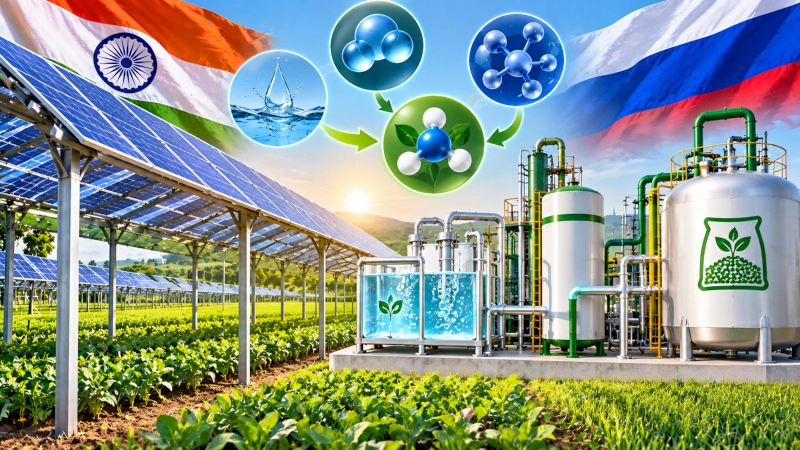
Indian and Russian researchers have developed a proposed approach to producing ammonia, a critical ingredient in nitrogen fertilisers, using solar electricity, water and atmospheric nitrogen. The technology could enable agricultural communities to manufacture fertiliser ingredients closer to farms, reduce dependence on natural gas and support the integration of renewable energy into agricultural production.
The research brings together scientists from Vellore Institute of Technology (VIT) in India, Bauman Moscow State Technical University and the Russian University of Transport. Supported by the Russian Science Foundation, the findings were published in the International Journal of Hydrogen Energy and announced by the foundation on November 2, 2026. The study examines the technical and economic possibilities of combining agrivoltaics, water electrolysis and ammonia synthesis, with particular attention to production conditions in India and Russia.
Using Solar Energy to Produce Agricultural Fertilisers
Ammonia is among the most important industrial chemicals used in agriculture because it provides the nitrogen required for manufacturing widely used fertilisers. Nitrogen is essential for plant growth, and ammonia-based fertilisers contribute significantly to agricultural productivity worldwide.
Conventional ammonia manufacturing involves combining nitrogen obtained from the atmosphere with hydrogen under high temperatures and pressures in the presence of a catalyst. Industrial production commonly operates at temperatures of approximately 350–450 degrees Celsius, while the hydrogen required for the process is generally obtained from natural gas.
This dependence on fossil fuels contributes to the carbon emissions associated with fertiliser manufacturing. The Indian and Russian research addresses the problem by examining how renewable electricity could replace fossil-fuel-derived energy in the production of hydrogen.
Under the proposed arrangement, electricity generated by solar panels would power an electrolyser that separates water into hydrogen and oxygen. The hydrogen would subsequently be combined with nitrogen extracted from the atmosphere to produce ammonia. By obtaining hydrogen from water rather than natural gas, the process offers a route towards reducing emissions associated with conventional ammonia production.
Agrivoltaics Connects Solar Power with Farming
An important feature of the research is its integration with agrivoltaics, an approach in which agricultural land is used simultaneously for crop cultivation and solar-electricity generation.
Instead of dedicating separate land exclusively to solar installations, photovoltaic panels can be positioned above agricultural fields, allowing crops to grow beneath or around them. Depending on the crop, climate and installation design, this arrangement can provide useful shading while generating electricity.
The researchers examined how surplus electricity from such installations could be directed towards ammonia production. Electricity that would otherwise be exported or remain underutilised could support water electrolysis, producing hydrogen that could later be used to manufacture fertiliser ingredients.
This approach could make renewable-energy installations more valuable to farming communities by connecting electricity generation directly with agricultural requirements. It also creates opportunities for farms to participate in energy production while reducing their dependence on externally supplied industrial inputs.
The study therefore considers solar electricity not merely as a source of power for agricultural equipment but as an input into the chemical processes that support fertiliser manufacturing.
Economic Study Identifies Significant Advantages for India
The research team developed an economic model to evaluate the feasibility of producing ammonia using the proposed solar-powered system under conditions prevailing in India and Russia.
The calculations examined installations capable of manufacturing between 0.1 and 150 tonnes of ammonia annually, allowing researchers to assess how production costs change as the size of the facility increases.
The analysis found that very small installations producing up to three tonnes of ammonia annually were not economically viable under the modelled conditions. Their capital and operational costs remained relatively high, and the main economic benefit came from electricity generation rather than ammonia production.
The findings became more favourable as production capacity increased. At an annual output of approximately 150 tonnes, the calculated cost of producing ammonia approached prevailing market prices, suggesting that larger decentralised installations could become commercially competitive.
India emerged as particularly favourable in the comparison because its solar conditions allow photovoltaic installations to generate substantial quantities of electricity. According to the Russian Science Foundation, the economic calculations indicated that additional financial support would be largely unnecessary for the modelled Indian installations, whereas comparable projects in Russia would benefit from subsidies, capital-cost compensation or concessional financing.
This distinction highlights India’s potential advantage in integrating solar-energy generation with the production of agricultural chemicals. Regions with abundant sunlight could offer opportunities to develop locally integrated renewable-energy and fertiliser-production systems.
Decentralised Fertiliser Production Could Support Rural Communities
One of the proposed technology’s important applications is the possibility of producing ammonia at or near agricultural locations rather than relying entirely on large industrial complexes situated far from farming communities.
Conventional fertiliser supply chains involve industrial manufacturing facilities, storage systems and extensive transportation networks. Agricultural communities located at considerable distances from production centres depend on these networks for regular supplies.
Smaller ammonia-production installations integrated with solar farms could provide an alternative source of locally manufactured fertiliser ingredients. Such facilities could potentially reduce transportation requirements and strengthen local supply arrangements, particularly in areas where renewable-energy resources are readily available.
The researchers also identified possible applications in farms and smaller settlements where dependence on distant industrial suppliers can increase logistical costs. By producing hydrogen from water and nitrogen from the surrounding atmosphere, the proposed system could reduce reliance on imported or transported hydrogen feedstocks.
Ammonia would still require appropriate storage, handling and conversion into suitable fertiliser products, but decentralised production could provide a foundation for more locally integrated agricultural-input systems.
For India, where agriculture supports a substantial rural population, the combination of solar electricity and fertiliser manufacturing represents a potentially useful direction for developing renewable-energy applications beyond conventional power generation.
Reducing Dependence on Natural Gas in Fertiliser Manufacturing
The research also addresses the environmental consequences of traditional ammonia production, particularly the dependence on natural gas as the principal source of hydrogen.
In conventional production, hydrogen is commonly generated through processes that release carbon dioxide. Replacing this hydrogen with hydrogen obtained through renewable-powered electrolysis can substantially reduce the emissions associated with the hydrogen-production stage.
The proposed system uses solar electricity to drive electrolysis, allowing hydrogen to be produced without the direct carbon dioxide emissions associated with natural gas reforming.
The broader environmental benefit would depend on the energy requirements of the complete ammonia-synthesis process, equipment manufacturing and the operating conditions of the facility. Nevertheless, renewable-powered hydrogen production offers an important pathway for reducing the fossil-fuel dependence of nitrogen-fertiliser manufacturing.
The technology is particularly relevant to countries seeking to expand renewable-energy use while maintaining reliable agricultural-input production. India and Russia both possess substantial agricultural sectors, making the development of alternative ammonia-production methods a subject of practical economic interest.
Vellore Institute of Technology Contributes to Indo-Russian Research Cooperation
The participation of Vellore Institute of Technology places an Indian research institution within a collaborative programme addressing agricultural sustainability, renewable energy and industrial chemistry.
The project combines expertise from Indian and Russian researchers to examine how renewable electricity can be applied to processes traditionally dependent on fossil fuels. Its emphasis on the economic conditions of both countries demonstrates the importance of evaluating emerging technologies against local energy resources and production requirements.
The Russian research team is led by Egor Loktionov, head of the Green Energy Laboratory at Bauman Moscow State Technical University. According to the Russian Science Foundation, the researchers intend to continue examining applications of solar electricity within agricultural fields, including the development of an artificial-intelligence-supported service for evaluating agrivoltaic systems.
Such work could help researchers assess different combinations of agricultural activity, solar generation and industrial processes to identify arrangements that make efficient use of available land and energy resources.
The collaborative study illustrates the growing scope of Indo-Russian scientific cooperation in areas extending beyond conventional energy and industrial technology into sustainable agriculture and renewable-powered chemical production.
Towards Solar-Powered Agricultural Manufacturing
The research presents a possible pathway for connecting three important requirements of modern agriculture: reliable fertiliser production, renewable-energy utilisation and efficient use of agricultural land.
By integrating photovoltaic electricity generation with hydrogen production and ammonia synthesis, the proposed system could allow agricultural regions to participate directly in the manufacture of important chemical inputs. Its potential benefits include lower dependence on natural gas, reduced transportation requirements and new economic applications for electricity generated by agrivoltaic installations.
The economic results are especially relevant to India, where favourable solar conditions contributed to stronger projected viability than in the Russian scenario examined by the researchers.
Although the findings currently concern a proposed technology supported by economic modelling rather than an operational commercial fertiliser plant, they establish a research foundation for further development of decentralised ammonia production.
The Indo-Russian collaboration demonstrates how advances in renewable energy, chemical engineering and agricultural technology can converge to address practical requirements of food production. For India, solar-powered ammonia manufacturing represents a promising avenue for linking its expanding clean-energy capabilities with agricultural productivity and greater self-reliance in fertiliser production.
Mate, the research is confirmed by an official Russian Science Foundation announcement dated November 2, 2026. The Indian partner is Vellore Institute of Technology (VIT), while the Russian institutions are Bauman Moscow State Technical University and Russian University of Transport.
The particularly interesting finding is that the researchers’ economic model indicates solar-powered ammonia production could be commercially attractive in India without additional financial support, under the conditions examined, because of India’s favourable solar-energy output. The study evaluates production facilities ranging from 0.1 to 150 tonnes annually; it does not report the commissioning of a commercial plant. Russian Science Foundation
Here is the Dharmakshethra-ready article.
Indian and Russian Scientists Develop Solar-Powered Ammonia Production Method for Greener Fertilisers
Indian and Russian researchers have developed a proposed approach to producing ammonia, a critical ingredient in nitrogen fertilisers, using solar electricity, water and atmospheric nitrogen. The technology could enable agricultural communities to manufacture fertiliser ingredients closer to farms, reduce dependence on natural gas and support the integration of renewable energy into agricultural production.
The research brings together scientists from Vellore Institute of Technology (VIT) in India, Bauman Moscow State Technical University and the Russian University of Transport. Supported by the Russian Science Foundation, the findings were published in the International Journal of Hydrogen Energy and announced by the foundation on November 2, 2026. The study examines the technical and economic possibilities of combining agrivoltaics, water electrolysis and ammonia synthesis, with particular attention to production conditions in India and Russia.
Using Solar Energy to Produce Agricultural Fertilisers
Ammonia is among the most important industrial chemicals used in agriculture because it provides the nitrogen required for manufacturing widely used fertilisers. Nitrogen is essential for plant growth, and ammonia-based fertilisers contribute significantly to agricultural productivity worldwide.
Conventional ammonia manufacturing involves combining nitrogen obtained from the atmosphere with hydrogen under high temperatures and pressures in the presence of a catalyst. Industrial production commonly operates at temperatures of approximately 350–450 degrees Celsius, while the hydrogen required for the process is generally obtained from natural gas.
This dependence on fossil fuels contributes to the carbon emissions associated with fertiliser manufacturing. The Indian and Russian research addresses the problem by examining how renewable electricity could replace fossil-fuel-derived energy in the production of hydrogen.
Under the proposed arrangement, electricity generated by solar panels would power an electrolyser that separates water into hydrogen and oxygen. The hydrogen would subsequently be combined with nitrogen extracted from the atmosphere to produce ammonia. By obtaining hydrogen from water rather than natural gas, the process offers a route towards reducing emissions associated with conventional ammonia production.
Agrivoltaics Connects Solar Power with Farming
An important feature of the research is its integration with agrivoltaics, an approach in which agricultural land is used simultaneously for crop cultivation and solar-electricity generation.
Instead of dedicating separate land exclusively to solar installations, photovoltaic panels can be positioned above agricultural fields, allowing crops to grow beneath or around them. Depending on the crop, climate and installation design, this arrangement can provide useful shading while generating electricity.
The researchers examined how surplus electricity from such installations could be directed towards ammonia production. Electricity that would otherwise be exported or remain underutilised could support water electrolysis, producing hydrogen that could later be used to manufacture fertiliser ingredients.
This approach could make renewable-energy installations more valuable to farming communities by connecting electricity generation directly with agricultural requirements. It also creates opportunities for farms to participate in energy production while reducing their dependence on externally supplied industrial inputs.
The study therefore considers solar electricity not merely as a source of power for agricultural equipment but as an input into the chemical processes that support fertiliser manufacturing.
Economic Study Identifies Significant Advantages for India
The research team developed an economic model to evaluate the feasibility of producing ammonia using the proposed solar-powered system under conditions prevailing in India and Russia.
The calculations examined installations capable of manufacturing between 0.1 and 150 tonnes of ammonia annually, allowing researchers to assess how production costs change as the size of the facility increases.
The analysis found that very small installations producing up to three tonnes of ammonia annually were not economically viable under the modelled conditions. Their capital and operational costs remained relatively high, and the main economic benefit came from electricity generation rather than ammonia production.
The findings became more favourable as production capacity increased. At an annual output of approximately 150 tonnes, the calculated cost of producing ammonia approached prevailing market prices, suggesting that larger decentralised installations could become commercially competitive.
India emerged as particularly favourable in the comparison because its solar conditions allow photovoltaic installations to generate substantial quantities of electricity. According to the Russian Science Foundation, the economic calculations indicated that additional financial support would be largely unnecessary for the modelled Indian installations, whereas comparable projects in Russia would benefit from subsidies, capital-cost compensation or concessional financing.
This distinction highlights India’s potential advantage in integrating solar-energy generation with the production of agricultural chemicals. Regions with abundant sunlight could offer opportunities to develop locally integrated renewable-energy and fertiliser-production systems.
Decentralised Fertiliser Production Could Support Rural Communities
One of the proposed technology’s important applications is the possibility of producing ammonia at or near agricultural locations rather than relying entirely on large industrial complexes situated far from farming communities.
Conventional fertiliser supply chains involve industrial manufacturing facilities, storage systems and extensive transportation networks. Agricultural communities located at considerable distances from production centres depend on these networks for regular supplies.
Smaller ammonia-production installations integrated with solar farms could provide an alternative source of locally manufactured fertiliser ingredients. Such facilities could potentially reduce transportation requirements and strengthen local supply arrangements, particularly in areas where renewable-energy resources are readily available.
The researchers also identified possible applications in farms and smaller settlements where dependence on distant industrial suppliers can increase logistical costs. By producing hydrogen from water and nitrogen from the surrounding atmosphere, the proposed system could reduce reliance on imported or transported hydrogen feedstocks.
Ammonia would still require appropriate storage, handling and conversion into suitable fertiliser products, but decentralised production could provide a foundation for more locally integrated agricultural-input systems.
For India, where agriculture supports a substantial rural population, the combination of solar electricity and fertiliser manufacturing represents a potentially useful direction for developing renewable-energy applications beyond conventional power generation.
Reducing Dependence on Natural Gas in Fertiliser Manufacturing
The research also addresses the environmental consequences of traditional ammonia production, particularly the dependence on natural gas as the principal source of hydrogen.
In conventional production, hydrogen is commonly generated through processes that release carbon dioxide. Replacing this hydrogen with hydrogen obtained through renewable-powered electrolysis can substantially reduce the emissions associated with the hydrogen-production stage.
The proposed system uses solar electricity to drive electrolysis, allowing hydrogen to be produced without the direct carbon dioxide emissions associated with natural gas reforming.
The broader environmental benefit would depend on the energy requirements of the complete ammonia-synthesis process, equipment manufacturing and the operating conditions of the facility. Nevertheless, renewable-powered hydrogen production offers an important pathway for reducing the fossil-fuel dependence of nitrogen-fertiliser manufacturing.
The technology is particularly relevant to countries seeking to expand renewable-energy use while maintaining reliable agricultural-input production. India and Russia both possess substantial agricultural sectors, making the development of alternative ammonia-production methods a subject of practical economic interest.
Vellore Institute of Technology Contributes to Indo-Russian Research Cooperation
The participation of Vellore Institute of Technology places an Indian research institution within a collaborative programme addressing agricultural sustainability, renewable energy and industrial chemistry.
The project combines expertise from Indian and Russian researchers to examine how renewable electricity can be applied to processes traditionally dependent on fossil fuels. Its emphasis on the economic conditions of both countries demonstrates the importance of evaluating emerging technologies against local energy resources and production requirements.
The Russian research team is led by Egor Loktionov, head of the Green Energy Laboratory at Bauman Moscow State Technical University. According to the Russian Science Foundation, the researchers intend to continue examining applications of solar electricity within agricultural fields, including the development of an artificial-intelligence-supported service for evaluating agrivoltaic systems.
Such work could help researchers assess different combinations of agricultural activity, solar generation and industrial processes to identify arrangements that make efficient use of available land and energy resources.
The collaborative study illustrates the growing scope of Indo-Russian scientific cooperation in areas extending beyond conventional energy and industrial technology into sustainable agriculture and renewable-powered chemical production.
Towards Solar-Powered Agricultural Manufacturing
The research presents a possible pathway for connecting three important requirements of modern agriculture: reliable fertiliser production, renewable-energy utilisation and efficient use of agricultural land.
By integrating photovoltaic electricity generation with hydrogen production and ammonia synthesis, the proposed system could allow agricultural regions to participate directly in the manufacture of important chemical inputs. Its potential benefits include lower dependence on natural gas, reduced transportation requirements and new economic applications for electricity generated by agrivoltaic installations.
The economic results are especially relevant to India, where favourable solar conditions contributed to stronger projected viability than in the Russian scenario examined by the researchers.
Although the findings currently concern a proposed technology supported by economic modelling rather than an operational commercial fertiliser plant, they establish a research foundation for further development of decentralised ammonia production.
The Indo-Russian collaboration demonstrates how advances in renewable energy, chemical engineering and agricultural technology can converge to address practical requirements of food production. For India, solar-powered ammonia manufacturing represents a promising avenue for linking its expanding clean-energy capabilities with agricultural productivity and greater self-reliance in fertiliser production.
Official Reference
Russian Science Foundation — November 2, 2026
Original title: Солнечные панели над полями помогут производить «зеленые» азотные удобрения
English translation: Solar Panels Above Fields Could Help Produce Green Nitrogen Fertilisers
Russian Science Foundation — Official Research Announcement
The announcement confirms the participating institutions, research methodology, economic modelling across India and Russia, and publication in the International Journal of Hydrogen Energy. Russian Science Foundation
You may also like
-
Advanced Protective Coatings to Improve Machining of Critical Superalloys can Help Aerospace, Energy & Petrochemical Sectors
-
India Advances Space Debris Removal Technology as Cosmoserve Opens Advanced Robotics Facility in Hyderabad
-
Nagaland University Researchers Develop AI Framework to Preserve India’s Endangered Languages and Cultural Heritage
-
Team led by Indian Astronomers Redefine Star Cluster UBC 63 as a Double Cluster System Spotted After Close Flyby
-
IIT Bombay Develops Low-Cost Blood Screening Technology for Anaemia and Sickle Cell Disease
