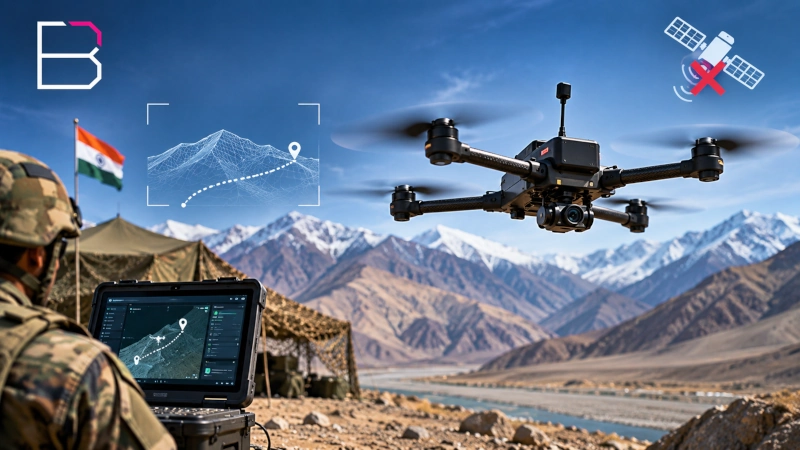
Two engineering students from BITS Pilani’s Hyderabad campus have developed an indigenous drone navigation technology designed to enable unmanned aerial vehicles to operate in environments where Global Positioning System (GPS) signals are unavailable or disrupted by electronic warfare. Their defence technology startup, Beijan, has progressed from a university robotics project to field trials with the Indian Army, developing autonomous systems for drone navigation, battlefield communication and artillery operations.
Founded by Naman Kasliwal and Shiv Patil, Beijan is developing the Beijan Autonomous Navigation Module (BANM), a compact hardware system that uses onboard cameras, sensors and computing capabilities to support navigation without continuous dependence on satellite positioning. The startup has undertaken field evaluations at military locations including Pokhran, Secunderabad and Leh, while its separately developed Prachand Swarm Ground Station software is reported to have been deployed with formations under the Indian Army’s Southern Command.
From Mars Exploration Research to Indigenous Defence Technology
The development originated from the founders’ participation in the Indian Space Research Organisation’s robotics challenge, where they explored methods for enabling robotic vehicles to navigate environments without conventional GPS infrastructure. Their research focused on low-cost visual navigation systems capable of determining movement and position using information gathered from onboard cameras and sensors.
Navigation on Mars presents challenges because the satellite positioning systems available on Earth cannot provide conventional GPS services on the Martian surface. Robotic explorers must therefore rely on alternative methods, including visual information, inertial measurements and onboard computational systems, to determine their movement and navigate unfamiliar terrain.
The BITS Hyderabad students developed a visual navigation system that reached the finals of the ISRO robotics competition. Their work subsequently attracted the attention of defence personnel, who recognised its potential application to military operations where satellite navigation signals may be unavailable, degraded or deliberately disrupted.
The founders were subsequently invited to the Pokhran Field Firing Range in Rajasthan, where interactions with Army personnel exposed them to operational challenges involving unmanned systems, battlefield coordination and the vulnerability of conventional positioning technologies.
These engagements encouraged the students to adapt their original research towards military applications. What began as an experimental robotics project consequently evolved into a startup developing autonomous technologies for the Indian defence sector.
Indigenous Navigation Module Designed for GPS-Denied Environments
The Beijan Autonomous Navigation Module is designed to provide drones with an alternative means of determining their movement and position when conventional satellite navigation cannot be relied upon. The system combines visual information gathered through onboard cameras with sensor measurements and local computing capabilities.
According to the company, BANM uses customised visual odometry techniques to estimate movement by analysing changes in the surrounding environment. This approach enables the navigation system to derive information from visual observations rather than depending entirely on external positioning signals.
The module incorporates edge-computing capabilities, allowing navigation-related calculations to be performed directly onboard the aircraft. Local processing reduces dependence on external computing infrastructure and enables the system to continue performing essential computational functions without requiring continuous connectivity to remote servers.
Beijan’s official website describes BANM as a compact hardware module weighing less than 200 grams. The company is developing it with a platform-independent architecture intended to support integration with different unmanned aerial vehicles through compatible interfaces.
This modular approach is significant because it could allow existing drone platforms to incorporate additional autonomous navigation capabilities without requiring manufacturers to develop entirely new aircraft.
GPS-independent navigation has become an important area of defence research as electronic warfare systems increasingly target satellite positioning signals. Technologies capable of maintaining navigation functions under such conditions can improve the resilience of unmanned systems operating in electronically contested environments.
Indian Army Field Trials Conducted in Leh, Pokhran and Secunderabad
Beijan has undertaken field trials and demonstrations of its autonomous technologies at several military locations, including Leh, Secunderabad and the Pokhran Field Firing Range.
According to the founders, the company has tested its navigation systems under different environmental and operating conditions to assess their suitability for defence applications. These evaluations have provided opportunities to examine the performance of onboard computing, visual navigation and autonomous detection technologies outside controlled laboratory environments.
The startup has also reported a field deployment near Jaisalmer, Rajasthan, during which it evaluated GPS-independent navigation and autonomous detection capabilities. Such field activities are important for understanding how experimental navigation technologies perform when exposed to changing terrain, lighting conditions and other practical operating requirements.
Beijan has received letters of intent from eight military units expressing interest in its navigation technology. The company has also reported that three modules were taken for additional field testing following a demonstration before the Indian Army’s Southern Command.
The navigation module remains under development, with further system integration and validation required before broader deployment. The field evaluations demonstrate continuing engagement with military users, while the company’s reported letters of intent indicate interest in potential future applications.
Prachand Swarm Ground Station Software Reportedly Deployed With Army Formations
Alongside its navigation module, Beijan has developed Prachand Swarm Ground Station software designed to support the management and coordination of multiple unmanned aerial systems.
According to the startup, the software is deployed with formations operating under the Indian Army’s Southern Command. The company has also developed additional applications for Army Air Defence, extending its work beyond individual drone navigation into battlefield information and coordination systems.
Drone swarm technologies involve the coordinated operation of multiple unmanned aircraft, creating opportunities for distributed surveillance, reconnaissance and other military applications. Ground-control software plays an important role in enabling operators to monitor unmanned systems, manage missions and coordinate their activities.
Beijan’s work in this area reflects its broader focus on developing software and electronic systems that can be integrated with existing defence platforms. Rather than concentrating exclusively on manufacturing complete aircraft, the company is developing specialised modules intended to enhance the capabilities of equipment already available to military users.
The company’s reported Prachand software deployment represents a separate achievement from the continuing development of BANM. While the ground station software has reportedly entered operational use with Army formations, the autonomous navigation hardware remains in the testing and integration stage.
Autonomous Artillery Positioning System Expands Defence Applications
Beijan is also developing an Autonomous Artillery Positioning System (AAPS), intended to modernise conventional artillery equipment through computer vision, positioning technologies and automated mechanical systems.
The technology is designed to integrate computing and electronic control capabilities with existing artillery platforms, reducing reliance on certain manual processes involved in gun positioning.
According to the company, AAPS combines computational methods, positioning sensors and motorised actuation to support artillery positioning operations. The system is being developed as a modular upgrade that can be incorporated into compatible equipment rather than requiring the replacement of entire platforms.
This approach forms part of Beijan’s wider strategy of developing adaptable hardware and software systems for existing military equipment. By concentrating on modular autonomy and computing technologies, the startup aims to create products that can be integrated across different defence applications.
The company has reported securing a ₹20 lakh order associated with an artillery automation system. It is also developing technologies for battlefield communication and distributed computing, with the objective of supporting coordination among different military platforms.
These activities demonstrate the startup’s expansion from drone navigation into a wider range of defence electronics and autonomous systems.
Startup Secures ₹1.7 Crore Investment to Expand Research and Development
Beijan has secured ₹1.7 crore in pre-seed investment led by AJVC, providing additional financial support for its research, product development and engineering activities.
According to co-founder Naman Kasliwal, the funding will help the company accelerate development of its autonomous technologies, conduct additional field trials, expand technical capabilities and prepare its systems for potential larger-scale manufacturing.
The startup has also received approval for a ₹25 lakh grant through the Curiosity 2026 programme, associated with South Park Commons and ARTPARK. The founders indicated that the grant had not yet been disbursed at the time of the November reporting.
Operating from the CORAS Lab at BITS Pilani’s Hyderabad campus, Beijan represents an example of advanced engineering research being translated into entrepreneurial activity. The startup’s work combines computer vision, embedded computing, autonomous navigation and specialised defence electronics.
The financial support and institutional environment provide opportunities for the company to undertake further engineering development while strengthening its relationships with potential military users and industrial partners.
Indigenous Autonomous Systems Strengthen India’s Defence Technology Ecosystem
The development of GPS-independent navigation technologies is relevant to India’s broader efforts to strengthen indigenous capabilities in unmanned aerial systems and advanced defence electronics.
Modern military operations increasingly involve environments where communication and satellite navigation systems may be disrupted. The ability to develop alternative positioning technologies domestically can support the creation of unmanned platforms designed for demanding operational requirements.
Indian startups are contributing to this field through research involving computer vision, artificial intelligence, embedded processors, autonomous control systems and specialised sensors. These technologies have applications extending beyond military drones into robotics, unmanned ground vehicles and industrial autonomous systems.
Beijan’s approach is particularly noteworthy because it focuses on developing compact, adaptable modules for existing equipment. Such systems can create opportunities for collaboration with drone manufacturers, defence electronics companies and organisations involved in military platform integration.
The company’s journey from an ISRO robotics challenge to field evaluations with the Indian Army also highlights the role of university research laboratories and student entrepreneurship in developing indigenous technologies.
With its autonomous navigation module undergoing further validation, Prachand Swarm Ground Station software reportedly deployed with Army formations and additional work progressing in artillery automation, Beijan is expanding its participation in India’s defence technology ecosystem. Its development illustrates the growing contribution of Indian deep-tech startups to autonomous systems, military electronics and indigenous engineering capabilities.
You may also like
-
India and Myanmar Launch First Tri-Services Disaster Relief Exercise ‘Rahat Mitra’ in Chennai
-
Indian Startup Aina Unveils AI Smart Ring with Context-Aware Controls
-
Airbus Confirms Extended Flight Testing of India’s First Made-in-India C-295 Aircraft
-
India’s Startup Revolution Enters a New Era as Growing Number of Companies Achieve Profitability
-
AVNL Showcases Upgraded T-72 Ajeya Tank with 1,000 HP Engine
