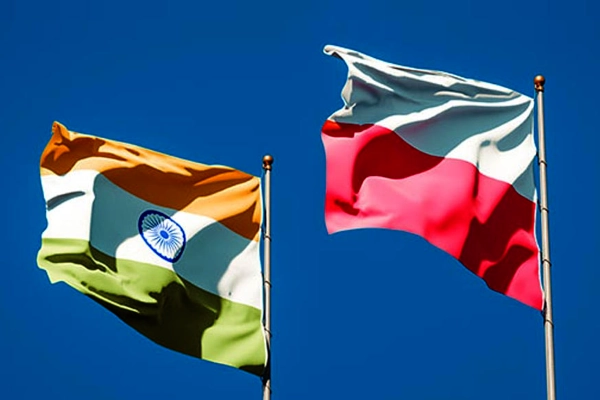
India and Poland have explored opportunities to expand bilateral cooperation in artificial intelligence, semiconductors, cybersecurity, critical minerals and advanced manufacturing as part of their growing strategic partnership. The discussions took place during Minister of State for Commerce and Industry and Electronics and Information Technology Jitin Prasada’s official visit to Poland on 2–3 November 2026, accompanied by a business delegation representing 12 Indian companies.
The visit focused on strengthening technological collaboration, industrial investment and commercial partnerships between the two countries. It followed Polish Prime Minister Donald Tusk’s visit to India in October 2026 and reflected the expanding scope of the India–Poland Strategic Partnership established during Prime Minister Narendra Modi’s visit to Warsaw in August 2024.
According to the Ministry of Commerce and Industry, the engagements sought to identify opportunities for Indian and Polish enterprises to collaborate in emerging technologies, strengthen global supply chains and expand market access through the evolving India–European Union economic partnership.
Artificial Intelligence, Semiconductors and Cybersecurity at the Centre of Discussions
During his visit, Jitin Prasada met Poland’s Deputy Prime Minister and Minister of Digital Affairs, Krzysztof Gawkowski, to discuss cooperation in artificial intelligence, semiconductor technologies, data centres and cybersecurity. The meeting examined opportunities for technological collaboration and the development of digital infrastructure that could support the expanding requirements of both economies.
The Polish Ministry of Digital Affairs provided additional details about the discussions, highlighting the shared interest in developing sovereign artificial intelligence capabilities and large language models adapted to national languages and cultural requirements. Poland is developing its PLLuM language model, while India has established the BHASHINI platform to expand access to digital services across Indian languages.
The two sides discussed exchanging experience in developing language technologies and reducing dependence on external digital platforms. Such cooperation could contribute to the development of artificial intelligence systems designed around the linguistic diversity, administrative requirements and technological priorities of both countries.
Another important area of discussion concerned sovereign computing infrastructure, including data centres and semiconductor capabilities. Both governments recognised opportunities for investment and collaboration in technologies that are increasingly important for digital infrastructure, industrial development and national technological resilience.
The Polish government also highlighted India’s experience in delivering digital public services at population scale. Discussions covered the potential application of artificial intelligence agents in public administration and the lessons Poland could draw from Indian platforms serving hundreds of millions of users.
Critical Minerals and Semiconductor Manufacturing Offer New Industrial Opportunities
Jitin Prasada also met Poland’s Deputy Minister for Economic Development and Technology, Michal Baranowski, to explore cooperation in critical minerals, semiconductors and startup ecosystems. The discussions focused on identifying opportunities for industrial partnerships that could combine the technological expertise and manufacturing capabilities available in both countries.
The Indian Minister highlighted the opportunities offered by the Make in India initiative and emphasised the importance of joint development, joint production and technology transfer. These approaches could encourage companies from both countries to establish deeper industrial relationships extending beyond conventional trade in finished products.
Critical minerals are increasingly important to semiconductor manufacturing, electric vehicles, renewable energy systems, batteries, electronics and advanced defence technologies. Developing diversified supply chains for these materials has consequently become an important strategic priority for major industrial economies.
India and Poland have already identified critical mineral cooperation as an important component of their broader strategic relationship. During the October 2026 summit between Prime Ministers Narendra Modi and Donald Tusk, the two leaders highlighted opportunities in battery recycling, rare earth refining, mineral processing and associated industrial technologies.
The latest ministerial discussions provide further momentum to these areas of cooperation, particularly as India expands domestic semiconductor manufacturing and seeks to strengthen its advanced materials and electronics industries.
India–EU Free Trade Agreement Creates Opportunities for Bilateral Commerce
The proposed expansion of India–Poland economic cooperation also featured prominently in discussions concerning the India–European Union Free Trade Agreement. During a meeting with Poland’s Secretary of State in the Ministry of Foreign Affairs, Ignacy Niemczycki, Jitin Prasada examined opportunities expected to emerge from the agreement.
The Minister emphasised the potential for stronger cooperation in agricultural technologies, food processing and greater participation by small and medium enterprises. These sectors offer opportunities to connect Indian manufacturing and agricultural capabilities with European markets, technology providers and industrial value chains.
The India–EU Free Trade Agreement is expected to strengthen commercial engagement between India and European Union member states by improving market access and creating opportunities for trade and investment. Poland, with its established industrial base and position within the European single market, represents an important potential partner for Indian companies seeking to expand their European operations.
Both sides also recognised the importance of supporting smaller businesses in accessing new international opportunities. Stronger connections between Indian and Polish enterprises could contribute to technology adoption, industrial modernisation and participation in international supply chains.
India–Poland Business Forum Highlights Investment and Industrial Partnerships
On 3 November, Jitin Prasada delivered the opening address at the India–Poland Business Forum organised by the Polish National Chamber of Commerce in Warsaw. The event brought together business representatives to examine opportunities for expanding bilateral trade, industrial investment and technological partnerships.
Addressing the gathering, the Minister encouraged Indian and Polish companies to identify new areas of commercial cooperation and develop stronger business relationships. He also highlighted the opportunities expected from the India–EU Free Trade Agreement and urged businesses to explore the possibilities for improving market access and investment flows.
During the visit, Prasada interacted with members of the Indian business community in Poland and held discussions with potential Polish investors interested in opportunities within India. These engagements formed part of a broader effort to strengthen business-to-business connections and translate high-level diplomatic cooperation into industrial and commercial partnerships.
The Minister also visited Transition Technologies, a Polish information technology and software engineering company, and WB Electronics, a Polish defence technology company. Both organisations have business interests in India, reflecting the potential for collaboration across software engineering, electronics and advanced defence technologies.
The interactions demonstrated the range of sectors being considered for closer cooperation, extending from digital infrastructure and industrial manufacturing to technologies with applications in civilian and defence systems.
Strategic Partnership Expands into Advanced Research and Innovation
The November visit builds upon the commitments made during the India–Poland summit in October 2026, when Prime Ministers Narendra Modi and Donald Tusk agreed to expand cooperation in emerging technologies and strengthen connections between their respective innovation ecosystems.
The leaders identified collaborative research in artificial intelligence, semiconductors and quantum technologies as important areas of future engagement. They also supported stronger startup partnerships, closer links between research institutions and greater cooperation between technology enterprises.
The two countries have additionally recognised the significance of cooperation in space technologies, cybersecurity and defence innovation. Their expanding relationship reflects a shared interest in developing advanced technological capabilities, strengthening industrial resilience and creating opportunities for research-driven economic growth.
The proposed India–Poland Startup Bridge and technology hackathons for young innovators are among the initiatives intended to encourage stronger connections between entrepreneurs, researchers and technology developers.
These engagements could help Indian startups and research institutions establish partnerships with European counterparts while creating opportunities for Polish companies to participate in India’s expanding technology and manufacturing ecosystem.
Strengthening India’s International Technology Partnerships
India’s growing engagement with Poland reflects the increasing importance of technology cooperation within its international economic relationships. Semiconductors, artificial intelligence, critical minerals and advanced manufacturing are central to India’s efforts to establish stronger domestic industrial capabilities and expand participation in global technology value chains.
Poland offers opportunities for cooperation through its engineering expertise, technology enterprises, industrial capabilities and integration with European markets. For India, stronger partnerships in these sectors will support indigenous research, industrial investment, technology transfer and the development of internationally competitive manufacturing capabilities.
The November 2026 engagements have reinforced the technology-focused agenda of the India–Poland Strategic Partnership, bringing together government institutions, research priorities and business interests across multiple sectors. By placing joint development, investment and innovation at the centre of their discussions, both countries are expanding the foundations for a more diversified and technologically advanced economic relationship.
You may also like
-
Philippines Hails BrahMos Missile Technology, Signals Growing Interest in Advanced Indian Defence Equipment
-
India Showcases Digital Public Infrastructure and Expanding Trade Partnerships at Commonwealth Summit
-
India and US Launch TIGER TRIUMPH 2026 to Strengthen Joint Disaster Response and Military Coordination
-
Indian and Indonesian Special Forces Begin GARUDA SHAKTI 2026 Validation Exercise in East Java
-
Indian and Sri Lankan Coast Guards Strengthen Maritime Security Cooperation at 9th High-Level Meeting
