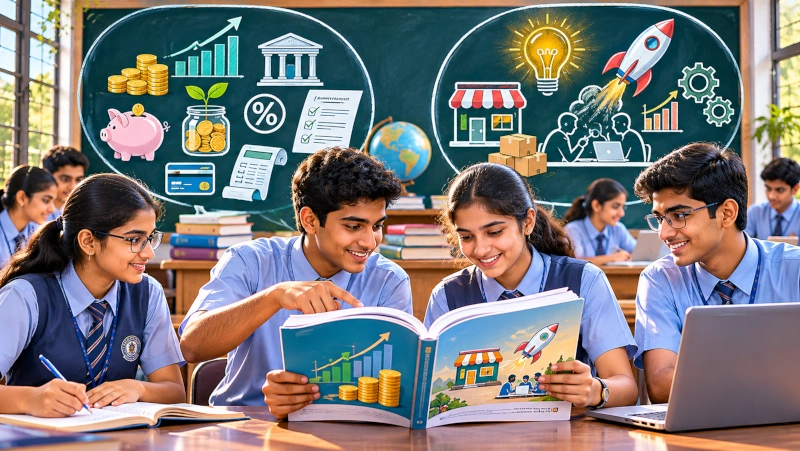
The National Council of Educational Research and Training (NCERT) has introduced dedicated chapters on personal finance and entrepreneurship in its revised Class 9 Social Science textbook, bringing practical financial knowledge, investment awareness and business education into the school curriculum. The new material aims to equip students with an understanding of everyday financial decisions while encouraging innovation, enterprise development and responsible economic participation from an early age.
The two chapters, titled Managing Your Personal Finances and From Ideas to Startups, are included in Understanding Society: India and Beyond — Part II, released for the 2026–27 academic session. The textbook forms part of the curriculum reforms undertaken in accordance with the National Education Policy 2020 and the National Curriculum Framework for School Education 2023. The development attracted renewed attention on November 4 when Sanjeev Sanyal, Member of the Economic Advisory Council to the Prime Minister, highlighted the chapters and their emphasis on practical life skills.
Personal Finance Becomes Part of School-Level Economics Education
Chapter 5, Managing Your Personal Finances, introduces students to the fundamental principles of money management and the importance of making informed financial decisions. The chapter encourages students to consider how they use money received as pocket money, gifts or other sources of personal income and introduces the relationship between immediate spending and long-term financial goals.
The curriculum explains the role of saving, budgeting and investing in financial planning. Students learn how financial decisions influence their ability to meet future requirements and why understanding income, expenditure and savings is an important life skill.
NCERT’s official syllabus identifies personal financial management as a key competency, encouraging students to prepare simple personal or family budgets showing income, expenditure and savings. Such exercises connect economic concepts with situations that students encounter in their daily lives.
The approach provides an opportunity to develop financial awareness before students begin managing larger financial responsibilities. By introducing these subjects during secondary education, NCERT is strengthening the practical application of economics beyond conventional classroom theory.
Students Introduced to Fixed Deposits, Mutual Funds and Investment Risks
The revised curriculum includes an introduction to commonly used financial instruments such as fixed deposits, stocks, bonds and mutual funds. Students are encouraged to understand the differences between saving and investing, including the relationship between potential returns and financial risk.
The syllabus also introduces simple and compound interest, enabling students to examine how money grows over time and how borrowing costs are calculated. These concepts provide a foundation for understanding bank deposits, loans and other financial arrangements.
The textbook discusses Equated Monthly Instalments, commonly known as EMIs, which are widely used for repaying loans. Understanding instalment payments helps students recognise the financial commitments associated with borrowing and the importance of evaluating repayment obligations.
Another important component concerns risk management and insurance. Students are introduced to the principle that financial planning involves protecting resources alongside saving and investing for future requirements.
These lessons provide a foundation for responsible financial decision-making and greater familiarity with the institutions and instruments that form part of India’s financial system.
Taxation Explained as an Essential Part of Economic Life
The chapter also introduces students to India’s taxation system, explaining why governments collect taxes and how public revenue supports the provision of essential services and infrastructure.
Students learn the distinction between direct and indirect taxes. Direct taxation includes personal income tax, while indirect taxation includes the Goods and Services Tax, which applies to specified transactions involving goods and services.
The textbook explains the basic principles of income taxation, including taxable income, applicable exemptions and the calculation of tax obligations. It also introduces practical examples intended to help students understand how taxation operates within the broader economy.
This approach connects financial education with civic awareness by explaining the relationship between government revenue, public expenditure and economic development.
By studying taxation alongside savings, expenditure and investments, students gain a more complete understanding of how individual financial decisions relate to the functioning of the national economy.
Entrepreneurship Chapter Encourages Innovation and Enterprise
Chapter 6, From Ideas to Startups, introduces students to entrepreneurship as an important component of economic development, employment generation and technological innovation.
The chapter examines how individuals identify opportunities, develop business ideas and organise the resources necessary to establish an enterprise. It also introduces the stages involved in transforming an idea into a functioning business.
Students learn about business planning, financial management and the relationship between revenue, costs and profitability. The curriculum introduces basic accounting concepts, including profit-and-loss calculations and the principal components of a balance sheet.
These subjects provide students with an understanding of how enterprises operate and why planning, financial discipline and efficient resource management are important to business activity.
The chapter also examines the role of entrepreneurs in developing new products, services and technologies. Through examples and practical activities, students are encouraged to recognise creativity, problem-solving and responsible risk-taking as important elements of entrepreneurship.
The inclusion of these topics creates opportunities for students to explore enterprise development as a possible professional pathway alongside conventional employment.
India’s Startup Ecosystem and MSMEs Included in Curriculum
The entrepreneurship chapter extends beyond individual business planning to examine India’s wider startup and manufacturing ecosystem.
NCERT’s syllabus includes the role of initiatives such as Startup India, Make in India and Digital India in supporting entrepreneurship, industrial development and technological innovation.
Students are introduced to the importance of Micro, Small and Medium Enterprises (MSMEs), which contribute to manufacturing, employment, services and regional economic activity.
The curriculum also examines the role of the unorganised sector and the relationship between entrepreneurship, innovation and inclusive economic development.
Through this broader perspective, students can understand how small enterprises, technology startups and established businesses contribute to the production and distribution of goods and services.
The material encourages an appreciation of enterprise creation as an activity involving initiative, planning, innovation and the productive use of resources.
It also introduces students to the idea that successful businesses develop by identifying needs, creating solutions and responding to changing market conditions.
Sanjeev Sanyal Highlights Practical Financial and Business Skills
Sanjeev Sanyal, Member of the Economic Advisory Council to the Prime Minister, drew attention to the new chapters through posts on X, highlighting their practical approach to financial education and entrepreneurship.
In his observations on the personal finance chapter, Sanyal welcomed the inclusion of subjects such as fixed deposits, mutual funds, EMIs, taxation and the relationship between risk and returns.
He emphasised that the objective is to provide students with useful life skills that can support informed financial decisions.
Sanyal also highlighted the entrepreneurship chapter’s discussion of business plans, accounting, profit-and-loss calculations and innovation.
He particularly welcomed its presentation of entrepreneurship, business creation and responsible risk-taking as constructive economic activities.
His observations reflect the practical orientation of the revised economics curriculum, which seeks to connect classroom education with the financial and entrepreneurial decisions students may encounter as they grow older.
New Curriculum Emphasises Experiential and Competency-Based Learning
The revised Social Science textbooks have been developed within the framework of the National Education Policy 2020 and the National Curriculum Framework for School Education 2023.
An important feature of the new approach is the emphasis on competency-based and experiential learning, encouraging students to apply academic concepts to practical situations.
NCERT’s official syllabus recommends activities such as preparing household budgets, examining changes in market prices, developing simple business plans and participating in classroom exercises that simulate economic transactions.
Teachers are encouraged to connect economic theory with familiar situations, enabling students to understand concepts through discussion, observation and practical application.
For entrepreneurship education, such activities can include identifying a product or service, estimating the resources required to create it, calculating potential costs and developing a basic business proposal.
Similarly, financial education can involve preparing savings plans, comparing investment options and understanding how interest affects borrowing and deposits.
The approach strengthens analytical ability, financial awareness and independent decision-making while providing opportunities for collaborative learning.
Financial Literacy and Enterprise Education Support Future Readiness
The introduction of personal finance and entrepreneurship into the Class 9 curriculum represents an important development in preparing students for the economic responsibilities of adult life.
Financial literacy enables individuals to understand savings, investments, borrowing and taxation, while entrepreneurial education introduces the skills associated with innovation, business planning and enterprise management.
Together, these subjects provide a foundation for greater economic awareness and practical decision-making.
The inclusion of startup development and MSMEs also connects school education with India’s expanding entrepreneurial and manufacturing ecosystem, allowing students to understand how businesses contribute to employment, industrial development and national economic growth.
For students interested in science, technology, engineering or other professional fields, early exposure to entrepreneurship can help establish a connection between technical knowledge and its potential commercial applications.
Similarly, financial literacy provides practical knowledge relevant to individuals pursuing employment, higher education, business ownership or independent professional careers.
NCERT Strengthens Practical Economics Education for a New Generation
The introduction of Managing Your Personal Finances and From Ideas to Startups marks an important expansion of practical economics education in Indian schools.
By incorporating money management, investments, taxation, business planning and entrepreneurship into the Class 9 curriculum, NCERT is providing students with opportunities to develop financial and economic understanding at an early stage.
The emphasis on real-world examples, practical exercises and competency-based learning makes the material relevant to everyday decisions while encouraging students to explore innovation and enterprise creation.
The revised curriculum also connects education with India’s growing startup ecosystem and the wider national emphasis on manufacturing, technological advancement and entrepreneurship.
Through these additions, NCERT is strengthening the relationship between classroom learning and practical life skills, helping young Indians develop the knowledge, confidence and analytical abilities required to participate meaningfully in an increasingly dynamic economy.
Reference
National Council of Educational Research and Training, Understanding Society: India and Beyond — Part II, Class 9 Social Science, 2026–27; NCERT Grade 9 Social Science Syllabus, 2026.
You may also like
-
India and Russia’s Tatarstan Expand Cooperation in Higher Education, Scientific Research and Industrial Skills
-
India Pledges Protection for Medical Students in Uzbekistan Against Exploitation
-
India Sets Guinness World Record with Nearly 2.88 Lakh Student Innovation Project Submissions
-
NLC India Opens 1,067 Apprenticeship Opportunities in Technical and Professional Fields
-
Indian Physicist Ashoke Sen Becomes First Indian to Receive Prestigious Oskar Klein Medal
