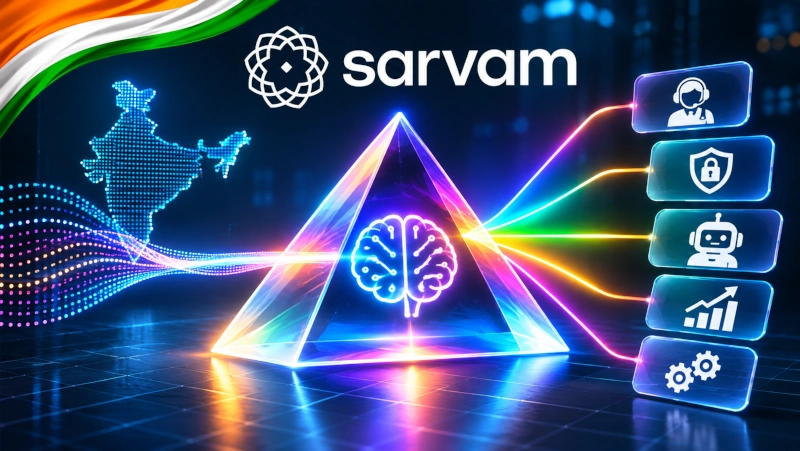
Indian artificial intelligence company Sarvam AI has introduced Prism, an indigenous open-weight decision model designed to enable enterprises to make rapid, structured and confidence-based decisions using artificial intelligence. Built on the company’s Sarvam 105B foundation model, Prism represents a specialised approach to enterprise AI, focusing on classification, decision-making, automated workflow management and the evaluation of AI-generated actions rather than conventional text generation.
Announcing the development on November 3, Sarvam stated that Prism achieved an average score of 71.8 across three decision-making benchmarks while delivering a median response time of 44 milliseconds on a single NVIDIA B200 graphics processing unit. The company has released the model weights under the Apache 2.0 licence, allowing developers and enterprises to customise and deploy the technology using their own infrastructure. The model is also available through Sarvam’s commercial application programming interface.
Moving Beyond Conversational AI Towards Automated Decisions
Most widely used large language models are designed to generate responses sequentially, producing text one token at a time. While this approach supports conversational applications, document generation and complex reasoning, many enterprise processes require a different capability: selecting the most appropriate action from a defined set of possibilities.
Sarvam Prism has been developed specifically for such applications. Instead of generating a lengthy explanation, the model receives information describing a situation, evaluates a question and assigns probabilities to the available responses. This allows software systems to interpret its output directly and incorporate the result into automated business processes.
For example, a customer service platform may need to determine whether an incoming request concerns billing, technical support or account management. Similarly, an enterprise security system may need to classify a suspicious message, while an AI management platform may need to decide whether an automated task was completed successfully or requires human review.
In these circumstances, a specialised decision model can provide structured results without requiring an additional process to interpret generated text. Prism’s architecture is intended to make such operations faster and more predictable while enabling enterprises to evaluate the confidence associated with individual decisions.
Built on India’s Sarvam 105B Foundation Model
Prism is based on Sarvam 105B, a large-scale foundation model developed by the Bengaluru company. The underlying architecture uses a mixture-of-experts design, which distributes computational work among specialised components rather than activating every model parameter for each processing operation.
Sarvam has developed Prism through low-rank adaptation, commonly known as LoRA, which allows an existing foundation model to be fine-tuned for specialised tasks without retraining the entire model from the beginning. This approach enables the company to adapt its general-purpose AI capabilities to the specific requirements of structured decision-making.
The model receives a description of the situation, a question and a set of possible responses. A specialised scoring mechanism then produces a probability distribution across the available options, indicating the model’s relative confidence in each outcome.
Unlike conventional generative systems, Prism does not produce a token-by-token textual answer. Its output is designed to be consumed directly by software applications, making it suitable for tasks involving categorisation, routing, evaluation and automated decision support.
This distinction is important because enterprises increasingly require AI systems that can perform clearly defined functions within existing operational processes. By developing a dedicated model for decision-making, Sarvam is extending its indigenous AI capabilities into specialised enterprise applications.
Company Reports 44-Millisecond Response Time
One of Prism’s principal technical characteristics is its reported processing speed. Sarvam stated that the model achieved a median response time of 44 milliseconds when tested on a single NVIDIA B200 GPU, following a series of engineering optimisations designed to reduce computational requirements.
The company reported that an earlier version required approximately 664 milliseconds per request while operating across two GPUs. By optimising numerical precision, processing specialised model components more efficiently and improving the execution of its inference operations, Sarvam reduced the reported response time substantially.
According to the company’s benchmark results, Prism achieved an average score of 71.8 across three decision indices. Its performance included a score of 82.5 on an Indian-language evaluation, highlighting its potential application in multilingual enterprise environments.
Sarvam compared Prism with 24 other decision models and reported that it achieved the highest average score among those delivering responses within 100 milliseconds. The evaluation included publicly available benchmarks, the company’s reproduction of an external decision benchmark and an internally developed Indian-language assessment.
These results were obtained through evaluations conducted by Sarvam itself. They demonstrate the company’s reported technical progress but should not be interpreted as independently verified performance across every possible enterprise application.
Supporting Indian Languages in Enterprise AI
A significant aspect of Prism is its ability to process decision-making tasks involving Indian languages. Sarvam’s documentation identifies support for English, ten Indian languages and Hinglish, providing a foundation for applications that must operate across linguistically diverse environments.
Language accessibility is particularly important for Indian businesses serving customers across different states and regions. Customer support platforms, financial service providers, digital commerce companies and public-facing technology services frequently receive information in multiple languages, creating a need for automated systems capable of interpreting and categorising requests consistently.
Prism’s multilingual capabilities could support the classification of customer enquiries, identification of service requirements and evaluation of structured information without requiring every interaction to be translated into English before processing.
The model could also be adapted for specialised industry terminology and organisation-specific workflows through additional training. This provides opportunities for enterprises to develop applications reflecting their operational requirements while retaining control over the underlying decision-making infrastructure.
By incorporating Indian-language capabilities into a specialised AI model, Sarvam is addressing a practical requirement in the domestic enterprise technology market while extending the potential applications of its indigenous foundation models.
Applications in Cybersecurity and AI-Agent Monitoring
Sarvam has identified cybersecurity as an important potential application for Prism. Enterprise security systems frequently need to examine large volumes of messages, documents and system activities to determine whether particular patterns indicate malicious behaviour.
The company has evaluated Prism on tasks involving phishing detection, prompt-injection identification and the classification of cybersecurity threats. In an internal benchmark containing 5,517 questions across nine tasks, Sarvam reported an accuracy score of 89%.
The ability to classify potentially harmful content or suspicious activity rapidly could support automated security monitoring systems, particularly where large numbers of requests must be assessed within limited processing time.
Another application involves evaluating autonomous AI agents. As enterprises deploy software agents to complete tasks independently, organisations need mechanisms for determining whether those tasks were completed correctly, whether errors occurred and whether human intervention is required.
Prism is designed to examine records of AI-agent activity and make structured assessments concerning task completion, operational errors and the need for additional review. Sarvam reported an overall accuracy of 78.5% in its internal agent-evaluation tests.
These capabilities could support systems responsible for monitoring automated workflows and identifying activities requiring closer examination. The cybersecurity and agent-evaluation results remain company-reported benchmarks rather than evidence of operational deployment across every enterprise environment.
Open-Weight Release Encourages Independent Development
Sarvam has released Prism’s model weights through Hugging Face under the Apache 2.0 licence. This allows developers and organisations to access the model, modify it and develop applications without relying exclusively on a proprietary hosted service.
The release is particularly relevant to enterprises that require control over their data processing infrastructure or wish to adapt artificial intelligence models to specialised internal workflows. Organisations with suitable computing resources can deploy Prism within their own environments and undertake additional training using relevant datasets.
Sarvam has indicated that the model can operate using FP8 numerical precision on a GPU with at least 120 GB of available memory. This requirement places the technology within the category of computationally demanding enterprise AI systems rather than models intended for ordinary consumer computers.
For organisations that do not wish to operate the model independently, Sarvam also provides access through its Decisions API. The service accepts structured inputs and returns probabilities associated with the available decision options.
The combination of publicly available model weights and commercial API access creates multiple adoption pathways for developers, researchers and enterprises. It also allows independent organisations to examine the model’s performance and explore applications suited to their requirements.
Strengthening India’s Indigenous Artificial Intelligence Ecosystem
Prism’s release represents another development in India’s expanding ecosystem of companies building specialised artificial intelligence technologies. While much of the global AI industry has concentrated on increasingly capable general-purpose models, enterprise applications also require systems optimised for particular operational functions.
Specialised models can be designed to prioritise characteristics such as processing speed, predictable output structures and integration with existing software. These capabilities are valuable in applications where AI must perform repeated decisions rather than generate extensive responses.
For Indian AI companies, developing such technologies offers opportunities to participate in enterprise markets that require multilingual processing, customised deployment and integration with industry-specific workflows.
Sarvam’s approach also demonstrates how an indigenous foundation model can serve as the basis for multiple specialised applications. Rather than limiting the Sarvam 105B architecture to general-purpose interactions, the company is adapting it for defined computational tasks with practical enterprise requirements.
The availability of Prism under an open-weight licence could encourage further experimentation among Indian developers, research institutions and technology businesses. This may support the development of applications in customer service, financial services, cybersecurity, enterprise software and other sectors requiring structured automated decisions.
Expanding Indigenous AI from Foundation Models to Practical Applications
The launch of Sarvam Prism highlights the development of a specialised segment within India’s artificial intelligence industry, where companies are building systems intended to perform operational tasks with measurable speed and accuracy.
Its combination of a large indigenous foundation model, specialised decision-making architecture, multilingual support and open-weight distribution provides a platform for developing enterprise applications across different industries.
Sarvam’s reported benchmark results indicate progress in reducing response times while maintaining competitive performance on structured decision tasks. The model’s broader capabilities can now be examined by developers and organisations using the publicly available weights and commercial API.
The development illustrates how India’s growing AI ecosystem is moving beyond the creation of general-purpose models towards technologies designed for specific business requirements. By extending indigenous foundation-model capabilities into enterprise decision-making, Sarvam AI is contributing to the expansion of domestically developed artificial intelligence infrastructure and its potential applications across the Indian economy.
You may also like
-
India Showcases Digital Public Infrastructure and Expanding Trade Partnerships at Commonwealth Summit
-
Pune Fintech Fibe Enters UPI Payments Market After NPCI Approval
-
TRAI Introduces Revised Telecom Interconnection Regulations to Modernise India’s Communication Networks
-
Bengaluru Space Startup Akashalabdhi Tests Expandable Space Habitat Technology at 30 Kilometres Altitude
-
India Proposes Expanded Import Network for Medicines and Medical Devices to Improve Healthcare Logistics
