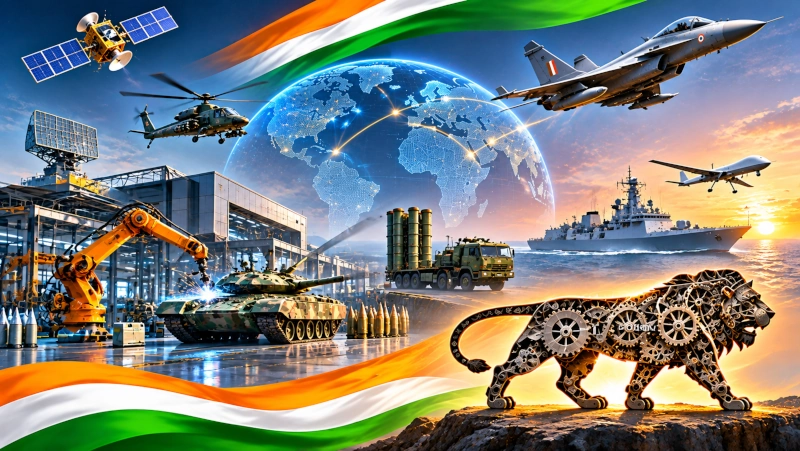
India has reaffirmed its ambition to achieve annual defence production worth ₹3 lakh crore and defence exports of ₹50,000 crore by 2029, as the government intensifies efforts to strengthen indigenous military manufacturing, accelerate technological innovation and modernise the armed forces. Defence Minister Rajnath Singh outlined these objectives during a meeting of the Ministry of Defence’s Consultative Committee in Jaisalmer, Rajasthan, on November 3, emphasising the importance of developing a technologically advanced and self-reliant military capable of responding to evolving security challenges.
The meeting, devoted to the modernisation of the Indian Armed Forces, examined changing warfare requirements, the induction of next-generation military platforms and the development of indigenous technologies. Discussions also focused on improving coordination among the three services, strengthening defence research and development, expanding domestic manufacturing capabilities and ensuring that military modernisation programmes produce measurable improvements in operational preparedness.
Defence Production Reaches Record ₹1.78 Lakh Crore
India’s domestic defence manufacturing industry has recorded substantial growth over the past decade, supported by increasing procurement from indigenous manufacturers and the expansion of the country’s defence industrial capabilities. According to figures presented by the Defence Minister, annual defence production increased from ₹46,429 crore in FY2014–15 to a record ₹1.78 lakh crore in FY2025–26, reflecting the growing contribution of domestic enterprises to the country’s military equipment requirements.
Defence exports have also expanded significantly, rising from less than ₹2,000 crore in 2014 to approximately ₹40,000 crore. The government is seeking to build on this growth by strengthening manufacturing capacity, improving product competitiveness and expanding the international market for Indian military equipment and technologies.
The target of ₹3 lakh crore in annual production by 2029 represents a further expansion of India’s defence industrial base. Achieving this objective will require sustained investment in manufacturing infrastructure, research and development, skilled personnel and reliable domestic supply chains capable of supporting increasingly sophisticated military platforms and equipment.
The export target of ₹50,000 crore reflects the government’s intention to strengthen India’s position as an international supplier of defence equipment. Beyond manufacturing complete military platforms, this expansion could create opportunities for Indian enterprises producing specialised components, electronic systems, ammunition, engineering materials and other technologies required by international defence customers.
₹7.85 Lakh Crore Defence Budget Supports Modernisation
Rajnath Singh highlighted the government’s allocation of ₹7.85 lakh crore for defence in FY2026–27, describing it as an important component of India’s military preparedness and long-term capability development. The allocation includes a capital outlay of ₹2.19 lakh crore earmarked for modernisation and capital procurement, supporting the acquisition and development of military equipment and infrastructure.
The Defence Minister emphasised that adequate financial resources must be accompanied by effective utilisation and clear prioritisation of operational requirements. Modernisation programmes must address the critical needs of the armed forces while ensuring that investments translate into tangible improvements in military capabilities.
The meeting examined the importance of accelerating the induction of advanced weapon systems, next-generation platforms and technologies capable of improving combat effectiveness across different operational environments. Particular attention was given to developing a structured approach to capability enhancement, ensuring that procurement, research and manufacturing activities remain aligned with the evolving requirements of the services.
The government also stressed the need for institutional mechanisms and measurable implementation milestones to monitor the progress of modernisation initiatives. Such arrangements are intended to strengthen accountability and help ensure that the development and procurement of military capabilities proceed according to identified operational priorities.
Artificial Intelligence, Autonomous Systems and Space Capabilities Take Priority
Emerging technologies formed a central component of the Consultative Committee’s deliberations, reflecting the changing nature of military operations and the increasing importance of capabilities extending beyond conventional land, sea and air warfare. The meeting identified artificial intelligence, autonomous systems, unmanned platforms, cybersecurity, space technologies, electronic warfare and advanced communications as important areas for future capability development.
Artificial intelligence and autonomous technologies are becoming increasingly relevant to military surveillance, information processing, operational planning and the coordination of complex systems. Unmanned platforms offer additional possibilities for reconnaissance and other missions, while advances in communication technology can improve the exchange of information across geographically dispersed military formations.
Cybersecurity and electronic warfare capabilities are also receiving greater attention as modern military operations depend heavily on digital networks, sensors and communication systems. Protecting these systems against interference and disruption is essential for maintaining operational effectiveness, particularly in environments where adversaries may attempt to degrade electronic infrastructure.
The growing significance of space-based systems further reinforces the need to integrate different technological capabilities into military planning. Satellite communications, navigation and surveillance technologies support a wide range of defence activities, making resilience and coordination across operational domains important elements of future preparedness.
The Ministry’s discussions recognised that technological innovation must be accompanied by corresponding changes in military training, operational procedures and organisational structures. Advanced equipment alone cannot deliver the intended capabilities unless personnel are adequately prepared to employ it and the necessary systems are integrated into broader military operations.
DRDO, Defence PSUs and Private Industry to Strengthen Indigenous Capabilities
The Defence Minister highlighted the role of the Defence Research and Development Organisation (DRDO) in developing advanced weapons, missiles and military technologies. He emphasised that strengthening India’s indigenous defence capabilities requires closer cooperation between government research establishments, defence public sector undertakings, private manufacturers, academic institutions and the armed forces.
The government is seeking to create greater opportunities for private-sector participation across the defence manufacturing ecosystem, including micro, small and medium enterprises, startups and large industrial corporations. This approach recognises that developing advanced military technologies requires contributions from organisations possessing different areas of scientific, engineering and manufacturing expertise.
Smaller enterprises can play an important role by supplying specialised components, materials, electronic assemblies and engineering services to larger defence programmes. Research institutions and startups can contribute emerging technologies, while established manufacturers provide the production infrastructure and industrial experience required to translate technical developments into operational equipment.
Closer cooperation between these organisations could help shorten the transition from research and development to manufacturing and deployment. Aligning technological innovation with military requirements is particularly important in fields where rapid advances can alter operational capabilities and create new demands for equipment and supporting infrastructure.
Rajnath Singh described the government’s approach as a whole-of-the-nation effort, emphasising that defence modernisation depends on coordinated participation from the armed forces, research organisations and domestic industry. The objective is to develop an industrial ecosystem capable of supporting immediate military requirements while building indigenous technological expertise for the longer term.
Greater Integration Between Army, Navy and Air Force
The meeting also examined the importance of strengthening jointness and integration among the Indian Army, Navy and Air Force. Modern military operations increasingly require coordinated planning and the employment of capabilities across multiple domains, making effective cooperation between the services essential to operational preparedness.
The Consultative Committee identified joint operational planning, integration of military capabilities and improved coordination as priorities for strengthening the effectiveness of the armed forces. These measures are intended to support the coordinated employment of resources and ensure that different military formations can operate effectively within a common operational framework.
Rajnath Singh observed that the rapidly changing nature of warfare requires the services to continuously refine their organisational structures and operational practices. He referred to the Indian Army’s new formations, including the Asani, Bhairav and Shaktiban platoons, as examples of efforts to adapt military structures to contemporary battlefield requirements.
The discussion also acknowledged the importance of personnel training, professional competence and organisational readiness. While advanced technologies and increased financial resources are important, military effectiveness ultimately depends on the ability of personnel to operate equipment, respond to changing conditions and coordinate their activities during demanding operational situations.
The Ministry emphasised that technological modernisation must therefore proceed alongside improvements in military training, operational planning and the development of specialised capabilities. Integrating these elements is essential for ensuring that investments in new equipment contribute meaningfully to national defence preparedness.
Indigenous Defence Manufacturing and Strategic Autonomy
The government’s emphasis on domestic manufacturing is closely linked to its objective of reducing strategic dependence on foreign sources for critical military equipment and technologies. Developing indigenous capabilities across research, design, production and maintenance can provide greater control over the availability, modernisation and long-term sustainability of defence systems.
A strong domestic industrial base can also support the armed forces by improving access to replacement components, maintenance services and technical expertise. These capabilities are particularly important for military platforms expected to remain in service for extended periods, during which equipment may require upgrades, repairs and continuing logistical support.
The Defence Minister underlined that self-reliance involves more than acquiring domestically manufactured equipment. It requires the development of national capabilities that can respond to changing technological requirements and sustain military systems throughout their operational lives.
The government’s approach therefore seeks to align indigenous technology development with the practical requirements of the armed forces while encouraging a wider range of Indian enterprises to participate in defence manufacturing. Expanding this ecosystem could also strengthen the country’s export capabilities by improving its ability to design, manufacture and support military equipment for international customers.
Modernisation Roadmap to Focus on Implementation
The Consultative Committee meeting brought together senior government officials, military representatives and Members of Parliament from both Houses to examine the priorities associated with India’s defence modernisation programme. Participants discussed the need to streamline acquisition and development processes, strengthen coordination among stakeholders and monitor progress against clearly identified objectives.
The deliberations emphasised a phased and structured approach to modernisation, with particular attention to prioritising critical military capabilities and ensuring that research, procurement and manufacturing activities support operational requirements. The government also highlighted the need for periodic assessments to determine whether modernisation programmes are delivering the intended results.
The meeting was attended by Minister of State for Defence Sanjay Seth, Defence Secretary Rajesh Kumar Singh, Secretary (Defence Production) Sanjeev Kumar, Secretary (Ex-Servicemen Welfare) Sukriti Likhi, Secretary (Defence Finance) Vishvajit Sahay and other senior civil and military officials.
India’s targets of ₹3 lakh crore in defence production and ₹50,000 crore in exports by 2029 form part of a broader effort to expand domestic manufacturing, strengthen military preparedness and build advanced technological capabilities. Achieving these objectives will depend on sustained industrial investment, effective collaboration between research institutions and manufacturers, and the timely development and deployment of systems required by the armed forces.
The Jaisalmer meeting reinforced the government’s emphasis on treating defence modernisation as a continuous process involving equipment acquisition, technological development, organisational adaptation and industrial capacity building. By linking military requirements with indigenous research and manufacturing, India is seeking to develop a defence ecosystem capable of supporting long-term operational preparedness while expanding its participation in international defence markets.
You may also like
-
Hindustan Zinc Introduces VedAZ and VedAyush Zinc Alloys for Galvanising Industry
-
Chennai Space Startup Inbound Aerospace Seeks $10 Million to Develop Reusable Spacecraft
-
ISRO’s Space Supply Chain Opens New Opportunities for Indian Companies as Gayatri Rubbers Enters Aerospace Sector
-
Maestros Electronics Wins ₹1.67 Crore Order to Equip Four Indian Navy Ships with Telemedicine Systems
-
BAE Systems Explores Indian Manufacturing Partnership for Bofors TRIDON Mk2 Air Defence System
