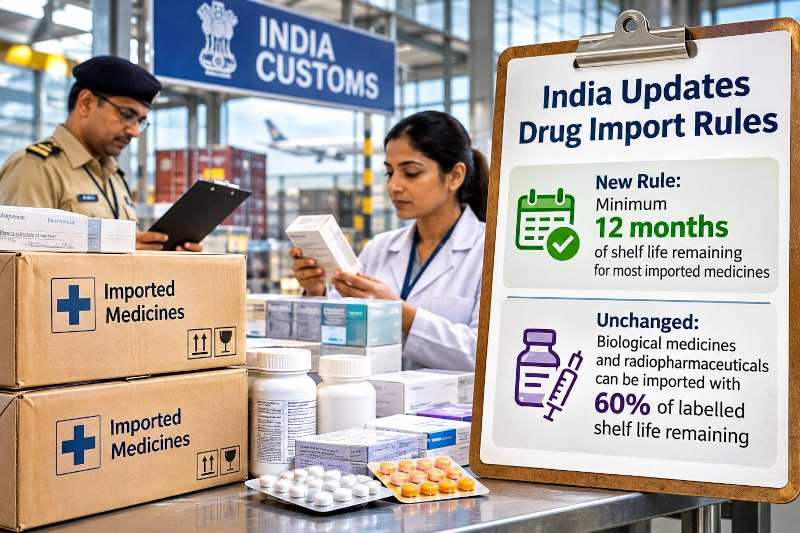
The Government of India has introduced an amendment to its pharmaceutical import regulations, replacing the earlier percentage-based residual shelf-life requirement for most imported medicines with a minimum remaining shelf life of 12 months. The regulatory reform aims to improve pharmaceutical supply-chain efficiency, reduce avoidable medicine wastage and facilitate the movement of imported pharmaceutical products into the Indian market.
The Ministry of Health and Family Welfare introduced the amendment through the Drugs (Thirteenth Amendment) Rules, 2026, notified under G.S.R. 951(E). The notification was issued on 16 October 2026 and published in the Gazette of India dated 28 October 2026. The revised provisions came into force upon publication in the Official Gazette, establishing a new regulatory framework governing the minimum remaining shelf life of medicines imported into the country.
The amendment modifies Rule 31 of the Drugs Rules, 1945, which specifies the residual shelf-life conditions applicable to pharmaceutical imports. Under the revised framework, medicines covered by the general provision must retain at least one year of their approved shelf life when imported into India. The government has retained a separate provision for biological medicines and radiopharmaceuticals, for which the applicable requirement continues to be expressed as a percentage of their labelled shelf life.
The regulatory change represents an effort to provide greater flexibility to pharmaceutical manufacturers, importers and distributors while preserving the quality and safety requirements applicable to medicines entering the Indian market.
Government Introduces a Fixed 12-Month Shelf-Life Requirement
Under the earlier regulatory framework, imported medicines were generally required to retain more than 60% of their original approved shelf life at the time of import. Although intended to ensure that pharmaceutical products had sufficient remaining usable life, the percentage-based requirement created practical challenges for manufacturers and importers handling medicines with longer total shelf lives.
Pharmaceutical products often undergo several stages of manufacturing, quality-control testing, regulatory documentation, packaging and international transportation before reaching their destination markets. Each stage requires time, reducing the remaining shelf life available when a medicine enters the importing country.
Under the previous system, a medicine originally assigned a shelf life of 36 months could face import restrictions if its remaining shelf life fell below the prescribed percentage, even when it still had a considerable period before its expiry date. Such restrictions could affect pharmaceutical inventory management and result in otherwise usable medicines becoming ineligible for import.
The revised regulation replaces this percentage-based requirement with a fixed minimum of 12 months for medicines covered by the general provision. Consequently, a pharmaceutical product with 18 months remaining before expiry may satisfy the new requirement even if that period represents less than 60% of its originally approved shelf life.
The amendment provides greater predictability for pharmaceutical importers because eligibility is determined through a defined minimum period rather than a percentage calculated from the medicine’s total shelf life. This approach may help companies plan international shipments and manage pharmaceutical inventories more efficiently.
However, the change does not permit the import of expired medicines or products that fail to meet the prescribed residual shelf-life requirements. Pharmaceutical imports remain subject to applicable statutory provisions, regulatory approvals and quality-control requirements.
Separate Provisions for Biological Medicines and Radiopharmaceuticals
The government has maintained a distinct regulatory provision for biological medicines and radiopharmaceuticals because these products have specialised characteristics and may require particular manufacturing, storage, handling and distribution conditions.
Biological medicines are manufactured using biological materials or processes and include several categories of advanced therapeutic products. Depending on their classification, such medicines may include vaccines, therapeutic proteins, monoclonal antibodies and other complex biological formulations.
Radiopharmaceuticals contain radioactive substances and are used in specialised medical procedures, including diagnostic imaging and certain therapeutic applications. Their handling and distribution may involve additional requirements relating to radiation safety, stability and the properties of the radioactive material.
Under the revised framework, biological medicines and radiopharmaceuticals remain subject to a separate provision under which imports may be permitted with 60% of their labelled shelf life remaining. The application of this provision remains subject to the relevant regulatory requirements and the authority of the licensing officials.
The distinction recognises that pharmaceutical products differ significantly in their composition, stability characteristics and distribution requirements. A uniform approach may not always be appropriate for medicines requiring specialised storage or handling.
By retaining a separate percentage-based provision for these categories, the government has introduced greater flexibility for most pharmaceutical imports while maintaining differentiated requirements for products with particular regulatory considerations.
Reducing Pharmaceutical Wastage Across Supply Chains
One of the principal objectives of the amendment is to reduce avoidable medicine wastage arising from restrictions that prevent the import of pharmaceutical products despite their remaining within their approved expiry periods.
The pharmaceutical supply chain involves numerous interconnected stages, beginning with the procurement of raw materials and active pharmaceutical ingredients and continuing through manufacturing, formulation development, quality testing, packaging, transportation and distribution.
Medicines manufactured outside India may require additional time for international shipping, customs clearance and regulatory procedures before they become available to domestic distributors and healthcare institutions.
These processes can consume a considerable portion of a product’s approved shelf life, particularly when shipments encounter logistical delays or administrative requirements.
Under a percentage-based system, pharmaceutical products could become ineligible for import even when they retained sufficient time for normal distribution and use before expiry. This situation could contribute to unnecessary inventory losses and complicate supply planning.
The revised 12-month requirement is intended to address these concerns by allowing greater flexibility for medicines that remain within their approved shelf lives.
The Ministry of Health and Family Welfare had identified the need to rationalise these requirements during the earlier consultation process, highlighting the potential benefits of improved inventory utilisation and reduced pharmaceutical wastage.
The actual impact of the amendment will depend on how manufacturers, importers, distributors and healthcare institutions manage their inventories. Effective stock rotation, appropriate storage conditions and timely distribution will remain essential for minimising waste.
Improving Efficiency in India’s Pharmaceutical Import System
India is one of the world’s major pharmaceutical manufacturing and exporting countries, supplying generic medicines, vaccines and other healthcare products to international markets. At the same time, the country imports certain specialised medicines, biological products and pharmaceutical formulations required by its healthcare system.
These imports form part of an extensive international network connecting pharmaceutical manufacturers, active ingredient suppliers, regulatory authorities, distributors, hospitals and pharmacies.
The revised shelf-life requirement may help pharmaceutical companies coordinate their international manufacturing and distribution schedules more effectively.
A fixed minimum residual shelf life of 12 months provides a clearer regulatory benchmark for companies planning shipments to India. Manufacturers and importers can assess compliance with this requirement while arranging production, quality testing, packaging and logistics.
The change may also reduce situations in which medicines are rejected solely because they do not meet a prescribed percentage of their original shelf life, despite having more than one year remaining before expiry.
Such flexibility could be particularly useful for pharmaceutical products manufactured in limited batches or supplied through complex international distribution arrangements.
However, the amendment does not eliminate other regulatory conditions governing pharmaceutical imports. Companies must continue to obtain the necessary permissions and ensure that imported medicines comply with applicable standards concerning manufacturing, quality, safety, labelling and storage.
The regulatory reform should therefore be understood as an adjustment to import eligibility rather than a relaxation of the broader standards governing pharmaceutical products.
Maintaining Medicine Quality and Patient Safety
Pharmaceutical shelf-life regulations are intended to ensure that medicines retain their approved quality, strength and stability throughout the period during which they are intended for use.
A medicine’s expiry date is established through stability studies conducted under specified conditions. These studies assess whether the product maintains its required characteristics over time when stored according to the manufacturer’s recommendations.
The residual shelf-life requirement determines how much of this approved period must remain when a medicine enters the country.
It does not independently extend the medicine’s expiry date or authorise its use beyond the period supported by stability testing.
Under the revised framework, medicines covered by the general provision must have at least 12 months remaining before expiry at the time of import. This requirement establishes a minimum period during which the products can move through domestic distribution channels and reach healthcare providers and patients.
Importantly, the amendment does not change the obligation of pharmaceutical manufacturers and importers to comply with applicable quality standards.
Medicines must continue to satisfy the relevant requirements under the Drugs and Cosmetics Act, 1940, and the Drugs Rules, 1945.
The Central Drugs Standard Control Organisation and other competent regulatory authorities retain their responsibilities concerning pharmaceutical import permissions, regulatory compliance and the enforcement of applicable drug-quality standards.
The government has therefore sought to balance greater supply-chain flexibility with the continuing need to protect patients from medicines that do not satisfy established regulatory requirements.
Amendment Finalised Following Public Consultation
The revision to India’s pharmaceutical import regulations followed a formal public consultation process initiated by the Ministry of Health and Family Welfare in June 2026.
The government published a draft amendment under G.S.R. 505(E), proposing changes to the residual shelf-life requirement for imported medicines.
The draft notification was issued on 22 June 2026 and made available for public consultation on 25 June. Stakeholders likely to be affected by the proposed changes were invited to submit objections and suggestions within the prescribed consultation period.
The proposal sought to replace the existing percentage-based requirement with a minimum remaining shelf life of 12 months for most imported pharmaceutical products.
The consultation process provided an opportunity for pharmaceutical manufacturers, importers, industry organisations and other stakeholders to communicate their views concerning the proposed regulatory change.
Following consideration of the submissions received and consultation with the Drugs Technical Advisory Board, the Ministry finalised the amendment.
The final rules were notified under G.S.R. 951(E), dated 16 October 2026, and published in the Gazette of India dated 28 October 2026.
The publication of the final notification completed the regulatory process and brought the revised requirements into force.
Implications for Pharmaceutical Manufacturers and Importers
The amended rules may have implications for multinational pharmaceutical manufacturers, Indian pharmaceutical importers, distributors and healthcare institutions that depend on medicines manufactured outside the country.
Manufacturers exporting products to India may benefit from greater flexibility in determining shipment schedules, particularly for medicines with relatively long original shelf lives.
Importers may also find it easier to manage pharmaceutical inventories without facing restrictions based on the percentage of a product’s total approved shelf life.
The change could support more efficient coordination between overseas manufacturing facilities and domestic distribution networks, particularly where products require extensive quality testing or regulatory documentation before shipment.
For healthcare institutions, more efficient import arrangements may contribute to the availability of certain specialised pharmaceutical products that are not manufactured domestically or are supplied through limited international channels.
However, the revised rules do not guarantee immediate improvements in medicine availability or reductions in pharmaceutical prices.
The availability and affordability of imported medicines depend on numerous factors, including manufacturing capacity, international supply conditions, procurement arrangements, distribution costs and regulatory approvals.
Similarly, the amendment does not remove the responsibility of importers and distributors to ensure that pharmaceutical products are stored correctly and supplied before their expiry dates.
Effective inventory management and compliance with applicable distribution requirements will remain essential.
Supporting India’s Pharmaceutical Regulatory Modernisation
The amendment forms part of the government’s broader efforts to update pharmaceutical regulations in response to evolving industry requirements and international supply-chain practices.
India’s pharmaceutical sector operates within a complex regulatory environment that must accommodate domestic manufacturing, international trade, technological developments and public-health requirements.
Regulations governing pharmaceutical imports must therefore balance the need for effective oversight with the practical realities of manufacturing and distributing medicines across international markets.
A rigid import requirement may create unnecessary supply-chain difficulties when it restricts medicines that remain within their approved shelf lives and otherwise satisfy regulatory standards.
At the same time, excessive flexibility could undermine the objective of ensuring that imported products retain sufficient usable life before reaching patients.
The revised framework attempts to address these considerations by introducing a fixed minimum residual shelf life for most imported medicines while maintaining separate provisions for specialised categories.
The change may also encourage pharmaceutical companies to improve inventory planning and reduce avoidable losses associated with imported medicines.
By establishing more predictable import requirements, the government aims to support the efficient movement of pharmaceutical products without removing the regulatory safeguards governing their quality and safety.
Strengthening Pharmaceutical Supply Chains While Reducing Waste
The Drugs (Thirteenth Amendment) Rules, 2026, represent a significant change in India’s pharmaceutical import regulations, replacing the earlier percentage-based residual shelf-life requirement with a minimum of 12 months for medicines covered by the general provision.
The amendment responds to practical challenges associated with international pharmaceutical manufacturing, transportation and distribution, where delays can reduce the remaining shelf life of products before they reach the importing country.
By allowing medicines with at least one year remaining before expiry to satisfy the general import requirement, the government has introduced additional flexibility intended to improve inventory utilisation and reduce avoidable wastage.
The separate provision for biological medicines and radiopharmaceuticals reflects the need to accommodate specialised pharmaceutical categories within the regulatory framework.
For pharmaceutical manufacturers and importers, the amendment provides an opportunity to improve supply-chain planning and reduce unnecessary restrictions on medicines that remain within their approved expiry periods.
For India’s healthcare system, more efficient pharmaceutical imports could contribute to the availability of specialised medicines, although the actual benefits will depend on implementation, distribution practices and continued regulatory compliance.
The reform illustrates the importance of periodically reviewing pharmaceutical regulations to ensure that they remain appropriate for changing industrial and healthcare requirements.
By combining greater flexibility in import eligibility with the continuation of pharmaceutical quality and safety standards, India has taken another step towards improving the efficiency of its medicine supply chains and reducing avoidable pharmaceutical waste.
Official References
Ministry of Health and Family Welfare, Government of India
Notification: Drugs (Thirteenth Amendment) Rules, 2026.
Gazette Notification: G.S.R. 951(E), dated 16 October 2026, published in the Gazette of India dated 28 October 2026.
Regulation Amended: Rule 31 of the Drugs Rules, 1945.
Official Source: Central Drugs Standard Control Organisation, Gazette Notifications.
https://www.cdsco.gov.in/opencms/opencms/en/Notifications/Gazette-Notifications/
Earlier Draft Notification: G.S.R. 505(E), dated 22 June 2026, concerning the proposed rationalisation of residual shelf-life requirements for imported medicines.
Official PIB Announcement: Ministry of Health and Family Welfare, 26 June 2026.
https://www.pib.gov.in/PressReleseDetailm.aspx?PRID=2278097
You may also like
-
Sun Pharma Reportedly Secures Indian Regulatory Approval for Generic Oral Semaglutide Tablets
-
Reliance Retail Partners with All India Institute of Ayurveda to Develop Ayurveda-Based Skincare Products
-
Ayurveda for Shift Workers: Managing an Irregular Routine
-
India’s Social Security Coverage Reaches 68.4%, Extending Protection to Over One Billion People
-
India’s Extreme Poverty Rate Falls from 27.1% to 2.6% Between 2011 and 2023: World Bank
