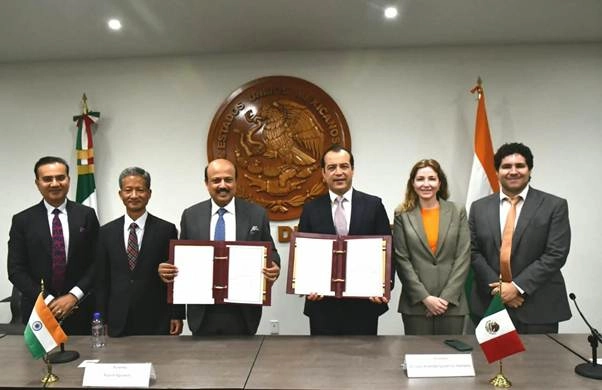
India and Mexico have formally launched negotiations for a Preferential Trade Agreement (PTA), marking a significant step towards strengthening economic cooperation, expanding market access and creating new opportunities for trade and investment between the two countries.
The development follows the signing of the Terms of Reference (ToR) for the proposed agreement, establishing the framework, scope, negotiating procedures and roadmap for future discussions. The Ministry of Commerce and Industry announced the development on 28 October 2026, highlighting the commitment of both countries to building a more diversified and mutually beneficial economic partnership.
The proposed agreement is expected to explore opportunities for reducing trade barriers, improving commercial exchanges and facilitating greater participation by businesses in each other’s markets. It also reflects the growing importance of economic cooperation between India and Latin America as countries seek to diversify supply chains and strengthen international trade relationships.
India and Mexico Establish Framework for Trade Negotiations
The Terms of Reference were signed during the visit of India’s Commerce Secretary, Rajesh Agrawal, to Mexico, where discussions focused on strengthening bilateral economic relations and identifying opportunities for expanding trade and investment.
The Indian delegation held discussions with Mexico’s Undersecretary of Foreign Trade, Luis Rosendo Gutiérrez Romano, who represented Secretary of Economy Marcelo Ebrard Casaubon.
The signing formally initiates negotiations towards a balanced Preferential Trade Agreement designed to create additional opportunities for businesses, exporters, manufacturers and investors in both countries.
Unlike a comprehensive Free Trade Agreement, which generally seeks broader liberalisation across multiple economic sectors, a Preferential Trade Agreement typically provides negotiated tariff concessions or improved market access for selected products. The precise coverage and concessions under the proposed India-Mexico arrangement will depend on the outcome of negotiations.
The agreement has not yet been finalised, and the signing of the Terms of Reference represents the beginning of the formal negotiating process rather than the implementation of new trade concessions.
Trade Negotiations to Cover Market Access and Regulatory Cooperation
The negotiating framework identifies several important areas that could influence the movement of goods between India and Mexico.
Market access for goods will form a central component of the discussions, with both countries examining opportunities to facilitate trade through mutually agreed concessions and improved commercial arrangements.
Rules of origin will also feature prominently in the negotiations. These provisions determine whether products qualify for preferential treatment based on their country of origin and the extent of domestic or regional processing involved in their manufacture.
The negotiations will additionally cover customs procedures and trade facilitation, potentially improving the efficiency of cross-border transactions and reducing procedural difficulties faced by exporters and importers.
Other areas identified in the negotiating framework include sanitary and phytosanitary measures, technical barriers to trade, trade remedies and dispute settlement mechanisms.
These provisions are particularly important for businesses operating in regulated sectors, where product standards, testing requirements, certification procedures and customs compliance can significantly influence international trade.
Establishing mutually acceptable procedures in these areas could help create a more predictable trading environment while preserving the regulatory interests of both countries.
Automotive, Pharmaceuticals and Electronics Among Priority Sectors
India and Mexico have identified several industries with considerable potential for expanded bilateral cooperation.
The automotive industry represents one of the important sectors under consideration, given Mexico’s established position in international automobile manufacturing and its integration into global automotive supply chains.
India’s expanding automotive manufacturing capabilities, particularly in vehicle components, engineering products and related industrial technologies, offer opportunities for greater engagement between manufacturers and suppliers in both countries.
The pharmaceutical industry is another area with potential for cooperation. India’s established capabilities in pharmaceutical manufacturing and generic medicines could support expanded commercial engagement with Mexico’s healthcare and pharmaceutical markets, subject to applicable regulatory requirements.
Electronics and advanced manufacturing also feature among the sectors identified for greater cooperation. Stronger industrial linkages could create opportunities for technology partnerships, component sourcing, contract manufacturing and participation in international production networks.
The two countries have additionally identified chemicals, agricultural and food products, energy, critical minerals and medical devices as promising areas for future commercial cooperation.
These sectors reflect the complementary strengths of the Indian and Mexican economies and provide a foundation for discussions extending beyond conventional merchandise trade.
Mexico’s Strategic Position in Global Supply Chains
Mexico occupies an important position in international manufacturing and trade because of its extensive industrial base and close integration with North American production networks.
Its manufacturing industries participate in global supply chains covering automobiles, electronics, machinery, electrical equipment and other industrial products.
For Indian exporters, closer commercial engagement with Mexico could provide opportunities to expand sales in an important Latin American economy and develop business relationships with companies participating in international manufacturing networks.
However, preferential access to the Mexican market would not automatically provide Indian products with preferential entry into the United States or Canada. Such access would remain subject to the relevant rules of origin and trade regulations governing those markets.
The proposed agreement could nevertheless encourage stronger industrial cooperation, investment partnerships and commercial exchanges between Indian and Mexican businesses.
For Mexico, closer economic engagement with India would provide opportunities to access one of the world’s major consumer markets while exploring new relationships with Indian manufacturers, technology companies and industrial investors.
Both countries are seeking to strengthen their economic resilience by expanding commercial partnerships and reducing excessive dependence on limited markets or supply sources.
Agreement Builds on Modi-Sheinbaum Meeting in 2025
The formal launch of negotiations follows discussions between Prime Minister Narendra Modi and Mexican President Claudia Sheinbaum during their meeting on the sidelines of the G7 Summit in Canada in June 2025.
During that meeting, the two leaders agreed to strengthen and deepen the India-Mexico partnership, providing political direction for subsequent engagement between their respective governments.
The decision to initiate Preferential Trade Agreement negotiations represents a concrete follow-up to that understanding.
India and Mexico have maintained diplomatic and economic relations across several sectors, including trade, investment, energy, pharmaceuticals and industrial cooperation.
The proposed trade agreement offers an opportunity to place these commercial relationships within a more structured negotiating framework and identify areas where both economies could benefit from improved market access and greater regulatory cooperation.
Mexican Business Delegation May Visit India in Early 2027
Alongside the formal trade negotiations, officials from both countries discussed arrangements to promote closer engagement between their business communities.
One proposal involves organising a Mexican business mission to India during the first quarter of 2027.
The proposed visit would facilitate direct interactions between companies, industry representatives and potential investors from the two countries.
Business-to-business meetings could help identify opportunities for joint ventures, technology partnerships, manufacturing cooperation and expanded commercial exchanges.
The mission could also provide Mexican businesses with a better understanding of India’s manufacturing ecosystem, investment opportunities and domestic market requirements.
The visit remains under consideration, and the official announcement did not specify confirmed dates or the composition of the proposed business delegation.
Strengthening India’s Economic Engagement with Latin America
The proposed agreement also assumes importance within India’s broader commercial engagement with Latin America and the Caribbean.
According to the Ministry of Commerce and Industry, India’s merchandise trade with the Latin American and Caribbean region reached approximately US$39.19 billion during the 2024–25 financial year.
Indian exports to the region accounted for approximately US$15.17 billion, while imports stood at US$24.02 billion.
The region possesses substantial natural resources, including mineral deposits, metals, agricultural commodities and energy resources, while India has established strengths in engineering goods, pharmaceuticals, information technology, textiles and manufacturing.
Greater trade engagement with Latin American countries could help Indian businesses diversify their export destinations while strengthening access to raw materials and industrial inputs.
Mexico’s position as a major manufacturing economy makes it an important partner within this broader regional engagement.
A negotiated preferential trading arrangement could provide an additional institutional mechanism for facilitating economic cooperation and encouraging private-sector participation.
Towards a More Diversified India-Mexico Economic Partnership
The launch of Preferential Trade Agreement negotiations marks a new stage in India-Mexico economic relations, reflecting the interest of both governments in developing stronger commercial and industrial ties.
The negotiations will determine the extent to which the two countries can reach mutually acceptable arrangements covering tariff concessions, product eligibility, customs procedures, regulatory requirements and dispute resolution.
Progress will depend on balancing the commercial priorities of both economies while addressing the concerns of domestic industries and maintaining appropriate regulatory safeguards.
For India, the negotiations present an opportunity to strengthen its economic presence in Latin America, expand opportunities for Indian exporters and develop partnerships in manufacturing, pharmaceuticals, electronics and strategic industrial sectors.
For Mexico, closer engagement with India could support market diversification, investment cooperation and stronger links with Indian industries.
The signing of the Terms of Reference establishes the foundation for these discussions, with the eventual scope and economic impact of the proposed Preferential Trade Agreement to be determined through subsequent negotiations.
You may also like
-
INS Sahyadri Arrives in South Korea for Bilateral Naval Exercise, Strengthening Indo-Pacific Maritime Cooperation
-
India and South Korea Explore Joint Defence Technology Development and Industrial Cooperation
-
India Strengthens Indo-Pacific Defence Partnerships with US, Japan and Singapore at ADMM-Plus
-
Ajara Ghansal Rice of Maharashtra: The GI-Tagged Aromatic Heritage of Kolhapur
-
India’s Telephone Subscriptions Reach 136.79 Crore as Telecom Sector Records Strong Growth in September 2026
