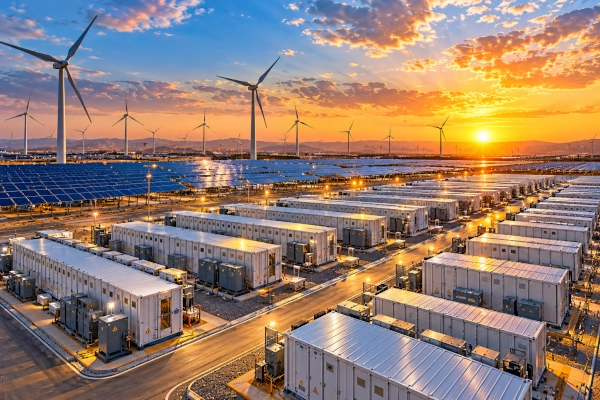
Adani Green Energy Limited (AGEL) has expanded its operational battery energy storage capacity to 6.63 gigawatt-hours (GWh) at Khavda in Gujarat, establishing what the company describes as the world’s largest operational Battery Energy Storage System (BESS) at a single location. The development marks a significant milestone in India’s renewable energy infrastructure by strengthening the country’s capacity to store electricity generated from renewable sources and supply it when required.
The company announced the milestone on 1 October 2026 and subsequently confirmed the expanded capacity in its financial results released on 21 October 2026. The installation’s operational storage capacity increased from 3.55 GWh in June 2026 to approximately 6.63 GWh by the end of September, representing an addition of nearly 3.08 GWh during the second quarter of FY2026–27. According to Adani Green Energy, the installation accounts for more than half of India’s operational battery energy storage capacity, highlighting its substantial contribution to the country’s emerging energy storage infrastructure.
The battery storage facility forms part of Adani Green Energy’s expanding renewable energy complex at Khavda, where the company is developing a large-scale solar and wind power project. By integrating renewable electricity generation with advanced storage technology, AGEL aims to improve the flexibility of power supply and reduce the challenges associated with fluctuations in solar and wind generation.
Khavda Emerges as a Major Global Battery Storage Centre
The operational battery storage installation at Khavda has reached a capacity of 6,632 megawatt-hours, equivalent to approximately 6.63 GWh. Adani Green Energy achieved this capacity within 14 months of commencing construction activities for the storage project, demonstrating the scale and pace of development undertaken at the site. The company reported that the latest expansion phase was completed within approximately ten months, supported by coordinated engineering, procurement, construction and commissioning activities.
The facility is integrated with Adani Green Energy’s planned 30 GW renewable energy development at Khavda, which covers approximately 538 square kilometres in Gujarat. The renewable energy complex combines large solar installations with wind power generation and supporting electrical infrastructure. Battery storage adds another important component to this development by allowing electricity generated during periods of high renewable output to be retained for use when generation falls or electricity demand increases.
According to AGEL, the project involved collaboration with leading global battery energy storage equipment manufacturers and the deployment of advanced energy management systems. The installation also incorporates digital monitoring and automated operating technologies designed to support reliable performance. These systems are particularly important for large battery installations because thousands of interconnected components must operate safely and efficiently under changing grid conditions.
Storage Capacity Equivalent to the Daily Electricity Needs of Two Million Homes
Adani Green Energy estimates that the Khavda battery installation can store enough electricity to meet the daily consumption of approximately two million homes. The company has also compared the facility’s capacity with the electricity requirements of major Indian cities and urban transport systems to illustrate the scale of the project. These comparisons demonstrate the considerable quantity of electricity that can be stored within a single integrated installation.
The company estimates that the facility’s storage capacity exceeds the combined battery capacity of approximately 150,000 mid-sized electric vehicles, assuming an average battery size of 40 kilowatt-hours. AGEL has also stated that the installation can store electricity equivalent to almost twice the estimated daily consumption of the Delhi Metro network. Such comparisons highlight the scale of energy storage infrastructure now being developed alongside India’s expanding renewable power generation capacity.
However, energy storage capacity must be distinguished from electricity generation and instantaneous power output. A 6.63 GWh battery installation can store a defined quantity of energy, but the amount of electricity it delivers at any given moment depends on its discharge power rating and operating configuration. Its ability to supply consumers over a particular period also depends on usable battery capacity, charging conditions, efficiency losses and electricity demand. The facility therefore represents a major energy storage resource rather than an independent source of continuous electricity generation.
Lithium-Ion Technology Supports Flexible Electricity Supply
The Khavda installation uses lithium-ion battery technology integrated with advanced energy management and monitoring systems. Lithium-ion batteries store electrical energy through electrochemical processes and release that energy when required. When solar and wind installations produce more electricity than can be immediately consumed or transmitted, battery systems can absorb part of the available output and retain it for subsequent use.
An integrated Energy Management System coordinates battery charging and discharging according to operating requirements. It monitors available storage capacity, equipment performance and electricity demand while supporting the movement of stored energy into the grid. Automated telemetry systems collect information from the installation’s components, enabling operators to evaluate performance and identify conditions requiring attention.
Large-scale battery storage also depends on power conversion equipment, thermal management systems, electrical protection devices and specialised safety infrastructure. Power conversion systems allow electricity to move between the batteries and the alternating-current grid, while thermal management helps maintain suitable operating conditions for battery modules. Protection and monitoring equipment are essential for managing electrical faults, temperature variations and other risks associated with high-capacity battery installations.
Why Battery Storage Matters for India’s Renewable Energy Expansion
India’s growing renewable energy sector increasingly depends on technologies that can manage the variable nature of solar and wind power. Solar electricity production changes throughout the day and declines after sunset, while wind generation varies according to atmospheric conditions. Electricity demand, however, continues throughout the day and often reaches higher levels during periods when renewable generation is comparatively low.
Battery energy storage systems help address this mismatch by storing electricity during periods of surplus generation and releasing it when required. For example, a solar power facility may produce substantial electricity during the afternoon when sunlight is strong. If immediate demand is insufficient, a connected battery installation can store part of that electricity and supply it during the evening when solar generation declines and electricity consumption may increase.
This capability improves the flexibility of renewable energy systems and can reduce dependence on conventional generation during certain periods. Battery installations can also support grid operations by responding rapidly to changes in electricity demand and supply. Depending on their design, they may provide services such as frequency regulation, voltage support and other forms of grid stabilisation.
The integration of battery storage with renewable generation is therefore becoming an important consideration in the planning of large solar and wind projects. At Khavda, Adani Green Energy is developing this approach on a substantial scale, combining renewable electricity generation with storage infrastructure intended to improve the delivery of power under varying operating conditions.
Energy Storage Can Reduce Renewable Power Curtailment
One of the challenges associated with large renewable energy projects is ensuring that all the electricity generated can be transmitted to consumers. Renewable energy facilities are often established in regions with favourable solar or wind resources, while major centres of electricity consumption may be located hundreds of kilometres away. This requires extensive transmission infrastructure capable of transporting power across different regions.
When renewable electricity generation exceeds immediate demand or available transmission capacity, grid operators may need to reduce the output of solar or wind installations. This process, known as renewable energy curtailment, results in some potentially available electricity not being supplied to the network. Battery storage can reduce certain forms of curtailment by absorbing surplus electricity and delivering it when demand increases or transmission capacity becomes available.
The effectiveness of this approach depends on the storage system’s charging and discharging capabilities, available energy capacity and the duration of grid constraints. Batteries cannot eliminate the need for transmission infrastructure, particularly when electricity must be transported over long distances. Nevertheless, they can complement transmission development by providing additional flexibility in managing electricity flows.
At Khavda, the combination of large renewable generation facilities, battery storage and transmission connectivity is intended to improve the utilisation of available renewable resources. The project illustrates how energy storage can become part of the wider infrastructure required to support India’s transition towards higher levels of renewable electricity generation.
Adani Green Energy Plans Further Expansion of Battery Storage Capacity
Following the commissioning of 6.63 GWh of battery storage capacity, Adani Green Energy is pursuing a broader expansion programme. The company has announced plans to add more than 10 GWh of battery energy storage capacity during FY2026–27, reflecting its intention to integrate storage more extensively with renewable electricity generation.
AGEL has also outlined a longer-term objective of developing approximately 50 GWh of battery storage capacity over the next five years. The proposed expansion would require substantial investment in battery equipment, power conversion systems, electrical infrastructure, grid connectivity and project execution. These targets represent planned future capacity rather than installations that have already been commissioned.
The company’s financial results released on 21 October indicated that the pace of storage development could enable it to exceed its capacity guidance for the current financial year. However, future commissioning will depend on equipment availability, construction progress, regulatory requirements and the successful integration of new installations with the electricity grid.
The expansion strategy reflects AGEL’s growing emphasis on combining renewable generation with storage capabilities. As the company’s solar and wind portfolio increases, additional battery installations could help improve the flexibility of electricity delivery and support more effective management of variable renewable generation.
Pumped Storage Projects Complement Battery Energy Storage
Adani Green Energy is also pursuing pumped storage hydropower projects as part of its wider energy storage strategy. Pumped storage operates by using electricity to move water from a lower reservoir to a higher reservoir when surplus power is available. When electricity demand increases, the stored water flows back through turbines to generate electricity.
This method provides a different form of energy storage that can complement lithium-ion batteries. Battery installations can respond rapidly to changes in electricity demand and are suitable for various short-duration and medium-duration applications. Pumped storage projects can provide larger quantities of stored energy over extended periods, depending on their reservoir capacity, generating equipment and operating conditions.
Developing different storage technologies allows electricity producers to address a wider range of grid requirements. While batteries can provide fast-response services and flexible short-term energy delivery, pumped storage can support longer-duration balancing and system operations. The combination becomes increasingly relevant as renewable energy forms a larger share of electricity generation.
AGEL’s investment in both technologies reflects its objective of developing renewable energy infrastructure capable of delivering electricity more consistently. The effectiveness of the approach will depend on how storage facilities are integrated with generation assets, electricity markets and transmission networks.
Renewable Energy Portfolio Expands to 20.8 GW
The battery storage milestone accompanies continued growth in Adani Green Energy’s renewable electricity generation portfolio. According to the company’s financial results released on 21 October 2026, its operational renewable energy capacity reached approximately 20.8 GW during the first half of FY2026–27, representing year-on-year growth of around 24%.
The company reported renewable capacity additions of 4,083 MW compared with the corresponding period of the previous financial year. These additions comprised approximately 2,957 MW of solar capacity, 805 MW of wind capacity and 321 MW of solar-wind hybrid capacity. The Khavda renewable energy complex accounted for a substantial portion of the company’s expansion.
Adani Green Energy also reported a 32% year-on-year increase in electricity sales to approximately 25.75 billion units during the first half of the financial year. Revenue from power supply increased by 36% to ₹8,299 crore, while earnings before interest, tax, depreciation and amortisation from power supply rose by 41% to ₹7,957 crore.
These figures indicate continued expansion in the company’s renewable electricity operations. AGEL has established a longer-term objective of achieving 50 GW of operational renewable energy capacity by 2030, with energy storage expected to play an increasingly important role in supporting the utilisation and delivery of electricity from its growing portfolio.
Large Battery Projects Create Opportunities for India’s Manufacturing Industry
The rapid expansion of battery energy storage in India is creating demand for specialised manufacturing, engineering and technology services. Large battery installations require electrochemical storage modules, power conversion equipment, thermal management systems, control software, transformers, electrical protection devices and sophisticated monitoring infrastructure.
The development of these facilities can generate opportunities for manufacturers of electrical equipment, power electronics, industrial control systems and specialised engineering components. Installation and commissioning activities also require expertise in civil engineering, electrical integration, industrial automation and high-voltage power systems.
However, the establishment of large battery storage facilities does not necessarily mean that all their equipment has been manufactured domestically. Adani Green Energy has acknowledged collaboration with global battery equipment manufacturers in developing the Khavda installation. The company has not stated that every major battery component or associated system was produced in India.
Nevertheless, the expansion of operational storage infrastructure can strengthen domestic capabilities in project engineering, system integration, installation, testing, maintenance and large-scale energy management. These activities are important elements of the industrial ecosystem required to support India’s growing renewable electricity sector.
As additional storage projects are commissioned, the demand for specialised technical expertise and supporting infrastructure is expected to increase. Sustained deployment could also provide opportunities for Indian manufacturers to develop greater capabilities in advanced battery technologies and associated equipment.
Khavda Development Strengthens India’s Renewable Energy Infrastructure
Adani Green Energy’s achievement of 6.63 GWh of operational battery storage capacity at Khavda represents an important milestone in the development of India’s energy storage infrastructure. According to the company’s assessment, the installation accounts for more than half of the country’s operational battery energy storage capacity, demonstrating the scale of the project relative to existing national deployment.
The facility brings together lithium-ion battery technology, automated energy management systems and large-scale renewable generation within a single energy development. Its expansion highlights the increasing importance of storage infrastructure in supporting electricity networks as solar and wind generation capacity grows.
The next phase of India’s renewable energy development will require greater coordination among generation companies, transmission utilities, technology providers, equipment manufacturers and electricity regulators. Battery installations will need to operate alongside pumped storage facilities, conventional power stations and expanding transmission networks to support reliable electricity supply.
With further battery storage additions planned for FY2026–27 and a longer-term target of approximately 50 GWh, Adani Green Energy is positioning storage technology as a major component of its renewable power strategy. The continued expansion of such infrastructure will strengthen India’s ability to manage variable renewable generation, improve electricity system flexibility and support the country’s transition towards a more diversified energy sector.
References
1. Adani Green Energy Limited — Official Media Release, 1 October 2026
Adani Green Energy Expands Battery Storage Capacity to 6.63 GWh; Accounts for More Than 50% of India’s Operational Battery Energy Storage System Capacity.
https://www.adanigreenenergy.com/newsroom/media-releases/adani-green-energy-expands-battery-storage-capacity-to-6point63-gwh-accounts
2. Adani Green Energy Limited — Official Financial Results, 21 October 2026
Adani Green Energy’s Energy Sales Grew 32% YoY to 25.8 Billion Units, Resulting in EBITDA Growth of 41% in H1 at ₹7,957 Crore.
https://www.adanigreenenergy.com/newsroom/media-releases/adani-green-energys-energy-sales-grew-32-percent-yoy-to-25point8-billion-units
3. Adani Group — Official Newsroom, 1 October 2026
Adani Green Energy Expands Battery Storage Capacity to 6.63 GWh.
https://www.adani.com/newsroom/media-releases/adani-green-energy-expands-battery-storage-capacity-to-63-gwh
4. Adani Green Energy Limited — Official Corporate Website
Company information, operational updates, renewable energy portfolio and sustainability initiatives.
https://www.adanigreenenergy.com
You may also like
-
India Updates Vehicle Rules to Strengthen E85 and E100 Flex-Fuel Technology
-
India Monitors 1,853 Infrastructure Projects Worth ₹37.56 Lakh Crore, ₹17.73 Lakh Crore Already Spent
-
Manastu Space Secures ₹116 Crore Government Support to Develop Indigenous Green Propulsion Systems
-
GeM’s AABHAR Collection Showcases 294 Indigenous Products, Strengthens Market Access for Indian Artisans
-
Balaghat Chinnor Rice of Madhya Pradesh: The Fragrant Heritage Grain with GI Recognition
