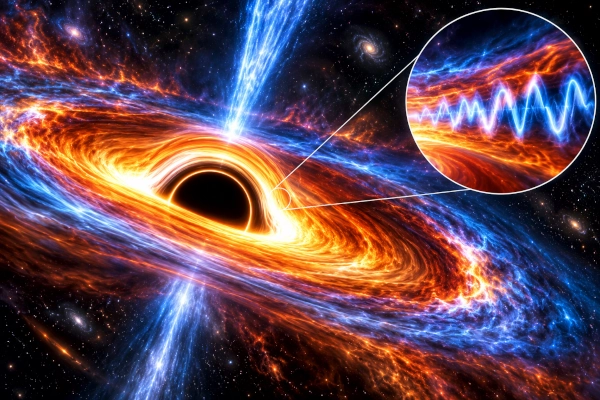
Indian astrophysicists have made an important advance in understanding why matter surrounding rapidly spinning black holes produces intense, rhythmic fluctuations in X-ray radiation. Researchers led by scientists from the Aryabhatta Research Institute of Observational Sciences (ARIES), Nainital, have developed a numerical model demonstrating how black-hole rotation and internal friction influence shock waves in streams of hot matter. Their findings offer a possible explanation for the rapid variations in X-ray brightness observed in several black-hole binary systems.
The research, led by Sanjit Debnath and Dr. Indranil Chattopadhyay of ARIES, involved scientists associated with MJP Rohilkhand University in Bareilly and the Nicolaus Copernicus Astronomical Center in Poland. Using advanced computer simulations, the team investigated how viscosity affects matter spiralling towards rotating black holes. The researchers found that variations in internal friction can destabilise shock waves within the accretion flow, causing them to oscillate and potentially produce observable X-ray fluctuations.
The Ministry of Science and Technology announced the findings on 23 October 2026. The study, titled QPOs from the Viscous Transonic Accretion Flow Around a Spinning Black Hole, appeared in the Journal of High Energy Astrophysics. The simulations showed that rapidly rotating black holes can generate oscillations exceeding 100 hertz under certain conditions. The findings provide a new theoretical connection between black-hole spin, the movement of surrounding matter and the radiation detected by astronomical observatories.
Understanding the Rapid X-Ray Flickering Around Black Holes
Black holes are astronomical objects whose gravitational fields become so intense that light cannot escape after crossing a boundary known as the event horizon. Although black holes do not emit light from within this boundary, the matter surrounding them can become extremely hot and produce powerful electromagnetic radiation. Astronomers study this radiation to investigate physical processes occurring in regions where gravity strongly influences the movement of matter.
When gas approaches a black hole, it can form a rotating structure known as an accretion disc. The material gradually moves inward while releasing energy through friction, compression and other physical processes. Temperatures in the inner regions can become sufficiently high to produce intense X-ray radiation, which space-based observatories can detect across enormous astronomical distances.
Scientists have observed that X-ray brightness from some black-hole systems fluctuates in patterns that repeat at approximately regular intervals. These variations, known as quasi-periodic oscillations or QPOs, provide valuable information about the movement and physical conditions of matter near black holes. Some oscillations occur relatively slowly, while others repeat hundreds of times every second. Understanding the mechanisms responsible for such different frequencies remains an important challenge in high-energy astrophysics.
The new Indian-led research investigates whether oscillating shock waves in the surrounding gas can account for this behaviour. By examining how black-hole rotation and viscosity influence the flow of matter, the scientists have identified conditions under which both slow and rapid oscillations can arise through related physical processes.
How Quasi-Periodic Oscillations Reveal the Behaviour of Matter
Quasi-periodic oscillations are recurring variations in the intensity of radiation emitted by astronomical systems. Unlike perfectly periodic signals, which repeat at precisely regular intervals, QPOs display an approximate rhythm whose frequency and strength may change over time. Astronomers identify these signals by analysing how the brightness of an X-ray source varies and examining the characteristic frequencies present in the observed radiation.
Black-hole X-ray binary systems are particularly important for studying these phenomena. Such systems generally consist of a black hole and a companion star, with gravitational forces transferring material from the star towards the black hole. As this matter spirals inward, it experiences increasing temperatures and strong gravitational effects, producing radiation that contains information about the surrounding environment.
The frequency of a QPO reflects characteristic timescales associated with physical processes in the emitting region. Relatively slow oscillations may occur when changes involve larger regions of the accretion flow, while faster oscillations can arise from processes operating closer to the black hole. However, the exact relationship between frequency and physical location depends on the underlying mechanism, making theoretical modelling essential for interpreting astronomical observations.
Earlier investigations had established several possible explanations for QPOs, including changes in accretion-flow geometry, orbital motion and shock-wave oscillations. The latest study examines how rotating black holes affect one of these mechanisms, providing a framework that can reproduce a broad range of oscillation frequencies.
ARIES Researchers Use Advanced Numerical Simulations
The research team employed a numerical simulation framework developed by the Numerical and Theoretical Astrophysics Group at ARIES to investigate viscous accretion flows around rotating black holes. Numerical simulations allow scientists to study complex physical systems by solving mathematical equations describing the movement of matter and the exchange of energy. Such methods are particularly valuable in astrophysics because the extreme environments surrounding black holes cannot be reproduced through conventional laboratory experiments.
The researchers constructed models of hot gas moving towards a spinning black hole while accounting for the effects of viscosity, gravity and fluid dynamics. Their calculations incorporated conservation principles governing mass, momentum and energy, alongside thermodynamic relations appropriate for matter moving at relativistic speeds. These mathematical descriptions enabled the team to examine how different physical conditions influence the structure and stability of the accretion flow.
By changing the viscosity of the gas and the spin of the black hole, the scientists observed how shock waves formed, moved and responded to changes in the surrounding environment. The simulations revealed that the behaviour of these shocks can change substantially when internal friction exceeds certain critical values. Under some conditions, previously stable shock structures begin oscillating, producing variations that could influence the radiation emitted by the accreting material.
This approach enabled the researchers to investigate a possible connection between microscopic properties of the moving gas and large-scale astronomical observations. The resulting model provides a physical explanation that can be compared with the X-ray timing characteristics measured by space observatories.
Internal Friction Can Destabilise Shock Waves
One of the central findings concerns the influence of viscosity on shock-wave stability within the accretion flow. Viscosity describes the internal friction that affects how neighbouring layers of a fluid move relative to one another. In material surrounding a black hole, viscous processes contribute to the redistribution of angular momentum, allowing gas to move inward while transferring angular momentum through the flow.
As matter approaches a black hole, it may pass through regions where its speed, density, pressure and temperature change abruptly. These transitions can produce shock waves, which are important features of certain theoretical models of black-hole accretion. The position and stability of a shock depend on the physical properties of the gas and the gravitational environment through which it moves.
The ARIES simulations showed that shock waves can remain comparatively stable when viscosity stays below a critical threshold. When the researchers increased viscosity beyond this level, the shocks became unstable and began moving back and forth. These oscillations altered the conditions within the hot gas, creating fluctuations in quantities associated with the production of radiation.
The findings suggest that internal friction can act as an important factor controlling the development of quasi-periodic oscillations. Rather than requiring an external disturbance, the model demonstrates how instabilities arising within the accretion flow itself can produce recurring changes in the emitting region.
Black-Hole Rotation Influences Oscillation Frequency
The researchers found that black-hole spin strongly affects the location and behaviour of oscillating shocks. A rotating black hole changes the geometry of the surrounding spacetime, influencing how matter moves in its gravitational field. These effects become particularly significant close to the black hole, where orbital motion and relativistic gravity govern the behaviour of the accreting gas.
In simulations involving slowly rotating black holes, increasing viscosity generally pushed the average shock position farther outward. Because the characteristic timescales of motion tend to increase at larger distances, these configurations produced comparatively slow oscillations. The results helped explain why some accretion flows generate low-frequency variations in X-ray brightness.
Rapidly rotating black holes displayed different behaviour. Under the conditions examined, the shock could form and oscillate closer to the black hole, where the characteristic timescales of fluid motion are much shorter. These configurations produced higher-frequency oscillations and allowed the model to reproduce a wider range of timing behaviour.
The relationship between rotation and oscillation frequency provides a possible explanation for differences observed among black-hole X-ray binary systems. It also indicates that interpreting QPO frequencies requires considering both the rotation of the black hole and the properties of the surrounding matter.
Rapidly Spinning Black Holes Can Produce Oscillations Above 100 Hertz
An important result emerged when the researchers examined rapidly rotating black holes with masses comparable to those commonly observed in stellar-mass black-hole binary systems. The team modelled accretion around a black hole approximately ten times the mass of the Sun and investigated how increasing its rotation affected the frequency of shock oscillations.
The simulations showed that black holes with high dimensionless spin parameters, particularly values exceeding approximately 0.9, could produce quasi-periodic oscillations at frequencies above 100 hertz. Such frequencies correspond to brightness variations occurring more than one hundred times every second, demonstrating the extremely short timescales associated with matter moving close to rapidly rotating black holes.
This result is significant because astronomers have detected high-frequency QPOs in several black-hole systems, yet reproducing their properties through a consistent physical model has remained difficult. The calculations indicate that the interaction between black-hole rotation, viscous transport and shock-wave instability can generate rapid oscillations without introducing an entirely separate mechanism.
The researchers also found that their model could produce lower-frequency oscillations under different physical conditions. This ability to reproduce a broad frequency range strengthens the theoretical framework, although additional investigations will be necessary to determine how accurately it describes individual astronomical sources.
X-Ray Spectra Provide Another Connection to the Model
Beyond examining oscillation frequencies, the scientists investigated how changes in the accretion flow influence the energy distribution of emitted radiation. Astronomers use X-ray spectra to study the physical conditions surrounding compact astronomical objects, including black holes and neutron stars. These spectra reveal how radiation intensity varies with photon energy and can provide information about the temperature and behaviour of the emitting material.
One important quantity in X-ray spectral analysis is the photon index, which describes the slope of a power-law component of the radiation spectrum. Changes in this quantity can reflect variations in the physical environment responsible for producing high-energy photons. Astronomers frequently examine the relationship between spectral properties and timing behaviour to develop a more complete understanding of accreting systems.
The ARIES researchers calculated radiation spectra for their simulated accretion flows and examined how the photon index changed with QPO frequency. Their results revealed a correlation between these quantities, indicating that the movement of shocks can influence both the timing and spectral characteristics of the predicted emission.
This finding provides another potential method for evaluating the proposed mechanism. A theoretical model that can reproduce multiple observational characteristics may offer a more comprehensive explanation than one addressing oscillation frequencies alone. Future comparisons with measured spectra and timing data could help researchers assess the model’s applicability to different black-hole systems.
Collaboration Between Indian and International Research Institutions
The study was conducted by Sanjit Debnath, Indranil Chattopadhyay, Soumyadip Mandal, Raj Kishor Joshi, Priyesh Kumar Tripathi and M. Saleem Khan. The participating institutions included ARIES in Nainital, MJP Rohilkhand University in Bareilly and the Nicolaus Copernicus Astronomical Center in Poland. The collaboration brought together expertise in numerical astrophysics, theoretical modelling and the study of matter moving in strong gravitational fields.
ARIES is an autonomous research institute under the Department of Science and Technology, Government of India. The institute conducts research in astronomy, astrophysics and atmospheric sciences, using observational facilities and computational methods to investigate a wide range of scientific questions. Its researchers study objects and phenomena such as stars, galaxies, black holes and changes in the Earth’s atmosphere.
The Numerical and Theoretical Astrophysics Group at ARIES develops mathematical frameworks and computer models to examine the behaviour of matter under extreme physical conditions. These tools complement astronomical observations by helping researchers understand the processes responsible for radiation and other measurable signals.
The latest study demonstrates the importance of collaboration between observational science, numerical methods and theoretical physics. It also reflects the contribution of Indian institutions to international investigations concerning black holes and the fundamental behaviour of matter in extreme gravitational environments.
Research Extends Earlier Work on Black-Hole Accretion
The new findings build on previous studies conducted by ARIES researchers into the dynamics of accretion flows around black holes. Earlier numerical investigations had examined the formation and oscillation of shock waves in matter moving towards non-rotating or simplified black-hole environments. These studies indicated that shock instabilities could provide a possible explanation for certain low-frequency QPOs observed in astronomical systems.
The latest research extends this framework by incorporating black-hole rotation, an important physical property that influences the movement of surrounding matter. Real astrophysical black holes can possess substantial angular momentum, and their spin affects the behaviour of accretion flows close to the event horizon. Including rotation therefore allows researchers to examine a wider range of physically relevant conditions.
By combining rotational effects with viscous transport and shock-wave dynamics, the scientists developed a model capable of producing both relatively slow and rapid oscillations. The results suggest that related physical mechanisms may operate across different regions of the accretion flow, with their observable characteristics changing according to the black hole’s spin and the properties of the gas.
The study contributes to the continuing effort to connect simplified theoretical descriptions with the complex behaviour of real astronomical systems. Further research incorporating additional physical processes, including magnetic fields and more detailed radiation mechanisms, could help establish the model’s wider applicability.
Numerical Astrophysics Helps Investigate Extreme Gravity
Black holes provide natural environments for investigating physical laws under conditions that cannot be recreated on Earth. Matter near these objects can experience enormous gravitational forces, extreme temperatures and velocities approaching the speed of light. Understanding such environments requires mathematical descriptions capable of combining gravity, thermodynamics, fluid dynamics and radiation processes.
Astronomical observatories provide measurements of the radiation emitted by these systems, but observations alone cannot always reveal the precise mechanisms responsible for the detected signals. Numerical simulations help bridge this gap by allowing scientists to examine how matter should behave under specified physical conditions. Researchers can change individual parameters in a model and investigate how those changes affect predicted observable quantities.
The ARIES-led study used this approach to identify how viscosity and black-hole spin influence shock-wave behaviour. By varying these parameters systematically, the team established relationships between the location of shocks, their oscillation frequencies and the expected properties of the emitted radiation.
Such investigations are particularly valuable because high-frequency QPOs originate from regions where physical processes occur over extremely short timescales. Developing models that reproduce these variations can improve scientific understanding of matter close to black holes and support the interpretation of increasingly detailed astronomical observations.
Implications for Future Black-Hole Observations
The findings could contribute to future efforts to determine the physical properties of black-hole systems from their X-ray radiation. Astronomers already use timing and spectral measurements to investigate the structure of accretion flows, the behaviour of hot gas and the effects of strong gravity. However, converting observed signals into reliable estimates of physical parameters requires theoretical models that accurately describe the relevant processes.
The relationship identified between black-hole spin and QPO frequency provides one possible avenue for such investigations. If further studies establish that oscillating shocks explain the timing behaviour of particular sources, the model could help researchers place constraints on the physical conditions surrounding those black holes.
The study also offers a framework for examining how internal friction influences the stability of accretion flows. Understanding these processes is important because viscosity and angular momentum transport affect the way matter moves towards compact astronomical objects and releases energy.
Future comparisons with observations from X-ray astronomy missions will be important for testing the model’s predictions. Researchers may also extend the numerical framework to incorporate additional physical effects and investigate whether similar mechanisms operate under a wider range of astrophysical conditions.
Indian Research Advances Understanding of Black-Hole Physics
The study represents an important contribution by Indian researchers to the theoretical understanding of high-energy astrophysical phenomena. By demonstrating how the rotation of a black hole and the internal friction of surrounding matter can influence shock-wave oscillations, the team has developed a possible explanation for X-ray variability across a broad frequency range.
The findings connect several important physical processes that researchers have often examined separately. Black-hole spin determines aspects of the surrounding gravitational environment, viscosity influences the movement and redistribution of angular momentum, and shock-wave instabilities can produce recurring changes in the hot gas. Their interaction offers a coherent mechanism for generating rapid fluctuations in electromagnetic radiation.
The research also highlights India’s growing capabilities in computational astrophysics. Institutions such as ARIES contribute to the study of extreme astronomical environments by developing theoretical models, conducting numerical investigations and collaborating with research organisations in other countries.
As space-based observatories continue to produce increasingly detailed measurements of black-hole systems, theoretical investigations will remain essential for interpreting their behaviour. The latest findings provide a foundation for further research into the relationship between rotation, gravity and radiation, strengthening India’s contribution to understanding some of the most energetic phenomena in the universe.
References
- Press Information Bureau, Ministry of Science and Technology, 23 October 2026. Unveiling the Impact of Black Hole Spin on Flickering of Light Emitted from Matter Around the Black Hole. Release ID: 2327410.
https://www.pib.gov.in/PressReleseDetailm.aspx?PRID=2327410 - Journal of High Energy Astrophysics, Volume 54, August 2026. Sanjit Debnath, Indranil Chattopadhyay, Soumyadip Mandal, Raj Kishor Joshi, Priyesh Kumar Tripathi and M. Saleem Khan. QPOs from the Viscous Transonic Accretion Flow Around a Spinning Black Hole. Article 100654.
https://doi.org/10.1016/j.jheap.2026.100654 - arXiv, 21 April 2026; revised 29 May 2026. QPOs from the Viscous Transonic Accretion Flow Around a Spinning Black Hole.
https://arxiv.org/abs/2604.19692 - Department of Science and Technology, Government of India. Astronomers Probe into Intriguing Beats from Black Hole Systems.
https://dst.gov.in/astronomers-probe-into-intriguing-beats-from-black-hole-systems
You may also like
-
ISRO Completes Historic SPADEX Mission as Both Satellites Re-enter Earth’s Atmosphere After Successful Space Docking Experiments
-
Indian Scientists Discover Rare Accretion Disk Around Neutron Star 24,000 Light-Years Away
-
BARC Scientists Develop Indigenous Technology to Recover 90% of Lithium from Seawater
-
How Indigenous Indian Technologies Are Helping Aircraft and Trains Navigate Safely Through Dense Fog
-
ISRO Successfully Completes Critical Gaganyaan Crew Module Separation Tests at VSSC
