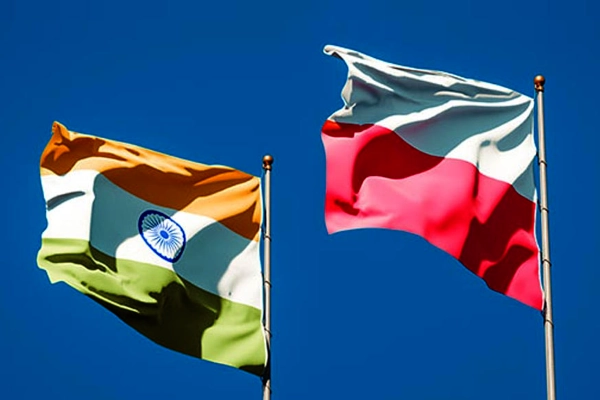
Polish Prime Minister Donald Tusk arrived in New Delhi on October 21, 2026, for a three-day official visit aimed at strengthening the India–Poland Strategic Partnership and expanding cooperation in defence, trade, investment, emerging technologies and renewable energy. The visit comes two years after India and Poland elevated their bilateral relationship to a Strategic Partnership during Prime Minister Narendra Modi’s historic visit to Warsaw in August 2024.
Tusk is visiting India from October 21 to 23 at the invitation of Prime Minister Narendra Modi. The two leaders are scheduled to hold bilateral talks at Hyderabad House in New Delhi on October 22, where they will review the progress of bilateral relations and explore opportunities for expanding cooperation across strategic and economic sectors. The discussions will also cover regional and international developments of mutual interest.
The Polish Prime Minister is accompanied by Andrzej Domański, Poland’s Minister of Finance and Economy, and a large business delegation. His itinerary includes official engagements in New Delhi and a visit to Bengaluru, highlighting the growing importance of industrial cooperation, technology partnerships and private-sector participation in relations between the two countries.
India Welcomes Polish Prime Minister Donald Tusk
Prime Minister Donald Tusk arrived in New Delhi on October 21, marking his second visit to India in his capacity as Poland’s Prime Minister. His previous visit in that role took place in 2010, during his earlier tenure in office. He also visited New Delhi in 2017 as President of the European Council for the India–European Union Summit.
Minister of State Dr Raj Bhushan Choudhary received the Polish Prime Minister at the airport on behalf of the Government of India. Ministry of External Affairs spokesperson Randhir Jaiswal welcomed Tusk and expressed confidence that the visit would provide fresh momentum to the India–Poland Strategic Partnership and strengthen the longstanding relationship between the two nations.
India and Poland established diplomatic relations in 1954 and have since developed cooperation across several sectors, including trade, engineering, mining, pharmaceuticals, information technology and education. The relationship has also benefited from historical connections and cultural exchanges that continue to strengthen mutual understanding between the two societies.
The elevation of bilateral relations to a Strategic Partnership in August 2024 marked an important milestone in this relationship. It established a wider framework for political dialogue, defence cooperation, economic engagement, technological collaboration and closer coordination on regional and global issues.
Modi and Tusk to Review India–Poland Strategic Partnership
Prime Minister Narendra Modi and Prime Minister Donald Tusk are scheduled to hold bilateral discussions on October 22, focusing on the implementation of the Strategic Partnership established during Modi’s visit to Warsaw on August 21–22, 2024. The two leaders are expected to review progress across existing areas of cooperation and identify opportunities for strengthening engagement in emerging sectors.
During the 2024 visit, India and Poland adopted an Action Plan for 2024–2028 to guide the implementation of their Strategic Partnership. The document identifies political dialogue, security cooperation, trade, investment, climate action, energy, science, technology, connectivity and people-to-people exchanges as important priorities for bilateral engagement.
The Action Plan provides a structured framework for cooperation among government institutions, businesses, universities and research organisations. It also encourages regular exchanges and closer collaboration in areas where the two countries possess complementary industrial and technological capabilities.
The discussions in New Delhi will provide an opportunity to assess the implementation of these commitments while exploring practical initiatives that can strengthen the partnership. The leaders are also expected to exchange views on regional and international developments, reflecting the growing importance of India–Poland cooperation within the broader India–European Union relationship.
Defence Cooperation Offers Opportunities for Industrial Partnerships
Defence and security cooperation constitute an important component of the India–Poland Strategic Partnership. The two countries have maintained a formal framework for defence cooperation since signing a bilateral agreement in 2003, which established opportunities for engagement in defence-related activities and exchanges.
Poland has considerable experience in defence manufacturing, particularly in land-based military systems, engineering equipment and associated technologies. Its defence industry has developed capabilities in armoured platforms, military vehicles, electronics and specialised manufacturing processes. India has simultaneously expanded its domestic defence industrial base through public-sector enterprises, private manufacturers, research institutions and emerging technology companies.
The increasing capabilities of India’s defence manufacturing ecosystem create opportunities for cooperation with Polish industries in engineering, technology development, production and industrial partnerships. India’s emphasis on indigenous manufacturing and technological self-reliance also provides a foundation for exploring cooperation with international partners possessing complementary expertise.
Both countries recognise the importance of reliable defence supply chains and the development of domestic industrial capabilities. The Strategic Partnership provides an institutional framework for strengthening dialogue on defence and security matters while encouraging greater interaction between relevant industries and government organisations.
The October 2026 visit offers an opportunity to advance this engagement and identify areas where Indian and Polish capabilities can support mutually beneficial defence-industrial cooperation.
Bilateral Trade and Investment Continue to Expand
Economic cooperation remains one of the principal foundations of India–Poland relations. According to the Ministry of External Affairs’ bilateral brief published in April 2025, trade between the two countries reached approximately US$5.72 billion in 2024, reflecting substantial growth over the preceding decade.
India exports a range of products to Poland, including engineering goods, chemicals, pharmaceuticals, textiles, machinery and other manufactured products. Polish exports to India include machinery, electrical equipment, industrial products and specialised engineering goods. The commercial relationship has expanded alongside growing investment and the presence of Indian businesses in the Polish market.
Poland occupies an important position within the European Union’s industrial and logistics network. Its geographical location provides access to major European markets, making it an attractive destination for Indian companies seeking to expand manufacturing, distribution and service operations across Central and Eastern Europe.
India, meanwhile, offers Polish enterprises opportunities in manufacturing, infrastructure, renewable energy, information technology, pharmaceuticals and advanced engineering. The country’s expanding industrial base and large domestic market provide considerable scope for long-term commercial partnerships.
The presence of Poland’s Minister of Finance and Economy and a substantial business delegation during Tusk’s visit underlines the importance attached to economic engagement. Business forums scheduled in New Delhi and Bengaluru are expected to facilitate interaction between companies and encourage cooperation in investment, technology and manufacturing.
Bengaluru Visit Highlights Growing Technology Cooperation
Prime Minister Donald Tusk is scheduled to travel to Bengaluru on October 22 as part of his official visit to India. His engagements in Karnataka will include meetings with the state’s Governor and Chief Minister, alongside interactions associated with economic and industrial cooperation.
Bengaluru is one of India’s principal centres for information technology, aerospace, biotechnology, electronics, advanced manufacturing and scientific research. Its established technology ecosystem provides opportunities for collaboration with international businesses, research institutions and innovation-driven enterprises.
Indian information technology companies have already developed a significant presence in Poland, which serves as an important European location for technology services and business operations. Indian enterprises have established development centres and service facilities that support customers across the European market, contributing to employment, investment and technological exchanges.
The relationship between India’s technology industry and Poland’s expanding digital economy offers opportunities for cooperation in software development, cybersecurity, artificial intelligence, industrial automation and advanced engineering. Universities and research organisations can also contribute through academic exchanges, collaborative research and innovation partnerships.
Tusk’s visit to Bengaluru reflects the increasing importance of regional industrial ecosystems in India’s international partnerships. Engagement with Karnataka’s technology and manufacturing sectors can complement national-level diplomatic discussions and support new business relationships between Indian and Polish enterprises.
Renewable Energy and Industrial Engineering Emerge as Important Priorities
Renewable energy, industrial technology and sustainable development are among the sectors identified for stronger cooperation under the India–Poland Strategic Partnership. Both countries possess substantial industrial capabilities and are undertaking energy transitions that require new technologies, infrastructure investment and engineering expertise.
Poland has longstanding experience in mining, energy engineering and industrial machinery. Polish companies have previously participated in India’s mining and energy sectors through equipment supply, technical services and industrial cooperation. The two countries also signed a memorandum of understanding on coal and mining cooperation in February 2019, providing an institutional framework for technical exchanges.
India’s expanding renewable energy sector creates opportunities for international partnerships in solar power, wind energy, energy storage, grid modernisation and energy-efficient industrial processes. The development of these technologies requires cooperation among equipment manufacturers, engineering firms, research institutions and project developers.
Polish companies possess industrial capabilities that could complement India’s expanding renewable energy manufacturing and infrastructure ecosystem. Cooperation in energy engineering, manufacturing technologies and industrial research can support the development of new products and strengthen economic relations.
The inclusion of renewable energy in the agenda for Tusk’s visit demonstrates the intention of both governments to extend traditional industrial cooperation into sectors associated with modern energy infrastructure and long-term economic development.
India–Poland Relations Strengthen Cooperation with the European Union
Poland’s membership of the European Union gives the bilateral relationship wider strategic and economic importance. The India–Poland Strategic Partnership complements India’s broader engagement with the European Union, which includes cooperation in trade, investment, technology, connectivity, security and international affairs.
Poland is an important manufacturing and logistics centre within Central Europe and maintains extensive commercial connections across the European market. Its industrial capabilities and transport networks create opportunities for Indian companies seeking to establish or expand operations within the European Union.
India’s growing manufacturing capacity, technological expertise and expanding domestic market also create opportunities for European companies interested in industrial partnerships and investment. Cooperation with Poland can contribute to stronger business relationships and greater integration of manufacturing and technology supply chains.
The Ministry of External Affairs has indicated that Tusk’s visit will also contribute to strengthening the India–European Union Strategic Partnership. This wider dimension is particularly relevant as India and the European Union seek to expand economic engagement and cooperate on emerging technologies, industrial resilience and international connectivity.
Closer engagement between India and Poland can therefore support broader cooperation between India and European institutions while creating additional opportunities for businesses, researchers and industrial organisations in both countries.
Historical Connections Strengthen People-to-People Relations
The relationship between India and Poland is supported by historical connections that continue to hold considerable significance in both countries. One of the most enduring examples dates to the Second World War, when Maharaja Jam Saheb Digvijaysinhji Ranjitsinhji of Nawanagar provided refuge to Polish children displaced by the conflict.
The Maharaja established a safe haven for Polish children in Balachadi, near Jamnagar in present-day Gujarat. His humanitarian assistance became an important symbol of friendship between the people of India and Poland, and his contribution continues to receive recognition in Poland.
Another significant chapter in this shared history involved the settlement established at Valivade, near Kolhapur in Maharashtra, where Polish refugees found shelter during the war. These experiences created lasting emotional connections between the two societies and remain an important element of their bilateral relationship.
During his August 2024 visit to Warsaw, Prime Minister Narendra Modi paid tribute to these historical connections by visiting memorials dedicated to the Maharaja of Nawanagar and the Polish refugees. The visit also highlighted the importance of preserving shared historical experiences and strengthening cultural understanding.
India subsequently announced the Jamsaheb Youth Exchange Programme, intended to provide opportunities for Polish young people to visit India and develop a deeper understanding of the relationship between the two countries.
Educational exchanges, academic collaboration, tourism, cultural programmes and interactions among younger generations continue to strengthen the foundation of India–Poland relations. These connections complement diplomatic and economic cooperation while sustaining the longstanding goodwill between the two nations.
India–Poland Action Plan Provides Framework for Future Cooperation
The Action Plan for 2024–2028 remains an important instrument for implementing the India–Poland Strategic Partnership. Adopted during Prime Minister Modi’s visit to Warsaw, the document identifies priority areas for cooperation and encourages continued engagement between government institutions and other stakeholders.
The plan covers political consultations, defence and security cooperation, economic relations, investment, science and technology, energy, connectivity, cultural activities and educational exchanges. Its implementation requires sustained coordination among ministries, businesses, universities and research institutions.
The October 2026 visit provides an opportunity for both governments to assess progress under the Action Plan and strengthen cooperation in areas where practical partnerships can deliver mutual benefits. The participation of Polish business representatives and the inclusion of Bengaluru in the itinerary indicate the importance attached to translating diplomatic commitments into economic and technological engagement.
Regular political dialogue and industry participation can help sustain momentum across different sectors of cooperation. The Action Plan also provides continuity for bilateral initiatives by establishing priorities that extend beyond individual diplomatic visits.
As India and Poland develop their strategic relationship, this framework will remain important for strengthening institutional cooperation and encouraging long-term partnerships between their industrial, scientific and educational communities.
Donald Tusk’s Visit Opens New Opportunities for India–Poland Cooperation
Prime Minister Donald Tusk’s visit to India from October 21 to 23, 2026, represents another important step in the development of bilateral relations following their elevation to a Strategic Partnership in August 2024.
The scheduled discussions with Prime Minister Narendra Modi, participation of senior Polish officials and business representatives, and engagements in Bengaluru demonstrate the increasing breadth of the relationship. Defence manufacturing, trade, investment, emerging technologies, renewable energy and education offer opportunities for expanding cooperation between the two countries.
India’s growing industrial and technological capabilities complement Poland’s position as an important manufacturing and logistics centre within the European Union. Stronger partnerships between businesses, research institutions and government organisations can contribute to innovation, economic development and more diversified international supply chains.
The relationship also benefits from historical goodwill, cultural understanding and expanding people-to-people exchanges. These connections provide a lasting foundation for cooperation while strengthening the wider India–European Union partnership.
The continued implementation of the India–Poland Action Plan for 2024–2028 will help both countries build upon their existing achievements and develop new avenues for mutually beneficial engagement. Tusk’s visit provides fresh momentum for advancing a partnership increasingly shaped by strategic dialogue, industrial cooperation and technological innovation.
References
1. Ministry of External Affairs, Government of India
Visit of the Prime Minister of Poland to India (October 21–23, 2026). Published October 19, 2026.
Official announcement covering Prime Minister Donald Tusk’s visit, bilateral talks, accompanying delegation and areas of cooperation.
https://www.mea.gov.in/press-releases?dtl/41888/Visit_of_the_Prime_Minister_of_Poland_to_India_October_2123_2026
2. Ministry of External Affairs, Government of India
India–Poland Bilateral Relations. Updated April 2025.
Official bilateral brief covering diplomatic relations, economic cooperation, investment, defence, information technology and historical connections.
https://www.mea.gov.in/Portal/ForeignRelation/India-Poland-Apr-2025.pdf
3. Ministry of External Affairs, Government of India
Joint Statement: Establishment of India–Poland Strategic Partnership. Published August 22, 2024.
Official joint statement issued during Prime Minister Narendra Modi’s visit to Poland.
https://www.mea.gov.in/bilateral-documents.htm
4. Ministry of External Affairs, Government of India
Action Plan for the Implementation of the Strategic Partnership between India and Poland (2024–2028). Published August 22, 2024.
Official framework outlining cooperation in political dialogue, defence, trade, investment, energy, technology and cultural exchanges.
https://www.mea.gov.in/bilateral-documents.htm
You may also like
-
India and Singapore Begin SIMBEX 2026 Naval Exercise in Bay of Bengal, Focus on Anti-Submarine Warfare
-
IBSAMAR IX 2026 Concludes in South Africa, Strengthening Maritime Cooperation Between India, Brazil and South Africa
-
India, US and UAE Discuss Energy and Connectivity in Trilateral Meeting in Mumbai
-
India Calls for Unified Action Against Terrorism at SCO Meeting, Pushes for Sovereignty-Based Connectivity and Trade
-
India and UAE Strengthen Strategic Partnership as Foreign Ministers Hold High-Level Engagement in Mumbai
