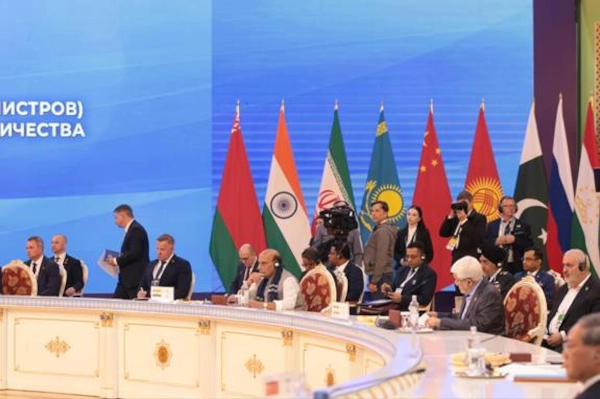
India has called for coordinated international action to dismantle the entire ecosystem of terrorism, including the networks that finance, support and provide safe havens to terrorist organisations. Defence Minister Rajnath Singh delivered the message at the 25th Meeting of the Shanghai Cooperation Organisation (SCO) Council of Heads of Government in Dushanbe, Tajikistan, on 20 October 2026.
Addressing representatives of SCO member states, Rajnath Singh emphasised that terrorism remains one of the gravest threats to regional peace, economic development and international cooperation. He also outlined India’s priorities for strengthening regional connectivity, expanding trade, developing resilient supply chains and ensuring that economic cooperation delivers tangible benefits to citizens.
The meeting brought together SCO members to review progress in multilateral economic cooperation and establish priorities for the organisation’s next phase of development.
India Calls for Dismantling the Entire Terrorism Ecosystem
Rajnath Singh urged SCO countries to move beyond declarations and take concrete steps against terrorism and its supporting infrastructure. He stressed that effective counterterrorism efforts must address not only terrorist organisations but also their financial networks, logistical support systems and sources of external assistance.
“There can be no justification for terrorism, no double standards in addressing it, and no place for those who finance, support, or provide safe havens to terrorists,” the Defence Minister stated.
He warned that terrorism destroys innocent lives, discourages investment, disrupts commercial activity and contributes to the radicalisation of societies. Such activities also deprive young people of educational, economic and developmental opportunities.
India’s position reflects its longstanding emphasis on comprehensive counterterrorism cooperation, including measures against terrorist financing, radicalisation and cross-border support networks.
The Defence Minister also welcomed the SCO’s decision to establish a Universal Centre in Tashkent and an Anti-Drug Centre in Dushanbe as permanent institutions. He emphasised that their effectiveness would depend on coordination among member states and the timely execution of agreed responsibilities.
Connectivity Must Respect National Sovereignty
Regional connectivity emerged as another major priority in India’s address. Rajnath Singh reiterated India’s support for infrastructure and transport initiatives that improve access to markets, strengthen trade relationships and create new opportunities for economic development.
However, he emphasised that connectivity projects must respect the sovereignty and territorial integrity of participating countries. India maintains that sustainable regional infrastructure requires consultation, mutual agreement and respect for established international principles.
The Defence Minister identified the International North-South Transport Corridor (INSTC) and Chabahar Port as important initiatives for improving Central Asia’s access to wider international markets.
These projects offer opportunities to develop alternative trade routes linking India with Central Asia and other regions. Improved transport connections can facilitate cargo movement, strengthen commercial relationships and support greater integration between regional economies.
Rajnath Singh also called for improvements beyond physical infrastructure. He highlighted the importance of simplifying customs procedures, promoting digital documentation, strengthening logistics systems and adopting interoperable digital solutions.
Such measures can reduce transaction costs and improve the efficiency of cross-border commercial operations.
India Supports SCO Economic Cooperation Plan for 2026–2030
The Defence Minister reaffirmed India’s support for the Action Plan for the Programme of Multilateral Trade and Economic Cooperation covering 2026–2030.
The plan seeks to strengthen economic engagement among SCO members through coordinated initiatives covering trade, investment, connectivity and development.
Rajnath Singh noted that geopolitical tensions, disruptions to global supply chains, energy security concerns and technological disparities are creating challenges for regional economies. He called for consensus-driven cooperation that produces practical results.
India emphasised the importance of strengthening resilient supply chains, expanding investment opportunities and using technological innovation to support sustainable economic development.
The Defence Minister also cautioned against unnecessary institutional expansion within the SCO. He argued that creating additional organisations and mechanisms does not automatically produce better outcomes.
Instead, new initiatives should address clearly identified requirements, avoid duplication and generate measurable benefits for participating countries.
Chabahar Port and INSTC to Strengthen Central Asian Trade Links
India’s emphasis on Chabahar Port and the International North-South Transport Corridor reflects the growing importance of diversified transport infrastructure across Eurasia.
Chabahar, located on Iran’s southeastern coast, provides a maritime gateway that can support trade between India, Afghanistan and Central Asian countries. Its development complements India’s efforts to improve access to markets across the region.
The International North-South Transport Corridor is designed to facilitate multimodal cargo movement through combinations of maritime, rail and road transport.
Together, these initiatives can support more diversified trade connections, improve logistical flexibility and create additional opportunities for businesses operating across participating economies.
Rajnath Singh also referred to the symposium on financing infrastructure projects in Central Asia, held in Mumbai earlier in October. He appreciated the participation of Central Asian countries and SCO partners in the discussions.
He also acknowledged the organisation of the first SCO Asian Economic Dialogue, highlighting the importance of sustained engagement on regional economic priorities.
Digital Public Infrastructure and Innovation as Drivers of Development
Rajnath Singh presented India’s experience with digital transformation as an example of how technology can support inclusive economic growth.
He highlighted India’s Digital Public Infrastructure, which has expanded access to public services and strengthened financial inclusion through technology-enabled delivery systems.
The Defence Minister also referred to India’s growing startup ecosystem and the country’s emphasis on women-led development. He identified innovation, entrepreneurship and broader economic participation as important elements of sustainable growth.
India believes that the success of regional cooperation should be measured by its direct benefits to citizens rather than institutional expansion alone.
“Our success should be measured by the opportunities we create for youth, new markets we open for our entrepreneurs, technologies we make available to our farmers and small-scale business owners, and the connections we foster among societies,” Rajnath Singh stated.
The emphasis places entrepreneurs, farmers, small businesses and young people at the centre of the SCO’s economic development agenda.
India Highlights International Cooperation on Clean Energy and Resilience
The Defence Minister also drew attention to India’s international initiatives addressing clean energy, sustainable development and climate resilience.
He highlighted the International Solar Alliance as a platform for expanding affordable solar energy and strengthening cooperation among participating countries.
The Coalition for Disaster Resilient Infrastructure supports the development of infrastructure capable of withstanding natural disasters and climate-related challenges.
Rajnath Singh also referred to Mission LiFE, which promotes environmentally responsible lifestyles and consumption patterns, and the Global Biofuels Alliance, which encourages international cooperation on cleaner energy alternatives.
These initiatives demonstrate India’s approach to combining technological development, international partnerships and sustainable economic growth.
SCO Adopts Joint Communiqué and Economic Action Plan
The 25th SCO Council of Heads of Government meeting reviewed cooperation in transport, finance, the digital economy, trade and social development.
Participating delegations adopted the meeting’s Joint Communiqué, along with the SCO budget for 2027 and associated financial and administrative decisions.
The meeting also adopted the Action Plan for the Programme of Multilateral Trade and Economic Cooperation for 2026–2030, establishing a framework for continued economic engagement among member states.
India has been a full member of the Shanghai Cooperation Organisation since 2017 and continues to participate in its security, economic and diplomatic mechanisms.
Rajnath Singh reaffirmed India’s commitment to the principles of sovereign equality, consensus and mutual respect. He also invited SCO member states to participate in the first SCO Civilisational Dialogue Forum, which India will host later in 2026.
India Seeks Practical Outcomes from SCO Cooperation
India’s intervention at the Dushanbe meeting brought together three priorities: decisive action against terrorism, connectivity based on respect for national sovereignty, and economic cooperation that creates opportunities across society.
By supporting regional transport corridors, trade facilitation, digital technologies and resilient supply chains, India is seeking to strengthen its economic engagement with Central Asia and other SCO partners.
The adoption of the 2026–2030 economic cooperation plan provides a framework for advancing these objectives through coordinated programmes and institutional engagement.
As the SCO builds on 25 years of cooperation, India’s emphasis on security, sovereignty and practical development offers a clear direction for strengthening regional stability and shared prosperity.
References
- Press Information Bureau, Ministry of Defence, Government of India, 20 October 2026. 25th SCO Council of Heads of Government Meeting: Raksha Mantri Calls for Unified Action to Dismantle the Entire Ecosystem of Terrorism.
https://pib.gov.in/ - Shanghai Cooperation Organisation — Official information on SCO institutions, cooperation mechanisms and activities.
https://eng.sectsco.org/ - Ministry of External Affairs, Government of India — India’s engagement with the Shanghai Cooperation Organisation and regional connectivity initiatives.
https://www.mea.gov.in/
You may also like
-
India, US and UAE Discuss Energy and Connectivity in Trilateral Meeting in Mumbai
-
Solar Defence Expands Its Vision Towards Military Humanoid Robotics and Advanced Autonomous Defence Systems
-
AVTEC Strengthens India’s Indigenous Defence Manufacturing with Automatic Transmissions for Combat Vehicles
-
Jindal Defence–Taurus T9: Indian Army Showcases Made-in-India Submachine Gun
-
India and UAE Strengthen Strategic Partnership as Foreign Ministers Hold High-Level Engagement in Mumbai
