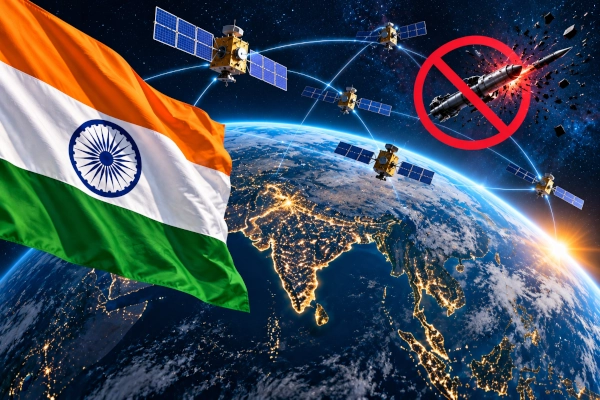
India has called for a comprehensive, legally binding international treaty to prevent an arms race in outer space and protect the orbital environment from becoming a new arena of military confrontation. Reaffirming its longstanding position at the United Nations, India emphasised that international agreements governing space security must be universally acceptable, verifiable and negotiated through a multilateral framework.
Speaking at the United Nations on October 20, 2026, Rajya Sabha Member Sudha Murty, representing India as part of a parliamentary delegation, highlighted the growing challenges associated with military activities in space. She emphasised the importance of establishing legally enforceable international rules that address emerging security threats while preserving the peaceful and sustainable use of outer space.
India’s position reflects its growing responsibilities as a major spacefaring nation with significant investments in satellite communications, navigation, Earth observation, scientific exploration and space technology. The country has consistently advocated international cooperation to ensure that outer space remains accessible for peaceful activities and socioeconomic development.
India Seeks Comprehensive International Agreement on Space Security
India has reiterated its support for negotiating a legally binding instrument under the Prevention of an Arms Race in Outer Space (PAROS) framework. The proposed agreement would strengthen international rules intended to prevent the deployment of weapons in space and reduce the possibility of military confrontation involving space-based assets.
Addressing the United Nations, Sudha Murty emphasised that an effective agreement must cover the wider range of threats to space security rather than concentrating on selected categories of weapons or activities. India believes that such an arrangement must consider the safety, security and long-term sustainability of outer space.
The Indian position also recognises the dangers arising from misunderstandings, miscalculations and differing interpretations of military behaviour in space. Such situations can create international tensions, particularly when countries lack common rules for identifying threatening activities or determining what constitutes the use of force.
India has identified the Conference on Disarmament in Geneva as the appropriate international forum for negotiating a comprehensive treaty. The country has consistently supported this multilateral mechanism because it brings together governments to address international arms control and disarmament issues.
The proposed framework would seek to establish common obligations while ensuring that legitimate peaceful activities and international cooperation in space can continue.
Growing Military Activities Raise Concerns About Outer Space Security
The increasing dependence of modern economies and armed forces on satellites has made outer space an important component of national security infrastructure.
Satellites support communication networks, navigation services, weather forecasting, disaster management, financial transactions and maritime transportation. They also contribute to military surveillance, secure communications, reconnaissance and operational planning.
This combination of civilian and military applications has created a complex security environment. Many space technologies are inherently dual-use, meaning the same infrastructure can support both peaceful development and national defence requirements.
During the UN discussions, India drew attention to the need for international rules that recognise these technological realities.
Military space capabilities can include satellite interference systems, anti-satellite technologies, electronic warfare equipment and other systems capable of disrupting space-based infrastructure.
The growing capabilities of such technologies have intensified international discussions about how to prevent hostile actions against satellites and avoid an escalation of military competition beyond Earth’s atmosphere.
India’s proposal seeks to address these challenges through comprehensive international obligations supported by credible verification arrangements.
India Supports Negotiations Through the Conference on Disarmament
India has consistently maintained that the Conference on Disarmament should play a central role in developing legally binding international agreements governing military activities in outer space.
The Conference on Disarmament is a multilateral negotiating forum that addresses issues involving arms control, disarmament and international security.
India believes that negotiations conducted through this mechanism can provide the international legitimacy and participation required for a widely accepted agreement.
The Indian delegation reiterated that any future treaty must be developed through multilateral negotiations and incorporate provisions capable of effective verification.
Verification is particularly important because space technologies often serve both civilian and military functions. Determining whether a particular system constitutes a weapon or whether an activity violates an international agreement can present substantial technical and legal challenges.
India has therefore emphasised the need for clear definitions, objective criteria and internationally acceptable verification procedures.
The objective is to establish rules that provide greater certainty to participating countries while reducing the possibility of misunderstandings and disputes.
India Recognises Draft Treaty Proposed by Russia and China
India has acknowledged the draft Treaty on the Prevention of the Placement of Weapons in Outer Space, the Threat or Use of Force Against Outer Space Objects, commonly known as the PPWT.
Russia and China introduced an initial version of this proposal in 2008, seeking to establish international restrictions on placing weapons in space and threatening or using force against space objects.
India considers the draft a possible basis for further international discussions rather than a completed agreement ready for adoption.
The proposal has generated differences among major spacefaring nations. The United States has raised concerns regarding its verification provisions and the treatment of certain terrestrial anti-satellite capabilities.
These disagreements highlight the difficulty of creating an international agreement capable of addressing the full range of space-related security threats.
India’s position is that negotiations must consider such concerns comprehensively while working towards a universally acceptable framework.
This approach reflects the country’s emphasis on multilateral discussions, technical clarity and international consensus.
Transparency Measures Can Complement a Binding Treaty
India has also expressed support for developing universal and non-discriminatory transparency and confidence-building measures related to outer space activities.
Such arrangements can encourage countries to exchange information, improve communication and reduce uncertainty surrounding potentially sensitive space operations.
Transparency measures may include notifications concerning certain activities, exchanges of information about space operations and mechanisms designed to improve mutual understanding.
These arrangements can contribute to greater predictability and help reduce the risk of accidental escalation.
However, India has emphasised that voluntary measures cannot replace legally binding international obligations.
The country’s position is that transparency and confidence-building mechanisms should complement a comprehensive treaty rather than serve as substitutes for enforceable restrictions on an arms race in outer space.
This distinction reflects India’s preference for a durable international legal framework supported by practical cooperation among spacefaring nations.
Existing Outer Space Treaty Provides Foundation for International Cooperation
International space law already contains important provisions governing the exploration and use of outer space.
The 1967 Outer Space Treaty established fundamental principles, including the peaceful exploration and use of space, freedom of access and the prohibition on national appropriation of celestial bodies.
The treaty also prohibits placing nuclear weapons or other weapons of mass destruction in orbit around Earth, installing such weapons on celestial bodies or stationing them in outer space by other means.
However, the existing legal framework does not comprehensively prohibit every category of conventional weapon or military activity associated with space.
This distinction has become increasingly relevant as countries develop more sophisticated satellite technologies and capabilities capable of interfering with space-based systems.
India supports strengthening the existing international legal framework to address these emerging challenges.
A comprehensive agreement under PAROS would build upon established international obligations while addressing technological and security developments that have emerged since the Outer Space Treaty entered into force.
India’s Expanding Space Programme Strengthens Its Interest in Orbital Security
India’s growing capabilities in space exploration, satellite technology and launch systems have increased the importance of maintaining a stable and secure orbital environment.
The Indian Space Research Organisation (ISRO) operates programmes covering Earth observation, communication satellites, navigation, scientific missions and space transportation.
India’s Chandrayaan-3 mission achieved a successful soft landing near the Moon’s south polar region in August 2023, demonstrating the country’s growing technological capabilities in deep-space exploration.
The Aditya-L1 mission further expanded India’s scientific research capabilities through the study of the Sun and its surrounding environment.
India is also advancing its human spaceflight programme through Gaganyaan while developing technologies and infrastructure required for future space activities.
These programmes depend on predictable orbital conditions, reliable communication networks and continued international cooperation.
The protection of space infrastructure is therefore important not only for national security but also for scientific research, economic development and the delivery of essential public services.
India’s support for international space security agreements complements its broader efforts to promote responsible and sustainable space activities.
Space Weaponisation Could Threaten Global Satellite Infrastructure
The potential expansion of military competition into outer space raises concerns about the safety of satellite networks used by countries worldwide.
Satellites operate within an increasingly congested orbital environment, where the number of spacecraft and associated objects continues to grow.
Hostile actions involving satellites could disrupt communication systems, navigation services, weather monitoring and other critical applications.
Certain destructive anti-satellite activities can also generate orbital debris, creating hazards for operational spacecraft and future launches.
These risks extend beyond the countries directly involved in a confrontation because orbital debris and interference can affect spacecraft operated by other nations.
The challenge is particularly important for developing countries, many of which depend on satellite infrastructure for telecommunications, agriculture, education, disaster management and economic activities.
India’s call for international restrictions on space weaponisation therefore connects space security with broader questions of global development and technological accessibility.
India Advocates Inclusive International Cooperation on Space Governance
India has consistently supported the principle that outer space should remain accessible to all countries for peaceful exploration and development.
The country’s approach places importance on international cooperation, equitable access to space technologies and the participation of developing nations in global space governance.
A comprehensive international agreement would require cooperation among established space powers and emerging spacefaring countries.
India has emphasised that the negotiation of such an instrument must be inclusive and based on objective standards that apply consistently to participating nations.
The country also recognises the value of discussions within United Nations mechanisms addressing responsible behaviour, transparency and the reduction of space-related threats.
By supporting both legally binding obligations and complementary confidence-building measures, India seeks to promote an international framework capable of addressing present and emerging security challenges.
India Reinforces Commitment to Peaceful and Sustainable Use of Space
India’s renewed call for a legally binding international treaty reflects its longstanding commitment to preventing an arms race in outer space.
The proposal emphasises comprehensive negotiations, credible verification, universal participation and the development of clear international rules governing potentially threatening space activities.
As satellite infrastructure becomes increasingly important to national economies, scientific research and security, preserving a stable orbital environment has become a shared international responsibility.
India’s expanding space programme gives the country an important role in discussions concerning the future governance of outer space.
Through continued engagement at the United Nations and the Conference on Disarmament, India is contributing to international efforts to strengthen space security and preserve the benefits of space technology for future generations.
The country’s position reinforces a central principle of its space diplomacy: outer space should remain an arena for international cooperation, scientific progress and peaceful development rather than military confrontation.
References
1. DD News — Prasar Bharati
अंतरिक्ष को ‘युद्ध का मैदान’ बनने से रोकेगा भारत, संयुक्त राष्ट्र से व्यापक संधि की अपील.
Published: October 21, 2026.
Reports India’s call for a comprehensive, legally binding international treaty, including remarks attributed to Rajya Sabha Member Sudha Murty at the United Nations.
https://ddnews.gov.in/india-has-urged-the-adoption-of-a-comprehensive-legally-binding-treaty-to-outlaw-armaments-in-space
2. Permanent Mission of India to the United Nations, New York
Statement by Ambassador Anupam Ray at the Joint Meeting of the UN General Assembly First and Fourth Committees.
Published: October 27, 2022.
Official statement confirming India’s opposition to the weaponisation of outer space and its support for a comprehensive, verifiable, legally binding international instrument.
https://pminewyork.gov.in/IndiaatUNGA?id=NDgwOQ
3. United Nations — General Assembly First Committee
First Committee, 17th Plenary Meeting, 80th Session.
Official UN proceedings recording India’s position on preventing an arms race in outer space, the proposed legally binding instrument, transparency measures and the importance of comprehensive space security arrangements.
https://transcripts.un.org/en/ga/c1/80/17
4. United Nations — General Assembly First Committee
First Committee, 24th Plenary Meeting, 80th Session.
Official proceedings documenting India’s position on the prevention of weaponisation of outer space and its support for strengthening the international legal framework.
https://transcripts.un.org/en/ga/c1/80/24
5. United Nations Office for Outer Space Affairs
Treaty on Principles Governing the Activities of States in the Exploration and Use of Outer Space, Including the Moon and Other Celestial Bodies.
Official information on the Outer Space Treaty and the international legal framework governing space activities.
https://www.unoosa.org/oosa/en/ourwork/spacelaw/treaties/outerspacetreaty.html
You may also like
-
India and New Zealand Strengthen Trade Ties with Electronic Origin Data Exchange Agreement Under FTA
-
Polish Prime Minister Donald Tusk Arrives in India to Strengthen Strategic Partnership in Defence, Trade and Technology
-
India and Singapore Begin SIMBEX 2026 Naval Exercise in Bay of Bengal, Focus on Anti-Submarine Warfare
-
IBSAMAR IX 2026 Concludes in South Africa, Strengthening Maritime Cooperation Between India, Brazil and South Africa
-
India, US and UAE Discuss Energy and Connectivity in Trilateral Meeting in Mumbai
