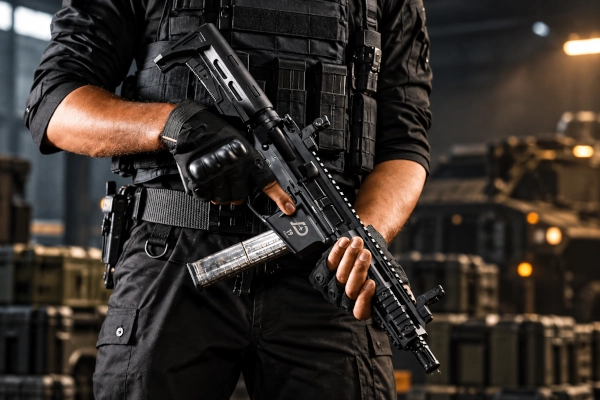
The Indian Army’s latest tactical video has drawn attention to the Jindal Defence–Taurus T9, a compact 9 mm submachine gun manufactured in India through an Indo-Brazilian defence partnership. The weapon represents an important development in India’s expanding domestic small-arms industry and illustrates how international technology cooperation is supporting military equipment manufacturing under the Make in India initiative.
Released on 18 October 2026 through the Indian Army’s official social media account, the video forms part of the Shadows and Steel 2.0 series. The footage has attracted interest among defence observers because of the weapon’s modern configuration and its connection with an Indian manufacturing joint venture.
The T9’s appearance comes nearly two years after Taurus Armas reported completing the delivery of 550 locally produced submachine guns to the Indian Army’s Northern Command. The development places the T9 among the compact firearms supplied by India’s emerging private-sector defence manufacturers.
Jindal Defence–Taurus: An Indo-Brazilian Defence Manufacturing Partnership
Jindal Defence Taurus emerged from a partnership between India’s Jindal Defence and Brazilian firearms manufacturer Taurus Armas S.A. The companies formalised their joint venture in January 2020 during the first Brazil–India Defence Industry Dialogue, establishing a framework for manufacturing small arms in India.
Under the ownership structure, Jindal Defence holds a 51% stake, while Taurus Armas owns the remaining 49%. The partnership combines the Indian company’s manufacturing and industrial presence with Taurus’s established firearms designs and technical expertise.
The venture was established to serve India’s military, paramilitary, police and other authorised security markets. Its product portfolio includes pistols, submachine guns and rifles, reflecting a wider strategy to build domestic production capabilities across several categories of small arms.
The T9 represents one of the partnership’s first confirmed successes in supplying the Indian military. Beyond delivering finished weapons, the venture also provides an industrial framework for transferring manufacturing processes, developing local technical expertise and strengthening India’s small-arms production ecosystem.
Indian Army Receives 550 Locally Produced T9 Submachine Guns
The T9’s entry into the Indian military supply chain became evident during 2024, when Taurus Armas disclosed a contract to supply 550 submachine guns to the Indian Army’s Northern Command.
In its third-quarter 2024 financial disclosures, Taurus stated that the weapons would be manufactured locally using component kits supplied from Brazil. The company subsequently confirmed in its full-year 2024 results that all 550 T9 submachine guns had been delivered.
This delivery established an important procurement milestone for Jindal Defence Taurus. It demonstrated the joint venture’s ability to manufacture, inspect and supply military small arms within India.
The manufacturing arrangement also illustrates the progressive nature of defence industrial localisation. Initial production using imported component kits creates opportunities to develop expertise in assembly, inspection, testing and quality assurance. Greater indigenous manufacturing depth can subsequently emerge through increased local component production and technical integration.
The October 2026 Army video provides renewed visibility for a weapon already supplied to the military rather than announcing a fresh order. Publicly available company disclosures establish the original 550-weapon delivery, while the latest footage highlights the T9’s presence in Army communications.
Jindal Taurus T9: Design and Technical Characteristics
The Jindal Taurus T9 is a compact, magazine-fed firearm chambered for the widely used 9×19 mm cartridge. Its configuration combines features associated with modern submachine guns and compact tactical carbines, including a short barrel, adjustable shoulder stock and accessory mounting provisions.
According to Jindal Defence Taurus, the weapon uses an eight-inch barrel and weighs approximately 2.8 kilograms without its magazine. Its relatively compact dimensions make it suitable for personnel who require a firearm smaller than a conventional infantry assault rifle.
The manufacturer specifies a body constructed using hard-anodised 7075-T6 aluminium alloy, a material known for its strength-to-weight characteristics. A protective Cerakote finish contributes to surface durability and resistance to environmental wear.
The T9 incorporates a retractable shoulder stock with six adjustment positions, allowing personnel to modify its overall length and shoulder fit. Its design supports safe, semi-automatic and automatic firing modes, providing different operating options within its intended military role.
A 32-round detachable magazine supplies the ammunition. This capacity is comparable to that of several established submachine guns and provides a practical balance between ammunition availability and weapon size.
The T9 also includes Picatinny mounting rails for compatible optical sights and other authorised accessories. Ambidextrous firing controls and magazine-release provisions improve accessibility for both left- and right-handed personnel.
These design elements reflect the broader evolution of modern submachine guns towards modular construction, improved ergonomics and greater compatibility with contemporary military equipment.
Why Compact 9 mm Firearms Remain Relevant to Modern Armies
Modern armed forces employ different categories of small arms because operational responsibilities vary considerably between infantry soldiers, vehicle crews, specialist personnel and security units.
Conventional assault rifles offer greater effective range and generally employ ammunition designed for infantry combat. However, their dimensions can make them less convenient for personnel operating inside confined environments or performing duties that do not require a full-length service rifle.
Compact 9 mm firearms address a different requirement. Their smaller size and relatively manageable handling characteristics make them suitable for selected military personnel who need an easily carried weapon for close-range defence.
The Indian Army and DRDO have previously identified several applications for this category, including vehicle crews, heavy-weapon detachments, communications personnel and specialised security duties.
Submachine guns consequently remain relevant despite the widespread adoption of compact assault rifles and carbines. They occupy a particular segment of the military small-arms inventory, complementing rather than replacing standard infantry rifles.
The T9 belongs to this category, providing another domestically manufactured option for Indian defence procurement.
Made-in-India ASMI: The Closest Indian Alternative to the Taurus T9
India has also developed its own 9×19 mm machine pistol, known as ASMI, through a collaboration involving the Indian Army and the Defence Research and Development Organisation (DRDO).
The weapon was officially announced in January 2021 after development by the Infantry School at Mhow and DRDO’s Armament Research and Development Establishment (ARDE) in Pune. The project demonstrated India’s ability to develop a modern compact firearm using domestic engineering capabilities.
ASMI uses an upper receiver made from aircraft-grade aluminium and a lower receiver constructed from carbon fibre. Its development also incorporated additive manufacturing techniques, including 3D printing for selected components during prototyping.
The weapon was designed for applications similar to those served by the Taurus T9, including personal defence, close-quarter operations and use by military personnel who require compact firearms.
Hyderabad-based Lokesh Machines subsequently became an important manufacturing partner for ASMI. In 2024, the company delivered 550 ASMI submachine guns to the Indian Army’s Northern Command. The Army announced the induction of these weapons in November 2024.
This creates an interesting development in India’s small-arms industry. Both ASMI and the Taurus T9 have confirmed deliveries of 550 weapons each to Northern Command, according to their respective manufacturers and public reporting. These are separate procurements involving different manufacturers and designs.
ASMI represents an indigenous design developed through Indian military and defence research institutions. The Taurus T9 represents licensed local manufacturing supported by Brazilian technology. Together, they demonstrate two complementary approaches to expanding India’s military manufacturing capabilities.
How the Taurus T9 Compares with Other Submachine Guns
The Taurus T9 operates in a category containing several established international firearms. Although individual designs differ in dimensions, materials and operating mechanisms, they share a common emphasis on compact construction and close-range applications.
| Weapon | Country of origin | Calibre | Typical magazine capacity | Distinguishing characteristic |
|---|---|---|---|---|
| Jindal Taurus T9 | Brazil / India | 9×19 mm | 32 rounds | Indo-Brazilian manufacturing partnership |
| ASMI | India | 9×19 mm | 33 rounds | Indigenous Indian development |
| Heckler & Koch MP5 | Germany | 9×19 mm | 30 rounds | Established military and police submachine gun |
| CZ Scorpion EVO 3 | Czech Republic | 9×19 mm | 30 rounds | Modern lightweight modular design |
| IWI UZI Pro | Israel | 9×19 mm | 20 or 25 rounds | Particularly compact machine-pistol configuration |
| B&T APC9 | Switzerland | 9×19 mm | 15, 20 or 30 rounds | Modular pistol-calibre carbine and submachine-gun family |
The comparison shows that the Taurus T9 belongs to an internationally established category rather than introducing an entirely new type of firearm. Its principal significance for India lies in domestic manufacturing, industrial collaboration and its successful entry into the military procurement system.
The development of ASMI is especially relevant because India now possesses an indigenous alternative within the same broad category. The availability of different manufacturing sources can support competition, specialised procurement requirements and the expansion of domestic industrial capabilities.
The Importance of Technology Transfer and Local Manufacturing
India’s defence manufacturing strategy increasingly combines indigenous research and development with international industrial partnerships. Both approaches contribute to strengthening the domestic defence production ecosystem, although they represent different levels of technological independence.
The Jindal Defence–Taurus partnership illustrates how foreign-developed equipment can enter production in India through structured industrial cooperation. Taurus Armas confirmed that the initial T9 delivery involved locally produced weapons assembled using component kits supplied from Brazil.
Such arrangements help Indian manufacturers develop experience in production management, technical inspection, quality control and military supply-chain requirements. These capabilities are important for establishing reliable manufacturing operations in a sector where equipment must satisfy demanding specifications.
Over time, technology partnerships can also create opportunities for greater localisation of components and manufacturing processes. The industrial benefits depend on the extent of technology absorption, domestic supplier development and the capabilities established within India.
Taurus’s financial disclosures have highlighted the transfer of technical knowledge to its Indian team. The company’s broader Indian portfolio also creates opportunities to expand the range of firearms produced locally.
For India, the strategic advantage extends beyond one particular weapon. Building a competitive small-arms industry requires sustained investment in engineering, manufacturing infrastructure, materials processing and testing facilities.
Expanding Opportunities for India’s Private Defence Industry
The successful supply of Taurus T9 submachine guns reflects the growing participation of private Indian companies in military small-arms manufacturing.
Historically, much of India’s organised defence firearms production was concentrated within government-owned manufacturing establishments. Recent years have witnessed greater involvement from private enterprises developing indigenous designs or collaborating with international manufacturers.
Companies such as Lokesh Machines, Jindal Defence Taurus, PLR Systems and SSS Defence represent different approaches to expanding domestic capabilities.
The availability of multiple manufacturers can broaden the military’s procurement options while encouraging competition in manufacturing standards, reliability, ergonomics and production efficiency.
A larger domestic industrial base also supports the development of specialised suppliers involved in precision machining, materials processing, surface treatment and component manufacturing.
The Taurus T9 programme forms part of this wider transformation, contributing to an increasingly diversified Indian defence manufacturing landscape.
Jindal Taurus T9 and India’s Defence Self-Reliance
The Indian Army’s October 2026 video has brought renewed attention to a weapon that already has an established procurement history.
The Taurus T9 demonstrates how India can use international industrial partnerships to manufacture modern military equipment domestically. Its delivery to Northern Command represents a tangible achievement for Jindal Defence Taurus and the country’s expanding private-sector defence industry.
At the same time, the parallel development and induction of India’s indigenous ASMI machine pistol highlights the growing capabilities of domestic research institutions and Indian manufacturers.
These developments illustrate the complementary roles of indigenous design, technology transfer and local production in strengthening national defence capabilities.
As India’s small-arms industry continues to expand, programmes such as the Taurus T9 and ASMI provide a foundation for greater manufacturing expertise, a broader domestic supplier base and stronger participation by Indian companies in defence production.
References
Official and primary sources
- Indian Army – ADGPI, 18 October 2026. Swadeshi Steel. Warrior DNA. Built Different. Shadows and Steel 2.0 tactical video.
Indian Army Official X Account - Jindal Defence Taurus – Official Website. T9 product information and photographs.
https://jdtaurus.in/security-forces/project-two-ky966-jrcrf - Jindal Defence Taurus – Company Newsletter. T9 specifications and inspection of the first consignment.
https://jdtaurus.in/latestnews - Taurus Armas – FY 2024 Financial Results. Confirmation of delivery of 550 locally produced T9 submachine guns to the Indian Army’s Northern Command.
Taurus Investor Relations – FY 2024 Results - Ministry of Defence – Press Information Bureau, 14 January 2021. India’s First Indigenously Developed 9mm Machine Pistol.
https://www.pib.gov.in/PressReleasePage.aspx?PRID=1688547 - Ministry of Defence – Press Information Bureau, March 2025. Transfer of Technology for ASMI to Lokesh Machines.
https://www.pib.gov.in/PressReleasePage.aspx?PRID=2108036
You may also like
-
Solar Defence Expands Its Vision Towards Military Humanoid Robotics and Advanced Autonomous Defence Systems
-
AVTEC Strengthens India’s Indigenous Defence Manufacturing with Automatic Transmissions for Combat Vehicles
-
Hooghly Cochin Shipyard Advances Six Hybrid-Electric Catamaran Project for India’s Inland Waterways
-
India–Australia Joint Military Exercise AUSTRAHIND 2026 Begins in Kerala with 240 Troops, New Zealand Joins as Observer
-
Indian Health-Tech Startup Kubo Care Develops Radar-Based Technology for Elderly Care
