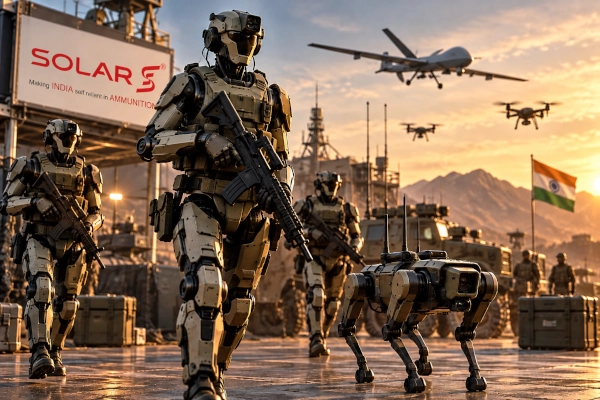
India’s defence manufacturing industry is preparing to enter a new technological frontier as Solar Industries India Limited explores the development of humanoid robots for military and national security applications. The Nagpur-based defence manufacturer, which has established significant capabilities in ammunition, missile components, rocket propulsion and unmanned aerial systems, has officially confirmed its interest in expanding into humanoid robotics as part of its long-term technological ambitions.
The development was confirmed during the company’s third-quarter FY2025–26 investor conference call held on 4 February 2026. Manish Nuwal, Managing Director and Chief Executive Officer of Solar Industries, acknowledged the company’s interest in pursuing humanoid robotics for national security programmes. The company subsequently submitted the conference-call transcript to the National Stock Exchange (NSE) and BSE Limited on 9 February 2026, placing the statement on official record.
Solar Industries’ proposed expansion reflects the increasing importance of robotics, artificial intelligence and autonomous systems in modern defence technology. Having already developed capabilities in loitering munitions and other advanced military systems, the company is exploring opportunities in technologies that could eventually support military personnel in hazardous environments, logistics operations and other specialised defence activities.
Solar Industries Officially Confirms Interest in Humanoid Robotics
Solar Industries formally acknowledged its interest in humanoid robotics during its investor conference call on 4 February 2026, when company management responded to questions concerning emerging defence technologies and future business opportunities.
During the discussion, Manish Nuwal confirmed that humanoid robotics formed part of the company’s areas of technological interest, particularly in relation to India’s national security requirements. He stated that Solar Industries was interested in taking forward futuristic programmes involving humanoid robots and other advanced technologies for the country’s security applications.
The statement provides official confirmation that the company is exploring humanoid robotics as a possible extension of its defence business. It also establishes that the initiative is connected with national security rather than being limited to conventional industrial automation or civilian robotics.
Solar Industries has not presented the initiative as a completed product programme. Instead, management has identified humanoid robotics as a prospective technological direction and indicated that further information would be shared as these initiatives progress.
This announcement is significant because it introduces humanoid robotics into the publicly acknowledged technology ambitions of an established Indian defence manufacturer. The company’s existing engineering infrastructure, defence manufacturing experience and involvement in unmanned systems provide a potential industrial foundation for pursuing such programmes.
From Industrial Explosives to Advanced Defence Technology
Solar Industries began its operations in the industrial explosives sector before expanding into specialised defence manufacturing. Over time, the company developed expertise in energetic materials, ammunition, rocket systems, propulsion-related components and other products used in military applications.
Through its defence manufacturing operations, the group has established capabilities in producing ammunition, military explosives, warheads and components associated with advanced weapons systems. Its expansion has been supported by sustained investment in manufacturing infrastructure, engineering and specialised production processes.
The company’s official corporate disclosures identify several important achievements, including its participation in the indigenous manufacture of BrahMos missile booster components and the development of Nagastra loitering munitions.
These programmes demonstrate the increasing technological scope of India’s private defence industry, particularly in areas traditionally associated with specialised government research establishments and established international manufacturers.
The proposed entry into humanoid robotics represents another stage in this industrial progression. Unlike ammunition or propulsion systems, advanced robots require extensive integration of mechanical engineering, electronics, computing, sensors and motion-control technologies.
By exploring this field, Solar Industries is positioning itself to participate in a broader range of emerging defence technologies while building upon its established experience in complex military systems.
Nagastra Loitering Munitions Establish Experience in Unmanned Systems
Solar Industries’ involvement in autonomous and remotely operated defence technologies is closely associated with its Nagastra loitering munition programme. The system represents an important milestone in the company’s transition from conventional defence products towards increasingly sophisticated unmanned platforms.
According to Solar Industries’ official corporate information, the company successfully completed flight trials of the Nagastra loitering munition, demonstrating its capabilities in the development and integration of unmanned aerial weapon systems.
Loitering munitions combine the characteristics of unmanned aircraft with precision-guided weapon technology. These systems incorporate flight-control mechanisms, navigation equipment, communication links and sensors that support their operation.
Developing such platforms requires expertise across several engineering disciplines, including aerodynamics, embedded electronics, propulsion integration, mission-control software and systems testing.
Although humanoid robots differ substantially from aerial systems in their mechanical design and operating environments, certain technological capabilities developed through unmanned aircraft programmes are relevant to robotics. These include electronic control systems, sensor integration, onboard processing and the coordination of multiple subsystems.
Solar Industries’ experience with Nagastra therefore provides an established background in unmanned defence technologies. Its proposed humanoid robotics initiative would extend this experience into machines designed for movement and interaction within terrestrial environments.
Solar Industries Also Working on MALE-Class Unmanned Aircraft
Alongside its interest in humanoid robotics, Solar Industries has confirmed that it is pursuing the development of Medium Altitude Long Endurance (MALE) unmanned aerial vehicles.
During the February 2026 investor conference call, company management stated that work had begun on MALE-category drones as part of its expanding unmanned systems activities.
MALE aircraft represent a technologically demanding segment of military aviation because they are designed to operate for extended periods while carrying sophisticated communication, navigation and mission equipment.
These aircraft can support intelligence gathering, reconnaissance, surveillance and other specialised military operations. Their development requires coordinated engineering across airframe structures, propulsion, electronics, flight controls and mission systems.
The move towards MALE platforms represents a progression beyond smaller unmanned aircraft and loitering munitions. It also demonstrates Solar Industries’ interest in developing increasingly complex systems that combine mechanical engineering with electronic control and advanced software.
The company’s simultaneous interest in humanoid robotics reflects a broader technological direction in which unmanned platforms, automated systems and advanced engineering could become important areas of future investment.
These developments are particularly relevant to India’s efforts to strengthen domestic capabilities in next-generation military technologies and reduce dependence on imported equipment.
Understanding Military Humanoid Robotics and Its Technological Requirements
Humanoid robotics is a specialised branch of engineering focused on developing machines that reproduce selected characteristics of human physical movement and interaction. Such robots generally employ articulated limbs, motorised joints, sensing equipment and sophisticated control systems to navigate their surroundings and perform physical tasks.
Unlike conventional wheeled or tracked robots, humanoid systems are designed around mechanical arrangements that may allow them to operate within environments originally created for human activity. Their ability to interact with stairs, doors, equipment and other infrastructure makes them an area of considerable interest for advanced robotics research.
The development of a functional humanoid robot involves several interconnected technologies. Precision-engineered mechanical structures provide the physical framework, while electric motors and actuators generate controlled movement. Sensors supply information about the robot’s position, surroundings and interactions with external objects.
Computer-based control systems process this information and coordinate the movement of individual joints. Advanced software may incorporate artificial intelligence and machine-learning techniques to support environmental perception, object recognition and task planning.
Energy management is another major engineering challenge because mobile robots require continuous power for their motors, sensors and computing systems. The performance of the robot depends upon the integration of these components into a reliable and coordinated platform.
For defence applications, additional requirements may include environmental durability, secure communication, remote supervision and the ability to operate under difficult physical conditions.
Solar Industries’ proposed entry into this field would therefore involve technologies that extend well beyond its established expertise in explosives and ammunition manufacturing.
Potential Military Applications of Humanoid Robotic Systems
Humanoid robots could eventually support a range of military and national security activities, particularly in environments where human personnel face substantial physical risks.
One potential application involves hazardous-area inspection and reconnaissance. Robotic platforms equipped with cameras and environmental sensors could assist personnel in examining dangerous locations while allowing operators to remain at safer distances.
Such systems may also prove useful in military engineering and infrastructure inspection. Their ability to move within buildings and interact with equipment designed for human use could support selected maintenance, monitoring and technical assessment activities.
Logistics represents another possible area of application. Humanoid robots capable of manipulating objects could assist with handling supplies, inspecting equipment and performing repetitive tasks within military storage facilities or workshops.
Robotics may also contribute to disaster-response operations, where damaged infrastructure and hazardous surroundings can create substantial risks for rescue personnel.
The development of these capabilities depends upon improvements in mobility, mechanical reliability, perception technology and battery performance. Effective deployment would also require extensive testing to establish operational safety and suitability for specific tasks.
Solar Industries’ official statements identify national security as the intended area of interest for its humanoid robotics ambitions, providing a broad framework for exploring these potential applications.
Artificial Intelligence and Autonomous Systems in Future Military Platforms
Artificial intelligence and autonomous control technologies are becoming increasingly relevant to the development of unmanned military systems. These technologies support the ability of machines to interpret sensor information, navigate environments and perform predefined tasks with varying levels of human supervision.
In humanoid robotics, artificial intelligence can contribute to environmental perception, movement planning and coordination between different mechanical systems. Cameras and other sensors collect information about surrounding objects, while onboard processors interpret the data and support robotic movement.
Maintaining balance is one of the major challenges in developing legged robots. The control system must continuously adjust the movement of individual joints to account for changes in terrain, weight distribution and external forces.
Robots designed to manipulate objects face additional challenges because they must coordinate mechanical movement with information obtained through visual and tactile sensors.
Military applications introduce further requirements involving communication security, system reliability, operator supervision and operation in unpredictable environments.
These technological challenges explain why humanoid robotics remains a demanding engineering field requiring extensive research, development and validation.
Solar Industries’ interest in this area reflects the growing recognition that artificial intelligence, robotics and autonomous control will become important elements of future defence technology.
Expanding Defence Revenue Supports Solar Industries’ Technology Ambitions
Solar Industries’ proposed expansion into advanced robotics comes during a period of substantial growth in its defence manufacturing business.
According to the company’s official Q3 FY2025–26 investor conference-call disclosures, defence revenue reached approximately ₹702 crore during the quarter ended 31 December 2025, compared with approximately ₹409 crore during the corresponding quarter of the previous financial year.
This represented year-on-year growth of approximately 72%, highlighting the increasing contribution of defence manufacturing to the company’s operations.
Solar Industries also reported a defence order book exceeding ₹18,000 crore, while its overall order book stood above ₹21,000 crore.
These figures reflect the scale of the company’s existing defence business and the increasing demand for its products across different military equipment categories.
The company’s expanding defence portfolio includes ammunition, rocket-related products, propulsion systems and unmanned aerial technologies. These activities require specialised manufacturing processes, technical expertise and industrial infrastructure.
The financial growth of its defence business provides a wider corporate foundation for evaluating investment in new technologies and expanding its engineering capabilities.
Humanoid robotics represents a technologically different business area, but its exploration is consistent with Solar Industries’ broader movement towards advanced defence systems and specialised military engineering.
Advanced Robotics Opens Opportunities for India’s Defence Manufacturing Ecosystem
India’s defence manufacturing industry is increasingly moving towards products that combine mechanical engineering, electronics, computing and advanced materials. The expansion of private-sector participation has created opportunities for domestic companies to enter specialised technological fields previously dominated by a limited number of international manufacturers.
Humanoid robotics represents one such opportunity because its development involves a broad network of engineering disciplines and component suppliers.
Precision motors, actuators, electronic controllers, sensors, embedded processors and specialised mechanical components are essential elements of advanced robotic platforms. Domestic manufacturing capabilities in these areas could support the development of a larger Indian robotics ecosystem.
Universities, research institutions, startups and established engineering companies can contribute expertise in artificial intelligence, machine vision, mechanical design and autonomous navigation.
Defence manufacturers bring complementary experience in systems integration, quality assurance, engineering validation and specialised production requirements.
Solar Industries’ stated interest in humanoid robotics illustrates how India’s established defence companies are examining emerging technologies that could expand the country’s industrial capabilities.
The development of such technologies also offers potential applications beyond defence, including industrial automation, infrastructure maintenance, hazardous-environment operations and disaster management.
Consequently, investment in advanced robotics can contribute to engineering capabilities that serve several sectors of the Indian economy.
Strengthening India’s Position in Next-Generation Defence Technologies
India’s pursuit of defence self-reliance increasingly includes technologies associated with artificial intelligence, unmanned systems and advanced robotics. These capabilities complement traditional defence manufacturing by introducing new approaches to mobility, sensing, automation and human-machine interaction.
Solar Industries’ official confirmation of its interest in humanoid robotics demonstrates the growing technological ambitions of India’s private defence manufacturing industry.
The company’s experience in ammunition, missile-related components and Nagastra loitering munitions has already established a substantial presence in specialised military equipment manufacturing. Its ongoing work on MALE-class unmanned aircraft further illustrates the expansion of its technological interests.
Humanoid robotics would represent another significant area of diversification, requiring the development and integration of capabilities in advanced mechanical systems, artificial intelligence, electronic controls and autonomous mobility.
For India, the emergence of domestic industrial interest in these technologies is an encouraging development. Building national expertise in robotics can strengthen the country’s engineering ecosystem, support specialised component manufacturing and create new opportunities for defence innovation.
Solar Industries’ proposed expansion reflects a broader transformation in which Indian defence manufacturers are moving beyond conventional weapons production towards increasingly sophisticated technological systems.
The company’s exploration of military humanoid robotics adds another dimension to India’s expanding defence technology ambitions and reinforces the importance of developing indigenous capabilities in the autonomous systems of the future.
References
1. Solar Industries India Limited – Q3 FY2025–26 Investor Conference Call Transcript
Conference date: 4 February 2026
Stock exchange filing date: 9 February 2026
The official transcript records the company’s confirmation of its interest in humanoid robotics for national security applications. It also contains management statements concerning MALE-class unmanned aircraft and the expansion of its defence business.
Official NSE Filing – Solar Industries Investor Conference Call, February 2026 (PDF)
2. Solar Industries India Limited – Official Corporate Website
The company’s corporate information describes its defence manufacturing activities, including ammunition, Nagastra loitering munitions, missile-related technologies and other advanced defence products.
https://solargroup.com/about.html
3. Solar Industries India Limited – Q3 FY2025–26 Financial Results
Date: 3 February 2026
The company’s official stock exchange disclosure provides its financial performance for the quarter and nine months ended 31 December 2025.
Official NSE Filing – Q3 FY2025–26 Financial Results (PDF)
You may also like
-
AVTEC Strengthens India’s Indigenous Defence Manufacturing with Automatic Transmissions for Combat Vehicles
-
Jindal Defence–Taurus T9: Indian Army Showcases Made-in-India Submachine Gun
-
Hooghly Cochin Shipyard Advances Six Hybrid-Electric Catamaran Project for India’s Inland Waterways
-
India–Australia Joint Military Exercise AUSTRAHIND 2026 Begins in Kerala with 240 Troops, New Zealand Joins as Observer
-
Indian Health-Tech Startup Kubo Care Develops Radar-Based Technology for Elderly Care
