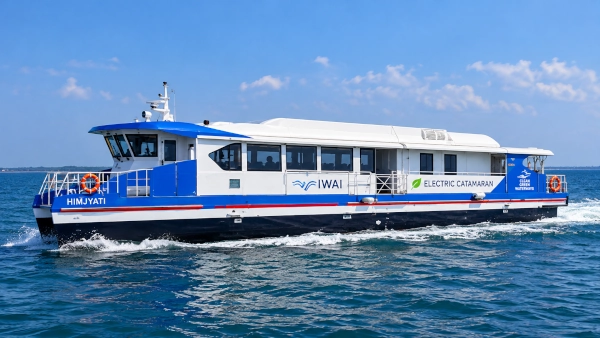
Hooghly Cochin Shipyard Limited (HCSL), a wholly owned subsidiary of Cochin Shipyard Limited, is advancing India’s green inland water transport programme through the construction of six indigenously built hybrid-electric passenger catamarans for the Inland Waterways Authority of India (IWAI).
The project combines domestic shipbuilding capabilities with advanced battery technology to develop cleaner, energy-efficient vessels for passenger transportation. Each catamaran has a capacity of 50 passengers and is designed to operate using electric propulsion, with a hybrid operating mode for extended endurance.
HCSL officially confirmed the launch of the fifth vessel in the six-catamaran series on 18 August 2026. The programme represents an important contribution to India’s efforts to modernise inland water transport and expand the use of environmentally sustainable maritime technologies.
Six Hybrid-Electric Catamarans for Inland Water Transport
Cochin Shipyard Limited secured the contract to construct six hybrid-electric catamaran passenger vessels for the Inland Waterways Authority of India as part of the country’s expanding inland waterways infrastructure.
The vessels are being constructed by Hooghly Cochin Shipyard Limited in Howrah, West Bengal. They are intended to support modern passenger transportation while introducing cleaner propulsion technologies into India’s river transport network.
HCSL announced the successful launch of the fifth catamaran on 18 August 2026. The launch took place in the presence of the company’s senior management, representatives of IWAI and surveyors from the Indian Register of Shipping.
The shipyard’s official announcement identified the vessel as the fifth in a series of six 50-passenger catamarans, demonstrating the progress achieved in executing the project.
Advanced Lithium-Titanate Battery Technology
The hybrid-electric catamarans incorporate lithium-titanate (LTO) battery technology and electric propulsion systems designed for efficient passenger movement on inland waterways.
According to HCSL, the vessels can operate in a fully electric mode that produces no direct exhaust emissions during propulsion. They also feature a hybrid operating mode that provides additional endurance when required.
This dual-mode capability allows operators to use electric propulsion for suitable river journeys while retaining greater operational flexibility for longer services.
Lithium-titanate batteries are known for their ability to support rapid charging and repeated charge-discharge cycles, making them suitable for applications requiring frequent operation.
The incorporation of these technologies demonstrates the increasing sophistication of India’s domestically built passenger vessels.
Prime Minister Modi Dedicated Hybrid-Electric Catamaran in January 2026
The government’s green inland water transport initiative received a significant boost on 18 January 2026, when Prime Minister Narendra Modi dedicated a 50-passenger hybrid-electric aluminium catamaran to the nation during a programme in West Bengal.
According to the Ministry of Ports, Shipping and Waterways, the vessel was developed at a cost of ₹12 crore and incorporated advanced lithium-titanate battery technology.
The initiative formed part of a larger programme involving port, inland waterways and railway infrastructure development in West Bengal.
The ministry highlighted the potential of modern electric passenger vessels to improve river transport while reducing the environmental impact associated with conventional propulsion systems.
Hooghly Cochin Shipyard Strengthens Indigenous Vessel Manufacturing
Hooghly Cochin Shipyard Limited operates as a wholly owned subsidiary of Cochin Shipyard Limited, one of India’s leading public sector shipbuilding companies.
The construction of hybrid-electric catamarans reflects the shipyard’s capabilities in aluminium vessel construction, electric propulsion integration and specialised passenger vessel development.
The project also demonstrates the role of domestic shipyards in meeting the requirements of government maritime infrastructure programmes.
By building such vessels in India, the shipyard contributes to the development of engineering expertise, specialised manufacturing capabilities and a supporting maritime equipment ecosystem.
The programme aligns with the wider objectives of Make in India and Atmanirbhar Bharat by encouraging the domestic construction of technologically advanced vessels.
Green Vessels Support Modernisation of India’s Inland Waterways
India is expanding the role of inland waterways as an alternative mode of passenger and cargo transportation.
The government has identified river transport as an important component of multimodal connectivity, particularly in regions where navigable waterways offer opportunities to complement existing road and railway networks.
Hybrid-electric vessels can support this transition by reducing fuel consumption and direct emissions during electric operation.
For passenger services, modern electric propulsion also offers advantages such as reduced engine noise and smoother operation.
The deployment of domestically manufactured vessels equipped with advanced propulsion systems provides opportunities to improve the quality and environmental performance of river transportation.
Building India’s Green Maritime Manufacturing Capabilities
The six-catamaran programme reflects growing cooperation between India’s public sector shipyards and inland waterways authorities in developing modern passenger vessels.
The combination of indigenous manufacturing, advanced battery systems and hybrid-electric propulsion represents an important step towards introducing cleaner technologies into domestic maritime operations.
The experience gained through the project can also strengthen the capabilities of Indian shipyards in constructing future generations of electric and hybrid passenger vessels.
Hooghly Cochin Shipyard’s contribution to the programme demonstrates India’s progress in combining indigenous shipbuilding with sustainable maritime technology, supporting the development of a cleaner and more advanced inland water transport network.
References
- Hooghly Cochin Shipyard Limited — Official LinkedIn Page. Announcement confirming the launch of the fifth 50-passenger hybrid-electric catamaran on 18 August 2026.
https://www.linkedin.com/company/hooghly-cochin-shipyard-limited-hcsl/ - Hooghly Cochin Shipyard Limited — Official Announcement. Technical information on the hybrid-electric catamaran programme, including lithium-titanate battery technology, electric propulsion and dual-mode operation.
https://www.linkedin.com/posts/hooghly-cochin-shipyard-limited-hcsl_it-is-with-great-honor-that-we-announce-the-activity-7418453256978452480-l6xv - Press Information Bureau, Ministry of Ports, Shipping and Waterways. PM Narendra Modi Dedicates Waterways and Railways Infrastructure Worth ₹830 Crore in West Bengal, 18 January 2026.
https://www.pib.gov.in/PressReleasePage.aspx?PRID=2215875 - Cochin Shipyard Limited — Annual Report 2023–24. Official confirmation of the order for six hybrid-electric catamaran passenger vessels for IWAI.
https://cochinshipyard.in/uploads/FORMS/26a684f96006e72cc42a96b56ea779f7.pdf
You may also like
-
Profitable Banks, Growing Savings and Timely EMI Repayments: Signs of a Healthy and Alive Indian Economy
-
Solar Defence Expands Its Vision Towards Military Humanoid Robotics and Advanced Autonomous Defence Systems
-
AVTEC Strengthens India’s Indigenous Defence Manufacturing with Automatic Transmissions for Combat Vehicles
-
Oil India Signs Contract for 272 Sq Km Coal Bed Methane Block in Singrauli, Expanding India’s Domestic Natural Gas Exploration
-
Jindal Defence–Taurus T9: Indian Army Showcases Made-in-India Submachine Gun
