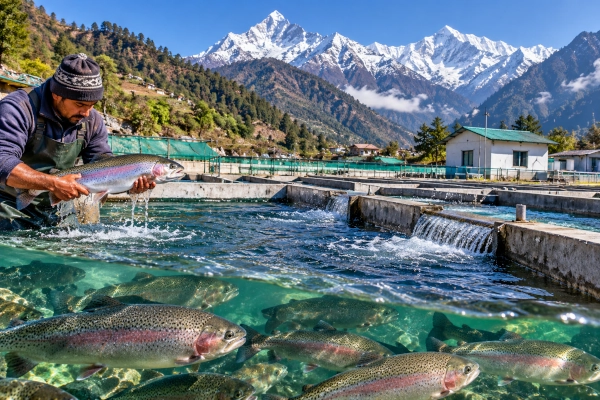
India’s coldwater fisheries sector is witnessing significant expansion, with trout production increasing sixfold over the past decade to reach nearly 5,000 metric tonnes annually, according to the Ministry of Fisheries, Animal Husbandry and Dairying. The growth reflects sustained investments in aquaculture infrastructure, scientific fish breeding, farmer training, and the development of new markets for high-value fish products.
The progress came into focus on 18 October 2026, when Union Fisheries Secretary Dr. Abhilaksh Likhi visited the Munsyari Coldwater Fisheries Cluster in Uttarakhand’s Pithoragarh district. The visit highlighted the transformation of traditional mountain fishing activities into organised aquaculture enterprises capable of generating income, supporting rural entrepreneurship, and contributing to India’s expanding fisheries economy.
India’s Himalayan regions offer suitable conditions for coldwater aquaculture, particularly rainbow trout farming. Government-backed infrastructure development and scientific support are helping farmers utilise these natural resources while creating economic opportunities in remote mountain communities.
Munsyari Emerges as a Centre for Rainbow Trout Farming
Situated in the Himalayan region of Uttarakhand, Munsyari has emerged as an important centre for rainbow trout cultivation. The region benefits from glacial streams associated with the Gori Ganga River, which provide the cool, oxygen-rich water required for trout farming.
During his visit, Dr. Likhi interacted with farmers at Johar Matsya Swayatt Sehkarita and Namjala Trout Farm. He reviewed the progress of the coldwater fisheries cluster and acknowledged the contribution of local cooperatives in developing trout cultivation as a sustainable livelihood activity.
Rainbow trout (Oncorhynchus mykiss) is a commercially valuable freshwater fish that thrives in cool, well-oxygenated water. Its cultivation requires appropriate water temperatures, reliable flow, good feed management, and careful monitoring of fish health.
The adoption of scientific trout farming has enabled local communities to move beyond traditional subsistence activities towards organised commercial aquaculture.
Munsyari’s emergence as a trout farming centre demonstrates how specialised agricultural and fisheries activities can develop around the natural advantages of India’s mountainous regions.
Government Sanctions Over 5,600 Raceways and 54 Hatcheries
The expansion of India’s coldwater fisheries sector has received substantial support under the Pradhan Mantri Matsya Sampada Yojana (PMMSY).
According to the Department of Fisheries, the government has sanctioned more than 5,600 raceways, 54 hatcheries, 293 cold-storage facilities, and 260 feed mills across six Himalayan states and Union Territories.
These facilities support different stages of the aquaculture production chain, from fish breeding and juvenile rearing to harvesting, storage, and marketing.
Raceways are specially designed channels or tanks that maintain a continuous flow of water, making them suitable for trout cultivation. Their design helps provide the oxygen-rich conditions necessary for healthy fish growth.
Hatcheries produce young fish for stocking in aquaculture facilities, while feed mills support the availability of specialised nutrition. Cold-storage infrastructure helps preserve harvested fish and maintain product quality during transportation.
Together, these investments are strengthening the infrastructure required to develop coldwater aquaculture as a commercially viable activity.
Six Himalayan Regions Drive Coldwater Fisheries Development
India’s principal coldwater fisheries production centres are concentrated in Uttarakhand, Himachal Pradesh, Jammu and Kashmir, Ladakh, Sikkim, and Arunachal Pradesh.
These regions contain snow-fed rivers, mountain streams, reservoirs, and high-altitude lakes that provide suitable conditions for commercially valuable coldwater fish species.
Jammu and Kashmir has established a substantial trout farming industry supported by hatcheries, government farms, and private aquaculture enterprises. Himachal Pradesh has also developed expertise in rainbow trout cultivation, particularly in districts with suitable water resources.
Uttarakhand is expanding production through fisheries clusters, cooperatives, and private farms, while Ladakh and northeastern Himalayan states are developing aquaculture activities adapted to their local climatic conditions.
The government’s cluster-based approach seeks to concentrate technical assistance, infrastructure, and market support in suitable geographical areas.
This model can improve production efficiency and make it easier for farmers to access quality fish seed, feed, veterinary services, and buyers.
Uttarakhand Receives ₹317 Crore for Fisheries Infrastructure
Uttarakhand has emerged as an important beneficiary of the government’s coldwater fisheries development initiatives.
Projects worth approximately ₹317 crore have been sanctioned in the state to strengthen fisheries production and supporting infrastructure.
These investments include modern fish markets, landing centres, and an integrated aquapark at Sitarganj.
The integrated aquapark is intended to support various components of the fisheries value chain, including production, processing, technology adoption, and marketing.
Improved market facilities and cold-chain infrastructure are particularly important in mountainous regions, where transporting fresh fish to distant markets can involve considerable logistical challenges.
By strengthening fisheries infrastructure, the government aims to improve market access and support the commercial expansion of aquaculture enterprises across Uttarakhand.
₹170 Crore Trout Protsahan Yojana to Expand Fish Farming
The Uttarakhand government has introduced the Trout Protsahan Yojana, with an allocation of ₹170 crore to support further expansion of trout farming.
The programme aims to establish 1,500 raceways, 100 mini hatcheries, and 600 cold-storage facilities by 2028–29.
The initiative seeks to expand production capacity while improving the availability of fish seed, storage infrastructure, and associated facilities.
Mini hatcheries can help strengthen local supply chains by reducing dependence on fish seed transported from distant locations. Additional raceways will provide production facilities for farmers interested in entering or expanding trout cultivation.
The programme also supports the development of a more organised coldwater fisheries ecosystem capable of serving domestic and export markets.
Uttarakhand Exports Trout to Nepal for the First Time
One of the notable milestones highlighted during the Fisheries Secretary’s visit was Uttarakhand’s first international trout export to Nepal in June 2026.
The shipment represents an important development for the state’s emerging aquaculture industry, demonstrating the potential to supply high-value fish products beyond domestic markets.
Exporting fresh or processed fish requires reliable production, appropriate handling, quality management, and efficient transportation.
The Nepal export milestone illustrates how organised aquaculture production and improved market connections can create new commercial opportunities for Himalayan fish farmers.
As production capacity expands, trout farming enterprises can explore additional domestic and international markets while developing value-added products suited to changing consumer preferences.
ICAR Scientists Support Trout Breeding and Fish Health Management
Scientific research has played an important role in establishing commercial trout farming in India’s Himalayan regions.
The ICAR–Directorate of Coldwater Fisheries Research (DCFR), Bhimtal, has provided technical support for rainbow trout cultivation in Munsyari.
The institute’s contributions include fish seed production, disease management, breeding techniques, and farmer training.
Reliable hatchery practices are essential for ensuring the availability of healthy juvenile fish. Scientific disease management also helps farmers reduce production losses and maintain consistent aquaculture performance.
Training programmes enable farmers to adopt suitable stocking densities, feeding practices, water-quality monitoring, and biosecurity measures.
Dr. Likhi acknowledged the institute’s contribution to introducing rainbow trout farming in Munsyari and supporting the development of local aquaculture expertise.
The collaboration between scientific institutions, government agencies, and farmers demonstrates the value of research-based approaches to fisheries development.
Trout Farming Creates New Livelihoods in Himalayan Border Villages
Coldwater aquaculture offers an important livelihood opportunity for communities living in remote mountain and border regions.
Agricultural activities in these areas often face limitations associated with difficult terrain, restricted cultivable land, harsh weather, and transportation challenges.
Trout farming provides an additional source of income that can complement traditional agriculture, tourism, and other rural occupations.
The Department of Fisheries has highlighted the contribution of cooperatives in organising farmers and improving access to resources and markets.
Institutional market connections, including those involving the Indo-Tibetan Border Police (ITBP), can provide additional commercial opportunities for producers operating in border regions.
The growth of trout farming may also support associated activities such as fish feed distribution, hatchery operations, cold-chain logistics, food processing, and local hospitality services.
These opportunities contribute to the wider development of mountain economies and support efforts to strengthen livelihoods in strategically important border villages.
Coldwater Aquaculture Supports India’s Expanding Blue Economy
India’s blue economy extends beyond marine fisheries and coastal industries to include inland aquaculture, freshwater resources, and associated economic activities.
Coldwater fisheries form an increasingly important component of this development.
The government has been supporting the sector through PMMSY, fisheries infrastructure investment, scientific research, and targeted development programmes.
Alongside rainbow trout, India’s coldwater ecosystems support important indigenous species such as golden mahseer and snow trout.
Scientific management is essential to ensure that commercial aquaculture develops without damaging natural river habitats or threatening indigenous fish populations.
Appropriate water management, disease prevention, controlled waste discharge, and responsible farming practices are important for sustaining the long-term productivity of coldwater fisheries.
The government’s initiatives also recognise opportunities for fisheries-linked ecotourism and conservation activities, allowing mountain communities to benefit from both aquaculture development and the protection of freshwater ecosystems.
Building a Stronger Fisheries Economy in the Himalayas
India’s expanding trout industry demonstrates how scientific research, targeted infrastructure investment, and farmer participation can transform specialised rural activities into commercially productive enterprises.
The increase in trout production to nearly 5,000 metric tonnes annually, as reported by the Department of Fisheries on 18 October, reflects growing production capacity across the Himalayan region.
Government support for raceways, hatcheries, cold-storage facilities, and feed mills is strengthening the entire production chain, while Uttarakhand’s first trout export to Nepal demonstrates emerging international market opportunities.
The development of the Munsyari Coldwater Fisheries Cluster also highlights the economic potential of remote Himalayan communities.
With continued investment in scientific aquaculture, cooperative enterprises, and reliable market infrastructure, India’s coldwater fisheries sector is developing into an important source of rural employment, agricultural diversification, and regional economic growth.
The expansion reinforces India’s commitment to building a productive, sustainable, and increasingly diversified fisheries economy across its mountain regions.
References
- Press Information Bureau, Ministry of Fisheries, Animal Husbandry and Dairying, 18 October 2026. Dr. Abhilaksh Likhi, Union Secretary, Department of Fisheries, Visits Munsyari Coldwater Fisheries Cluster; Interacts with Trout Farmers and Reviews Cluster Development Initiatives.
https://www.pib.gov.in/PressReleseDetailm.aspx?PRID=2324891&lang=1®=3 - Press Information Bureau, Ministry of Fisheries, Animal Husbandry and Dairying, 23 May 2026. India’s Cold Water Fisheries Emerging as a Key Pillar of the Blue Economy.
https://www.pib.gov.in/PressReleasePage.aspx?PRID=2264535&lang=2®=3 - Department of Fisheries, Government of India. Pradhan Mantri Matsya Sampada Yojana and coldwater fisheries development programmes.
https://dof.gov.in/ - ICAR–Directorate of Coldwater Fisheries Research, Bhimtal. Research, trout breeding, aquaculture technology, and fisheries development.
https://dcfr.icar.gov.in/ - Press Information Bureau, 2026. Government guidelines and infrastructure support for coldwater fisheries in Himalayan and hilly states.
https://www.pib.gov.in/PressReleasePage.aspx?PRID=2287591&lang=1®=48
You may also like
-
Bhandara Chinoor Rice — Maharashtra’s Fragrant Grain from the Wainganga Plains
-
India Approves Accession to Southern Indian Ocean Fisheries Agreement, Expanding High-Seas Fishing Opportunities
-
Indian Health-Tech Startup Kubo Care Develops Radar-Based Technology for Elderly Care
-
Indian Startup Pramatra Space Develops Chip-Based Quantum Security for Space and Ground Networks
-
India Develops First Riverine Lighthouses on Brahmaputra to Strengthen Inland Waterway Navigation
