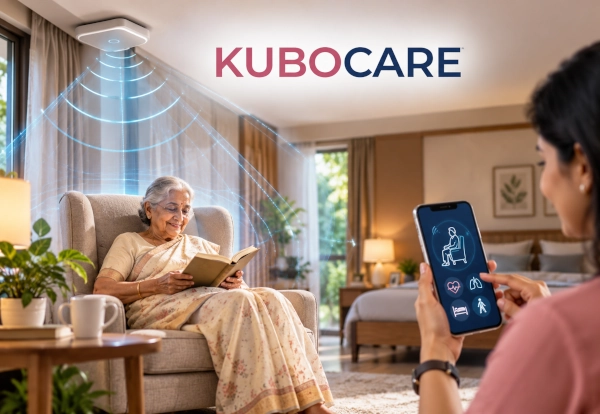
Bengaluru-based health technology startup Kubo Care has developed an artificial intelligence-enabled, radar-based monitoring system designed to improve the safety and well-being of elderly people living independently. The technology uses contactless sensors to monitor movement, detect falls and track selected health indicators without requiring cameras or wearable devices.
The innovation addresses a growing challenge in elderly care, particularly for families whose older members live alone. By combining millimetre-wave radar sensors with artificial intelligence, Kubo Care aims to provide continuous monitoring while maintaining personal privacy and independence.
The startup’s technology was highlighted in a report published on October 13, 2026, demonstrating the growing role of Indian deep-tech companies in developing practical healthcare solutions.
Contactless Radar Technology for Continuous Elderly Monitoring
Kubo Care’s system uses millimetre-wave radar technology to detect movement and monitor activity within a room. Unlike conventional surveillance cameras, radar sensors measure reflected radio signals to identify movement patterns without capturing visual images.
The technology allows the system to detect a person’s presence, observe movement and identify events that may indicate a fall.
Artificial intelligence algorithms analyse the sensor information to distinguish ordinary daily activities from potentially dangerous situations.
According to Kubo Care, its technology can monitor elderly individuals continuously without requiring them to wear smartwatches, emergency pendants or other monitoring equipment.
This approach is particularly useful for older people who may forget to wear or charge monitoring devices.
AI-Powered Fall Detection and Emergency Alerts
Falls represent a major safety concern among older adults, particularly those living independently.
Kubo Care has developed AI-powered fall detection capabilities that analyse changes in movement and body position to identify potentially dangerous incidents.
The company’s technology is designed to distinguish between actual falls and movements that resemble falls, helping reduce unnecessary alerts.
When the system identifies a possible emergency, it can notify caregivers through its connected monitoring platform.
According to the company, its technology also supports two-way communication through integrated audio components, allowing caregivers to communicate with residents when necessary.
These capabilities aim to improve response times and provide additional support for elderly individuals who may be unable to call for assistance after a fall.
Monitoring Heart Rate, Breathing and Sleep Without Wearables
Beyond fall detection, Kubo Care has integrated several health and activity monitoring capabilities into its platform.
The company’s radar-based technology can track heart rate and respiratory rate patterns without requiring physical contact.
Its system also monitors sleep-related activities, including time spent in bed, nighttime movement and changes in sleeping patterns.
Additional environmental sensors can measure temperature, humidity, lighting conditions and air quality.
By combining these measurements, the platform provides caregivers with information about an elderly person’s daily routine and general well-being.
The monitoring system is intended to identify changes in established activity patterns that may require attention from caregivers or family members.
These measurements support routine observation and are not a substitute for professional medical diagnosis or emergency medical assessment.
Protecting Privacy Through Camera-Free Monitoring
A distinguishing feature of Kubo Care’s technology is its emphasis on privacy.
Traditional video surveillance may provide information about an elderly person’s movements, but cameras can raise privacy concerns, particularly in bedrooms and bathrooms.
Kubo Care addresses this issue through radar sensors that monitor activity without recording images.
The system processes movement information and converts it into data that can be analysed by its AI software.
This allows caregivers to receive alerts about important events without continuously observing residents through video feeds.
The approach supports an important balance between safety monitoring and personal dignity, particularly for elderly individuals who wish to maintain independence.
AI Dashboard Connects Caregivers and Families
Kubo Care has developed a digital platform that allows caregivers to access monitoring information through a central dashboard.
The system provides insights into movement, sleep, vital-sign patterns and fall-related alerts.
Family members can receive updates through a connected mobile application, helping them remain informed about the well-being of elderly relatives.
The technology is designed for use in independent living arrangements, assisted living facilities, memory care centres and private homes.
According to the company, its sensors can be installed on walls or ceilings and connected to the monitoring platform through Wi-Fi.
This arrangement allows monitoring to take place without requiring elderly residents to operate complex equipment.
Indigenous Hardware Development and Artificial Intelligence Research
Kubo Care develops its technology through a combination of hardware engineering, embedded systems, radar sensing and artificial intelligence.
The company states that it designs, builds and assembles its monitoring hardware internally while continuously improving the algorithms used to interpret sensor information.
Its technology development began in August 2024 with a prototype capable of detecting room occupancy.
By October 2024, the company had introduced its initial fall detection algorithms. It subsequently added contactless heart rate and respiratory monitoring, environmental sensing and improved movement analysis.
The first complete product generation was introduced for initial pilot deployments in February 2025, followed by a second generation in August 2025.
The newer system incorporates additional capabilities involving fall-risk assessment, sleep monitoring and advanced sensor analytics.
These developments demonstrate how Indian startups are combining electronics engineering and artificial intelligence to create specialised healthcare technologies.
Supporting Independent Living and Modern Elderly Care
India’s changing family structures and growing elderly population are creating opportunities for technology-assisted home care.
Older people increasingly require solutions that support independent living while enabling relatives and caregivers to respond to emergencies.
Contactless monitoring systems offer one approach to addressing these requirements without demanding constant interaction from elderly users.
Kubo Care’s platform is designed to complement caregivers by providing continuous activity monitoring and timely notifications.
The company is also developing additional predictive capabilities intended to identify changes in movement and behaviour that may indicate an increased risk of falling.
Such technologies could support preventive elderly care by helping caregivers identify potential problems before serious incidents occur.
Indian Health-Tech Innovation Expands into Preventive Elderly Care
Kubo Care’s radar-based monitoring platform reflects India’s growing capabilities in artificial intelligence, sensor engineering and healthcare technology.
By integrating contactless sensing with automated movement analysis, the startup is developing an alternative to camera-based monitoring and wearable emergency devices.
The technology offers applications in private homes, assisted living facilities and specialised elderly care environments.
Continued improvements in sensor accuracy, artificial intelligence and emergency communication can strengthen the usefulness of such systems.
Innovations such as Kubo Care demonstrate how Indian technology companies are developing solutions that support safer independent living, improve caregiving capabilities and contribute to the country’s expanding digital healthcare ecosystem.
References
- Kubo Care — Official Website: Ambient AI Health Monitoring for Senior Living
- Kubo Care — Official Product Information: Radar-Based Fall Detection, Health Monitoring and AI Analytics
- Kubo Care — Research and Development: Inside the Kubo Care Innovation Laboratory
- Kubo Care — Official Company Profile: Company Background and Founders
- YourStory — October 13, 2026: Kubo Care Uses Radar Technology to Keep Elders Safe at Home
You may also like
-
Bhandara Chinoor Rice — Maharashtra’s Fragrant Grain from the Wainganga Plains
-
India Approves Accession to Southern Indian Ocean Fisheries Agreement, Expanding High-Seas Fishing Opportunities
-
India’s Trout Production Grows Sixfold as Himalayan Coldwater Aquaculture Expands
-
Indian Startup Pramatra Space Develops Chip-Based Quantum Security for Space and Ground Networks
-
India Develops First Riverine Lighthouses on Brahmaputra to Strengthen Inland Waterway Navigation
