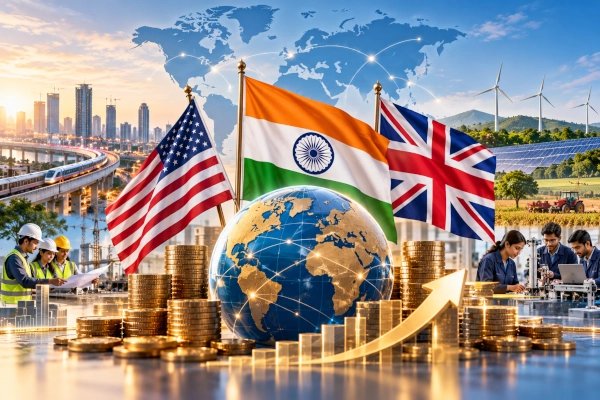
India has emerged alongside the United States and the United Kingdom as one of the leading sources of private capital mobilised by the World Bank Group, highlighting the country’s expanding participation in international development financing and global investment activities.
World Bank Group President Ajay Banga announced the development during his address to the 2026 Annual Meetings Plenary in Bangkok, Thailand, on October 16, 2026. He highlighted the institution’s success in attracting private investors from 110 countries to finance development projects, infrastructure and economic opportunities across emerging and developing economies.
According to the World Bank Group’s official figures, private capital mobilisation reached a record $112 billion in fiscal year 2026, compared with approximately $35 billion in FY2022. The increase represents more than a threefold expansion over four years.
Combined with the World Bank Group’s own financing, total development financing and private capital mobilisation exceeded $230 billion during FY2026.
India’s inclusion among the leading sources of this capital demonstrates its growing participation in international investment markets and its role in supporting development financing beyond its domestic economy.
India Among Leading Contributors to Global Development Financing
During his address, Ajay Banga identified the United States, United Kingdom and India as the leading sources of private investor capital mobilised through World Bank Group activities.
The institution attracted investors from 110 countries, reflecting the increasing geographical diversity of international development financing.The participation of Indian investors is significant because it demonstrates India’s growing involvement in financing development activities across emerging markets.
Private capital mobilisation involves attracting investment from commercial banks, institutional investors, asset managers, pension funds, insurance companies and other private financial institutions to support development projects.
These investments complement financing provided by multilateral development banks, allowing larger projects and programmes to access additional capital.The World Bank Group’s announcement identifies India as a leading source of private capital rather than merely a recipient of international development financing.
Although the official statement does not provide a separate country-wise investment total, India’s inclusion alongside the United States and United Kingdom demonstrates its importance within the institution’s expanding international investor network.
World Bank Group Mobilises Record $112 Billion in Private Capital
The World Bank Group recorded its highest-ever private capital mobilisation during FY2026, attracting $112 billion from investors worldwide.
The figure represents substantial growth from the approximately $35 billion mobilised in FY2022, when the institution began developing reforms aimed at increasing private-sector participation in development financing.The expansion has been supported by changes in financing arrangements, project preparation procedures, risk management instruments and cooperation between public and private financial institutions.
The World Bank Group has increasingly focused on using its financial resources and institutional expertise to attract additional investment into developing economies.This approach allows development projects to draw on a combination of public financing, concessional resources and commercially mobilised capital.
During FY2026, the institution’s own financing and private capital mobilisation together exceeded $230 billion, demonstrating the scale of financial resources directed towards development activities. The increase also reflects the growing importance of private investment in addressing infrastructure requirements, expanding productive industries and creating employment opportunities across developing countries.
Private Investment Expands Across Developing Economies
The World Bank Group reported substantial growth in private capital mobilisation across lower-middle-income and upper-middle-income economies during the four-year period.
Private capital mobilisation in lower-middle-income countries increased from approximately $14 billion in FY2022 to $37 billion in FY2026, representing nearly threefold growth. Upper-middle-income economies recorded an even larger expansion, with mobilisation increasing from approximately $12 billion to $50 billion during the same period.
Across Africa, private capital mobilisation increased from approximately $9 billion to $22 billion, demonstrating stronger investor participation in development financing across the continent. These developments reflect the World Bank Group’s efforts to improve investment conditions and attract private-sector financing into markets where development requirements remain substantial.
The institution also reported that mobilisation in low-income countries remained around $3 billion, highlighting the continuing importance of public and concessional finance in economies where commercial investment faces greater challenges.
The World Bank Group is addressing these challenges through financial guarantees, risk-sharing mechanisms and programmes supporting smaller enterprises. Such initiatives aim to expand access to investment while strengthening the role of private capital in long-term economic development.
World Bank Group Reforms Attract International Investors
The increase in private capital mobilisation follows institutional reforms introduced under Ajay Banga’s leadership to improve the World Bank Group’s financing capabilities.
The reforms include simplifying project preparation, strengthening coordination between public and private-sector operations and developing financial instruments that reduce risks for commercial investors. According to the institution’s official account, the average project preparation period has declined from approximately 19 months to nine months, allowing financing proposals to progress more efficiently.
The World Bank Group has also streamlined its institutional performance framework, reducing the number of scorecard indicators from 153 to 22 measures focused on development outcomes. Changes to its balance sheet have created more than $100 billion in additional lending capacity for the International Bank for Reconstruction and Development over a ten-year period.
The reforms are intended to improve the institution’s ability to support development projects while encouraging greater participation from international financial markets. By combining its own financing capacity with private investment, the World Bank Group aims to mobilise larger amounts of capital for projects that support economic productivity, infrastructure development and employment.
India’s participation among the leading sources of private capital reflects the broadening international investor base supporting this approach.
World Bank Group Issues More Than $25 Billion in Guarantees
Financial guarantees have become an important instrument in the World Bank Group’s efforts to attract private investors into developing economies.
The institution issued more than $25 billion in guarantees during FY2026, exceeding its target of $20 billion in annual guarantees by 2030 four years ahead of schedule.
The expansion was supported by the World Bank Group Guarantee Platform, established in 2024 to simplify access to guarantee products available across the institution. Guarantees help address certain risks that discourage commercial investment in developing markets. Depending on their structure, they can protect investors or lenders against specified financial, political or project-related risks.
By reducing selected investment risks, these instruments can encourage commercial institutions to finance infrastructure, industrial development and other projects that require substantial long-term capital. The World Bank Group has also expanded local-currency financing and equity instruments to support private-sector participation. These measures help address challenges involving foreign exchange exposure, financing costs and access to investment capital.
The expansion of these financial instruments is an important component of the institution’s strategy to mobilise private resources for development.
Infrastructure, Energy and Manufacturing Receive Major Investment Support
The World Bank Group is directing a substantial share of its financing towards sectors capable of improving productivity and generating employment.
According to Ajay Banga’s October 16 address, approximately 55% of the institution’s financing and mobilised private capital supported infrastructure and energy, agribusiness, healthcare, tourism and value-added manufacturing. These industries provide essential services while creating opportunities for businesses, workers and local economies.
Investments in electricity, transportation, water supply and digital connectivity help establish the infrastructure required for economic development. Reliable infrastructure also improves the operating environment for manufacturers, agricultural enterprises and service providers.
Agribusiness investment can support agricultural productivity, food processing, supply-chain development and access to markets. Healthcare investment strengthens service delivery while creating opportunities for medical infrastructure and associated industries. Tourism and value-added manufacturing can generate employment through local enterprises, industrial production and related services.
The World Bank Group’s emphasis on these sectors reflects its objective of connecting development financing with measurable improvements in economic opportunity and job creation.
India Also Attracts Growing Private Investment for Domestic Development
India’s growing importance as a source of international development capital is accompanied by substantial growth in private investment mobilised for projects within the country.
According to a World Bank Group assessment published on October 11, 2026, private capital mobilisation in India increased from approximately $3 billion in FY2022 to $14.5 billion in FY2026.
Over the four-year period, the institution helped mobilise a cumulative $36 billion in private capital for development activities across India. The financing has supported sectors including micro, small and medium enterprises, energy transition, electricity access, transportation, housing and urban development.
The increase reflects efforts to encourage institutional investors and commercial financial organisations to participate in projects that contribute to India’s economic growth. World Bank Group-supported financing arrangements have also helped direct investment towards businesses and sectors that face difficulty securing sufficient commercial funding.
India’s role as both a contributor to international investment flows and a destination for development financing demonstrates its expanding integration with global capital markets.
The two figures represent different financial activities. The $14.5 billion refers to private investment mobilised for development activities within India, while Ajay Banga’s announcement identifies India as one of the leading countries supplying private investor capital to World Bank Group-supported activities internationally.
India’s MSME Sector Benefits from Expanding Private Financing
Micro, Small and Medium Enterprises form an important part of India’s economy, contributing to manufacturing, services, exports and employment.
Access to affordable and reliable financing remains a major requirement for smaller enterprises seeking to expand production, adopt technology and enter new markets.
The World Bank Group estimates that India’s MSME sector faces a financing gap of approximately $333 billion, reflecting the difference between available financial resources and the investment requirements of businesses.
The institution has been supporting efforts to expand lending and investment through partnerships with financial institutions, policy reforms and risk-sharing arrangements. Since 2022, approximately $9.6 billion in private financing has been mobilised for India’s MSME sector through World Bank Group-supported activities.
These initiatives aim to strengthen access to credit and help smaller businesses invest in equipment, increase production capacity and expand their operations. Greater participation by commercial banks, institutional investors and other financial organisations can help diversify financing opportunities for Indian enterprises.
The World Bank Group’s approach also emphasises financial inclusion, including improved access to investment for women-led businesses and enterprises operating in underserved markets.
Strengthening MSME financing contributes to domestic industrial development while supporting India’s broader objectives of expanding manufacturing, entrepreneurship and employment.
Climate Financing Reaches $96 Billion
Climate-related development financing formed another major component of the World Bank Group’s activities during FY2026.
Ajay Banga announced that the institution’s total climate co-benefits reached $96 billion, including $48 billion contributed through mobilised private capital. Climate co-benefits refer to the climate-related benefits associated with financing activities, including projects supporting emissions reduction, climate resilience and adaptation.
Such financing can support renewable energy development, electricity infrastructure, sustainable transportation, water management and other investments addressing environmental challenges. The participation of private investors allows development institutions to expand the financial resources available for climate-related projects beyond their own lending capacity.
For developing countries, access to these resources can help strengthen infrastructure resilience, improve energy access and support the adoption of cleaner technologies. The increasing scale of private-sector participation in climate financing also creates opportunities for investors from emerging economies, including India, to contribute to international sustainable development projects.
World Bank Group Targets Employment Generation Through Private Investment
Employment generation remains a central priority of the World Bank Group’s development strategy.
During his Bangkok address, Ajay Banga highlighted the scale of the global employment challenge, particularly in developing economies.
The institution estimates that approximately 1.2 billion young people will enter the labour market over the next 10 to 15 years, while the number of jobs expected to become available will fall substantially short of that figure. Addressing this challenge requires investment in infrastructure, education, healthcare, industrial development and business expansion.
The World Bank Group’s strategy focuses on strengthening the economic foundations needed for private enterprises to grow and employ more workers. Improved infrastructure can reduce operating costs for businesses, while reliable regulatory frameworks can encourage investment and industrial development.
Access to financing also enables enterprises to purchase equipment, expand production and develop new products and services. The institution is combining these measures with efforts to mobilise additional capital from international investors.
India’s emergence as a leading source of private capital contributes to this broader international financing framework, which seeks to connect investment resources with economic development and employment opportunities.
International Development Financing Enters New Phase
The World Bank Group is also working with other multilateral development banks to develop new approaches for attracting long-term institutional investors.
Six multilateral development banks are collaborating on mechanisms to assess, document, package and transfer development investments. The initiative aims to make it easier for institutional investors to participate in financing projects across emerging markets.
Pension funds, insurance companies and sovereign wealth funds collectively manage substantial amounts of long-term capital. Development institutions are exploring ways to connect these resources with investment opportunities in infrastructure and productive economic activities.
By creating more standardised financial arrangements, multilateral institutions aim to expand the pool of investors willing to participate in emerging-market development. These initiatives can also release capital previously committed to existing projects, allowing development banks to support additional investments.
The approach reflects a broader transition towards financing models that combine multilateral resources with private capital, commercial expertise and long-term investment partnerships.
India’s Growing Role Strengthens International Development Cooperation
India’s inclusion alongside the United States and United Kingdom among the leading sources of private capital mobilised by the World Bank Group represents an important development in the country’s participation in international financial markets. The announcement demonstrates that Indian investors are contributing to the expanding pool of private capital supporting development activities across emerging and developing economies.
The World Bank Group’s record $112 billion in private capital mobilisation during FY2026 also reflects the increasing importance of commercial investment in financing infrastructure, industrial development and employment-generating activities. At the same time, the institution’s growing mobilisation of private capital within India demonstrates the country’s importance as a destination for development investment.
These complementary developments reflect India’s expanding economic capabilities and its increasing integration into international financial networks.
India’s emergence as a leading source of private capital for World Bank Group-supported development strengthens its role in global economic cooperation. As international investment increasingly supports infrastructure, manufacturing, energy and employment, India’s participation contributes to a broader development financing system that connects economic growth with opportunities for communities across the world.
References
- World Bank Group — October 16, 2026. Remarks by World Bank Group President Ajay Banga at the 2026 Annual Meetings Plenary, Bangkok. Official speech identifying India, the United States and the United Kingdom among leading sources of private capital.https://www.worldbank.org/en/news/speech/2026/10/16/remarks-by-world-bank-group-president-ajay-banga-at-the-2026-annual-meetings-plena
- World Bank Group — September 17, 2026. World Bank Group Mobilizes Record Private Capital for Developing Countries, Driving Job Creation. Official announcement confirming $112 billion in private capital mobilisation during FY2026.https://www.worldbank.org/en/news/press-release/2026/09/17/world-bank-group-mobilizes-record-private-capital-for-developing-countries-driving
- World Bank Group — October 11, 2026. From Credit Gaps to Growth: How India’s Small and Medium Firms Benefit from Private Investment. Official assessment of private capital mobilisation in India and financing for MSMEs.https://www.worldbank.org/en/news/feature/2026/10/11/from-credit-gaps-to-growth-how-india-s-small-and-medium-firms-benefit-from-private-investment
- World Bank Group — April 2026. Private Sector Investment Lab. Official information on financial instruments and reforms intended to expand private capital mobilisation.https://www.worldbank.org/en/brief/2026/04/01/private-sector-investment-lab
You may also like
-
160 Norwegian Companies Operating in India as Bilateral Trade and Investment Partnership Expands
-
White House Highlights $330.5 Billion in Indian Investment Commitments Across US Energy, Steel and Manufacturing Sectors
-
India Projected to Become World’s Fourth-Largest Economy in 2027, IMF Estimates
-
India’s ₹1,000 Crore Space Venture Capital Fund to Accelerate Indigenous Space Startups and Advanced Technologies
-
BHAVYA: India’s push to build 100 plug-and-play industrial parks
