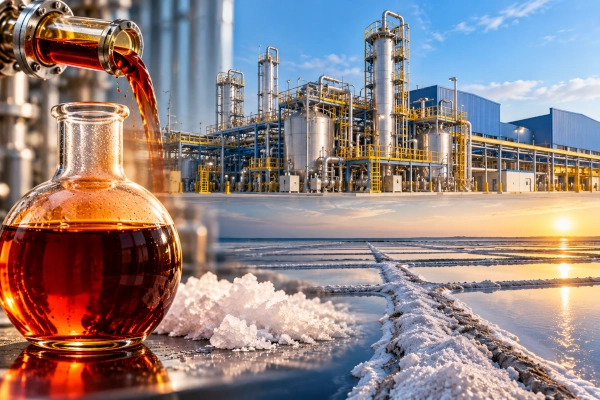
Indian chemical manufacturer GHCL Limited has commenced commercial production of liquid bromine at its new manufacturing facility in Kathivadar, Rajula taluka, Amreli district, Gujarat, marking an important expansion of its inorganic chemicals business. The facility has an installed annual production capacity of 2,800 metric tonnes, strengthening India’s manufacturing capabilities in a chemical used across several industrial sectors.
The company confirmed the commencement of production through a regulatory disclosure submitted to the Bombay Stock Exchange (BSE) and National Stock Exchange (NSE) on 12 October 2026. The new product, liquid bromine (Br₂), will serve both domestic and international markets.
The development represents a major step in GHCL’s strategy to diversify beyond its established soda ash and salt operations. By integrating bromine extraction with its existing salt-production infrastructure, the company aims to improve resource utilisation while developing an additional source of industrial chemicals.
GHCL Commissions 2,800-Tonne Bromine Plant in Gujarat
GHCL’s new bromine manufacturing facility is located at Kathivadar village in the Rajula region of Gujarat’s Amreli district. The location forms part of the company’s established salt-manufacturing operations near Port Victor on the Saurashtra coast.
According to the company’s stock-exchange disclosure, commercial production commenced on 12 October 2026, with an annual installed capacity of 2,800 metric tonnes of liquid bromine.
Bromine is a chemical element belonging to the halogen group. At ordinary temperatures, it is a reddish-brown liquid that produces reddish-brown vapours. It is also the only non-metallic element that remains liquid under normal room-temperature conditions.
The element occurs naturally in seawater and concentrated brines, making coastal salt-production facilities suitable locations for bromine recovery.
GHCL’s investment takes advantage of this natural resource availability and the infrastructure already established for its industrial salt operations.
The company has identified both domestic and international chemical markets as potential destinations for the new product. However, it has not disclosed specific export contracts or customers associated with the facility.
How GHCL Will Extract Bromine from Seawater and Salt Brine
One of the distinguishing features of GHCL’s new facility is its integration with existing salt-production operations.
In its Integrated Annual Report for 2025–26, GHCL explained that the bromine plant would use seawater already employed in its solar salt-manufacturing process.
Seawater contains bromide ions, although their concentration is relatively low. During salt production, evaporation can concentrate dissolved salts and other minerals, creating opportunities to recover additional commercially valuable substances.
Industrial bromine extraction generally involves chemically converting dissolved bromide ions into elemental bromine, separating the bromine and purifying the recovered product.
GHCL has adopted an integrated extraction and purification system suited to its salt operations.
After bromine recovery, the company plans to return the debrominated seawater to the salt pans for further utilisation.
This approach enables the company to recover an additional chemical product from an existing raw material stream rather than establishing an entirely separate source of feedstock.
The integration can also reduce duplication of supporting infrastructure, improve resource efficiency and create additional value from seawater used in industrial operations.
GHCL has described this salt–bromine manufacturing model as an important part of its resource-efficiency and circular-manufacturing strategy.
Advanced Extraction Technology from China and Germany
The bromine facility incorporates specialised international process technologies for extraction and purification.
GHCL’s 2025–26 annual report identifies the plant as a hybrid-technology installation combining two established industrial processes.
The bromine extraction technology, involving a cold process or feed-enhancement section, comes from China. The bromine purification technology, employing a hot process, comes from Germany.
According to the company, both technologies have demonstrated commercial applications in other industrial installations.
The integrated system combines these processes to recover bromine from brine and produce a purified chemical product suitable for industrial markets.
GHCL has also incorporated automation and digital monitoring technologies into the facility.
The company’s disclosed manufacturing arrangements include advanced bromine extraction and purification equipment, distributed control systems, gas detectors, scrubbers and online analysers.
These technologies are particularly important because bromine is a corrosive and hazardous substance that requires specialised containment, handling and environmental controls.
Automated process monitoring can help maintain production consistency while providing operators with continuous information about operating conditions.
The facility therefore represents an investment not only in production capacity but also in sophisticated chemical-processing technology.
Bromine Is an Important Raw Material for Pharmaceuticals and Specialty Chemicals
Bromine has a wide range of industrial applications, both in elemental form and through its chemical derivatives.
In the pharmaceutical industry, bromine compounds serve as intermediates in the synthesis of various active pharmaceutical ingredients and other complex organic molecules.
The chemical industry uses bromine to manufacture specialised compounds for industrial processing, chemical synthesis and material applications.
Brominated compounds also feature in certain flame-retardant formulations. These chemicals help improve the fire resistance of selected plastics, electronic components and industrial materials. Their applications are subject to regulatory and environmental restrictions, particularly where persistent brominated substances are involved.
Bromine chemistry also plays a role in photographic materials, dyes and selected chemical-processing applications.
Another emerging area is energy storage. Zinc-bromine flow batteries use bromine-based electrochemistry to store and release electricity.
These systems are being developed for stationary energy-storage applications, where long-duration storage and repeated charge-discharge cycles can offer advantages.
However, the production of liquid bromine does not automatically establish a company’s participation in battery manufacturing. Such applications require additional chemical processing, product specifications and supply-chain arrangements.
GHCL’s new facility creates the manufacturing capacity to supply bromine as an industrial raw material, while its eventual customer mix will depend on market demand and commercial agreements.
GHCL Strengthens Its Position in India’s Inorganic Chemicals Industry
Established in 1983, GHCL has developed substantial manufacturing operations in inorganic chemicals, particularly soda ash and sodium bicarbonate.
The company operates a major soda ash facility at Sutrapada in Gujarat, with an installed annual capacity of approximately 1.2 million metric tonnes.
Soda ash is an essential industrial chemical used in glass manufacturing, detergents, chemicals and several other manufacturing processes.
GHCL has also expanded its operations in salt and refined sodium bicarbonate, creating opportunities to integrate raw materials, chemical processing and downstream products.
The bromine plant adds another chemical to this portfolio.
Unlike soda ash, which serves large-volume industrial markets, bromine supports several specialised chemical applications where purity, processing technology and reliable supply are important.
By developing bromine manufacturing alongside existing operations, GHCL can broaden its product range without depending entirely on expansion in its traditional product categories.
New Facility Supports Resource Efficiency and Circular Manufacturing
GHCL has placed considerable emphasis on improving the utilisation of materials and energy across its manufacturing operations.
Its bromine project follows this strategy by recovering a commercially valuable element from seawater already used in salt production.
The company’s planned operating model sends debrominated seawater back into the salt-production process, supporting continued resource utilisation.
GHCL expects the integrated manufacturing approach to improve the economics of its salt operations while creating an additional value-added product.
The company’s annual report also identifies advanced automation and environmental monitoring as important components of the bromine facility.
These systems are designed to support operating efficiency, process stability and the safe handling of hazardous materials.
Such integration illustrates how chemical manufacturers can expand production through better utilisation of existing raw-material streams.
The environmental performance of the plant will ultimately depend on its actual energy use, emissions, chemical handling practices and treatment of process residues.
Bromine Plant Expected to Create Nearly 100 Employment Opportunities
Beyond the expansion of chemical production, GHCL expects the project to contribute to economic activity in the Rajula region.
According to the company’s 2025–26 annual report, the facility is expected to generate employment opportunities for nearly 100 skilled and semi-skilled personnel.
Industrial chemical plants require employees trained in process operations, equipment maintenance, instrumentation, chemical handling, laboratory testing and industrial safety.
The development could also create opportunities for supporting businesses involved in transportation, maintenance, industrial services and raw-material logistics.
The facility’s location near Pipavav Port provides access to established maritime transportation infrastructure.
This geographical advantage could support the movement of industrial chemicals to domestic customers and overseas markets, subject to the required chemical transport and safety regulations.
GHCL has identified the proximity of the port and regional industrial clusters as an important factor in the project’s commercial strategy.
India’s Chemical Manufacturing Base Gains Additional Bromine Production Capacity
India’s chemical industry supplies essential materials to pharmaceuticals, agriculture, electronics, textiles, energy and manufacturing.
Developing domestic production capacity for specialised industrial chemicals can strengthen supply-chain resilience and provide additional sourcing options for downstream manufacturers.
GHCL’s bromine project contributes to this process by adding 2,800 metric tonnes of annual installed production capacity.
The facility also demonstrates how Indian chemical companies can pursue diversification by combining existing natural resources with specialised processing technologies.
While the installation establishes new production capability, its contribution to reducing imports will depend on domestic demand, the grades produced, actual capacity utilisation and commercial competitiveness.
Similarly, export performance will become clearer as the company begins regular production and develops customer relationships.
The commencement of commercial operations nevertheless represents a concrete manufacturing milestone for GHCL and Gujarat’s chemical industry.
GHCL’s Bromine Expansion Opens New Opportunities in Specialty Chemicals
The commissioning of GHCL’s 2,800-tonne bromine facility marks the company’s entry into commercial production of an important industrial chemical.
By integrating bromine recovery with its coastal salt operations, GHCL has created an additional manufacturing capability while pursuing more efficient utilisation of existing raw materials.
The project combines chemical-processing technology, industrial automation and established coastal infrastructure to support domestic and international customers.
Its production capacity, integrated operating model and potential employment contribution make the facility a notable addition to Gujarat’s chemical manufacturing sector.
As GHCL expands its portfolio beyond soda ash and salt, the new bromine facility strengthens India’s industrial chemical production base and creates opportunities for further value addition in pharmaceuticals, specialty chemicals and other advanced manufacturing industries.
References
- GHCL Limited – Official BSE and NSE Regulatory Disclosure, 12 October 2026.
Intimation under Regulation 30 of SEBI (Listing Obligations and Disclosure Requirements) Regulations, 2015, regarding commencement of commercial production of bromine at Kathivadar, Rajula, Gujarat.
www.bseindia.com
www.nseindia.com
www.ghcl.co.in - GHCL Limited – 43rd Integrated Annual Report 2025–26.
Section: Integrated Bromine Plant: Advancing Value Addition Through Circular Manufacturing, including manufacturing capacity, integration with salt operations, technology, employment and market access.
ghcl.co.in/wp-content/uploads/2026/06/43rd-Integrated-Annual-Report-2025-26.pdf - GHCL Limited – Integrated Annual Report 2025–26.
Section: Technology Absorption, Adoption and Innovation, describing hybrid bromine extraction technology sourced from China and purification technology sourced from Germany.
www.ghcl.co.in - GHCL Limited – Q1 FY2025–26 Investor Presentation.
Corporate strategy for value-added chemicals, including the 2,800-tonne bromine manufacturing project.
ghcl.co.in/wp-content/uploads/2025/08/GHCL-Q1-FY26-Investor-Presentation.pdf - GHCL Limited – Official Corporate Milestones.
Company history, manufacturing expansion and development of inorganic chemical production facilities.
ghcl.co.in/our-milestones
You may also like
-
Indian Banks Expected to Record 25.4% Profit Growth in Q2 FY27 as Lending Expands and Margins Prepare for Recovery
-
India Targets 1 Billion 5G Users by 2030 as Telecom Sector Prepares for Global 6G Leadership
-
Bengaluru Startup Astrome Wins Indian Army iDEX Challenge to Develop Indigenous Portable Electronic Intelligence System
-
DRDO’s Shakti Electronic Warfare System: India’s Indigenous Shield Against Radar and Missile Threats at Sea
-
DRDO Develops Generative AI Framework to Improve Military Object Recognition with Limited Training Data
