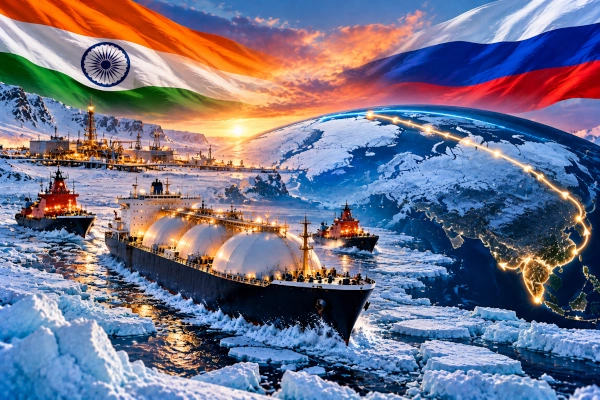
India is steadily expanding its engagement with Russia’s Arctic energy resources, combining investments in oilfields, exploration of liquefied natural gas opportunities and cooperation on maritime corridors that could connect the Russian Arctic with Indian ports. The emerging partnership brings together three strategic priorities: securing long-term energy supplies, developing Indian participation in overseas hydrocarbon production and establishing alternative maritime routes for international energy transportation.
A major development occurred on 6 September 2026, when Russia’s Rosneft announced the commissioning of its Vostok Oil project in northern Siberia. President Vladimir Putin inaugurated the first shipment of crude oil from the project through the newly developed Bukhta Sever Arctic terminal. The commencement of oil loading marked an important step towards establishing a large-scale petroleum export system linked to the Northern Sea Route.
The development has particular relevance for India. Indian public-sector energy companies already hold substantial investments in Russian oilfields, while both governments have formally agreed to expand cooperation in Arctic energy, liquefied natural gas, maritime infrastructure and polar shipping.
The broader objective is to connect energy production in Russia’s northern regions with growing Asian markets, including India. Such a connection would require more than access to oil and gas reserves. It would depend on specialised tankers, icebreaker support, port infrastructure, commercially viable shipping arrangements and reliable navigation through Arctic waters.
India and Russia have officially agreed to pursue these opportunities, but a dedicated Arctic-to-India oil or LNG shipping corridor has not yet been announced as an operational service. The significance of the current developments lies in the industrial, commercial and diplomatic foundations being established for future energy transportation.
Russia’s Vostok Oil Project Begins Arctic Shipments in September 2026
Rosneft’s Vostok Oil project is among Russia’s largest hydrocarbon developments. Located primarily on the Taimyr Peninsula and surrounding territories of northern Krasnoyarsk, it aims to develop substantial petroleum resources and establish export infrastructure on the Arctic coast.
On 6 September 2026, President Vladimir Putin formally launched the project’s first oil-loading operation. The initial shipment involved the ice-class tanker Valentin Pikul, operating at the Bukhta Sever terminal. Rosneft also identified the tanker Akademik Gubkin as part of the project’s initial maritime transportation arrangements.
The commissioning followed the development of a 790-kilometre Vankor–Payakha–Bukhta Sever oil pipeline, designed to transport crude from inland production areas to the Arctic export terminal.
According to Rosneft, the pipeline has a design capacity of 100 million tonnes annually. The company has also developed oil storage facilities, cargo berths and supporting infrastructure to enable petroleum transportation under severe northern operating conditions.
Rosneft reported that the project has an estimated resource base of approximately seven billion tonnes of oil. This is a company-reported resource estimate, not a statement that the entire quantity is available for immediate commercial production.
The Russian company outlined plans to ship 30 million tonnes of oil during the second half of 2027, reach 50 million tonnes annually by 2030 and potentially expand further as development progresses. These figures represent Rosneft’s announced targets rather than independently established production forecasts.
The September commissioning establishes a major new point of departure for Arctic petroleum exports. The project’s commercial expansion will depend on continued development of production facilities, shipping capacity and market access.
Indian Energy Companies Already Have Major Investments in Russian Oilfields
India’s interest in Russian Arctic energy is supported by investments made well before the latest maritime initiatives.
In 2016, Indian public-sector companies acquired substantial stakes in Rosneft-operated upstream assets in Russia. These acquisitions established India as an important investment partner in Russian petroleum production.
ONGC Videsh Limited holds a 26% stake in Vankorneft, while a consortium comprising Oil India Limited, Indian Oil Corporation and Bharat PetroResources holds another 23.9%. Together, Indian companies acquired a 49.9% interest in the project.
Vankor is located in northern Krasnoyarsk Territory and forms part of the wider petroleum-producing region associated with Rosneft’s northern Siberian operations.
The Indian consortium also acquired a 29.9% stake in Taas-Yuryakh Neftegazodobycha, which operates hydrocarbon assets in the Republic of Sakha, also known as Yakutia.
These investments give Indian companies economic exposure to Russian upstream production. They are distinct from ordinary crude-import agreements because the companies participate as shareholders in producing assets.
However, an ownership stake in an oilfield does not automatically mean that all associated production is shipped to India. Crude sales, transportation arrangements and shareholder returns operate through separate commercial mechanisms.
This distinction is particularly relevant when assessing the potential for a future Arctic energy route.
Vostok Oil Offers a New Dimension to India’s Existing Russian Investments
India’s involvement in Vankor provides an established connection to the region in which Rosneft is developing its broader Arctic petroleum infrastructure.
In February 2020, the Ministry of Petroleum and Natural Gas confirmed that Indian companies were examining further opportunities in Russia’s Eastern Cluster projects, particularly those connected with Arctic development.
Four Indian oil and gas public-sector undertakings had submitted expressions of interest to Rosneft concerning participation in the emerging Vostok Oil development. Both sides agreed to establish a working group to examine potential investment arrangements.
In September 2021, Rosneft again presented the Vostok Oil project to India’s petroleum leadership, highlighting its resources and opportunities for expanded cooperation.
The project includes areas already associated with Indian-participated investments, alongside additional fields and infrastructure under development.
Nevertheless, existing Indian ownership in Vankorneft should not be confused with a confirmed new Indian investment in the entire Vostok Oil project.
As of 11 October 2026, the available official announcements do not establish that an Indian company has acquired a newly negotiated equity stake covering the whole Vostok Oil development.
India’s established upstream investments and the possibility of additional participation therefore remain related but separate dimensions of bilateral energy cooperation.
India and Russia Have Been Exploring Arctic LNG Cooperation Since 2019
India’s Arctic energy strategy extends beyond crude oil to liquefied natural gas, which is increasingly important for electricity generation, fertiliser manufacturing, industrial production and city-gas distribution.
On 4 September 2019, India and Russia adopted a joint statement on hydrocarbon cooperation covering 2019–2024. The agreement explicitly identified Russian Arctic LNG projects as an area for potential Indian investment.
Both governments agreed that Indian public-sector and private-sector companies would examine opportunities to collaborate with Russian gas producers, including NOVATEK, a major developer of Arctic LNG infrastructure.
The agreement envisaged cooperation in upstream gas development, LNG imports, infrastructure and the expansion of India’s domestic natural gas market. This established an important policy foundation for Indian involvement in Russian Arctic gas projects.
However, the 2019 agreement did not constitute an Indian investment commitment to a specific NOVATEK development. No final Indian equity acquisition in Arctic LNG 2 has been established by the official documents examined for this article.
Arctic LNG Projects Could Provide an Additional Source of Natural Gas
Russia’s Yamal Peninsula and Gydan Peninsula contain substantial natural gas resources that support the development of Arctic LNG facilities.
The Yamal LNG project demonstrated the feasibility of exporting liquefied natural gas from Russia’s Arctic coast using specialised ice-class LNG carriers.
Arctic LNG 2, located on the Gydan Peninsula, represents another large Russian gas development. Its planned production infrastructure was designed to expand LNG exports from the region.
Natural gas extracted from these fields must undergo processing before it can be converted into LNG. The liquefaction process cools the gas to approximately minus 162 degrees Celsius, reducing its volume sufficiently for maritime transportation.
Specialised LNG carriers then transport the product to receiving terminals, where it is regasified and supplied to downstream consumers.
For India, Arctic LNG could potentially diversify gas imports beyond traditional suppliers in the Middle East and other producing regions. Nevertheless, the commercial situation surrounding Russian Arctic LNG has changed considerably since the original bilateral cooperation proposals.
The United States imposed sanctions on Arctic LNG 2 and associated companies and vessels, disrupting financing, equipment supplies and shipping arrangement.
In May 2026, Reuters reported that India had declined offers involving sanctioned Russian LNG while remaining open to supplies that satisfied applicable legal and commercial requirements.
Consequently, Russian Arctic LNG remains a potential area of long-term cooperation, but it cannot be presented as an established new supply source for India in October 2026.
The Northern Sea Route Could Connect Arctic Energy Fields with India
The Northern Sea Route is a maritime passage running along Russia’s Arctic coastline between the European Arctic and the Bering Strait.
It provides access to Russian ports and industrial facilities situated along the northern coast of Siberia.
For energy exports, the route is important because major Russian hydrocarbon resources lie close to the Arctic Ocean. Export terminals can potentially load crude oil and LNG directly onto specialised tankers without requiring all production to move through conventional southern pipeline and port systems.
The Northern Sea Route is not a single, fixed shipping lane. Vessels follow navigable passages according to ice conditions, their operating capabilities, regulatory requirements and the availability of supporting services.
Russia is developing ports, icebreaker capacity, navigation systems and maritime infrastructure to support greater commercial activity along the corridor. India’s interest centres on linking access to Russian resources with efficient transportation to Indian energy markets.
The possibility was explicitly recognised during the India–Russia summit in Vladivostok on 4 September 2019, when both governments agreed to examine the Northern Sea Route as a means of delivering Russian energy resources to India.
The cooperation therefore has a documented diplomatic history extending well beyond the latest discussions in 2026.
How an Arctic Energy Route to India Could Work
A future Arctic-to-India energy corridor could operate through an eastern maritime route connecting Russia’s northern export terminals with the Pacific Ocean and the Indian Ocean.
For crude produced at Vostok Oil, the initial stage would involve transportation from inland production facilities through the Vankor–Payakha–Bukhta Sever pipeline.
Tankers would then load crude at Bukhta Sever, on Russia’s Arctic coast near the Yenisei Gulf.
An eastbound voyage could follow the Northern Sea Route through suitable Arctic passages towards the Bering Strait, which separates Russia from Alaska After entering the Pacific Ocean, the vessel could proceed towards East Asian waters and continue through a commercially suitable passage into the Indian Ocean.
From there, the cargo could be delivered to an Indian refinery or appropriate oil-receiving terminal.
An illustrative eastbound route would be:
Vostok Oilfields → Bukhta Sever → Northern Sea Route → Bering Strait → North Pacific → Southeast Asian Sea Lanes → Bay of Bengal → Indian Port
Chennai and other eastern Indian ports are geographically relevant to such a routing concept. Final destinations, however, would depend on the receiving terminal’s facilities, refinery requirements and the commercial terms of individual shipments.
A westbound alternative would take Arctic cargo towards the Barents Sea and North Atlantic, followed by a suitable route to the Indian Ocean. Such a voyage might use the Mediterranean and Suez Canal where operationally and commercially appropriate.
These are possible maritime routing arrangements, not announced itineraries for a dedicated India–Russia Arctic energy shipping service.
The most suitable route would vary by production terminal, destination, season, ice conditions, tanker specifications and freight costs.
Chennai–Vladivostok Corridor Provides a Complementary Maritime Connection
India and Russia are separately developing the Chennai–Vladivostok Eastern Maritime Corridor to improve trade connectivity between India’s eastern coastline and Russia’s Far East.
The Government of India has described the corridor as approximately 5,600 nautical miles long.
In September 2023, the Ministry of Ports, Shipping and Waterways stated that the proposed connection could substantially reduce the distance and time associated with certain voyages between Indian ports and Russia’s Far Eastern region.
The government also identified oil, LNG and fertilisers among commodities that could eventually benefit from expanded maritime connectivity. The corridor is strategically relevant because Vladivostok lies on Russia’s Pacific coast, while Chennai provides access to India’s eastern industrial and maritime infrastructure.
However, the Eastern Maritime Corridor and the Northern Sea Route must be understood as two distinct maritime systems.
The Chennai–Vladivostok route connects India with Russia’s Far East. The Northern Sea Route runs across Russia’s Arctic coastline. Their integration could eventually allow cargo originating in Arctic Russia to connect with shipping networks serving the Indian Ocean, although an uninterrupted journey would not necessarily require a port call at Vladivostok.
A practical energy transport network could also employ transshipment facilities, transferring cargo from ice-class Arctic vessels to conventional tankers at suitable ports.
Such arrangements would require separate commercial and technical agreements.
India and Russia Established a Framework for Arctic Shipping Cooperation in 2024
The July 2024 India–Russia summit marked an important step towards institutionalising cooperation on the Northern Sea Route.
Prime Minister Narendra Modi and President Vladimir Putin agreed to support the development of shipping between the two countries through the Arctic corridor.
The joint statement expressed readiness to establish a working mechanism under the India–Russia Intergovernmental Commission on Trade, Economic, Scientific, Technological and Cultural Cooperation. The leaders also welcomed a programme of cooperation covering Russia’s Far East for 2024–2029, together with principles for cooperation in Russia’s Arctic zone.
These arrangements connected maritime transport with broader opportunities in energy, mining, industrial development and investment.
The Northern Sea Route thus became part of a wider bilateral connectivity strategy rather than a standalone shipping proposal.
The framework also strengthened the institutional basis for discussions involving Russian port authorities, shipping organisations and Indian maritime agencies.
December 2025 Summit Strengthened Arctic Energy and Shipping Commitments
The 23rd India–Russia Annual Summit on 5 December 2025 provided further momentum to cooperation involving energy and maritime connectivity.
The joint statement identified oil, petroleum products, refining, petrochemicals, upstream technology, LNG and related infrastructure as important areas of cooperation.
Both countries agreed to deepen engagement concerning the Northern Sea Route, the Chennai–Vladivostok Eastern Maritime Corridor and the International North–South Transport Corridor.
They also welcomed the signing of a memorandum of understanding concerning the training of specialists for ships operating in polar waters. The agreement is particularly significant because Arctic shipping requires capabilities that differ from those needed for conventional commercial voyages.
Prime Minister Narendra Modi highlighted the importance of developing Indian seafarers’ skills for polar operations and linked the initiative to maritime employment and industrial development.
The December summit also reaffirmed cooperation under the 2024–2029 programme covering Russia’s Far East, including opportunities associated with energy and maritime transportation.
Together, these measures demonstrate that India is pursuing Arctic engagement through both resource-development discussions and the practical requirements of maritime connectivity.
Icebreaker Construction Could Strengthen India’s Arctic Energy Shipping Capability
A critical requirement for expanded Arctic shipping is the availability of vessels capable of operating in ice-covered waters.
Icebreakers assist navigation by breaking or displacing sea ice and supporting the movement of vessels through difficult conditions.
Their role becomes particularly important when commercial ships encounter ice concentrations beyond their independent operating capabilities. Russia possesses extensive experience in icebreaker construction and operation. Its fleet includes nuclear-powered and conventional icebreakers designed for Arctic navigation.
India has been exploring industrial cooperation with Russia in this specialised segment.
On 8 October 2026, Russian state news agency TASS reported remarks by Union Minister Sarbananda Sonowal concerning India’s preparations for possible joint icebreaker construction.
The minister indicated that India was developing the industrial ecosystem necessary for participation in such projects.
Earlier discussions had explored the possibility of manufacturing non-nuclear icebreakers with Indian shipbuilding participation, although no final construction contract was identified in the latest announcement. For India, developing the capacity to build specialised ice-class vessels would provide access to a technologically demanding segment of global shipbuilding.
The potential industrial benefits include expertise in reinforced hulls, high-performance propulsion systems, advanced metallurgy and equipment designed for extremely low temperatures.
This cooperation could strengthen India’s maritime manufacturing capabilities even before a dedicated Arctic energy corridor enters commercial operation.
Arctic Tankers and Icebreakers Perform Different Functions
Large-scale petroleum transportation through the Arctic depends primarily on specialised cargo vessels rather than icebreakers alone.
Ice-class oil tankers and LNG carriers transport the actual energy cargo. Their hulls and propulsion systems are designed to operate within specified ice conditions.
Icebreakers provide assistance when the conditions require additional support.
Rosneft’s September 2026 announcement illustrates this distinction. The company identified the Valentin Pikul as an ice-class tanker involved in the first Vostok Oil loading operation.
It also reported the availability of the Aframax tanker Akademik Gubkin, with a deadweight of approximately 120,000 tonnes. Both vessels were built at Russia’s Zvezda shipbuilding complex. The use of specialised Arctic tankers demonstrates the importance of maintaining a fleet that can operate reliably at northern export terminals.
For future India-bound shipments, the commercial system would need sufficient tanker capacity for both the Arctic section and the subsequent ocean voyage.
Vessel availability, chartering arrangements and insurance costs would influence the viability of the transport chain.
Could the Arctic Route Reduce India’s Energy Transportation Costs?
The Northern Sea Route offers geographical advantages for certain voyages between northern Europe, Arctic Russia and East Asia.
However, its benefits for transporting energy to India require careful assessment.
A journey from the Russian Arctic to Chennai is not equivalent to a voyage from Rotterdam to Japan or another commonly cited Northern Sea Route comparison India lies considerably farther south than the principal East Asian destinations used in many Arctic shipping studies.
The total voyage must therefore include the distance from the Arctic route’s eastern or western exit to the Indian port. Cost calculations must also include icebreaker assistance, specialised vessel charter rates, seasonal operating restrictions and port charges. Arctic shipping can involve slower navigation through difficult ice conditions, additional fuel consumption and higher vessel-maintenance requirements.
As a result, a geographically shorter route does not automatically produce a lower delivered cost.
For Indian buyers, the relevant comparison would be between the total landed cost of Arctic crude or LNG and the cost of alternative supplies delivered through established maritime routes.
The economic case would be strongest where the price of the energy cargo, shipping arrangements and reliability of deliveries together create a competitive supply option.
Polar Shipping Requires Strict Environmental and Safety Standards
Arctic energy development presents significant environmental responsibilities because the region contains vulnerable marine ecosystems and experiences rapidly changing climatic conditions.
Oil spills in ice-covered waters can be especially difficult to manage. Extreme temperatures, limited daylight and the remoteness of operating areas can complicate emergency response.
Increased shipping also creates concerns about underwater noise, vessel emissions and disturbance to Arctic wildlife.
The International Maritime Organization’s Polar Code establishes mandatory requirements for ships operating in designated Arctic and Antarctic waters.
The framework addresses ship construction, equipment, navigation, crew training, voyage planning, emergency preparedness and pollution prevention.
Environmental responsibilities extend beyond complying with shipping regulations. Oil and gas developments also require appropriate assessment of their effects on local ecosystems, communities and the climate.
India’s participation in Arctic energy projects would need to account for these considerations.
The Government of India’s Arctic Policy, released in March 2022, specifically identifies climate and environmental protection as a major pillar of national engagement.
Responsible development therefore requires balancing commercial energy interests with scientific understanding and environmental safeguards.
India’s Arctic Policy Connects Energy Security with Scientific Research
India’s interest in the Arctic is not limited to access to hydrocarbons.
The country’s Arctic Policy, titled India and the Arctic: Building a Partnership for Sustainable Development, outlines six areas of engagement covering scientific research, environmental protection, economic development, transportation, governance and national capacity building.
India has maintained a scientific presence in the Arctic through its Himadri research station in Svalbard.
Indian researchers study Arctic climate processes, atmospheric conditions and environmental changes that may influence weather patterns beyond the polar region.
Scientific understanding of the Arctic is particularly important for India because research has identified connections between Arctic climatic changes and atmospheric processes affecting the Indian monsoon.
This creates a broader national interest in Arctic developments.
Economic activity in the region must therefore be considered alongside India’s scientific and environmental priorities.
Cooperation with Russia could provide opportunities for Indian institutions to strengthen expertise in polar technologies, environmental monitoring and cold-region engineering.
The Next Stage: Connecting Russian Arctic Production with Indian Demand
The combination of Rosneft’s Vostok Oil commissioning, India’s existing investments in Russian petroleum assets and expanding bilateral maritime cooperation provides a foundation for a possible Arctic energy supply chain.
The immediate opportunity lies in examining how production from northern Russian fields could reach Indian refineries and gas terminals through commercially viable shipping arrangements.
The next phase would require more specific agreements concerning energy purchases, vessel deployment, transportation services and receiving infrastructure.
Participation in Russian Arctic oil and gas developments could also create opportunities for Indian engineering companies, specialised equipment manufacturers and maritime service providers.
Companies with expertise in refinery technology, pipelines, industrial equipment, port construction and offshore engineering possess capabilities relevant to large energy infrastructure projects.
India’s growing shipbuilding ambitions add another industrial dimension to these discussions.
At the same time, the scale of future cooperation will depend on project economics, regulatory requirements, environmental safeguards and international market conditions.
The recent official announcements confirm substantial progress in Russian Arctic production and India–Russia maritime cooperation, but they do not yet establish a dedicated operating Arctic-to-India energy corridor.
India’s Arctic Energy Strategy Opens a New Chapter in India–Russia Cooperation
India’s engagement with Russian Arctic energy has evolved from diplomatic discussions into an increasingly interconnected framework of investments, industrial cooperation and maritime planning.
The most significant recent development is Rosneft’s commencement of Vostok Oil shipments on 6 September 2026. This creates a new export capability in a region where Indian energy companies already maintain substantial investment interests.
The Northern Sea Route offers a possible maritime connection between these northern production areas and markets in the Asia-Pacific region. India’s proposed participation in polar shipping, specialised vessel construction and maritime training complements this opportunity.
Meanwhile, the Chennai–Vladivostok Eastern Maritime Corridor provides a separate but potentially complementary link between Indian ports and the Russian Far East.
India’s long-term objective is to diversify the sources and transportation options available for meeting its energy requirements while strengthening domestic expertise in maritime and industrial technologies.
By combining overseas energy investments with Arctic connectivity and advanced shipbuilding cooperation, India is laying the foundations for a broader energy partnership with Russia—one that extends from Siberian oilfields to Indian industrial centres and supports the country’s long-term energy security and maritime development.
References
- Rosneft — 6 September 2026. Vostok Oil Project Commissioned: Vladimir Putin Launches First Oil Shipment. Official announcement covering the Bukhta Sever terminal, Vostok Oil pipeline and Arctic tanker operations.
https://www.rosneft.com/press/today/item/224692/ Rosneft - Government of India — 5 December 2025. India–Russia Joint Statement Following the 23rd Annual Summit. Energy cooperation, Northern Sea Route, Eastern Maritime Corridor and polar maritime training.
https://www.pib.gov.in/PressReleasePage.aspx?PRID=2199494 Press Information Bureau - Ministry of Petroleum and Natural Gas — 4 September 2019. Joint Statement on Cooperation Between India and Russia in the Hydrocarbon Sector for 2019–2024. Includes proposed Arctic LNG cooperation.
https://www.pib.gov.in/newsite/PrintRelease.aspx?relid=193002 Press Information Bureau - Government of India — 9 July 2024. Joint Statement Following the 22nd India–Russia Annual Summit. Covers the Northern Sea Route and cooperation in Russia’s Arctic and Far East.
https://www.pib.gov.in/PressReleasePage.aspx?PRID=2031946 Press Information Bureau - Ministry of Petroleum and Natural Gas — February 2020. Indian Oil Signs First Term Contract for Importing Russian Crude Oil. Includes discussions on Indian participation in Vostok Oil.
https://www.pib.gov.in/newsite/PrintRelease.aspx?relid=199028 Press Information Bureau - Rosneft — 1 September 2021. Meeting of Rosneft CEO Igor Sechin with Indian Petroleum Minister Hardeep Singh Puri. Describes existing Indian investments and emerging Vostok Oil cooperation.
https://www.rosneft.com/press/news/item/207645/ Rosneft - Rosneft — 2016. Operating Results for the Third Quarter and Nine Months of 2016. Confirms Indian ownership in Vankorneft.
https://limited.rosneft.com/press/releases/item/184459/ limited.rosneft.com - Ministry of Ports, Shipping and Waterways — September 2023. Eastern Maritime Corridor and India–Russia Maritime Connectivity.
https://www.pib.gov.in/PressReleasePage.aspx?PRID=1956694 Press Information Bureau - Ministry of Ports, Shipping and Waterways — 17 November 2025. India and Russia Hold High-Level Interagency Consultations in New Delhi.
https://www.pib.gov.in/PressReleasePage.aspx?PRID=2191056 Press Information Bureau - Ministry of Earth Sciences — 17 March 2022. India’s Arctic Policy: Building a Partnership for Sustainable Development.
https://www.moes.gov.in/sites/default/files/2022-03/compressed-SINGLE-PAGE-ENGLISH.pdf Ministry of Earth Sciences - International Maritime Organization. International Code for Ships Operating in Polar Waters (Polar Code).
https://www.imo.org/en/OurWork/Safety/Pages/polar-code.aspx International Maritime Organization - U.S. Department of State — January 2025. Sanctions to Degrade Russia’s Energy Sector. Includes measures affecting Arctic LNG 2 and associated maritime activities.
https://2021-2025.state.gov/office-of-the-spokesperson/releases/2025/01/sanctions-to-degrade-russias-energy-sector/ State Department - Reuters — 11 May 2026. India Declines Russian LNG Under Sanctions, Talks Continue on Permitted Cargoes, Sources Say.
https://www.reuters.com/business/energy/india-declines-russian-lng-under-sanctions-talks-continue-permitted-cargoes-2026-05-11/ Reuters
You may also like
-
Centre Approves ₹710 Crore for 509 Km of Rural Roads in Mizoram, Connecting 48 Habitations for First Time
-
India Plans EV Charging and Battery-Swapping Stations on Panchayat Land to Expand Rural Electric Mobility
-
India Expands Electric Vehicle Research Infrastructure as ARAI Inaugurates Advanced Testing Facilities
-
India Launches DEPA Framework to Enable Secure AI Training While Protecting Data Sovereignty
-
Sun Pharma Reportedly Secures Indian Regulatory Approval for Generic Oral Semaglutide Tablets
