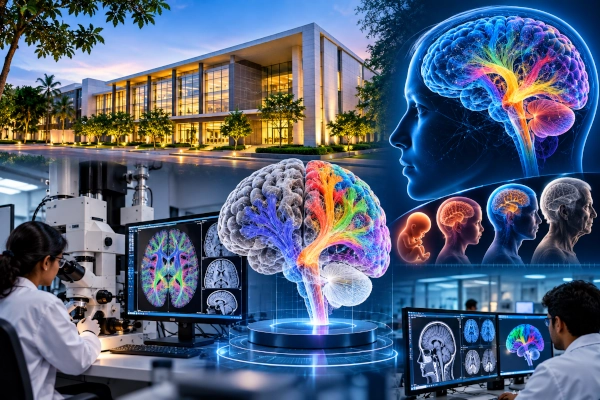
India is preparing to undertake an ambitious scientific mission to map the human brain in extraordinary detail. Prime Minister Narendra Modi will dedicate the Sudha Gopalakrishnan Brain Centre at IIT Madras to the nation on October 11, 2026, and launch a global research initiative to create three-dimensional atlases of more than 100 human brains at cellular resolution.
The mission will examine human brain development across the entire lifespan, from the foetal stage to old age. By combining advanced microscopy, high-resolution imaging and computational technologies, researchers aim to build detailed digital representations of the brain’s microscopic structures.
The Prime Minister will also release C-STROKE, a specialised three-dimensional atlas of a human brain affected by ischaemic stroke. The atlas contains more than 1,000 annotated microscopic sections and will support international research into the cellular changes associated with stroke.
The initiative builds on several years of research at IIT Madras and represents an important expansion of India’s capabilities in neuroscience, biomedical imaging and computational biology.
Global Mission to Map More Than 100 Human Brains
The Sudha Gopalakrishnan Brain Centre will undertake a large-scale scientific programme to convert more than 100 human brains into detailed three-dimensional digital atlases. The project will capture microscopic structures at cellular resolution, providing researchers with information that conventional brain imaging cannot reveal.
The mission will cover different stages of human development, including the foetal period, childhood, adulthood and old age. By examining brains across these stages, scientists can investigate how neural structures develop, mature and change over time.
Unlike conventional magnetic resonance imaging, which provides valuable information about the brain’s larger structures, cellular-resolution mapping reveals microscopic anatomical details. Researchers can use these digital atlases to study the organisation of brain regions and examine relationships between different cellular structures.
The resulting datasets are intended to serve as scientific reference resources for researchers working in neuroscience, medicine, artificial intelligence and related disciplines.
How IIT Madras Creates Three-Dimensional Brain Atlases
The Sudha Gopalakrishnan Brain Centre has developed a high-throughput imaging and computing platform capable of transforming human brain tissue into detailed three-dimensional digital representations.
The process involves preparing donated post-mortem brain tissue, cutting it into thin sections and capturing high-resolution microscopic images. Advanced computational methods then align the images and reconstruct the tissue into a three-dimensional digital model.
Because the human brain contains billions of neurons and many other specialised cells, mapping its microscopic organisation requires enormous quantities of imaging data. The centre’s technology can generate datasets reaching petabyte scale, creating substantial requirements for data processing, storage and computational analysis.
Researchers use image-processing algorithms and computational tools to reconstruct anatomical structures across successive tissue sections. These methods allow scientists to investigate brain architecture at a level of detail unavailable through routine clinical scans.
The platform brings together expertise in neuroscience, engineering, microscopy, computing and medicine, demonstrating the value of interdisciplinary research in addressing complex biomedical questions.
C-STROKE Atlas to Support Research into Brain Damage and Recovery
A major development accompanying the global mission will be the release of C-STROKE, a cellular-resolution atlas of a human brain affected by ischaemic stroke.
An ischaemic stroke occurs when a blockage interrupts blood supply to part of the brain, depriving affected tissue of oxygen and nutrients. The resulting cellular damage can disrupt neurological functions, including movement, speech, memory and cognition.
According to the Prime Minister’s Office announcement of October 10, the C-STROKE atlas contains more than 1,000 annotated microscopic sections from a stroke-affected brain. These detailed images will help researchers study changes in brain tissue associated with the condition.
The atlas can support investigations into the distribution of damaged cells, changes in surrounding structures and the anatomical characteristics of affected regions. Such information may contribute to identifying biological processes that could become targets for future therapeutic research.
Although the atlas is a research resource rather than a diagnostic or treatment system, its cellular-level information could complement existing clinical imaging and laboratory studies.
IIT Madras Builds on DHARANI Human Foetal Brain Atlas
The new mission follows IIT Madras’s earlier achievement in developing DHARANI, a three-dimensional digital atlas of the developing human foetal brain.
Released in December 2024, DHARANI provided a detailed cellular-resolution reference of human brain development during the second trimester of pregnancy. Researchers created the atlas using the centre’s specialised imaging and computational reconstruction technologies.
The project generated an extensive digital dataset that IIT Madras made publicly accessible to the international scientific community. Its high-resolution images provided new opportunities to examine how different brain structures develop during early human life.
Understanding normal brain development is important for investigating neurological conditions associated with abnormal development. Detailed anatomical reference maps can help scientists identify structural differences and formulate new research questions.
DHARANI established an important technological foundation for the centre’s wider ambition to develop comprehensive human brain atlases covering different ages and neurological conditions.
ANCHOR Brainstem Atlas Expands India’s Neuroscience Research
In June 2026, the Sudha Gopalakrishnan Brain Centre released ANCHOR, a highly detailed three-dimensional atlas of the human brainstem at cellular resolution.
ANCHOR stands for Atlas of Neurochemical Characterization of the Human Brainstem with 3D Reconstruction. The project combines anatomical imaging with neurochemical characterisation to produce detailed maps of brainstem structures.
The atlas covers more than 200 brainstem nuclei and fibre tracts reconstructed from hundreds of serial tissue sections. Researchers also used eight complementary immunostains across more than 500 sections to distinguish different cellular populations.
The brainstem performs essential functions involving breathing, cardiovascular regulation, consciousness and communication between the brain and spinal cord. Its complex internal organisation makes detailed anatomical mapping particularly valuable for neuroscience research.
Developed through international scientific collaboration, ANCHOR includes information from prenatal, childhood and adult brains. IIT Madras has made the resource publicly available to support further investigation of brainstem development, structure and neurological disorders.
The June release demonstrated the centre’s capacity to combine advanced imaging with specialised biological analysis, extending its work beyond conventional anatomical mapping.
A Global Neuroscience Network Built Around Indian Research Capabilities
Established in March 2022, the Sudha Gopalakrishnan Brain Centre has developed into a multidisciplinary research institution connecting neuroscience with engineering, computing and medicine.
The centre receives support from philanthropists Kris Gopalakrishnan and Sudha Gopalakrishnan, alongside government-supported research initiatives and institutional partnerships.
By June 2026, its research network included more than 200 researchers, engineers and technicians working with approximately 20 international collaborators. This cooperation supports the development of advanced imaging techniques, computational methods and specialised brain atlases.
The centre also collaborates with medical institutions that contribute clinical and anatomical expertise. These partnerships help connect laboratory investigations with neurological conditions and broader questions in medical science.
In June 2026, IIT Madras hosted the third BRICS Neuroscience Symposium, bringing together researchers and scientific institutions from participating countries. The event strengthened international engagement in brain imaging, computational neuroscience and neurotechnology.
The new human brain mapping mission will further expand opportunities for international collaboration while placing advanced research infrastructure and data generation capabilities within India.
Detailed Brain Maps Could Advance Neuroscience and Medical Research
Cellular-resolution atlases provide a foundation for studying how the human brain develops, functions and changes during disease. Their principal value lies in creating reliable anatomical reference datasets that researchers can examine and compare.
In developmental neuroscience, these resources can improve understanding of the organisation of brain structures across different stages of life. They may also help researchers investigate abnormalities associated with certain neurological and developmental conditions.
For diseases such as stroke, dementia and other neurological disorders, detailed tissue maps can provide information about structural changes that are difficult to observe through conventional imaging.
The datasets may also support the development of computational models and artificial intelligence tools designed to analyse complex biological images. Machine-learning methods can assist researchers in identifying cellular structures, processing large imaging datasets and discovering patterns across anatomical regions.
However, translating such findings into clinical applications requires further scientific investigation and validation. The immediate contribution of the mission will be the development of detailed research resources that can support future discoveries.
India’s Growing Contribution to Global Brain Research
The dedication of the Sudha Gopalakrishnan Brain Centre and the launch of its new mission mark another stage in India’s development of advanced scientific research infrastructure.
The initiative brings together capabilities in precision imaging, biomedical engineering, high-performance computing and computational analysis. It also creates opportunities for Indian researchers and students to work on complex scientific problems at the intersection of technology and medicine.
By generating detailed human brain atlases and making research resources accessible to the international scientific community, IIT Madras is contributing to a field that depends heavily on shared data and collaborative investigation.
The planned mapping of more than 100 human brains across the lifespan will build on the centre’s existing DHARANI and ANCHOR atlases, while the release of C-STROKE will extend its work into detailed investigations of neurological disease.
With its expanding brain imaging capabilities and international research partnerships, IIT Madras is strengthening India’s position in advanced neuroscience and creating scientific resources that can support future discoveries in human brain development, neurological disorders and medical technology.
References
- Press Information Bureau, Prime Minister’s Office — October 10, 2026: PM to Visit Chennai on 11 October
- Press Information Bureau, IIT Madras — June 12, 2026: IIT Madras Brain Centre Releases the World’s Most Detailed 3D Atlas of Human Brainstem at Cell Resolution
- Press Information Bureau — December 2024: IIT Madras Releases Detailed 3D High-Resolution Images of Human Foetal Brain
- Press Information Bureau — June 8, 2026: IIT Madras Hosts 3rd BRICS Neuroscience Symposium 2026 to Advance Global Brain Research Collaboration
- Press Information Bureau — March 2022: IIT Madras Launches Sudha Gopalakrishnan Brain Centre
- Akashvani News — October 10, 2026: PM Modi to Visit Chennai on October 11
You may also like
-
3,898 Indian Scientists Feature in 2026 Global Top 2% Research Database; IISc Leads Indian Institutions
-
New Metal-free Porous Material can Help Produce Affordable Clean Energy
-
A Decade of Cosmic Flickering Reveals New Clues About A Rare Giant Binary Black Hole System
-
Indian Researchers Screen 94 Pea Lines to Identify High-Protein, Mineral-Rich Breeding Material
-
Indian Researchers Combine AI and Infrared Spectroscopy to Detect Parkinson’s-Linked Biochemical Changes in Fruit Flies
