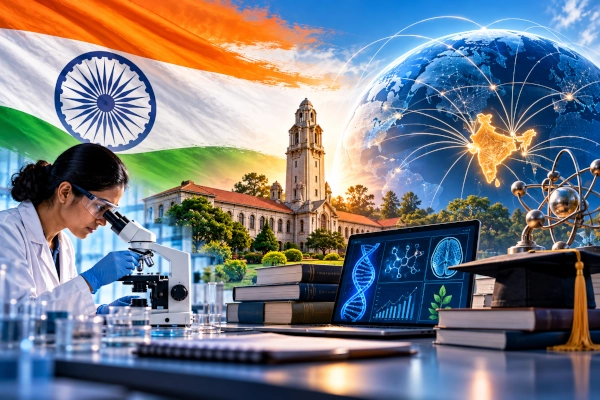
India’s scientific research community has secured substantial representation in the 2026 edition of the global database of highly cited scientists developed by Stanford University researcher John P. A. Ioannidis and published through Elsevier’s Data Repository. The latest edition identifies 3,898 Indian researchers associated with 1,185 academic and research institutions, with the Indian Institute of Science (IISc), Bengaluru, recording the highest institutional representation.
The institutional figures compiled from the 2026 dataset place IISc at the forefront with 139 researchers, followed by the Indian Institute of Technology (IIT) Delhi with 114 and IIT Kharagpur with 97. IIT Madras, IIT Bombay and IIT Roorkee also feature prominently, reflecting the significant contribution of India’s leading engineering and scientific institutions to internationally cited research.
The updated database, formally titled Updated Science-Wide Author Databases of Standardized Citation Indicators, was released on 7 October 2026. It uses Scopus citation information available as of 1 August 2026 and examines research citations accumulated through the end of 2025.
The database offers a standardised method for examining scientific citation impact across disciplines. Rather than evaluating researchers solely by the number of papers they publish, it considers multiple indicators reflecting the influence of their published work.
IISc Bengaluru Leads Indian Research Institutions
The Indian Institute of Science, Bengaluru, has the largest number of researchers among Indian institutions identified in the 2026 compilation, with 139 scientists represented.
Established in 1909, IISc conducts research across engineering, physical sciences, biological sciences, mathematics, materials science and interdisciplinary technologies. Its research activities extend from fundamental scientific investigations to advanced engineering and technology development.
IIT Delhi follows with 114 researchers, while IIT Kharagpur accounts for 97. IIT Madras and IIT Bombay have 81 and 73 researchers, respectively.
Other prominent institutions include IIT Roorkee with 62 scientists, IIT Kanpur with 55 and IIT Guwahati with 37. IIT (BHU) Varanasi accounts for another 33 researchers.
The substantial representation of IITs reflects their contribution to engineering research, materials development, computing, energy technologies and other scientific disciplines.
The inclusion of researchers from these institutions also highlights the international circulation of scientific publications originating from India’s technical education and research system.
India’s Leading Institutions in the 2026 Research Database
The institution-wise compilation identifies the following 20 Indian organisations with the highest numbers of listed researchers.
| Institution | Number of Scientists |
|---|---|
| Indian Institute of Science, Bengaluru | 139 |
| IIT Delhi | 114 |
| IIT Kharagpur | 97 |
| IIT Madras | 81 |
| IIT Bombay | 73 |
| IIT Roorkee | 62 |
| IIT Kanpur | 55 |
| Jadavpur University | 48 |
| Banaras Hindu University | 44 |
| Bhabha Atomic Research Centre | 40 |
| University of Delhi | 38 |
| IIT Guwahati | 37 |
| Academy of Scientific and Innovative Research | 35 |
| Vellore Institute of Technology | 35 |
| IIT (BHU) Varanasi | 33 |
| All India Institute of Medical Sciences, New Delhi | 30 |
| Postgraduate Institute of Medical Education and Research, Chandigarh | 29 |
| University of Hyderabad | 27 |
| Birla Institute of Technology and Science, Pilani | 24 |
| Indian Statistical Institute, Kolkata | 24 |
The 20 institutions together account for 1,033 researcher entries, demonstrating the concentration of highly cited scientific work within major research universities, technical institutions and specialised laboratories.
These are institution-wise counts associated with the database, rather than a separate institutional quality ranking issued by Stanford University. Differences in faculty size, research disciplines and publication practices must be considered when comparing institutions.
BARC and AcSIR Highlight India’s Government Research Capabilities
Beyond universities and IITs, the compilation demonstrates the presence of researchers from India’s specialised scientific organisations.
The Bhabha Atomic Research Centre (BARC), Mumbai, accounts for 40 scientists. As one of India’s principal nuclear research establishments, BARC undertakes scientific and technological work across nuclear engineering, reactor technologies, materials science, radiation applications and related disciplines.
Its inclusion reflects the contribution of specialised government research institutions to internationally cited scientific literature.
The Academy of Scientific and Innovative Research (AcSIR) has 35 researchers in the institutional compilation. AcSIR operates through a network of research institutions, including laboratories associated with the Council of Scientific and Industrial Research.
This structure connects advanced scientific education with laboratory-based research in fields such as chemistry, biotechnology, materials science, environmental science and engineering.
The Indian Statistical Institute, Kolkata, also features with 24 researchers, reflecting contributions in statistics, mathematics, computer science and associated areas.
Together, these institutions illustrate the importance of India’s publicly supported scientific research infrastructure alongside its university system.
Medical Research Institutions Gain International Citation Recognition
India’s medical research community is represented through major healthcare and postgraduate research institutions.
The All India Institute of Medical Sciences (AIIMS), New Delhi, has 30 researchers in the compilation, while the Postgraduate Institute of Medical Education and Research (PGIMER), Chandigarh, accounts for 29.
These institutions conduct clinical and biomedical research across medical specialties, including public health, diagnostics, medical treatment and disease management.
Scientific citations provide one indication of how published research contributes to subsequent studies. Medical research may influence the development of clinical knowledge, treatment approaches and further scientific investigations.
However, citation-based indicators do not directly measure patient outcomes, quality of healthcare delivery or the practical effectiveness of medical treatments.
The presence of AIIMS and PGIMER in the database demonstrates the international citation reach of research produced within India’s major medical institutions.
How the World’s Top 2% Scientists Database Is Prepared
The database is based on research led by John P. A. Ioannidis of Stanford University, in collaboration with Kevin W. Boyack and Jeroen Baas.
Its methodology was established through scientific publications examining how citation information can be standardised across researchers and disciplines.
The 2026 edition uses data from Scopus, Elsevier’s database of scientific publications, authors and citations.
Researchers are evaluated using several bibliometric indicators, including total citations, the h-index, the co-authorship-adjusted hm-index and citations associated with different authorship positions.
These measurements are combined into a composite citation indicator known as the c-score.
The c-score places emphasis on citation impact rather than simply rewarding researchers for publishing large numbers of papers. It also incorporates information about authorship positions and collaboration.
The database provides calculations with and without self-citations, allowing researchers and institutions to examine citation patterns from different perspectives.
Its authors emphasise that citation indicators have limitations and should not be interpreted as absolute measures of scientific excellence.
Scientists Are Classified Across 20 Research Fields
The 2026 database classifies researchers into 20 broad scientific fields and 174 specialised subfields, using the Science-Metrix classification system.
This classification allows researchers to be assessed within disciplines that may have different publication and citation practices.
For example, scientific publication patterns in physics, clinical medicine, computer science and mathematics can differ considerably. Research fields may also vary in the size of their scientific communities and the frequency with which publications receive citations.
The database therefore provides field-specific and subfield-specific percentile information for scientists with at least five published papers.
Researchers qualify for inclusion through the selection criteria established by the database. These include placement among the top 100,000 scientists according to the composite citation score, calculated with and without self-citations, or reaching the top 2% threshold within their respective subfields.
Consequently, the commonly used description of the database as the world’s top 2% scientists list is a simplified reference to a more detailed bibliometric selection process.
Separate Databases Measure Career-Long and Annual Research Impact
An important feature of the Stanford–Elsevier database is that it provides two distinct assessments of research citation impact.
The career-long database evaluates citations accumulated across a scientist’s research career, incorporating information available through the end of 2025.
This measure reflects the sustained citation influence of published scientific work over an extended period.
The single-year database examines citations received during the 2025 calendar year. It provides a more recent picture of how researchers’ publications were cited during that period.
These datasets serve different purposes. A scientist with a long record of influential publications may perform strongly in the career-long analysis, while another researcher may demonstrate substantial citation activity during a particular year.
The distinction is important when interpreting institutional counts and changes between annual editions.
Researchers appearing in both datasets should not automatically be counted twice when calculating the number of distinct individuals represented.
India’s 2026 Count Requires Careful Year-on-Year Interpretation
The institution-wise compilation reports 3,898 Indian researchers in the 2026 edition, compared with a reported 6,239 in the preceding edition.
The numerical difference is 2,341 researchers, equivalent to approximately 37.5% of the earlier figure.
However, this comparison requires caution because the original Elsevier dataset provides separate career-long and single-year citation analyses. Aggregate national totals depend on how researchers are selected, how duplicate entries are handled and which dataset is used.
Changes in Scopus author profiles, institutional affiliations and citation indicators can also influence the composition of successive editions.
The published aggregate figures therefore do not, by themselves, establish a corresponding decline in India’s scientific output, research quality or international research influence.
The researchers responsible for the database explicitly caution against treating citation metrics as definitive measures of scientific excellence. They also note that exclusion from the database does not mean a scientist’s research lacks quality or importance.
Meaningful assessment of India’s year-on-year research performance requires consistent selection criteria and examination of the underlying citation data.
International Citation Impact Reflects India’s Research Ecosystem
India’s scientific research system includes central universities, IITs, Indian Institutes of Science Education and Research, medical institutions, national laboratories and specialised research organisations.
These institutions contribute to research in fundamental sciences, engineering, healthcare, computing, biotechnology, agriculture, energy and advanced materials.
International citation databases provide one way to examine the reach of scientific publications originating from these organisations.
Citations indicate that a scientific publication has been referenced by subsequent scholarly work. They can reflect the influence of research findings on further investigations within a field.
However, scientific impact extends beyond published citations. Research can also contribute through technological development, patents, industrial applications, public health improvements and the training of skilled researchers.
A balanced assessment of national research capability therefore requires consideration of multiple indicators, including research quality, innovation outcomes, collaboration and practical applications.
The 2026 database provides a useful source of bibliometric information within this broader assessment.
India’s Scientific Research Community Builds on International Visibility
The 2026 update highlights the international citation presence of researchers associated with a wide range of Indian institutions.
IISc and the IITs account for substantial representation, while universities, medical institutions and government research laboratories contribute across specialised disciplines.
The database also demonstrates the importance of sustained research activity, scientific collaboration and the dissemination of findings through internationally accessible publications.
As India’s scientific institutions expand their capabilities in emerging technologies and established research fields, citation analysis can help researchers understand the dissemination and academic influence of their work.
The representation of thousands of Indian scientists in the 2026 Stanford–Elsevier citation database underscores the country’s active participation in international scientific research. Continued investment in research infrastructure, scientific talent and interdisciplinary collaboration will strengthen the foundation for India’s contributions to global knowledge and technological development.
References
- Elsevier Data Repository — August 2026 Data Update for Updated Science-Wide Author Databases of Standardized Citation Indicators. John P. A. Ioannidis, Version 9, published 7 October 2026. Official dataset containing career-long and single-year citation indicators, scientific field classifications and researcher information.
https://doi.org/10.17632/btchxktzyw.9 - Ioannidis, J. P. A., Boyack, K. W., and Baas, J. — Updated Science-Wide Author Databases of Standardized Citation Indicators. PLOS Biology, 16 October 2020. Original research explaining the database methodology and standardised citation metrics.
https://doi.org/10.1371/journal.pbio.3000918 - Ioannidis, J. P. A., Baas, J., Klavans, R., and Boyack, K. W. — A Standardized Citation Metrics Author Database Annotated for Scientific Field. PLOS Biology, 2019. Foundational methodology for the scientific field classification and citation indicators.
https://doi.org/10.1371/journal.pbio.3000384 - Elsevier Data Repository — August 2025 Data Update for Updated Science-Wide Author Databases of Standardized Citation Indicators. Version 8, published 19 September 2025. Previous edition for methodological and historical comparison.
https://doi.org/10.17632/btchxktzyw.8
You may also like
-
New Metal-free Porous Material can Help Produce Affordable Clean Energy
-
A Decade of Cosmic Flickering Reveals New Clues About A Rare Giant Binary Black Hole System
-
Indian Researchers Screen 94 Pea Lines to Identify High-Protein, Mineral-Rich Breeding Material
-
Indian Researchers Combine AI and Infrared Spectroscopy to Detect Parkinson’s-Linked Biochemical Changes in Fruit Flies
-
IIT Hyderabad Develops Lung-Derived Bioink for 3D Bioprinting and Regenerative Medicine
