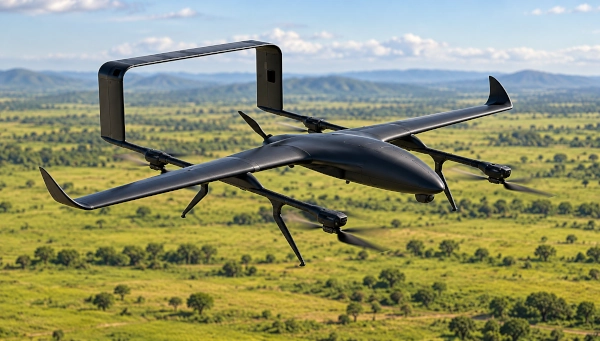
Indian unmanned systems company ideaForge Technology has expanded its tactical UAV portfolio with two new variants of the ZOLT platform: ZOLT Hybrid for long-endurance intelligence, surveillance, target acquisition and reconnaissance missions, and ZOLT UCAV for tactical missions and precision effects.
Launched on October 6, 2026, the two variants mark ideaForge’s entry into the long-range ISR and unmanned combat aerial vehicle segments. The company says both versions share a common platform architecture while addressing different operational requirements for endurance, reach and mission flexibility.
ZOLT Hybrid Pushes Endurance Beyond Six Hours
The ZOLT Hybrid combines an internal-combustion engine with battery power to extend mission duration. ideaForge states that the platform can remain airborne for more than six hours and support line-of-sight communications at ranges of up to 100 kilometres.
The hybrid configuration is intended for persistent surveillance and overwatch missions where endurance is more important than rapid deployment alone. It has a stated launch altitude capability of up to 2,000 metres above mean sea level.
Such endurance gives the platform potential utility for border surveillance, long-range reconnaissance, battlefield intelligence and persistent observation over areas where smaller battery-powered UAVs would require more frequent recovery and relaunch.
ZOLT UCAV Adds Precision-Effects Capability
The battery-powered ZOLT UCAV is designed for shorter tactical missions in which responsiveness, low logistical burden and precision effects are central requirements.
ideaForge places its endurance at around two to three hours, with line-of-sight transmission extending between 30 and 50 kilometres. The platform can be launched at altitudes of up to 4,500 metres above mean sea level, giving it particular relevance for operations in mountainous and high-altitude terrain.
The company has described the UCAV variant as being intended for tactical missions and precision effects rather than presenting it simply as another surveillance drone. This represents a notable expansion of ideaForge’s portfolio beyond conventional ISR platforms.
Electronic-Warfare Resilience Is Central to the Design
A defining feature of the ZOLT family is ideaForge’s emphasis on operating in contested electromagnetic environments.
The company says the platform incorporates anti-jam communications, GNSS-denied navigation and onboard intelligence. Together, these technologies are designed to maintain mission effectiveness when satellite-navigation signals or communications links are degraded, jammed or unavailable.
GNSS-denied navigation is increasingly important for military UAVs because dependence on satellite positioning creates a potential vulnerability in electronic-warfare environments. A platform capable of maintaining navigation and mission functions after losing reliable GNSS input has significantly greater operational resilience.
Similarly, onboard processing can reduce dependence on constant communication with a ground station by allowing more mission-related decisions to be handled at the edge.
One Platform for Multiple Battlefield Roles
ideaForge has designed ZOLT around a common architecture that can support several tactical roles rather than limiting the system to a single surveillance mission.
The company lists border and frontier surveillance, tactical reconnaissance, target acquisition, long-range day-and-night observation, battlefield intelligence and Direction of Own Artillery Fire among the intended applications.
The last of these can be particularly valuable for artillery units. A UAV capable of observing the impact area can help provide information on shot placement and support correction of subsequent fire without requiring forward observers to move closer to hostile positions.
This combination of surveillance, targeting support and precision-effects capability moves ZOLT closer to an integrated battlefield system rather than a standalone reconnaissance aircraft.
NAKSH Payload Family Expands Sensor Options
ZOLT can also be configured with ideaForge’s NAKSH family of ISR payloads.
According to the company, available sensor options include electro-optical, infrared and mid-wave infrared payloads, along with laser ranging and tracking capabilities.
This allows the same air vehicle to be configured according to mission requirements. Electro-optical sensors can support high-resolution daytime surveillance, while infrared and MWIR systems extend observation into darkness and conditions where visible-light imaging is less effective.
Laser ranging and tracking can further improve target-location accuracy and battlefield awareness, particularly when the UAV is supporting artillery, reconnaissance or precision-engagement missions.
High-Altitude ZOLT Variant Is Already Planned
ideaForge has also indicated that another variant is under development.
Building on the ZOLT Hybrid architecture, the company plans to introduce a high-altitude configuration with a launch-altitude capability of up to 4,000 metres above mean sea level.
This would extend the ZOLT family further into mountainous operating environments where density altitude, wind conditions, low temperatures and reduced aerodynamic performance create considerable challenges for unmanned aircraft.
For India, such capability has obvious relevance along high-altitude northern frontiers, where UAV endurance and reliability can be affected significantly by terrain and environmental conditions.
The high-altitude variant has not yet been presented as an operationally fielded system, so it should be viewed as the next planned development in the family rather than an available production configuration.
ideaForge Moves Beyond Its Traditional ISR Role
ideaForge has built much of its reputation around surveillance and reconnaissance UAVs used by Indian government and security customers.
The ZOLT expansion is significant because it broadens the company’s role from platforms designed primarily to observe the battlefield towards systems capable of contributing directly to tactical missions and precision effects.
Sachin Pukale, AGM for Product Management at ideaForge, said the tactical long-range UAV field is evolving from systems that primarily observe the battlefield towards platforms that can contribute more directly to operational missions.
That shift is increasingly visible across the global unmanned-systems sector, where ISR drones, loitering systems and armed UAVs are becoming more closely integrated with artillery, targeting networks and battlefield command systems.
A Broader Shift in India’s Drone Industry
The introduction of ZOLT Hybrid and ZOLT UCAV also reflects the growing sophistication of India’s domestic unmanned-systems ecosystem.
Indian companies are increasingly moving beyond short-range quadcopters and basic surveillance platforms into longer-endurance aircraft, autonomous navigation, counter-jamming systems, precision targeting and combat-oriented unmanned platforms.
Electronic-warfare resilience is becoming especially important. Modern conflicts have demonstrated that UAV effectiveness depends not only on endurance or payload but also on the ability to operate when navigation and communications are actively contested.
The ZOLT architecture addresses that problem directly by combining range and endurance with anti-jam communications, GNSS-independent navigation and onboard computing.
From Surveillance Drone to Tactical Combat System
The significance of the new ZOLT variants lies in the way ideaForge is broadening the mission envelope of an Indian-designed tactical UAV family.
ZOLT Hybrid provides the persistent endurance needed for extended ISR and battlefield overwatch, while ZOLT UCAV introduces a more direct precision-effects role from a common technological base.
That common architecture could simplify training, maintenance and mission-system integration while allowing users to select configurations according to operational requirements.
For India’s defence industry, the development also illustrates how domestic UAV companies are moving into increasingly complex segments of unmanned warfare. Long-endurance surveillance, high-altitude operations, EW resilience and precision effects are converging into a new generation of tactical systems, and ZOLT represents ideaForge’s latest step into that space.
References
- ideaForge Technology Limited — Company announcement on the launch of ZOLT Hybrid and ZOLT UCAV, October 6, 2026.
- India Strategic — ideaForge Strengthens its Tactical UAV Portfolio with ZOLT Hybrid and ZOLT UCAV, Marking its Entry into Long-Range ISR & UCAV Segments, October 6, 2026.
- Raksha Anirveda — ideaForge Strengthens its Tactical UAV Portfolio with ZOLT Hybrid and ZOLT UCAV, October 6, 2026.
- Businessworld — ideaForge Enters Long-Range ISR, UCAV Segments With New ZOLT UAV Variants, October 6, 2026.
You may also like
-
Pine Labs Expands in Singapore with Unified Merchant Payments Platform
-
VORAN Partners Italian Manufacturer to Build Light-Aviation Ecosystem in India
-
Hical Technologies Expands Rafale and Aerospace Manufacturing with New Bengaluru Facility
-
IZI Enterprise Wins DRDO Order for VANA Surveillance Drones
-
Kaveri 2.0 Could Give India a Common Technology Base for Fighter and Transport Aircraft Engines
