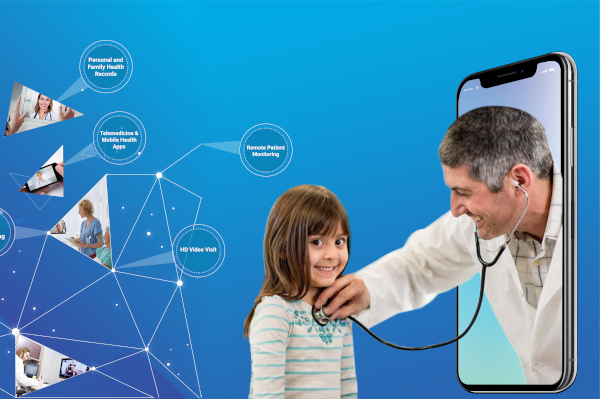
India’s national telemedicine platform eSanjeevani has crossed 50 crore teleconsultations, marking a major milestone in the country’s effort to expand access to healthcare through digital public infrastructure.
The platform crossed the milestone on September 15, 2026, with a cumulative 50,00,92,730 teleconsultations across all 36 States and Union Territories. The achievement reflects the growing use of remote medical consultations as a complement to physical healthcare facilities, particularly in rural, remote and underserved areas.
eSanjeevani Reaches Population Scale
eSanjeevani has grown into one of the world’s largest public telemedicine platforms for primary healthcare.
The service now supports more than 1.42 lakh Ayushman Arogya Mandir spokes, 19,473 medical hubs and 901 online OPDs, with 2,41,923 registered healthcare providers.
It is available in 15 languages, including English and 14 Indian languages, and currently facilitates around 2.5 lakh to 3 lakh consultations every day.
The platform’s highest single-day utilisation has reached 6,30,315 consultations, indicating that telemedicine has moved beyond pilot-scale use and become part of routine public healthcare delivery in many parts of the country.
Women and Older Citizens Form a Major Share of Users
Usage data shows that women account for 57.14% of total eSanjeevani utilisation.
Citizens aged 46 years and above account for 40.15% of consultations, while those aged 60 years and above represent 16.25% of total usage.
These figures are significant because women and older citizens can face greater logistical barriers in accessing physical healthcare facilities, particularly when long-distance travel, mobility constraints or waiting times are involved.
Telemedicine does not replace in-person care, but it can reduce unnecessary travel and provide easier access to medical advice when physical examination or hospital-based intervention is not immediately required.
AI-Powered Clinical Decision Support Added to the Platform
A major recent upgrade is the integration of an Artificial Intelligence-powered Clinical Decision Support System.
The AI-CDSS is designed to assist healthcare providers during consultations by supporting more consistent and efficient clinical decision-making.
The system has received the Gold Award under the National Awards for e-Governance 2026, reflecting the growing role of artificial intelligence in strengthening large-scale public digital health systems.
The introduction of AI also marks a shift in eSanjeevani’s evolution. The platform is no longer limited to connecting patients and doctors remotely but is increasingly incorporating digital tools intended to improve the quality and efficiency of consultations.
Integration With ERSS-112 Strengthens Emergency Linkages
eSanjeevani has also been integrated with the Emergency Response Support System, ERSS-112.
The integration is intended to strengthen coordination between emergency response services and remote medical expertise, creating better links between digital consultation and urgent healthcare support.
This can be particularly useful in situations where emergency responders require rapid access to medical advice before a patient reaches a healthcare facility.
The development shows how telemedicine is gradually becoming part of a broader digital healthcare network rather than operating as a standalone consultation service.
Specialist OPDs Expand Beyond Primary Healthcare
One of the most important changes in the platform is its expansion into specialist outpatient consultations.
Patient-to-doctor teleconsultation services for selected specialities have been introduced at AIIMS Jodhpur, AIIMS Jammu and AIIMS Patna.
This allows patients to access specialist medical expertise from home without always needing to travel to major tertiary-care hospitals.
The service is expected to be expanded progressively to other leading government institutions, including additional AIIMS facilities, JIPMER and PGIMER Chandigarh.
Specialist Telemedicine Could Reduce Travel Burden
Access to specialist care remains one of the biggest challenges for patients living far from large medical centres.
A patient requiring consultation with a specialist may otherwise need to travel long distances, spend money on transport and accommodation, and wait for an appointment at an overcrowded tertiary-care facility.
Remote consultations can reduce some of this burden by allowing initial assessments, follow-up consultations and selected specialist interactions to take place digitally.
In-person examination and hospital treatment will continue to remain essential where clinically required, but teleconsultation can help determine which patients need physical referral and which can be managed remotely.
A Made-in-India Digital Health Platform
eSanjeevani is an indigenous digital health system developed by the Centre for Development of Advanced Computing.
C-DAC Mohali has provided end-to-end technology development and engineering support for the platform, while the Ministry of Health and Family Welfare has guided its expansion within the public healthcare system.
The platform initially operated primarily through a hub-and-spoke model linking health facilities with doctors. It has since evolved into a much broader national digital health network covering direct patient consultations, specialist services, AI-assisted decision support and emergency-response integration.
Digital Public Infrastructure for Healthcare
The scale reached by eSanjeevani demonstrates India’s ability to deploy digital infrastructure across a healthcare system serving a population of more than a billion people.
Its importance lies not only in the number of consultations but also in the network connecting primary healthcare centres, doctors, specialists and public institutions across states and union territories.
As the platform expands into specialist care and integrates more advanced technologies, it could increasingly support continuity between primary, secondary and tertiary healthcare.
The 50-crore milestone therefore represents more than a numerical achievement. It shows how an indigenous digital platform is becoming an established part of India’s public healthcare architecture, bringing medical expertise closer to citizens while strengthening the wider goal of accessible and equitable healthcare.
References
- Press Information Bureau, Ministry of Health and Family Welfare, Government of India, “E-Sanjeevani Crosses 50 Crore Teleconsultations, Strengthening Access to Healthcare Across the Country,” October 6, 2026.
You may also like
-
Viruddha Ahara: Understanding Incompatible Food Combinations in Ayurveda
-
Integrated Ayurveda-Yoga Approach Shows Encouraging Results in Childhood Bedwetting: ITRA Study
-
India’s Cervavac HPV Vaccine Receives WHO Prequalification, Opening Path for Wider Global Use
-
Russia’s Irkutsk Pneumonia Scare: No Confirmed Plague Epidemic, No Immediate Threat to India
-
Ayurveda on Dinner: Why Lighter and Earlier May Be Better
