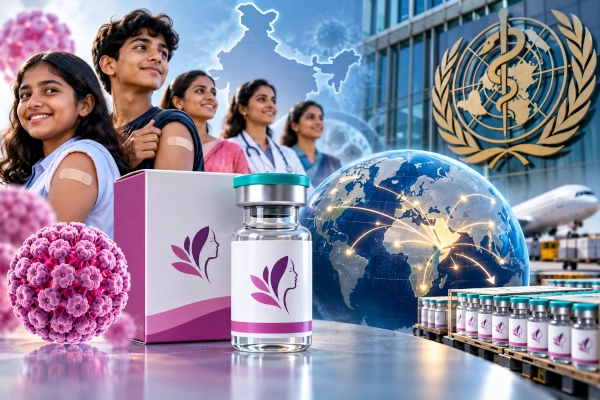
India’s first indigenously developed quadrivalent human papillomavirus vaccine, Cervavac, has received World Health Organization prequalification, marking a major step in the vaccine’s international acceptance and potential use in global immunisation programmes.
WHO’s official prequalification database lists Cervavac as a quadrivalent HPV vaccine manufactured by the Serum Institute of India, with prequalification effective from September 25, 2026. The product is regulated in India by the Central Drugs Standard Control Organization.
The WHO decision is significant because prequalification is a key requirement for vaccines procured by United Nations agencies and many international immunisation programmes. It allows countries and global health organisations to consider Cervavac for broader deployment based on WHO-assessed standards of quality, safety and efficacy.
Cervavac Targets Four Major HPV Types
Cervavac is a recombinant quadrivalent vaccine designed to protect against HPV types 6, 11, 16 and 18.
HPV types 16 and 18 are among the most important high-risk strains associated with cervical cancer and other HPV-related cancers. Types 6 and 11 are primarily linked with genital warts.
The vaccine is administered intramuscularly and is available in single-dose and two-dose vial presentations. WHO’s prequalification listing records the vaccine as a ready-to-use liquid product with a shelf life of 36 months when stored between 2°C and 8°C.
India’s First Indigenously Developed Quadrivalent HPV Vaccine
Cervavac was developed in India with support from the Department of Biotechnology and the Biotechnology Industry Research Assistance Council.
The Department of Biotechnology has described it as India’s first indigenously developed quadrivalent HPV vaccine against cervical cancer. The vaccine received market authorisation from the Drug Controller General of India in July 2022.
Its development represented an important step in reducing India’s dependence on imported HPV vaccines and creating a lower-cost domestically manufactured option for large-scale immunisation.
WHO Prequalification Is a Major Regulatory Milestone
WHO prequalification involves a detailed assessment of vaccine quality, safety, efficacy, manufacturing consistency and programmatic suitability.
Manufacturers must submit a comprehensive technical dossier, undergo independent testing and demonstrate that production facilities meet required standards. The responsible national regulatory authority must also meet WHO requirements for regulatory oversight.
WHO’s approval therefore places Cervavac within the group of HPV vaccines recognised for international public-health use.
The prequalification covers both the one-dose and two-dose vial presentations listed by WHO.
Cervavac Joins WHO’s Global HPV Vaccine Portfolio
Before Cervavac’s inclusion, WHO’s prequalified HPV vaccine portfolio included bivalent, quadrivalent and nonavalent products from other manufacturers.
The addition of an Indian-made quadrivalent vaccine expands the global supply base at a time when many lower- and middle-income countries are seeking to strengthen HPV vaccination programmes.
WHO has repeatedly identified vaccine availability, affordability and supply security as important factors in expanding HPV immunisation worldwide.
A larger pool of prequalified manufacturers can therefore improve procurement flexibility for national programmes and global health agencies.
Why HPV Vaccination Matters
Human papillomavirus is one of the most common sexually transmitted infections, and persistent infection with certain high-risk HPV types can lead to cervical cancer.
Cervical cancer remains one of the most important preventable cancers affecting women, particularly in countries where screening and vaccination coverage remain limited.
Vaccination before exposure to HPV can substantially reduce the risk of infection with vaccine-targeted types. WHO recommends HPV vaccination as a central pillar of its global strategy to eliminate cervical cancer as a public-health problem.
Cervavac’s Role in India
India has a substantial cervical cancer burden, making domestic access to HPV vaccines particularly important.
The availability of an Indian-made vaccine gives the country greater flexibility in expanding vaccination coverage while reducing dependence on imported products.
Cervavac’s WHO prequalification could also support future procurement by international agencies and other countries, giving Indian vaccine manufacturing a larger role in global cervical cancer prevention.
Single-Dose Research Continues
Although Cervavac has received WHO prequalification, research into simplified dosing strategies is continuing.
The International Agency for Research on Cancer is involved in studies assessing the immune response generated by a single dose of Cervavac compared with established HPV vaccines.
Single-dose vaccination is particularly important for public-health programmes because it can reduce costs, simplify logistics and improve coverage.
The results of these studies could eventually influence how Cervavac is used in large-scale immunisation programmes, particularly in countries where delivering multiple doses is difficult.
A Significant Step for India’s Vaccine Manufacturing Capability
Cervavac’s WHO prequalification adds to India’s growing record as a major global vaccine producer.
The Serum Institute of India already manufactures several vaccines supplied internationally, and its Pune facilities have undergone WHO inspections as part of global quality-assurance processes.
The addition of Cervavac strengthens India’s position not only as a large-volume vaccine manufacturer but also as a developer of products aimed at major global public-health challenges.
Cervavac Could Expand Access to HPV Vaccination Worldwide
The WHO decision gives Cervavac a wider international pathway than it had under national approval alone.
Countries and international organisations can now consider the vaccine within procurement and immunisation frameworks that require WHO prequalification. That could become especially important in regions where cost and supply constraints have slowed HPV vaccination.
For India, the milestone demonstrates the ability of domestic biotechnology, public research support and private-sector manufacturing to produce a vaccine that meets international regulatory standards.
Cervavac’s entry into the WHO-prequalified vaccine portfolio therefore represents both a public-health achievement and a significant advance for India’s indigenous vaccine ecosystem.
References
World Health Organization — CERVAVAC: Prequalified Vaccine Product Overview.
https://extranet.who.int/prequal/vaccines/p/cervavac
World Health Organization — Prequalified Vaccines Database.
https://extranet.who.int/prequal/vaccines/prequalified-vaccines
Department of Biotechnology, Government of India — 11 Years of Scientific Innovations, information on Cervavac and indigenous vaccine development.
https://dbtindia.gov.in/
World Health Organization — Considerations for Human Papillomavirus Vaccine Product Choice.
https://www.who.int/publications/i/item/9789240089167
International Agency for Research on Cancer — Medium-Term Strategy 2026–2030, including research on single-dose Cervavac immunogenicity.
https://www.iarc.who.int/
You may also like
-
Ayurveda and Mental Fatigue in the Digital Age: Ancient Wisdom for a Calm and Focused Mind
-
Bharat Biotech’s Nucelion and VeGen Bio Partner to Manufacture Advanced Dual-Target CAR-T Cancer Therapy in India
-
Ayurveda and Anger: How Emotional Excess Affects Physical and Mental Health
-
Ayurveda and Stress: Daily Practices for Mental Balance and Emotional Well-Being
-
Ayurveda and Bowel Routine: Why Regularity Matters for Digestive Health
