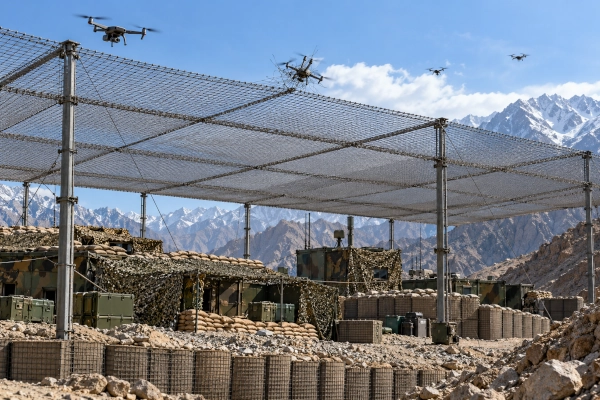
The Indian Army is moving to strengthen passive protection against drones by installing multi-layer steel mesh screens over selected sensitive military structures in forward areas. The measure is intended to provide an additional physical barrier against small unmanned aerial systems and swarm-drone attacks while complementing active counter-drone systems already in service.
A Request for Information issued by the Army on September 25, 2026, outlines the requirement for large anti-drone mesh structures designed to intercept incoming aerial threats before they can reach protected buildings. Initial deployment is planned at multiple locations in the Western Sector, where critical infrastructure faces an increasingly complex drone threat.
Three-Layer Steel Mesh Forms the Core of the Defence
The proposed anti-drone structure will use three separated layers of steel mesh rather than a single overhead screen.
Each layer is intended to perform part of the interception process. The outer mesh can disrupt or slow an incoming drone, while subsequent layers are designed to absorb more of its remaining energy and prevent the aircraft or its payload from reaching the protected structure below.
The Army’s requirement describes this approach as staged interception, energy dissipation and progressive arrest of incoming drones or small unmanned aerial systems.
This layered design provides redundancy. A drone that penetrates the first screen would still need to pass through additional barriers before reaching the facility.
Western Sector Will Receive Initial Installations
The first multi-tier mesh systems are planned for locations in the Western Sector.
Forward areas along India’s western frontier have experienced growing exposure to unmanned aerial threats ranging from surveillance drones to small aircraft used for carrying weapons or contraband.
The Army has therefore been expanding both active and passive counter-UAS measures.
Steel mesh screens represent the passive side of this layered defence. They do not need to detect, track or electronically interfere with a drone. Instead, they provide a final physical obstruction if an aircraft succeeds in approaching a protected installation.
Command Centres and Ammunition Facilities Are Likely Priorities
The screens are intended primarily for high-value infrastructure in field areas.
Command facilities and ammunition storage sites are particularly important because damage to either can have consequences far beyond the immediate physical target.
Command centres support communications and battlefield coordination, while ammunition facilities contain stores that can produce secondary explosions if struck.
Providing a physical overhead barrier can therefore help reduce vulnerability even when very small drones are difficult to detect or engage in time.
Camouflage Will Reduce Visual and Thermal Signatures
The Army’s proposed design includes camouflage and concealment measures as part of the outer layer.
Non-reflective coatings, multi-spectral camouflage paint and blending with surrounding terrain are intended to make the protective structure less conspicuous from both the air and the ground.
Reducing thermal and visual signatures is important because modern drones increasingly carry electro-optical and infrared sensors.
A large protective structure that is easily identifiable could itself reveal the location of a valuable military installation. The camouflage requirement is therefore designed to ensure that protection does not come at the cost of making the target easier to locate.
Steel Mesh Will Complement Jammers, Guns and Lasers
The new system is not intended to replace active counter-drone weapons.
Instead, it adds another layer to an existing defensive network that can include electronic jammers, anti-drone guns, air-defence weapons and directed-energy systems.
Active systems attempt to detect and defeat drones before they reach their targets. Passive mesh screens provide protection closer to the installation itself.
This layered approach is especially useful against small and low-flying drones, which can be difficult to detect early because of their limited radar cross-section and ability to operate close to terrain.
Small Drones Have Changed Battlefield Protection Requirements
Recent conflicts have demonstrated how inexpensive unmanned aircraft can threaten equipment and installations that were previously protected mainly against artillery, rockets and conventional air attack.
Small first-person-view drones and commercial-type quadcopters can approach at low altitude, manoeuvre around obstacles and strike relatively precise points on a target.
Their low cost also allows them to be deployed in large numbers.
Traditional air-defence systems remain important against larger aircraft and missiles, but using expensive interceptors against every small drone can be inefficient. Physical barriers therefore offer another method of reducing vulnerability.
Passive Drone Protection Is Already Being Used by the Army
The planned fixed installations build on passive protective measures already being used elsewhere by the Indian Army.
Steel mesh and synthetic netting have been employed to provide overhead protection for bunkers, observation posts, artillery pieces, armoured vehicles and other frontline equipment.
Some anti-drone protective structures fitted to vehicles were also displayed during Republic Day activities in New Delhi.
The new requirement differs in scale because it extends the same basic principle to larger fixed military facilities.
Drone Intrusions Have Increased the Need for Counter-UAS Measures
The Ministry of Defence’s 2025-26 annual reporting recorded hundreds of drone intrusions along the India-Pakistan border.
A total of 863 intrusions were reported during the year, with the overwhelming majority occurring in Punjab and Rajasthan. Authorities brought down 237 drones during the same period.
Some recovered aircraft were carrying narcotics or war-like stores, while others carried no payload.
The pattern demonstrates that drones are being used for several purposes, including surveillance, smuggling and potentially hostile activity.
Counter-Drone Architecture Is Becoming More Layered
The Indian Army’s response increasingly combines several different technologies rather than depending on a single counter-UAS system.
Electronic warfare can disrupt communication or navigation links. Radar, electro-optical systems and acoustic sensors can help detect drones. Guns and directed-energy systems can physically destroy them. Passive barriers can reduce damage if a drone penetrates the outer defensive layers.
Each method addresses a different part of the threat.
This makes layered counter-UAS protection particularly important because no single technology is equally effective against every drone size, flight profile or mode of operation.
Swarm Attacks Increase the Value of Passive Protection
Physical barriers may become especially important when military installations face multiple drones simultaneously.
Active counter-drone systems can be challenged if large numbers of targets arrive within a short period. Every sensor, jammer or interceptor has practical limits on how many threats it can track or engage at once.
A steel mesh screen does not face the same type of saturation problem.
Even if several drones penetrate outer air-defence layers, the physical structure remains in place and can continue protecting the facility beneath it.
This makes passive protection a useful complement to more sophisticated active systems.
Indian Army Is Expanding Its Wider Drone and Counter-Drone Ecosystem
The Army has been accelerating development and induction of unmanned and counter-unmanned systems through a combination of in-house programmes and cooperation with Indian industry.
A dedicated organisational mechanism has also been created to coordinate decisions relating to the induction, deployment and proliferation of UAS and counter-UAS equipment.
The Army has identified numerous categories of unmanned systems for surveillance, strike, air defence, logistics and specialised missions, reflecting the increasingly central role that drones are expected to play in future operations.
Existing air-defence equipment is also being adapted where possible to improve its ability to detect and engage smaller aerial targets.
Steel Mesh Adds a Low-Cost Layer to High-Tech Drone Defence
One of the advantages of passive mesh protection is that it addresses a sophisticated battlefield threat with a comparatively simple engineering solution.
Modern counter-drone systems can require radar, electronic warfare equipment, electro-optical sensors and specialised weapons. Steel mesh does not replace those technologies, but it can provide an additional layer without requiring continuous power, spectrum access or target detection.
This makes it particularly suitable for static locations where permanent physical protection can be constructed around critical infrastructure.
Forward Military Infrastructure Gets an Additional Protective Layer
The Army’s move towards multi-tier anti-drone steel mesh screens reflects how rapidly battlefield protection requirements are changing.
Military installations can no longer be protected only against conventional threats. Small drones, loitering systems and other low-cost unmanned aircraft have created new vulnerabilities, particularly for fixed command centres and ammunition facilities.
The proposed three-layer steel mesh structures add a passive physical barrier to India’s wider counter-drone architecture, complementing electronic jammers, guns, lasers and air-defence systems.
By combining staged interception, camouflage and physical protection, the Army is adapting relatively straightforward engineering solutions to one of the most persistent threats of modern warfare. The planned deployment in forward areas adds another layer of resilience to sensitive military infrastructure while reinforcing India’s broader shift towards integrated and multi-layered counter-UAS defence.
References
The Tribune — Army to Shield Key Installations With Anti-Drone Steel Mesh Screens, September 26–27, 2026.
https://www.tribuneindia.com/news/india/army-to-shield-key-installations-with-anti-drone-steel-mesh-screens/
The New Indian Express — In a First, Indian Army to Install Anti-Drone Steel Mesh Screens at Key Locations, September 27, 2026.
https://www.newindianexpress.com/india/2026/Sep/27/in-a-first-indian-army-to-install-anti-drone-steel-mesh-screens-at-key-locations
Ministry of Defence — Annual Report 2025-26, Government of India.
https://mod.gov.in/
Indian Army — Request for Information for Multi-Tier Anti-Drone Steel Mesh Screens, September 25, 2026.
You may also like
-
Apollyon Dynamics Conducts Initial Vehicle-Mounted Tests of Nightshade ADX-1 High-Speed Strike UAV
-
India Advances Project-75(I) and Submarine Modernisation Plans to Strengthen Underwater Warfare Capability
-
Kokasa Launches to Build Indigenous Mission-Critical Systems for Su-30MKI, MiG-29 and T-72
-
Flying Wedge Defence Partners With Portugal’s Keydef to Manufacture Kaal Bhairava and YAMA Drones in Europe
-
ASEAN Diplomats Visit BrahMos Facility as India Showcases Defence Engineering Capabilities
